Nov 04, 2026
Author:Lisa Martinez
Choosing a dog water fountain might seem straightforward until you encounter two popular options: wireless and wired models.
Both are designed to provide circulating drinking water, but they differ in how they receive power, where they can be placed, and how much attention they require.
A wireless dog water fountain typically uses a rechargeable battery, allowing it to operate without a permanently connected power cord. A wired fountain draws electricity from an outlet, making it a convenient choice for a fixed drinking station.
So, which is better: a wireless or wired dog water fountain?
The answer depends on your home's layout, your dog's drinking habits, and whether you prefer cordless flexibility or uninterrupted access to an electrical power source.
This guide explains seven important differences between wireless and wired dog water fountains, compares their long-term costs, and helps you decide which option makes the most sense for your household.
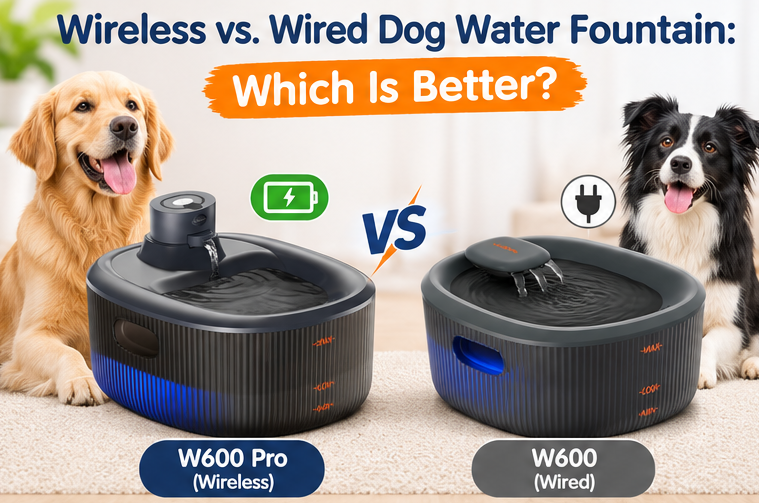
Before exploring the details, here's a side-by-side comparison.
| Feature | Wireless Dog Water Fountain | Wired Dog Water Fountain |
|---|---|---|
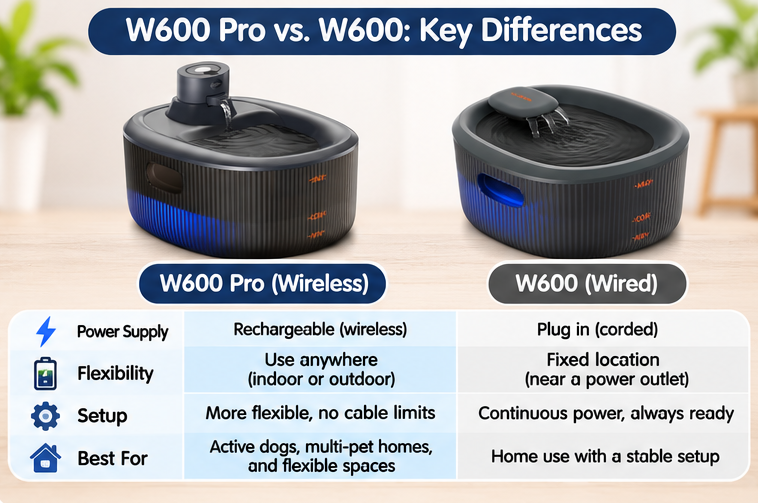
| Power source | Rechargeable battery | Electrical outlet |
| Placement flexibility | Greater | Limited by outlet location |
| Charging required | Yes | No |
| Battery maintenance | Required | Not applicable |
| Continuous circulation | Depends on battery and model | Common on models designed for it |
| Power outage | May continue while charged | Circulation typically stops |
| Exposed power cord | Usually absent during cordless use | Present during operation |
| Battery aging | Possible capacity decline | No rechargeable battery to age |
| Ongoing costs | Charging, filters, possible battery service | Electricity, filters, possible replacement parts |
| Best use | Flexible or cordless placement | Fixed indoor drinking station |
Quick answer: Choose a wireless fountain if you want flexible placement and fewer exposed cords. Choose a wired fountain if you prefer a stationary setup without the need to monitor battery charge.
Neither design is automatically better for every dog.
A wireless dog water fountain is a drinking system that can operate without a continuous connection to a wall outlet.
Most cordless models use a built-in rechargeable battery.
After charging, the stored electrical energy powers the fountain's circulation system and electronic controls.
Some wireless fountains offer several operating modes, such as:
Continuous circulation.
Timed circulation.
Motion-sensor activation.
Intermittent water flow.
Available modes vary by model.
A typical rechargeable fountain follows a simple process:
The battery is charged using the manufacturer's recommended equipment.
Stored energy powers the circulation system.
Water moves from the reservoir into the drinking area.
The fountain operates according to its selected mode.
The battery is recharged when necessary.
This design makes it possible to place the fountain away from a power outlet during cordless operation.
No.
The word wireless can describe different technologies.
For dog water fountains, it often refers to cordless, battery-powered operation.
It does not automatically mean that the fountain connects to Wi-Fi, supports a smartphone app, or includes remote monitoring.
A rechargeable fountain may be completely cordless without having any smart-home features.
Always check the product specifications rather than assuming that wireless means smart.
A wired dog water fountain receives power through a cable connected to a compatible electrical supply.
Unlike a rechargeable fountain, it does not depend on a battery for normal operation.
When connected to power and operating correctly, the circulation system moves water through the fountain.
A typical wired fountain:
Connects to an electrical outlet using approved power equipment.
Powers its circulation system.
Moves water through the drinking area.
Continues operating according to its design and selected settings.
Some wired fountains circulate water continuously.
Others may offer additional operating modes.
A wired fountain can be convenient when you already have a suitable drinking area near an outlet.
You don't need to remember a battery-charging schedule.
However, you do need to manage the power cable safely and account for what happens during an electrical outage.
Understanding these differences will help you choose a fountain based on everyday use rather than marketing terminology.
The most fundamental difference is how the fountain receives electricity.
A wireless fountain stores energy in a rechargeable battery.
A wired fountain uses electricity supplied through a cable.
Advantages:
Can operate away from an outlet.
Does not require a permanently connected power cable during cordless use.
May continue circulating water during a power outage if charged.
Considerations:
Battery capacity is limited.
Recharging is necessary.
Battery performance may decline over time.
Advantages:
No rechargeable battery to manage.
Suitable for a fixed drinking station.
Can operate while power is available, according to the product's design.
Considerations:
Requires a suitable power source.
Cable routing needs attention.
Circulation generally stops during a power outage.
Which is better?
Wireless is better for placement flexibility. Wired is more convenient if you want to avoid battery management.
Where you place a dog's drinking station can affect how comfortably the dog uses it.
A fountain should be accessible, stable, and positioned away from unnecessary hazards.
A cordless fountain may be placed in areas such as:
A living room corner.
A hallway with adequate space.
A designated indoor pet area.
A location away from convenient electrical outlets.
Placement still needs to follow the manufacturer's environmental and operating requirements.
A wired fountain must be positioned within reach of a suitable power supply.
Avoid stretching cables across walking paths.
Keep connections away from spilled water and locations where dogs may chew cords.
Which is better?
Wireless is generally more flexible, especially in homes where the preferred drinking location is not near an outlet.
Water circulation is another important difference.
A wired fountain can draw power from an outlet for extended operation.
A rechargeable fountain must balance circulation time with available battery energy.
Continuous operation keeps the circulation system running throughout its intended operating period.
This may appeal to dogs that prefer consistent water movement.
However, it also requires energy.
For a rechargeable model, continuous circulation can shorten battery runtime compared with intermittent operation.
Some wireless fountains activate water flow when a pet approaches.
For example, the WOPET W600 Pro offers an induction mode that activates approximately 20 seconds of water flow when a nearby pet is detected.
This can reduce unnecessary circulation time.
Actual battery savings depend on how frequently the sensor activates.
Some fountains circulate water at scheduled intervals.
This may reduce operating time, although the effect on energy consumption depends on the device.
Which is better?
If your priority is continuous circulation without battery charging, a wired fountain may be more convenient.
If your priority is cordless placement and intermittent operation, a rechargeable fountain may be a better fit.
Both wireless and wired fountains need regular cleaning.
Water movement does not eliminate the need to remove pet hair, saliva residue, mineral buildup, or other debris.
However, their power systems introduce different maintenance tasks.
A rechargeable fountain may require:
Battery-status checks.
Periodic charging.
Inspection of charging equipment.
Regular reservoir cleaning.
Filter replacement.
Cleaning of accessible circulation components.
A wired fountain may require:
Power-cable inspection.
Adapter checks.
Regular reservoir cleaning.
Filter replacement.
Cleaning of accessible circulation components.
| Task | Wireless | Wired |
|---|---|---|
| Daily water checks | Yes | Yes |
| Reservoir cleaning | Yes | Yes |
| Filter replacement | If applicable | If applicable |
| Battery charging | Yes | No |
| Cable inspection | Charging equipment | Operating power cable |
| Circulation-system maintenance | Yes | Yes |
Which is better?
A wired fountain may be easier for owners who prefer not to manage charging.
A wireless fountain may be more convenient for owners who value cordless placement enough to accept periodic charging.
Both fountain types can be used safely when designed, installed, and maintained correctly.
However, they introduce different considerations.
A rechargeable fountain reduces the need for an exposed operating power cable during cordless use.
This may be helpful around dogs that are curious about cords.
However, rechargeable batteries require appropriate handling.
Follow the manufacturer's charging instructions, avoid damaged charging equipment, and stop using the fountain if its battery becomes swollen or unusually hot.
A wired fountain requires a power connection during operation.
Important precautions include:
Keeping cables away from chewing pets.
Avoiding damaged insulation.
Keeping electrical connections away from water.
Using compatible power adapters.
Following the manufacturer's placement instructions.
Not necessarily.
A cordless design can reduce certain cable-related hazards, but battery-powered equipment introduces its own electrical and charging considerations.
The safest choice is a properly designed fountain used according to its instructions.
A dog water fountain's purchase price is only part of its total cost.
Both wireless and wired models may require replacement filters and other maintenance items.
Potential expenses include:
Initial purchase.
Electricity for charging.
Replacement filters.
Replacement circulation components.
Battery service or replacement, if supported and eventually necessary.
Potential expenses include:
Initial purchase.
Electricity during operation.
Replacement filters.
Replacement circulation components.
Compatible power accessories.
Suppose a wired fountain draws an average of 3 watts continuously.
Monthly electricity use would be:
3W × 24 hours × 30 days ÷ 1,000 = 2.16 kWh
At an illustrative electricity rate of $0.16 per kWh:
2.16 × $0.16 = approximately $0.35 per month.
This is a hypothetical calculation, not a verified specification or electricity cost for a WOPET model.
A rechargeable fountain also consumes electricity when charging.
Its energy use depends on circulation frequency, standby consumption, and charging efficiency.
Neither power type is automatically cheaper over its entire useful life.
The answer depends on:
Purchase price.
Filter replacement frequency.
Actual energy consumption.
Battery durability.
Replacement-part availability.
Product lifespan.
For many fountains, filter and replacement-part expenses may be more significant than electricity costs.
Reliable water access is more important than any individual fountain feature.
Both wireless and wired fountains can stop circulating water.
A rechargeable fountain may stop operating when:
The battery is depleted.
Charging equipment malfunctions.
The circulation system fails.
A protective mechanism activates.
A wired fountain may stop operating when:
Electricity is unavailable.
The power adapter fails.
The circulation system malfunctions.
A protective mechanism activates.
A charged wireless fountain may continue circulating water during an outage, depending on its design and remaining battery charge.
A wired fountain without battery backup generally stops circulating.
However, neither fountain should be the only water source you rely on without regular checks.
Best practice: Keep a separate clean water bowl available as a backup, particularly when your dog is alone for part of the day.
If you want a fountain that circulates water throughout the day without needing periodic recharging, a wired model is often the more straightforward choice.
A rechargeable model may also support continuous circulation, but its runtime will depend on the battery and power consumption.
For example, a fountain advertised to last up to 30 days in an energy-saving mode should not be assumed to operate continuously for 30 days.
Always verify which operating conditions apply to a manufacturer's runtime claim.
Not automatically.
Circulation can move water through a filter, but it does not sterilize the reservoir.
Bacteria and biofilm can still develop if the fountain is not cleaned properly.
Both wireless and wired fountains require regular water changes and maintenance.
Households with multiple dogs often need more water capacity and additional drinking locations.
Power source matters, but it is not the only consideration.
A rechargeable fountain can be convenient when you want to place drinking stations in different parts of the home.
It may also help when outlets are unavailable near the preferred drinking location.
However, frequent use can shorten battery runtime.
A wired fountain can work well as a permanent shared drinking station.
You don't need to manage charging intervals, which may be convenient in a busy household.
For multiple dogs, consider:
Reservoir capacity.
Drinking-area dimensions.
Ease of cleaning.
Accessibility.
Number of water stations.
Resource guarding between pets.
Even a large fountain may not be enough if one dog prevents others from approaching it.
Provide additional water bowls or fountains when necessary.
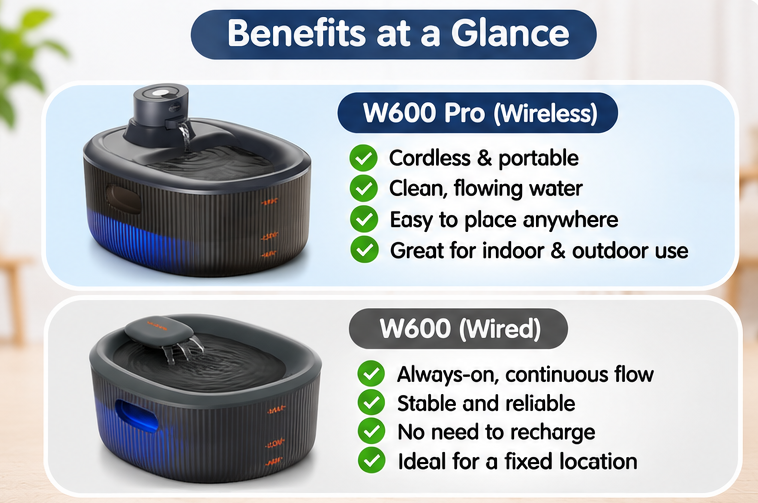
WOPET offers different fountain designs for different household needs.
Two examples are the rechargeable W600 Pro and corded W600.
The WOPET W600 Pro is a 6L rechargeable dog water fountain.
Its cordless design makes it suitable for households that want more flexibility when choosing a drinking location.
Published product specifications include a 5,000mAh battery and an advertised runtime of up to 30 days under suitable operating conditions.
The fountain also offers induction operation, which activates water flow when a nearby pet is detected.
Actual runtime depends on usage and operating mode.
Consider the W600 Pro if:
You prefer cordless operation.
Your drinking station is away from a convenient outlet.
You want flexible placement.
You're comfortable monitoring and charging a battery.
The WOPET W600 is a 6L corded dog water fountain.
It is suited to households with a fixed drinking location and a suitable nearby power source.
Because it uses a wired power connection, it does not require periodic battery charging for normal operation.
Consider the W600 if:
You have a dedicated indoor drinking station.
A power outlet is conveniently located.
You prefer not to monitor battery charge.
You want a straightforward corded setup.
| Feature | WOPET W600 Pro | WOPET W600 |
|---|---|---|
| Power type | Rechargeable / Cordless | Plug-In / Corded |
| Water capacity | 6L | 6L |
| Battery capacity | 5,000mAh | Not applicable |
| Advertised battery runtime | Up to 30 days | Not applicable |
| Charging required | Yes | No |
| Placement flexibility | Greater | Requires suitable power access |
| Battery aging | Relevant | Not applicable |
| Best household fit | Flexible drinking locations | Fixed indoor drinking station |
Both fountains still require regular cleaning, water checks, and filter maintenance.
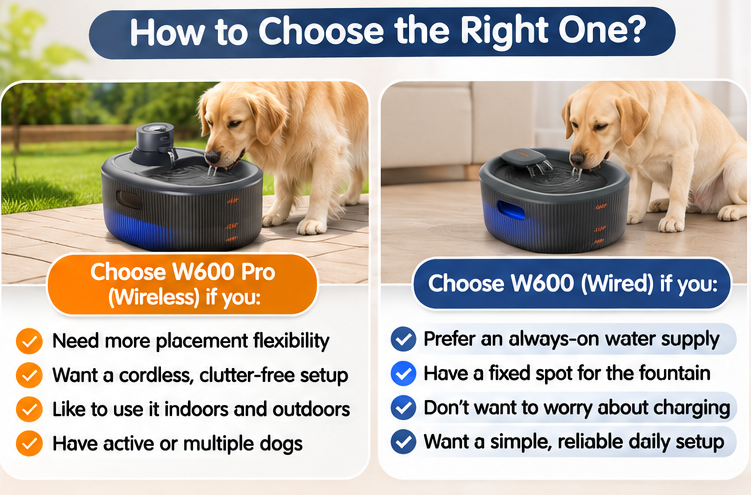
If you're deciding between wireless and wired models, consider the following questions.
If the preferred drinking location is far from an outlet, wireless may be more convenient.
If you already have a suitable outlet nearby, wired may be simpler.
If your dog frequently chews electrical cables, reducing exposed cords may be useful.
However, you should still supervise your dog and manage all charging equipment safely.
Check the fountain's supported operating modes.
A wired model may be more convenient for extended circulation without charging interruptions.
Wireless fountains require periodic charging.
If you prefer to avoid another charging routine, a wired model may be better.
More pets can mean more frequent drinking, faster water depletion, and additional cleaning.
Choose an appropriate capacity and consider providing multiple water stations.
Compare filter prices, replacement-part availability, electricity consumption, and possible battery-service costs.
Regardless of the fountain type, keep a clean water bowl available when appropriate.
This helps maintain water access if the fountain stops working.
Not necessarily.
Wireless fountains offer greater placement flexibility, while wired fountains eliminate the need for battery charging.
The better choice depends on your household.
Runtime varies by model, battery capacity, and operating mode.
For example, the WOPET W600 Pro advertises up to 30 days of battery runtime under suitable conditions.
Some rechargeable fountains support continuous operation, but battery runtime will depend on power consumption.
Check the manufacturer's specifications.
Yes.
Rechargeable fountains use electricity to charge their batteries.
Wireless does not mean electricity-free.
No.
Wireless often refers to cordless battery operation rather than internet connectivity.
They can be when used according to the manufacturer's instructions.
Keep cables and electrical connections protected from chewing, water exposure, and physical damage.
Water capacity, basin dimensions, and drinking comfort generally matter more than whether the fountain is wired or wireless.
Either can work.
Choose an appropriate reservoir and provide enough drinking locations to prevent competition.
Not necessarily.
Total ownership cost depends on the purchase price, electricity consumption, filters, battery service, and replacement parts.
Circulation may stop until the battery is recharged.
Provide a separate clean water source so your dog is not dependent on the fountain alone.
The main difference between a wireless and wired dog water fountain is how it receives power.
A wireless dog water fountain offers cordless placement and greater flexibility, but requires periodic charging.
A wired dog water fountain uses an electrical connection, making it convenient for a permanent drinking station without battery management.
Neither design is automatically healthier, cleaner, or better for every dog.
If you want a flexible cordless setup, a rechargeable model such as the WOPET W600 Pro may be worth considering.
If you prefer a fixed indoor drinking station with no battery-charging routine, a corded model such as the WOPET W600 may be a practical choice.
Whatever you choose, prioritize a comfortable drinking area, regular cleaning, adequate water capacity, and reliable access to fresh drinking water.
Explore WOPET dog water fountains to find a model that suits your home and your dog's drinking habits.
Read More:
How Long Does a Rechargeable Dog Water Fountain Battery Last?
Best Indoor Dog Water Fountain: 7 Features and Placement Tips
Label:
Popular Post

The Ultimate Guide to Tabby Cats: Patterns, Personalities, and More
Mar 27, 2025

Top 8 Reasons Why Does My Cat Sleep Between My Legs?
Mar 03, 2025

What to Do If My Dog's Poop Is Black But Not Tarry
Feb 04, 2023

Superfecundation Cats: When Kittens in One Litter Have Different Fathers
Jul 11, 2025

How Long Does Dry Cat Food Last Once Opened? A Comprehensive Guide
Mar 19, 2025
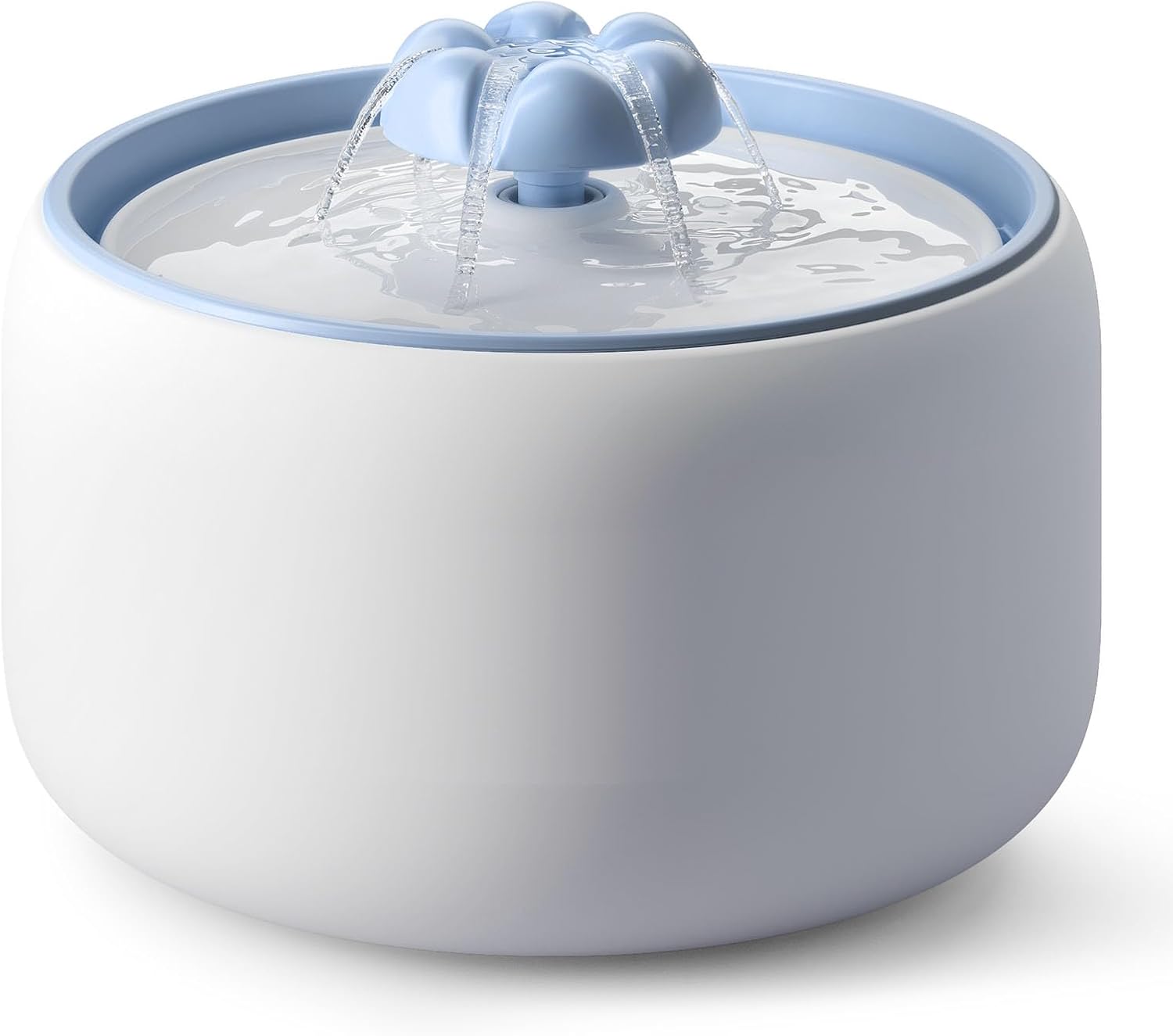
[Blue] W03L 3L Premium Ceramic Cat Water Fountain
Model: W03 LITE
$59.99
$69.99
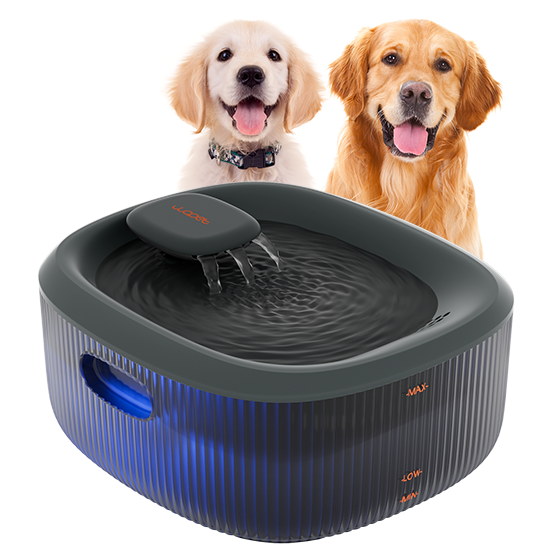
Basin Pet Water Fountain-W600
Model: W600
$43.99
$69.99
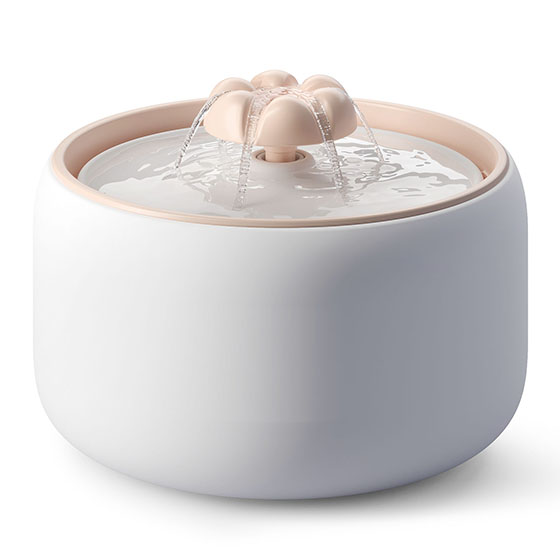
[Basic] Ceramic Pet Water Fountain with Power Cable
Model: W03L
$59.99
$99.00
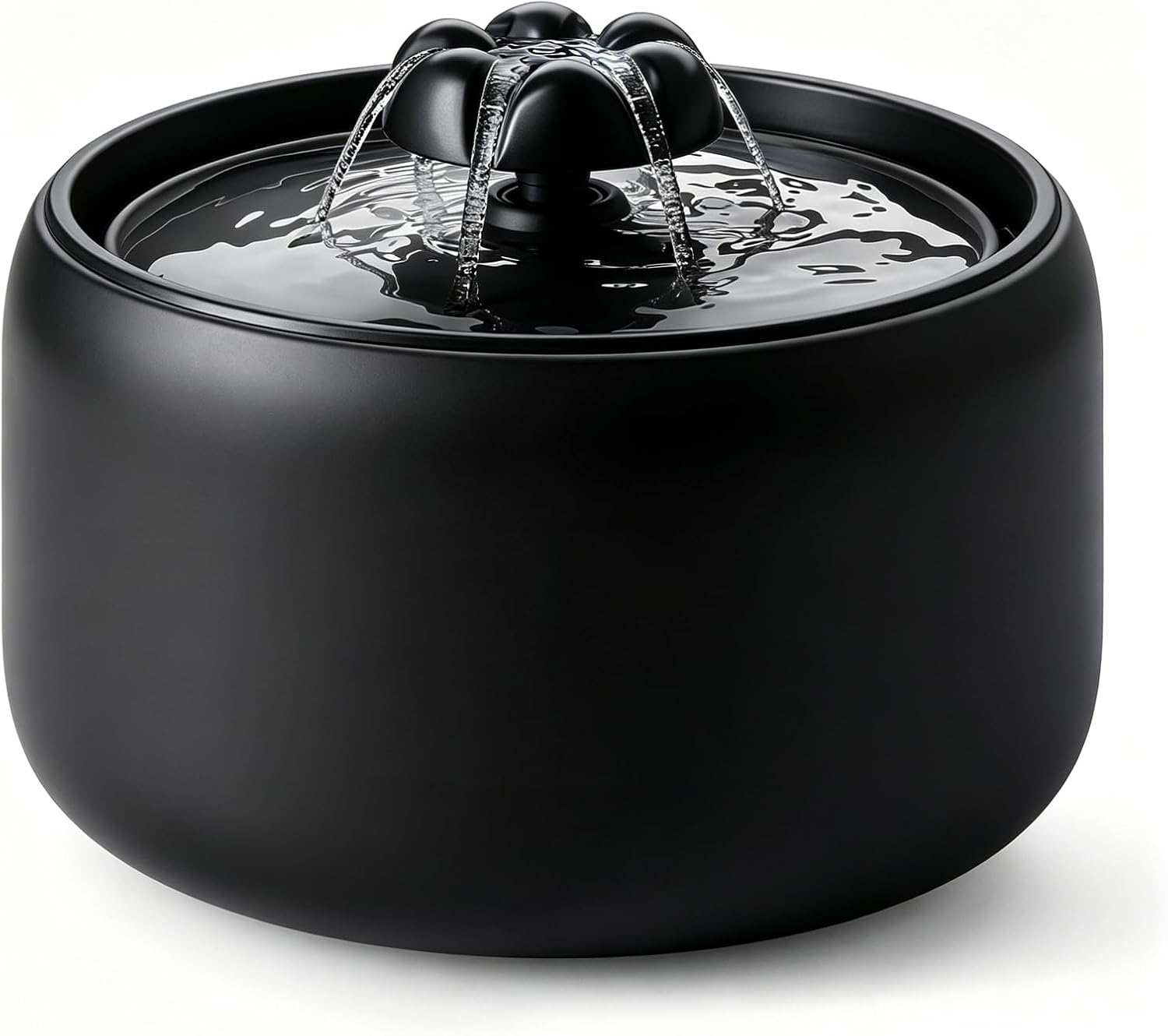
[Black] W03L 3L Premium Ceramic Cat Water Fountain
Model: W03L Black
$59.99
$69.99
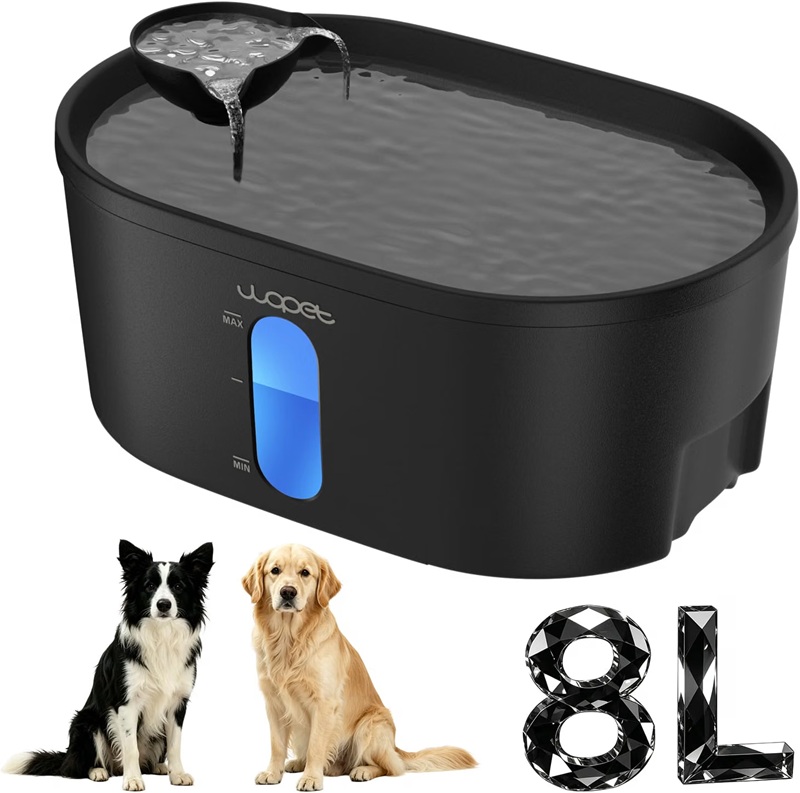
WOPET 8L Pet Water Fountain For Multiple Cats or Large Dogs A08
Model: A08
$49.99
$59.99
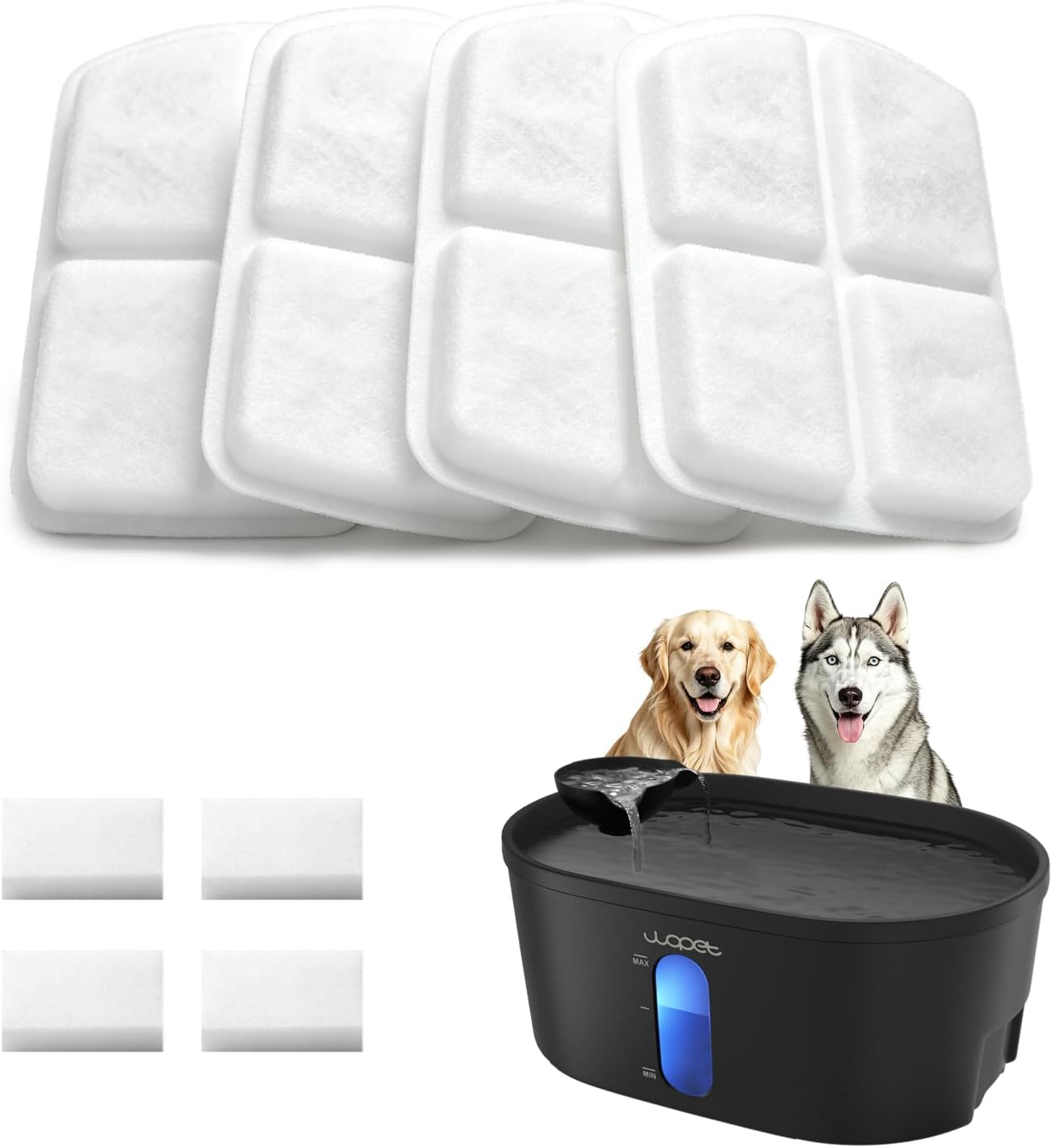
WOPET A08 Dog Water Fountain Filters
Model: A08 Filter
$19.99
$29.99

DOWNLOAD APP

WOpet life




Copyright © 2026 WOPET. All Rights Reserved.