Nov 03, 2026
Author:Sam Wonder
A dog water fountain can be a convenient way to provide your pet with accessible drinking water throughout the day. But traditional fountains often need to stay plugged into an electrical outlet, which can limit where you place them.
That's where a battery-operated dog water fountain comes in.
Instead of relying on a permanent wall connection, a battery-powered fountain uses stored electrical energy to circulate water. This makes it possible to position the drinking station in a wider range of locations, from a quiet living room corner to a convenient spot in your kitchen.
But how does the technology actually work? Does the water flow continuously? What happens when the battery runs out? And how do newer magnetic-drive systems differ from traditional water pumps?
In this guide, we'll explain how battery-operated dog water fountains work, the components that make them function, and what pet owners should know about filtration, battery life, maintenance, and everyday safety.
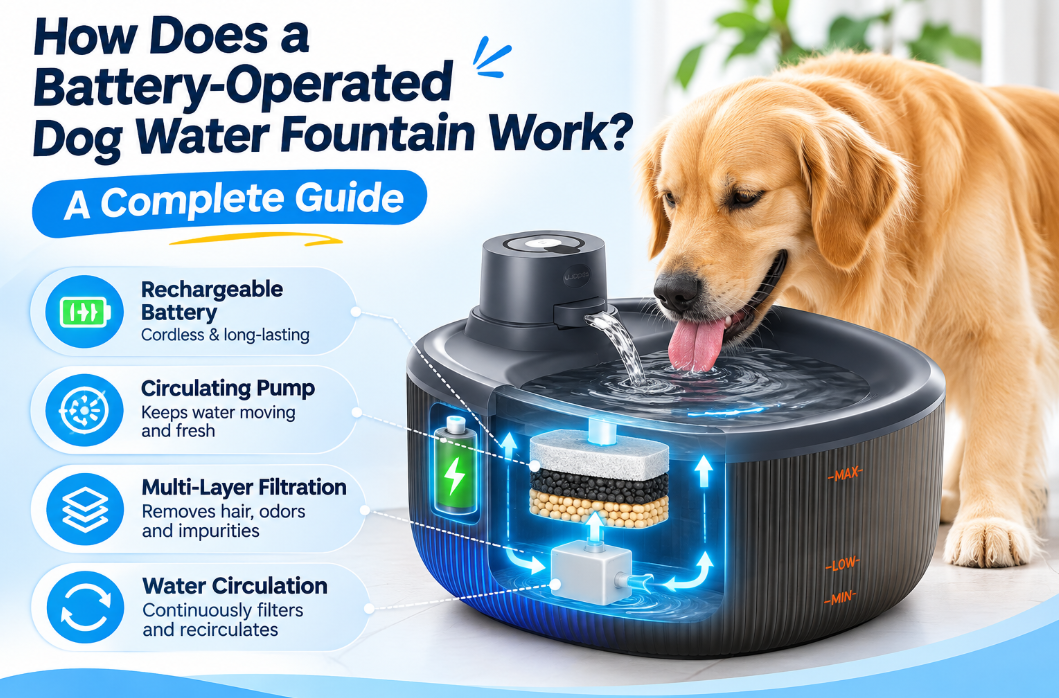
A battery-operated dog water fountain is an automatic drinking system that uses battery power to move water through a reservoir and drinking area.
Unlike a standard water bowl, which holds stationary water, a fountain uses a circulation mechanism to create water movement.
Depending on its design, the fountain may include:
A rechargeable or replaceable battery
A water reservoir
A circulation mechanism
A drinking basin
A filtration system
A controller that manages operation
A charging port or charging base
Optional sensors or adjustable operating modes
Most modern rechargeable models are designed to operate without a continuous power cable.
However, the term wireless can describe different features.
Some fountains are wireless because they run on battery power. Others use a wireless or magnetically coupled pump design while still requiring an external electrical connection.
Understanding this distinction helps you choose a fountain that meets your expectations.
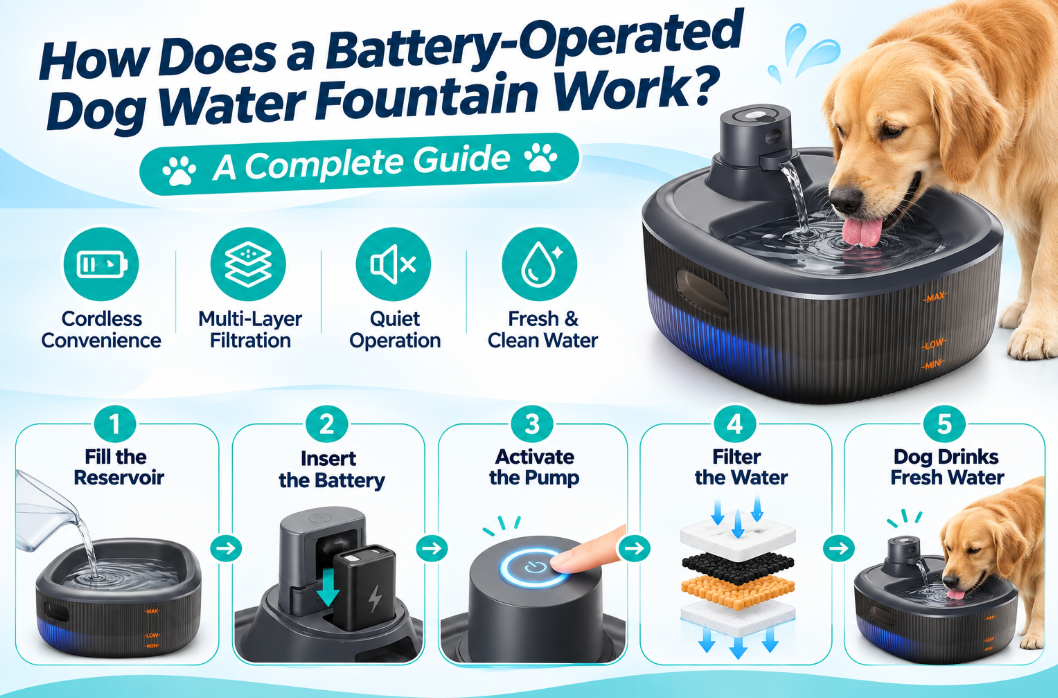
The basic principle is straightforward: a battery supplies electrical energy to a circulation system, which moves water through the fountain.
The exact internal design varies between models, but the general process follows five steps.
A rechargeable dog water fountain stores energy in an internal battery.
When the fountain is switched on, its electronic controller draws energy from the battery to operate the circulation mechanism.
The battery may also power other components, such as indicator lights or sensors.
Battery capacity is commonly expressed in milliamp-hours (mAh), although this number alone does not determine how long the fountain will run.
Actual runtime also depends on battery voltage, power consumption, and operating mode.
For example, two fountains with similar battery capacities may have different runtimes if one circulates water continuously and the other operates intermittently.
Key point: A battery-powered fountain still uses electricity. The difference is that it stores electrical energy rather than requiring a permanent wall connection.
Once electrical power reaches the circulation system, the fountain begins moving water from its reservoir toward the drinking area.
There are different ways to accomplish this.
Many conventional pet fountains use a small electric pump positioned inside the water reservoir.
An electric motor drives an impeller, which pushes water through an internal channel.
The water then reaches the drinking surface before returning to the reservoir.
Some newer fountains use a magnetic coupling system.
In these designs, magnetic forces transfer rotational motion from a motor-driven component to a water-moving impeller.
Depending on the construction, this can allow the motor and water-moving components to be physically separated.
However, not every magnetic-drive fountain uses the same internal structure.
The terms magnetic drive, wireless pump, and electromagnetic drive should not be treated as interchangeable without checking the manufacturer's technical documentation.
Why does this matter?
The circulation design can influence cleaning accessibility, operating noise, component wear, and the location of electrical parts.
When comparing fountains, look at the actual engineering rather than assuming one technology is automatically better.
As water circulates, it may pass through one or more filtration components.
The purpose of these filters is to help capture certain particles and improve the condition of the circulating water.
Common filtration materials include:
Mechanical filtration: Mesh or sponge materials help trap hair, food particles, and larger debris.
Activated carbon: May reduce certain substances that affect water taste or odor, depending on the filter design.
Additional filter media: Some fountains use other materials for specific filtration functions.
Not every fountain has the same filtration arrangement.
In some designs, water passes through the filter before reaching the drinking basin. In others, water is filtered as it returns to the reservoir.
The filtration path depends on the product.
A standard pet fountain filter should not be assumed to disinfect water or remove all microorganisms.
Use drinking water that is already suitable for your dog.
Regular water replacement and cleaning remain necessary even when the fountain includes filtration.
After being moved through the circulation system, water reaches the fountain's drinking area.
Depending on the design, it may:
Flow gently over a surface
Rise through a central outlet
Create a small stream
Move across a shallow drinking basin
The goal is to provide an accessible drinking area with water movement.
Some dogs are attracted to moving water, while others prefer drinking from a calm surface.
The best design depends on your dog's preferences.
For large dogs, drinking basin width and water capacity are especially important.
A narrow fountain may be less comfortable for a dog with a broad muzzle.
After reaching the drinking area, water generally flows back into the reservoir through the fountain's return path.
The cycle repeats according to the selected operating mode.
In continuous mode, the circulation system runs regularly without long pauses.
In intermittent mode, it operates at scheduled intervals.
In sensor mode, circulation may activate when the fountain detects nearby activity.
The precise behavior depends on the model.
In simple terms:
Battery power → Water circulation → Filtration → Drinking area → Reservoir → Repeat
This repeated movement is what distinguishes a water fountain from a traditional stationary bowl.
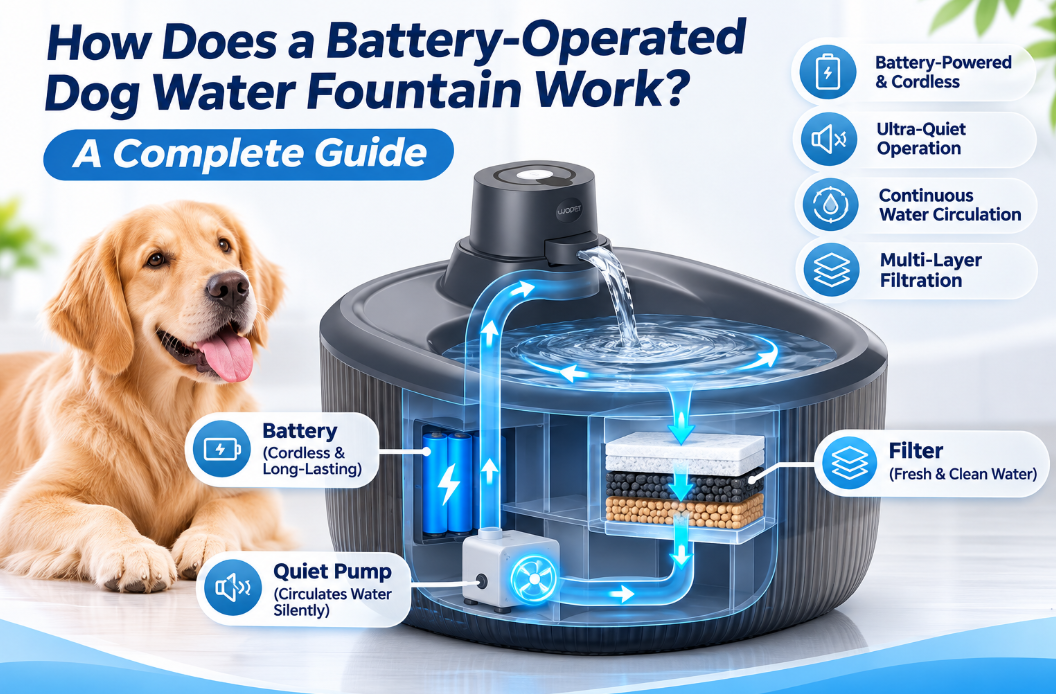
One of the most confusing aspects of modern pet water fountains is the difference between a traditional submersible pump and a magnetic-drive or wireless-pump system.
A traditional fountain commonly places an electrically powered pump assembly inside the water reservoir.
The motor rotates an impeller, which moves water through the fountain.
Advantages may include straightforward construction and widespread availability of replacement components.
However, cleaning may require removing and opening the pump assembly.
A magnetic-drive design uses magnetic coupling to transfer motion to the water-moving component.
Some systems allow the electrical motor and water-contact impeller to be separated by a physical barrier.
This can change how the fountain is assembled and cleaned.
However, magnetic-drive systems are not automatically maintenance-free or completely silent.
The impeller, water channels, and other components may still require cleaning.
Neither approach is universally better.
Consider:
Cleaning accessibility
Reliability
Operating noise
Replacement-part availability
Water circulation performance
Electrical design
Manufacturer maintenance instructions
A well-designed traditional pump may outperform a poorly designed magnetic-drive system, and vice versa.
Important: A wireless pump does not necessarily mean the fountain itself is battery-powered. Confirm the actual power source before buying.
Battery-operated dog water fountains may offer different circulation modes.
These settings influence how frequently water moves and how quickly the battery is depleted.
In continuous mode, the fountain circulates water for extended periods.
This may be useful for dogs that prefer moving water throughout the day.
However, continuous operation generally consumes more battery energy than comparable intermittent operation.
In intermittent mode, the circulation system operates for a set period, pauses, and then starts again.
For example, a hypothetical fountain might run for several minutes before pausing.
The actual timing depends on the product.
Intermittent operation can help conserve battery power.
However, water movement is not continuous.
Some fountains use sensors to activate water circulation when activity is detected.
Depending on the design, the sensor may respond to motion or proximity.
This can reduce unnecessary operation when no pet is nearby.
However, sensor performance depends on placement, detection range, and environmental conditions.
Choose a mode based on your dog's drinking habits and the fountain's available settings.
If your dog strongly prefers moving water, continuous operation may be useful.
If your dog drinks comfortably from the basin when circulation is paused, intermittent operation may be practical.
Regardless of mode, your dog should have reliable access to drinking water.
Battery life varies considerably between products.
There is no single runtime that applies to every rechargeable fountain.
Battery capacity: Larger usable energy capacity can support longer operation when other factors are equal.
Circulation power: A system that consumes more energy will generally discharge the battery faster.
Operating mode: Continuous circulation usually consumes more energy than intermittent operation.
Sensor activity: Frequent activation may increase energy consumption.
Battery age: Rechargeable batteries gradually lose capacity through use and aging.
Temperature: Extreme temperatures can affect battery performance.
A manufacturer may advertise a long runtime based on a specific low-power operating mode.
That figure may not represent continuous circulation.
Before purchasing, check:
Which operating mode was used during testing
Whether the runtime includes sensor operation
Charging time
Battery capacity
Whether the fountain can operate while charging
Suppose a hypothetical fountain has a usable battery energy capacity of 20 watt-hours and consumes an average of 1 watt while operating.
Estimated runtime:
20 Wh ÷ 1 W = 20 hours
This is a simplified calculation that does not account for all electrical losses or operating variations.
If the same fountain operates intermittently, its average energy consumption may be lower, potentially extending runtime.
These numbers are illustrative and are not specifications for any WOPET model.
Practical tip: Choose a fountain with a charging schedule you can maintain reliably, rather than selecting a model based solely on its maximum advertised runtime.
When the battery is depleted, the circulation system generally stops operating.
However, this does not always mean your dog immediately loses access to drinking water.
Some fountains retain water in an accessible basin even when circulation stops.
Others may have a design where the available drinking water becomes limited.
This is an important feature to check before buying.
Does water remain accessible when the battery is empty?
Does the fountain provide a low-battery indicator?
Can it operate while charging?
Does it automatically resume after charging?
Is there a safe fallback drinking area?
A battery-operated fountain should not be your dog's only source of water if you cannot ensure that water will remain accessible during battery depletion or equipment failure.
Keeping a separate water bowl available is a sensible precaution, especially during extended absences.
Battery operation allows you to position the fountain without needing a nearby electrical outlet.
This can be convenient in apartments, kitchens, living rooms, and other indoor spaces.
A cordless drinking station reduces the need for a permanent power cable near your dog's drinking area.
This can make the space tidier and simplify placement.
A battery-powered fountain may be easier to move between suitable indoor locations.
However, actual portability depends on its weight and reservoir size.
A charged battery-operated fountain may continue circulating water during a household power outage.
Runtime will depend on the remaining battery charge and operating mode.
Some rechargeable fountains provide multiple circulation modes, allowing owners to balance water movement and battery usage.
Rechargeable fountains need periodic charging.
If charging is forgotten, circulation may stop.
Rechargeable batteries naturally age.
Their usable capacity may decline after repeated charging cycles and prolonged use.
A fountain advertised with a long battery life may have a much shorter runtime under continuous circulation.
Battery-powered models include charging circuits and other electrical components that require appropriate handling.
A cordless design does not automatically mean the fountain is weatherproof.
Only use a fountain outdoors if the manufacturer explicitly approves that environment.
Battery-operated dog water fountains can be suitable for everyday use when properly manufactured, operated, and maintained.
However, safety depends on the complete product design.
Use the charging equipment recommended by the manufacturer.
Avoid exposing the battery or charging components to excessive heat or moisture.
Do not continue using a fountain with damaged electrical components.
Choose a fountain made from materials appropriate for drinking-water contact.
Inspect the reservoir and drinking basin regularly for cracks, scratches, or other damage.
Position the fountain on a level surface where it is unlikely to tip.
Keep it away from areas where it may be accidentally knocked over.
Circulating water is not automatically free from bacteria.
Biofilm can develop in the reservoir, drinking area, filters, and circulation channels.
Refresh water daily and clean the fountain according to the manufacturer's instructions.
Check the water level and battery condition regularly.
Make sure your dog can access water even when circulation is paused, or provide a separate water bowl.
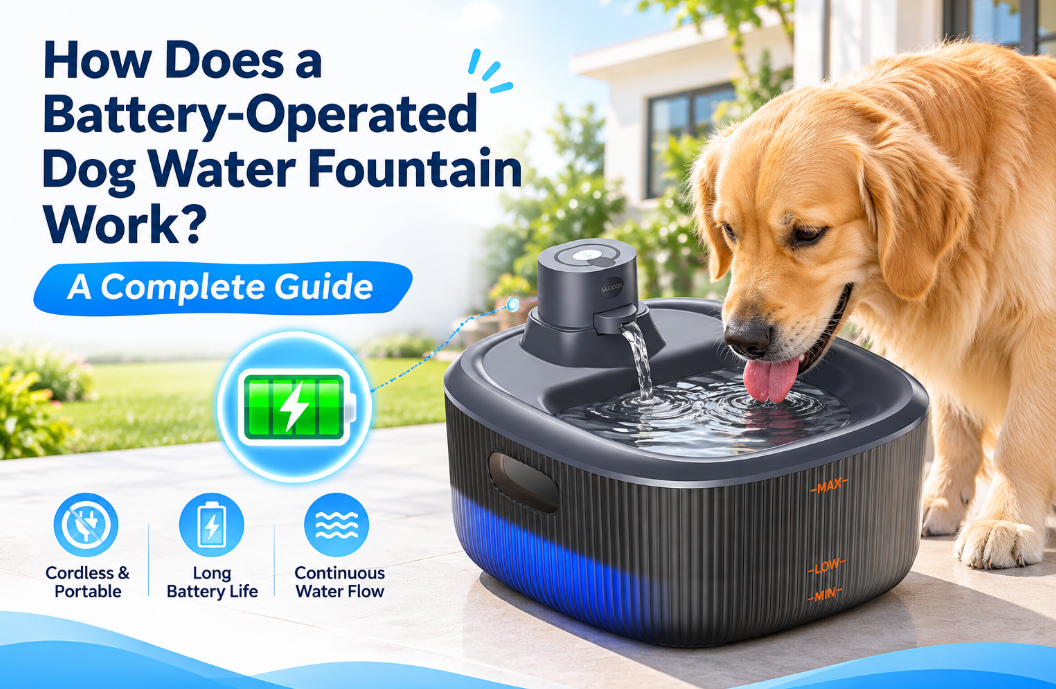
Proper maintenance helps the fountain operate reliably.
Switch off the fountain and disconnect charging equipment before cleaning.
Discard the remaining water and remove visible debris.
Follow the manufacturer's instructions for cleaning or replacing the filter.
Wash the drinking surface using a suitable mild cleaning product.
Avoid abrasive tools that may damage the material.
Inspect the impeller, water channels, and other accessible circulation parts.
Remove accumulated hair, residue, or mineral deposits according to the product instructions.
Remove cleaning-product residue from all washable components.
Check for damage, moisture, or unusual wear.
Do not immerse electrical components unless they are specifically designed for immersion.
Refill the fountain with fresh drinking water.
Confirm that the circulation system operates normally.
If runtime becomes noticeably shorter, check the manufacturer's troubleshooting instructions.
Battery aging or other technical issues may affect performance.
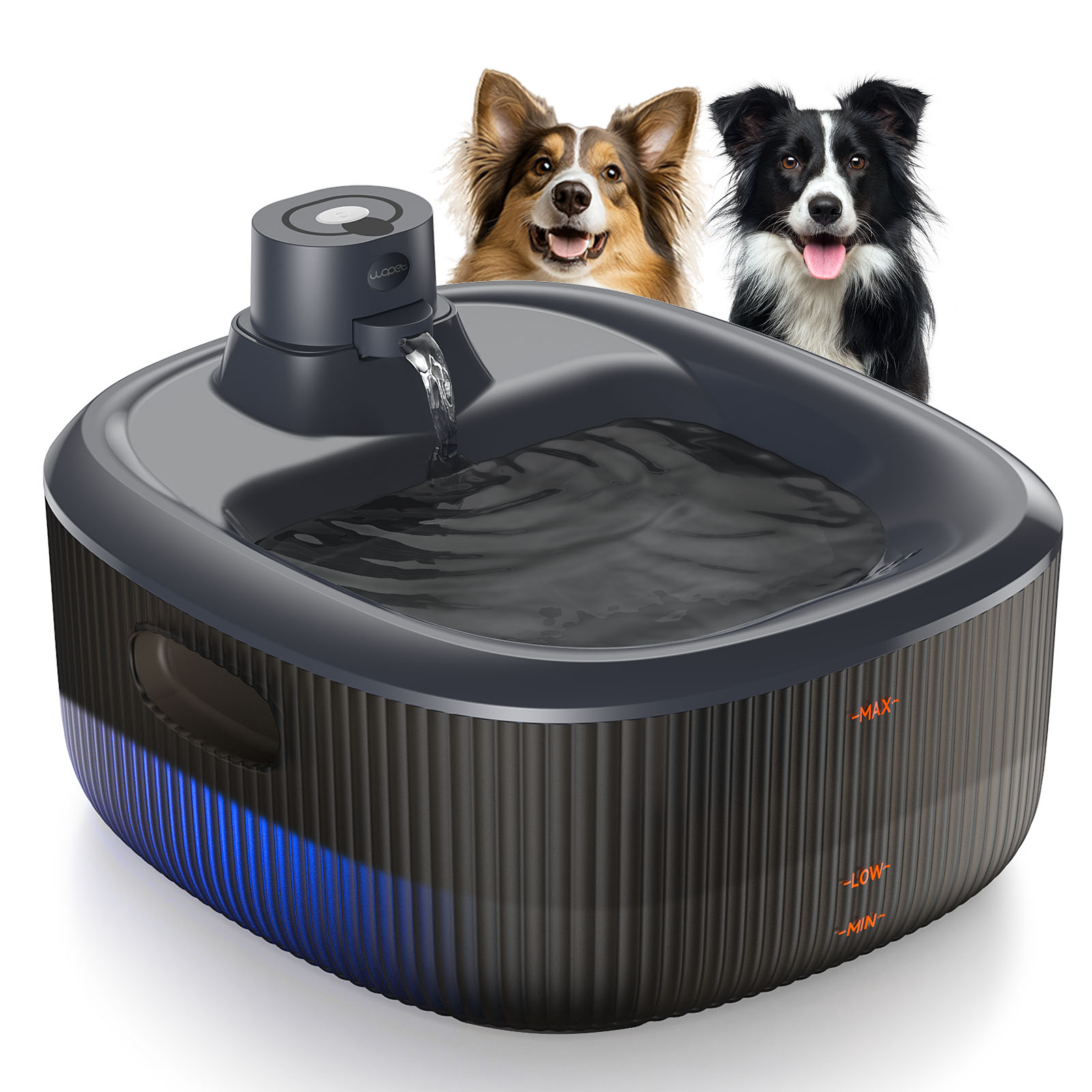
For pet owners interested in battery-powered drinking stations, the WOPET W600 Pro is a wireless dog water fountain option worth exploring.
Its cordless design is relevant to households that want greater freedom when choosing where to place a drinking station.
The W600 Pro can be considered by owners who want to avoid a permanent power connection at the drinking location.
This can be useful when an electrical outlet is inconveniently positioned.
Like other automatic fountains, the W600 Pro uses a circulation system to move water through the drinking area.
The exact internal mechanism, magnetic-drive configuration, and operating modes should be confirmed using the current official technical specifications.
When uating the W600 Pro, check its:
Rechargeable battery specifications
Charging requirements
Runtime under different operating modes
Low-battery behavior
Water accessibility when circulation stops
Review the model's filter design and cleaning instructions.
A fountain's long-term convenience depends heavily on how easily the reservoir, water channels, and circulation components can be maintained.
Consider your dog's size, drinking habits, and daily water needs.
Confirm that the reservoir capacity and drinking area are suitable for your pet.
For large dogs or multi-pet households, capacity and accessibility are especially important.
| Feature | Battery-Operated | Plug-In |
|---|---|---|
| Power source | Battery | Wall outlet |
| Permanent power cable | Usually unnecessary during operation | Required |
| Charging | Required for rechargeable models | Not normally required |
| Placement flexibility | High | Limited by outlet location |
| Runtime | Limited by battery charge | Continuous while powered |
| Power outage operation | May continue while charged | Usually stops |
| Maintenance | Battery and fountain maintenance | Fountain maintenance |
| Best for | Flexible placement | Fixed drinking stations |
Battery-powered fountains may be more convenient when you want flexible placement, fewer exposed cables, or temporary operation away from an electrical outlet.
Plug-in fountains may be preferable when you want continuous circulation without managing battery charging.
Neither power system is automatically better for every household.
Possible causes include:
Depleted battery
Low water level
Blocked circulation channel
Dirty impeller
Incorrect assembly
Operating mode settings
Start by checking the battery, water level, and manufacturer's troubleshooting instructions.
Possible causes include:
Clogged filter
Mineral buildup
Debris in the circulation mechanism
Low water level
Clean the accessible components and replace filters when required.
Battery aging, changes in operating mode, and charging problems may affect runtime.
Check the charging equipment and official maintenance guidance.
Low water levels, loose components, or accumulated debris can increase noise.
Inspect the fountain and clean it as directed.
If the noise continues or the product shows signs of damage, stop using it and contact the manufacturer.
It uses stored electrical energy from a battery to power a water circulation system. Rechargeable models need periodic charging.
Many models use a motor-driven circulation mechanism. Some use traditional submersible pumps, while others use magnetic-drive systems.
Some models support continuous circulation, but runtime depends on battery capacity and power consumption.
Many models include filtration systems that help capture hair and debris. However, filtration does not replace cleaning or make unsafe water automatically safe.
Circulation generally stops. Depending on the design, water may remain accessible in the drinking basin.
They can be, provided the reservoir capacity, drinking basin, and battery performance meet the dog's needs.
No. Wireless pump technology describes a circulation design, while rechargeable refers to the power source.
A properly functioning fountain may be used overnight if the manufacturer permits it, the battery has sufficient charge, and water remains accessible. Follow the product's operating instructions.
Charging frequency depends on battery capacity, operating mode, and usage. Follow the manufacturer's specifications and monitor battery indicators.
It can be worthwhile if you value cordless placement and are comfortable maintaining a charging routine. A plug-in fountain may be more convenient for fixed locations.
A battery-operated dog water fountain uses stored electrical energy to power a circulation mechanism that moves water through the fountain.
Depending on its design, water may pass through a filtration system before returning to the drinking area.
The fountain repeats this process continuously or at intervals according to its operating mode.
Battery-powered fountains offer useful advantages, including flexible placement and fewer exposed cables. However, they also require charging, regular cleaning, and attention to battery performance.
For pet owners exploring cordless options, the WOPET W600 Pro is a model worth comparing.
Before choosing any fountain, consider your dog's water needs, drinking-area comfort, filtration requirements, and your ability to maintain the product.
The best battery-operated dog water fountain is one that combines reliable circulation, convenient charging, accessible drinking water, and easy everyday maintenance.
Label:
Popular Post

The Ultimate Guide to Tabby Cats: Patterns, Personalities, and More
Mar 27, 2025

Top 8 Reasons Why Does My Cat Sleep Between My Legs?
Mar 03, 2025

What to Do If My Dog's Poop Is Black But Not Tarry
Feb 04, 2023

Superfecundation Cats: When Kittens in One Litter Have Different Fathers
Jul 11, 2025

Can Cats Have Orange Eyes? Genetics, Breeds, and Care Guide
May 20, 2025
[Blue] W03L 3L Premium Ceramic Cat Water Fountain
Model: W03 LITE
$59.99
$69.99
Basin Pet Water Fountain-W600
Model: W600
$43.99
$69.99
[Basic] Ceramic Pet Water Fountain with Power Cable
Model: W03L
$59.99
$99.00
[Black] W03L 3L Premium Ceramic Cat Water Fountain
Model: W03L Black
$59.99
$69.99
WOPET 8L Pet Water Fountain For Multiple Cats or Large Dogs A08
Model: A08
$49.99
$59.99
WOPET A08 Dog Water Fountain Filters
Model: A08 Filter
$19.99
$29.99

DOWNLOAD APP

WOpet life




Copyright © 2026 WOPET. All Rights Reserved.