Nov 04, 2026
Author:Lisa Martinez
A dog water fountain can be a convenient addition to your home, but choosing the right one involves more than finding a model with a large reservoir.
Indoors, every detail matters. A fountain that works well in a spacious kitchen may be too noisy for a bedroom. A deep drinking basin may be comfortable for a Labrador but create more splashing than expected. And a poorly placed power cord can turn an otherwise useful pet accessory into a household hazard.
The best indoor dog water fountain should provide easy access to fresh water while fitting comfortably into your living space.
That means considering water capacity, noise, stability, filtration, cleaning requirements, and where the fountain will be placed.
In this guide, we'll explore seven essential features, compare the best indoor placement options, and explain how to create a practical drinking station for your dog.
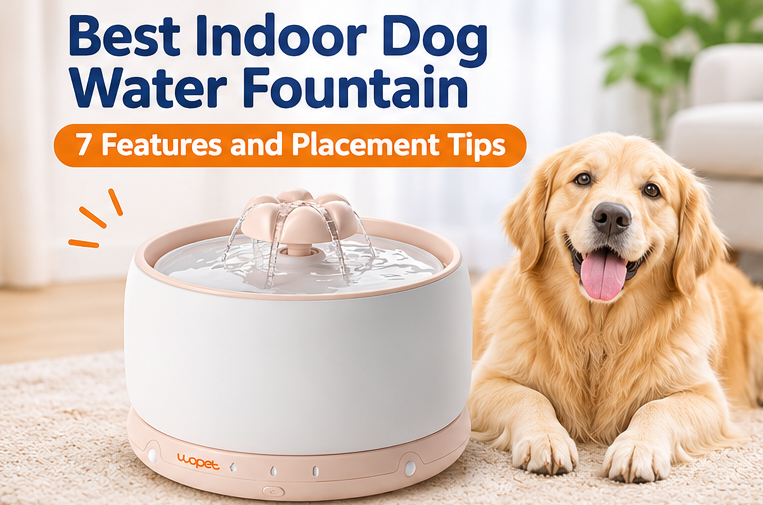
A good indoor dog water fountain should be comfortable for your dog and convenient for your household.
Unlike an outdoor water station, an indoor fountain must work around furniture, flooring, electrical outlets, and everyday foot traffic.
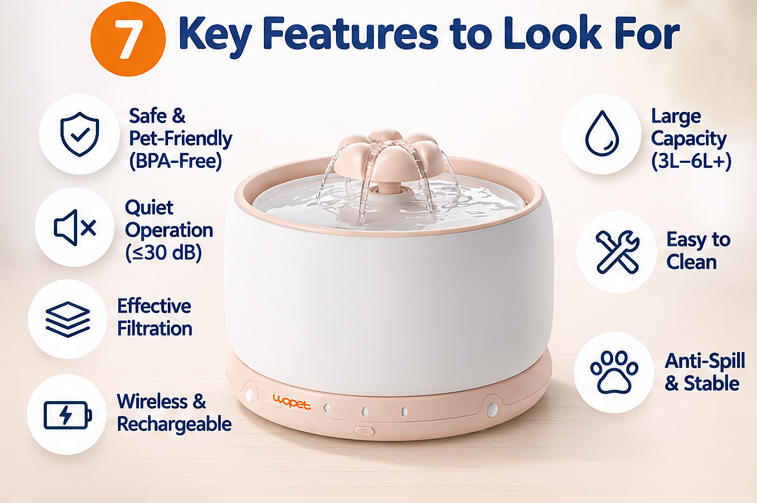
The seven most important features are:
Quiet operation: A circulation system that doesn't create distracting noise.
Splash-conscious design: A drinking area that helps keep water contained.
Appropriate capacity: Enough stored water for your dog's needs.
Stable construction: A base that resists accidental movement.
Effective filtration: A system that helps capture hair and other debris.
Safe power arrangement: A corded or rechargeable design suited to the intended location.
Easy cleaning: Accessible components that support regular maintenance.
The right combination depends on your dog's size, your home's layout, and your daily routine.
Noise is one of the most noticeable differences between indoor and outdoor water fountain use.
A soft water-circulation sound may be barely noticeable in a kitchen but distracting in a bedroom or quiet home office.
Common sources include:
Normal circulation-system humming.
Water splashing into the drinking basin.
Vibrations against hard flooring.
Low reservoir water levels.
Loose or incorrectly assembled components.
Dirty filters or obstructed water channels.
Some fountains use conventional submerged pumps, while others use magnetic-drive or different circulation designs.
Their maintenance requirements can differ, so follow the instructions for your specific model.
Look for a fountain with a circulation system designed for relatively quiet operation.
Also consider the following:
Choose a stable, level placement surface.
Keep the reservoir at the recommended water level.
Clean filters and accessible circulation components regularly.
Avoid placing the fountain against furniture that may amplify vibration.
Consider a suitable non-slip mat to reduce movement.
Indoor tip: If the fountain will be used near a bedroom or workspace, prioritize quiet operation over decorative water effects.
Dogs don't always drink neatly.
Some dogs lap enthusiastically, creating droplets around the drinking area. Others may push water outward with their tongues or paws.
For indoor use, the shape of the drinking basin can make a noticeable difference.
A wide basin can provide comfortable access, especially for larger dogs.
However, a wider basin does not automatically prevent splashing.
Splashing also depends on:
Your dog's drinking behavior.
Water flow and outlet position.
Basin depth and rim shape.
The amount of accessible water.
Whether the fountain is positioned on a level surface.
A narrow basin may contain some movement but could be uncomfortable for dogs with larger muzzles.
The best design balances accessibility with practical water containment.
Consider placing the fountain on a waterproof, non-slip pet mat.
The mat should extend beyond the drinking area to catch droplets.
For enthusiastic drinkers, choose a location with flooring that can tolerate occasional moisture.
Tile, sealed vinyl, and other water-resistant surfaces are often easier to maintain than carpet.
Wipe up spills promptly, especially on wood or laminate flooring.
A fountain's capacity affects how often it needs refilling, but the largest reservoir isn't always the best choice.
For indoor use, consider both your dog's water needs and the amount of floor space available.
A rough planning estimate for healthy adult dogs is approximately 50–60 mL of total daily water intake per kilogram of body weight.
Actual requirements vary with diet, activity, temperature, and health.
| Dog Weight | Approximate Total Daily Water Intake |
|---|---|
| 5 kg / 11 lb | 250–300 mL |
| 10 kg / 22 lb | 500–600 mL |
| 20 kg / 44 lb | 1.0–1.2L |
| 30 kg / 66 lb | 1.5–1.8L |
| 40 kg / 88 lb | 2.0–2.4L |
These are general estimates, not limits on how much water your dog should drink.
Some water comes from food, and needs may increase during hot weather or after exercise.
A 6L fountain can be a practical choice for many households, especially those with medium or large dogs.
However, it may take up more floor space than a smaller model.
Check the fountain's physical dimensions, not just its reservoir capacity.
An 8L reservoir may be helpful when:
Several dogs share a drinking station.
You have one or more large dogs.
Your household includes both dogs and cats.
You want additional stored water between checks.
A larger reservoir does not mean water should be left unchanged until it runs out.
Refresh drinking water regularly and inspect the fountain every day.
An indoor fountain should remain stable when your dog approaches it.
A lightweight or poorly positioned fountain may slide across smooth flooring or spill if bumped.
Look for:
A broad base.
Securely fitted drinking components.
Non-slip feet where available.
A design that doesn't tip easily.
A flat, level placement surface.
The fountain should also fit comfortably into its intended location.
Avoid placing it where people regularly walk, carry laundry, or move furniture.
A stable fountain can still create problems if it's placed in the wrong area.
For example, a fountain positioned beside a doorway may be knocked over when someone walks past.
A fountain squeezed into a narrow corner may make it difficult for a large dog to approach comfortably.
Choose a location where your dog can stand naturally while drinking.
Indoor fountains often use filtration systems to capture debris and help maintain water circulation.
Common filter materials include mechanical mesh, foam, activated carbon, and other filtration media.
Depending on its design, a filter may help:
Capture loose hair.
Reduce visible particles.
Trap some food debris.
Reduce certain odor- or taste-related compounds.
However, standard pet fountain filters do not sterilize water.
They cannot replace regular water changes or cleaning.
Follow the replacement schedule specified for your fountain.
Some disposable filters use replacement intervals around two to four weeks, but actual schedules vary by model and household conditions.
Multi-pet homes or households with heavy-shedding dogs may require more frequent inspection.
Always use compatible replacement filters.
Power design can affect where you place a fountain.
Both corded and rechargeable models have advantages.
Corded fountains are designed to operate with an electrical connection.
Advantages:
No battery charging routine.
Practical for permanent drinking stations.
Suitable for locations with conveniently positioned outlets.
Considerations:
Power cords require safe routing.
Placement is limited by outlet access.
Electrical components must be kept away from standing water.
Rechargeable fountains use a battery to operate without a continuous power connection during battery-powered use.
Advantages:
More flexible placement.
Fewer exposed cables during cordless operation.
Convenient for locations away from wall outlets.
Considerations:
Batteries require charging.
Runtime depends on the model and operating mode.
Some fountains circulate water intermittently to conserve power.
Owners must monitor both water level and battery status.
A corded fountain may be ideal for a permanent kitchen drinking station.
A rechargeable fountain may be more convenient in a living room where outlet access is limited.
Neither design is automatically safer or quieter. Proper installation, maintenance, and use are essential.
An indoor fountain should be easy to clean without creating unnecessary mess.
Hair, saliva, mineral deposits, and biofilm can accumulate over time, even when water is circulating.
Choose a fountain with:
Accessible reservoir surfaces.
Removable drinking components where applicable.
Filters that are easy to reach.
Water channels that can be inspected.
Clear cleaning instructions.
Available replacement parts.
Check the fountain every day.
Confirm that enough water is available, remove visible debris, and refresh the water regularly.
Clean spills around the fountain to prevent slippery flooring.
As a practical starting point, thoroughly clean the fountain at least weekly, or more frequently when needed.
Follow the manufacturer's instructions for your particular model.
A typical cleaning routine includes:
Disconnect the power supply or turn off the fountain.
Empty the reservoir.
Remove washable components.
Clean the drinking basin and reservoir.
Inspect accessible circulation components.
Rinse thoroughly.
Reassemble and refill with fresh water.
Do not immerse electrical or charging components unless the manufacturer specifically states that doing so is safe.
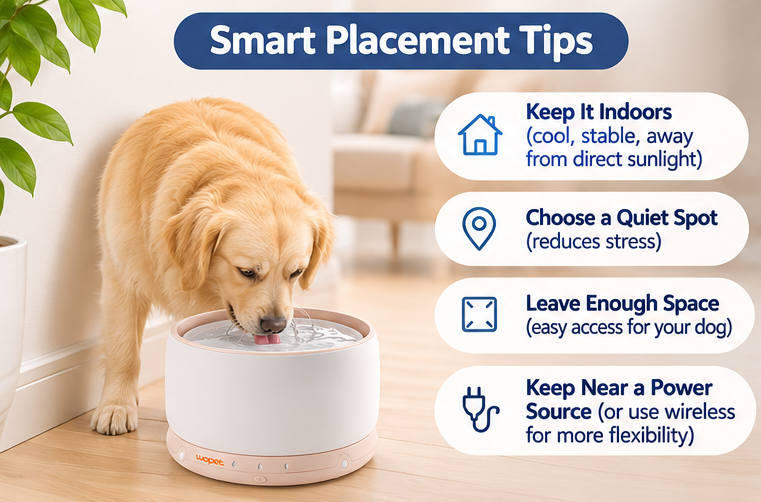
Choosing the right location is just as important as choosing the fountain itself.
Your dog should be able to approach the water comfortably, and the surrounding area should be easy to keep clean.
The kitchen is often a practical location because fresh water and cleaning supplies are nearby.
Advantages:
Convenient access to a sink.
Often has easy-to-clean flooring.
Simple to monitor during daily routines.
Things to consider:
Avoid food preparation surfaces, busy cooking areas, and locations where water could splash onto electrical appliances.
A living room can work well when your dog spends much of the day there.
Advantages:
Easy for pets to access.
Convenient for monitoring drinking habits.
Can provide a central household water station.
Things to consider:
Choose a quiet fountain and protect the floor from splashing.
Avoid blocking walkways.
A dining area may provide enough space for a permanent pet hydration station.
Advantages:
Can accommodate larger fountains.
Often offers accessible floor space.
Easy to establish a consistent drinking location.
Things to consider:
Keep the fountain away from chair movement and areas where people frequently walk.
A laundry room may work when it is accessible, well ventilated, and free of hazards.
Advantages:
Often has water-resistant flooring.
Spills may be easier to manage.
Can keep the fountain away from main living areas.
Things to consider:
Keep detergents and cleaning chemicals secured.
Avoid placing the fountain near appliance cords or areas exposed to leaks.
Some dogs may dislike the noise of washing machines or dryers.
A bedroom fountain can be useful when a dog sleeps nearby and needs easy access to water.
Advantages:
Convenient nighttime drinking access.
Useful for dogs that spend significant time in the room.
Things to consider:
Prioritize quiet operation, stable placement, and floor protection.
| Location | Main Advantage | Main Concern |
|---|---|---|
| Kitchen | Easy refilling and cleaning | Cooking activity and appliances |
| Living room | Convenient daily access | Noise and splashing |
| Dining area | Dedicated drinking space | Foot traffic |
| Laundry room | Often easy-clean flooring | Chemicals and appliance noise |
| Bedroom | Nighttime accessibility | Noise and floor protection |
Best overall placement: A quiet, accessible spot with a level, water-resistant floor, away from busy walkways and electrical hazards.
Some indoor locations create unnecessary risks or make maintenance more difficult.
Water spills can soak into carpet or damage moisture-sensitive flooring.
If these surfaces are unavoidable, use a suitable waterproof mat and clean spills promptly.
Avoid placing the fountain where splashing or leaks could reach power strips, chargers, or electrical connections.
Follow the manufacturer's electrical safety instructions.
A fountain placed in a hallway or doorway may create a tripping hazard.
Choose a location with enough space for your dog to approach without blocking movement.
Keep drinking water away from detergents, disinfectants, and other household chemicals.
In homes with both dogs and cats, keep drinking stations away from litter boxes and other contamination sources.
Prolonged heat and sunlight may warm the water and encourage unwanted biological growth.
A shaded indoor location is generally preferable.
Even a well-designed fountain cannot guarantee a completely dry floor.
Dogs have different drinking styles, and some naturally create more splashing.
Try these practical steps:
Place a waterproof, non-slip mat underneath the fountain.
Choose a basin with comfortable access and suitable rim height.
Keep the fountain level.
Use the recommended water level.
Avoid unnecessarily strong water flow when adjustable.
Wipe up spills promptly.
Keep the drinking station away from moisture-sensitive furniture.
For dogs that frequently paw at water, observe their behavior and consider whether a different drinking setup would be more suitable.
WOPET offers several fountains that may suit different indoor environments.
The following recommendations focus on published product characteristics and practical use cases, not independent laboratory or hands-on testing.
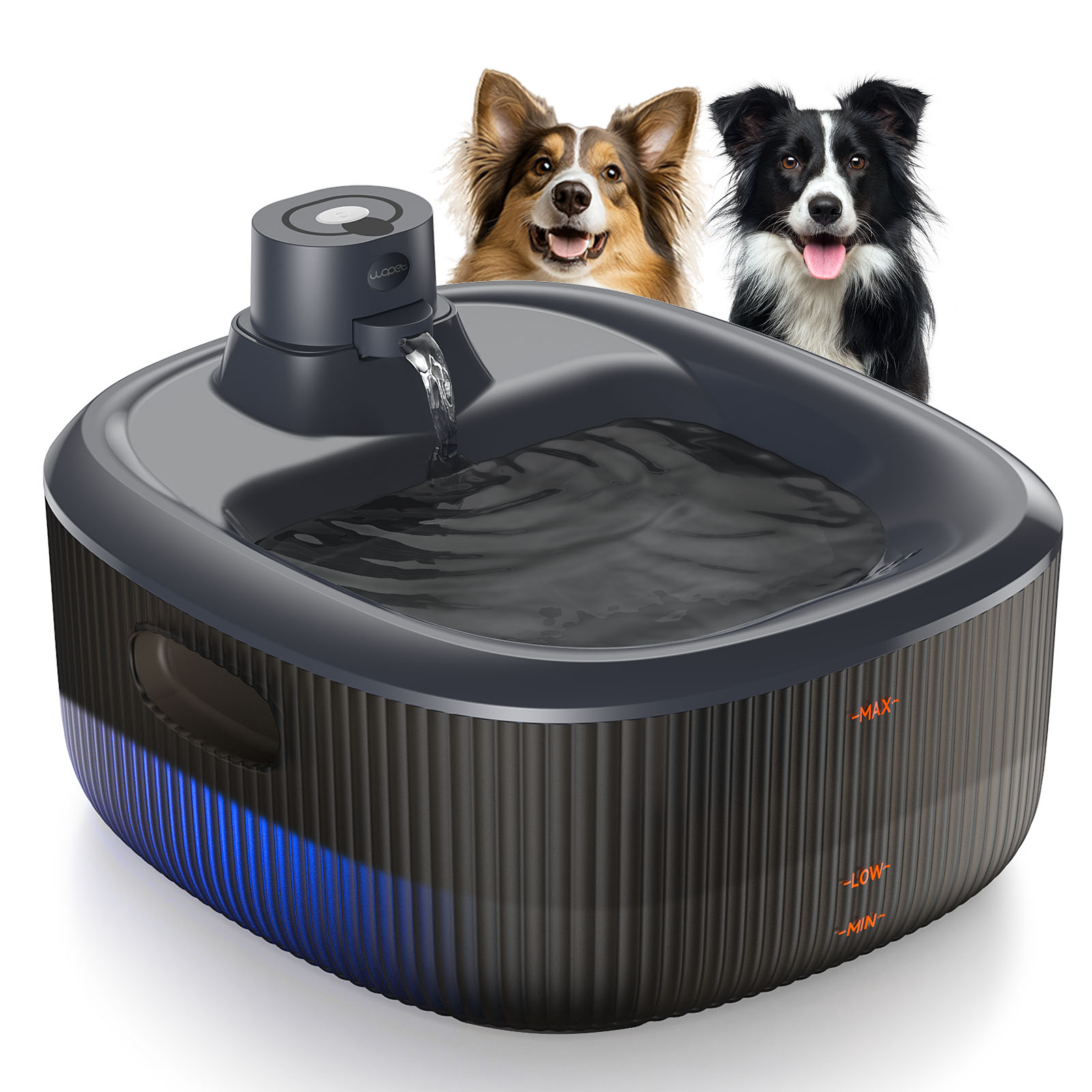
The WOPET W600 Pro is a rechargeable 6L dog water fountain.
Its cordless operating capability can be useful in rooms where a permanent power cable would be inconvenient.
Key Features:
6L reservoir capacity.
Rechargeable design.
5,000mAh battery specification.
Basin-style drinking area.
Flexible placement during cordless operation.
Why Consider It?
The W600 Pro may be useful for living rooms, open spaces, or other indoor locations where a wall outlet is not conveniently positioned.
Best for: Owners who prioritize flexible placement and rechargeable operation.
Before buying: Review battery runtime, circulation modes, and charging instructions for the current model.
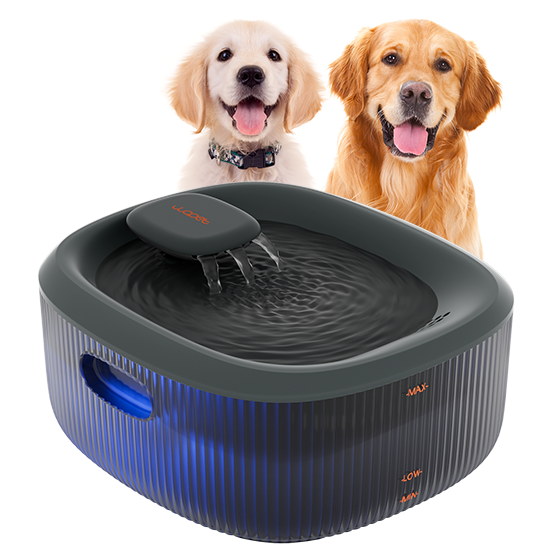
The WOPET W600 is a 6L corded fountain with a wide basin-style drinking area.
It may suit households that want a fixed drinking station in a kitchen or dining area.
Key Features:
6L water capacity.
Wide drinking basin.
Water-level monitoring features.
Replaceable filtration components.
Corded operation.
Why Consider It?
The W600 provides a spacious drinking area for dogs that prefer a bowl-like water surface.
Best for: Permanent indoor drinking stations, particularly for medium and large dogs.
Before buying: Confirm that an outlet is conveniently located and that the cord can be routed safely.

The WOPET A08 is an 8L fountain designed for larger pets and multi-pet households.
Its larger reservoir may be useful when several animals share a drinking station.
Key Features:
8L water capacity.
Multi-stage filtration.
Water-level monitoring features.
Design intended for large dogs and multi-pet households.
Why Consider It?
The A08 offers additional reservoir capacity compared with the 6L W600 models.
Best for: Indoor households with multiple dogs or a combination of dogs and cats.
Before buying: Check the fountain's physical dimensions and ensure that the chosen location has enough space.
| Feature | WOPET W600 Pro | WOPET W600 | WOPET A08 |
|---|---|---|---|
| Capacity | 6L | 6L | 8L |
| Power design | Rechargeable | Corded | Corded |
| Main advantage | Flexible placement | Spacious fixed drinking station | Larger reservoir |
| Suggested indoor use | Living room or flexible location | Kitchen or dining area | Multi-pet drinking area |
| Main consideration | Charging and operating modes | Safe cable routing | Space requirements |
The best model depends on your dog's size, household layout, and preferred maintenance routine.
Explore current specifications and available models at WOPET.
Before deciding where to put your fountain, ask yourself:
Can my dog approach the fountain comfortably?
Is the floor level and easy to clean?
Is the location away from busy walkways?
Can water spills be contained?
Are electrical connections protected from splashing?
Is the fountain away from cleaning chemicals?
Is the location relatively quiet?
Can I easily remove the fountain for cleaning?
Is the reservoir easy to check and refill?
Does my dog have another accessible source of clean water?
If the answer to most of these questions is yes, the location is likely a practical starting point.
The best indoor dog water fountain provides comfortable drinking access, adequate reservoir capacity, quiet circulation, stable construction, and easy cleaning.
The ideal model depends on your dog's size and your home's layout.
A quiet, accessible location with easy-to-clean flooring is generally best.
Kitchens, dining areas, and living rooms can all work when the fountain is placed away from electrical hazards and busy walkways.
Yes, dog water fountains can work well in apartments.
Consider noise, floor space, splash containment, and convenient cleaning.
A rechargeable fountain may be useful when outlet placement is limited.
Some produce gentle circulation or water-flow sounds.
Loud buzzing, rattling, or grinding may indicate low water levels, debris, vibration, or component problems.
You can, but protect the flooring with a suitable waterproof mat and wipe up spills promptly.
Water exposure may damage some wood finishes and flooring materials.
A cordless fountain may offer more flexible placement, but it also requires charging.
A corded fountain can be convenient for a permanent drinking station near an outlet.
Neither is automatically the better choice for every home.
Inspect the fountain daily and clean it whenever water becomes dirty.
Follow the manufacturer's instructions for thorough cleaning and filter replacement.
Yes, if all dogs can drink comfortably and enough water is available.
However, additional drinking stations may be helpful when dogs compete for access or spend time in different rooms.
Follow the manufacturer's instructions for the model's intended operating mode.
Ensure that the fountain has sufficient water, is functioning correctly, and is safely positioned.
If your dog needs water overnight, provide a reliable drinking source even when the fountain is turned off or charging.
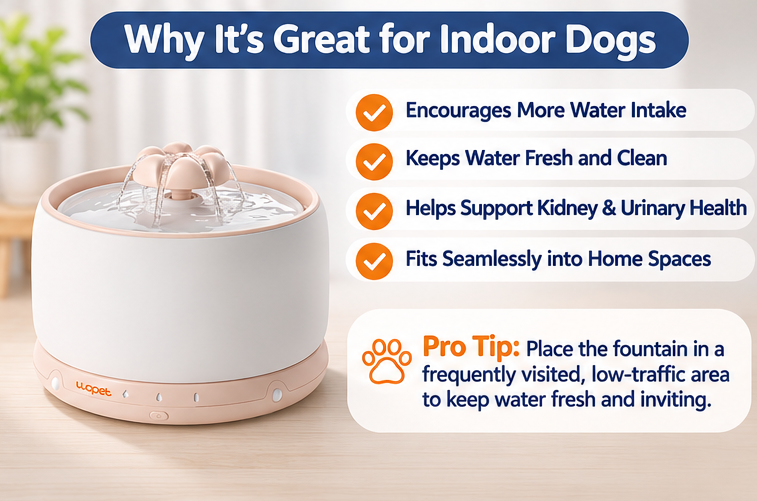
The best indoor dog water fountain should make drinking easier for your dog without creating unnecessary inconvenience at home.
Quiet operation, a comfortable basin, appropriate capacity, stable construction, and easy maintenance are all important.
Placement matters just as much.
A fountain positioned in a quiet, accessible area with water-resistant flooring and safe power arrangements is more likely to become a practical part of your dog's daily routine.
For WOPET shoppers, the W600 Pro offers rechargeable convenience, the W600 provides a wide basin for a permanent drinking station, and the A08 offers additional capacity for multi-pet households.
Whichever model you choose, continue to refresh the water regularly, maintain the fountain, and provide a backup drinking source.
A thoughtfully chosen indoor water fountain can help create a convenient hydration station for your dog—and a cleaner, more comfortable space for everyone at home.
Read more:
Label:
Popular Post
The Ultimate Guide to Tabby Cats: Patterns, Personalities, and More
Mar 27, 2025

Top 8 Reasons Why Does My Cat Sleep Between My Legs?
Mar 03, 2025

What to Do If My Dog's Poop Is Black But Not Tarry
Feb 04, 2023

Superfecundation Cats: When Kittens in One Litter Have Different Fathers
Jul 11, 2025
Can Cats Have Orange Eyes? Genetics, Breeds, and Care Guide
May 20, 2025
[Blue] W03L 3L Premium Ceramic Cat Water Fountain
Model: W03 LITE
$59.99
$69.99

Basin Pet Water Fountain-W600
Model: W600
$43.99
$69.99
[Basic] Ceramic Pet Water Fountain with Power Cable
Model: W03L
$59.99
$99.00
[Black] W03L 3L Premium Ceramic Cat Water Fountain
Model: W03L Black
$59.99
$69.99

WOPET 8L Pet Water Fountain For Multiple Cats or Large Dogs A08
Model: A08
$49.99
$59.99
WOPET A08 Dog Water Fountain Filters
Model: A08 Filter
$19.99
$29.99

DOWNLOAD APP

WOpet life




Copyright © 2026 WOPET. All Rights Reserved.