Nov 04, 2026
Author:Lisa Martinez
Every dog needs reliable access to fresh, clean drinking water. But when setting up a drinking station at home, pet owners face a common question: Is a dog water fountain better than a regular water bowl?
Traditional water bowls are affordable, simple, and familiar. Dog water fountains, on the other hand, circulate water and may include filtration systems designed to capture hair, debris, and other particles.
Both options have advantages, and neither is automatically better for every dog.
Some dogs enjoy drinking from moving water, while others prefer the quiet simplicity of a regular bowl. Your dog's size, age, drinking habits, and household environment all influence which option works best.
In this guide, we'll compare dog water fountains and traditional water bowls across hygiene, hydration, maintenance, costs, and convenience. We'll also explore when using both may be the smartest choice.
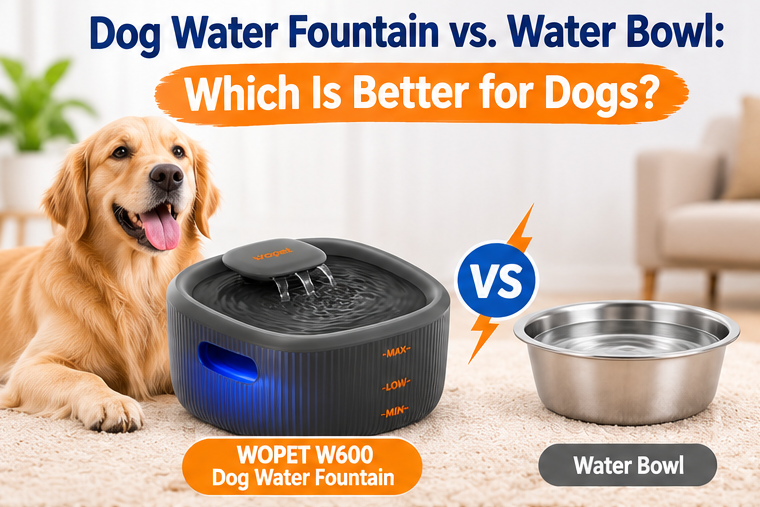
Before examining the details, here's how the two options compare.
| Feature | Dog Water Fountain | Traditional Water Bowl |
|---|---|---|
| Water movement | Circulating water | Still water |
| Filtration | Available on filtered models | Usually none |
| Initial cost | Generally higher | Generally lower |
| Electricity | Required for powered models | Not required |
| Cleaning | More components to maintain | Usually easier |
| Noise | May produce operating sounds | Silent |
| Placement | Depends on power source | Highly flexible |
| Water capacity | Varies by model | Varies by bowl size |
| Replacement parts | Filters and circulation components | Usually unnecessary |
| Power outage | Circulation may stop | Unaffected |
| Best for | Dogs comfortable with circulating water | Dogs preferring simplicity and quiet |
Quick answer: A dog water fountain may be worthwhile if your dog enjoys moving water and you want features such as filtration or a larger reservoir. A regular water bowl is often the better choice if you prioritize simplicity, low cost, and easy cleaning.
The most important factor is whether your dog drinks comfortably and consistently.
A dog water fountain uses a circulation system to move water from a reservoir through a drinking area.
Many models include a filter designed to capture visible particles or reduce certain impurities, depending on the filter materials.
A typical fountain may contain:
A water reservoir.
A circulation pump or other water-moving mechanism.
A drinking basin or spout.
A filtration system.
A power source.
Removable components for cleaning.
Water moves through the circulation system and returns to the reservoir.
This creates a continuously or intermittently refreshed drinking area, depending on the operating mode.
The biggest difference is water movement.
A regular bowl holds still water until you replace or refill it.
A fountain moves water through a circulation system, which may make the drinking experience more appealing to some dogs.
However, circulating water is not automatically cleaner or safer than still water.
Both require proper maintenance.
Dogs have individual drinking preferences.
Some may be interested in moving water because of its sound, movement, or the way it is presented.
Others may prefer still water in a familiar bowl.
There is no reliable reason to assume that every dog prefers a fountain.
Moving water can create sensory cues that attract attention.
For example, a dog may investigate the sound of gentle circulation or become curious about the movement.
Some dogs may also find a wide, accessible drinking basin comfortable.
Not every dog enjoys the sound or movement of a fountain.
A nervous dog may hesitate around an unfamiliar device.
Other dogs may dislike a narrow drinking area, splashing, or vibration.
For these dogs, a quiet bowl may be more comfortable.
Try offering both options in a calm location.
Observe:
Which water source your dog approaches naturally.
Whether your dog drinks comfortably.
Whether the fountain's noise causes hesitation.
Whether your dog can reach the water easily.
Whether your dog returns to the same source throughout the day.
Avoid forcing your dog to use a fountain.
If your dog prefers a regular bowl, that is a perfectly reasonable choice.
Hygiene is one of the most important considerations when comparing a dog water fountain vs. water bowl.
A fountain may contain a filter, but filtration does not eliminate the need for cleaning.
Depending on the filter design, a fountain may help capture:
Loose pet hair.
Food particles.
Dust.
Other visible debris.
Circulation can also keep water moving through the filtration system.
However, not all filters remove the same substances.
A standard pet fountain filter should not be assumed to sterilize water or remove every microorganism.
A regular bowl has fewer components.
That often makes it easier to inspect, empty, wash, rinse, and refill.
Stainless steel and other smooth, nonporous materials can be convenient to clean when properly maintained.
Yes.
Bacteria and biofilm can develop in fountains, just as they can in regular water bowls.
Pet saliva, food residue, and organic debris can enter the drinking water.
If a fountain is not cleaned regularly, buildup may develop in the reservoir, drinking area, or accessible water channels.
The answer depends more on maintenance than on water movement alone.
A clean water bowl may be more hygienic than a poorly maintained fountain.
Likewise, a properly cleaned fountain with suitable filtration can provide a convenient drinking experience.
Bottom line: Choose a drinking system you can clean consistently.
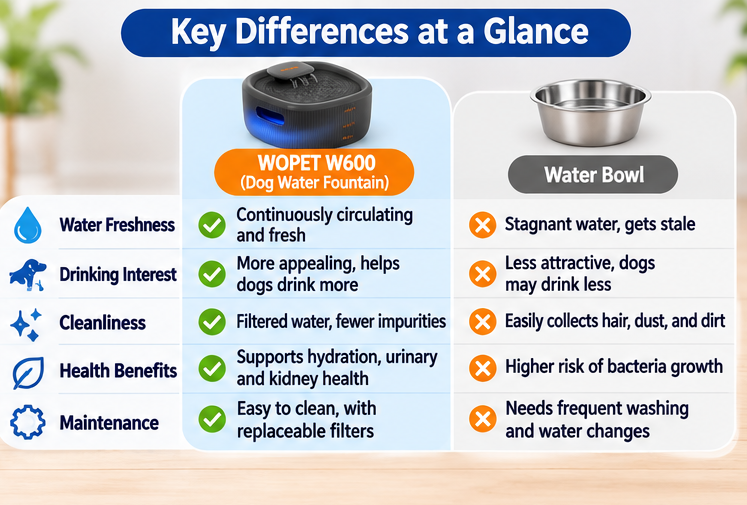
A water fountain may encourage some dogs to investigate their drinking station more often.
However, increased interest does not necessarily mean increased total water consumption.
Whether a dog drinks more depends on individual preferences and other factors.
A dog's water needs can vary with:
Body weight.
Activity level.
Weather and temperature.
Diet and food moisture.
Age.
Pregnancy or nursing.
Health conditions.
Medication.
A dog eating wet food may drink less directly from a bowl or fountain because some water comes from food.
If you want to compare drinking behavior, measure the amount of water added and remaining over a consistent period.
Account for spills, evaporation, and other pets sharing the water source.
Observe whether your dog appears comfortable using the fountain.
If your dog is drinking unusually little or substantially more than normal, contact your veterinarian rather than relying on a fountain to address the issue.
Regular water bowls are generally easier to clean.
A fountain requires additional attention because it contains more components.
Basic maintenance includes:
Empty the remaining water.
Wash the bowl with pet-safe dish soap.
Scrub away residue.
Rinse thoroughly.
Refill with fresh drinking water.
Wash water bowls daily, and more often if they become visibly dirty.
A fountain typically requires:
Disconnecting the power source or switching the unit off according to the manual.
Emptying the reservoir.
Removing user-serviceable components.
Cleaning the drinking area and reservoir.
Inspecting accessible circulation components.
Replacing the filter when needed.
Reassembling and refilling the fountain.
The exact procedure depends on the model.
| Task | Water Fountain | Water Bowl |
|---|---|---|
| Daily water checks | Yes | Yes |
| Regular washing | Yes | Yes |
| Filter replacement | Usually, on filtered models | No |
| Circulation-system cleaning | Yes | No |
| Electrical inspection | For powered models | No |
| Component reassembly | Often required | Usually not required |
If you prefer minimal maintenance, a traditional bowl has a clear advantage.
If you're comfortable with a more involved cleaning routine, a fountain may offer useful additional features.
Purchase price is only one part of the decision.
A water fountain may have recurring expenses that a regular bowl does not.
A basic water bowl usually involves:
Initial purchase price.
Cleaning supplies.
Replacement if damaged or worn.
It does not require electricity or disposable filters.
A fountain may involve:
Initial purchase price.
Replacement filters.
Electricity or battery charging.
Replacement circulation components.
Other compatible accessories.
The following figures are hypothetical examples for understanding the calculation, not actual WOPET prices.
| Expense | Regular Bowl | Filtered Fountain |
|---|---|---|
| Initial purchase | $15 | $50 |
| Filters over 3 years | $0 | $90 |
| Electricity over 3 years | $0 | $12 |
| Replacement parts | $0 | $15 |
| Illustrative total | $15 | $167 |
Actual costs depend on the product, filter replacement schedule, electricity rate, and component lifespan.
A fountain may be worth the additional expense if its features make daily water management more convenient or if your dog clearly prefers using it.
However, a regular bowl remains a practical and effective drinking solution.
Higher cost does not automatically mean better hydration.
In multi-dog households, water capacity and accessibility become especially important.
A larger fountain may reduce the frequency of refilling compared with a small bowl.
However, capacity alone does not determine whether a drinking station is suitable for multiple dogs.
A larger reservoir may offer:
More stored drinking water.
A shared drinking area.
Less frequent refilling under some conditions.
Circulation and filtration features.
Separate bowls can be particularly useful when dogs:
Prefer different drinking locations.
Have different heights or accessibility needs.
Show tension around shared resources.
Drink at different times.
Even with a large fountain, providing more than one drinking station can help prevent crowding and competition.
For households with several dogs, consider combining a fountain with additional bowls in separate locations.
This allows pets to access water without needing to approach the same station.
Different dogs may benefit from different drinking-station designs.
Puppies may be curious about moving water, but they also need a stable, accessible drinking area.
Choose a fountain or bowl that is appropriately sized and difficult to tip over.
Keep electrical cords out of reach.
Supervise puppies around unfamiliar drinking equipment.
Older dogs may experience mobility limitations.
Consider:
Comfortable drinking height.
Easy access without climbing or stretching.
A stable drinking surface.
Low operating noise.
Convenient placement.
Some senior dogs may prefer a familiar bowl rather than adapting to a new fountain.
Large breeds often benefit from spacious drinking areas.
A very small bowl may require frequent refilling, especially in warm weather or active households.
When choosing a fountain, consider both reservoir capacity and the dimensions of the drinking basin.
Dogs with mobility difficulties or medical conditions may have specific drinking needs.
Ask your veterinarian about suitable water access arrangements when necessary.
Never restrict access to water unless specifically directed by a veterinarian.
A dog water fountain may be a worthwhile purchase when it solves a practical problem in your household.
Your dog appears interested in circulating water.
You want a larger reservoir.
You prefer a filtered drinking system.
You have space for a dedicated drinking station.
You can maintain the fountain properly.
You want a cordless option for flexible placement.
Your dog prefers still water.
You want the simplest cleaning routine.
Your budget is limited.
You frequently travel with your dog.
You don't want to manage filters or electrical components.
You need a reliable drinking source without power.
Neither choice is inherently wrong.
The best option is one that your dog uses comfortably and that you can maintain reliably.
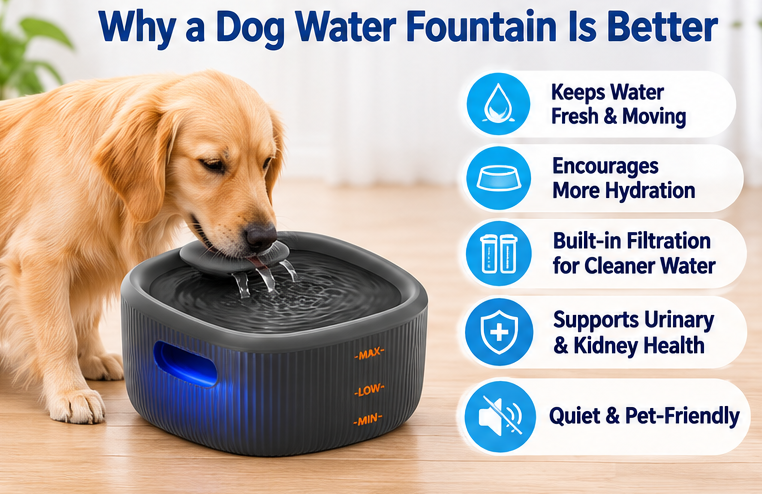
Buy WOPET W600 DOG WATER FOUNTAIN ON AMAZON
For many households, using both a fountain and a traditional water bowl is a practical solution.
Instead of treating the two products as competing alternatives, consider how they can complement each other.
A powered fountain may stop circulating when electricity is unavailable or its battery runs out.
A regular water bowl provides an independent water source.
Some dogs drink from a fountain at certain times and prefer a bowl at others.
Providing both allows your dog to choose.
Multiple water stations can help prevent one dog from controlling access to a shared drinking area.
When a fountain is being cleaned, a separate bowl ensures that drinking water remains available.
If your dog has never used a fountain, keep the familiar water bowl available during the transition.
Allow your dog to investigate the new fountain at its own pace.
Place a fountain in your dog's main indoor drinking area.
Keep a clean water bowl in another accessible location.
Check both daily, refresh water regularly, and maintain each according to its cleaning requirements.
This arrangement provides flexibility without requiring your dog to depend on a single water source.
If you decide that a fountain fits your dog's needs, consider the drinking-area design, power source, and reservoir capacity.
WOPET offers several options suited to different household situations.
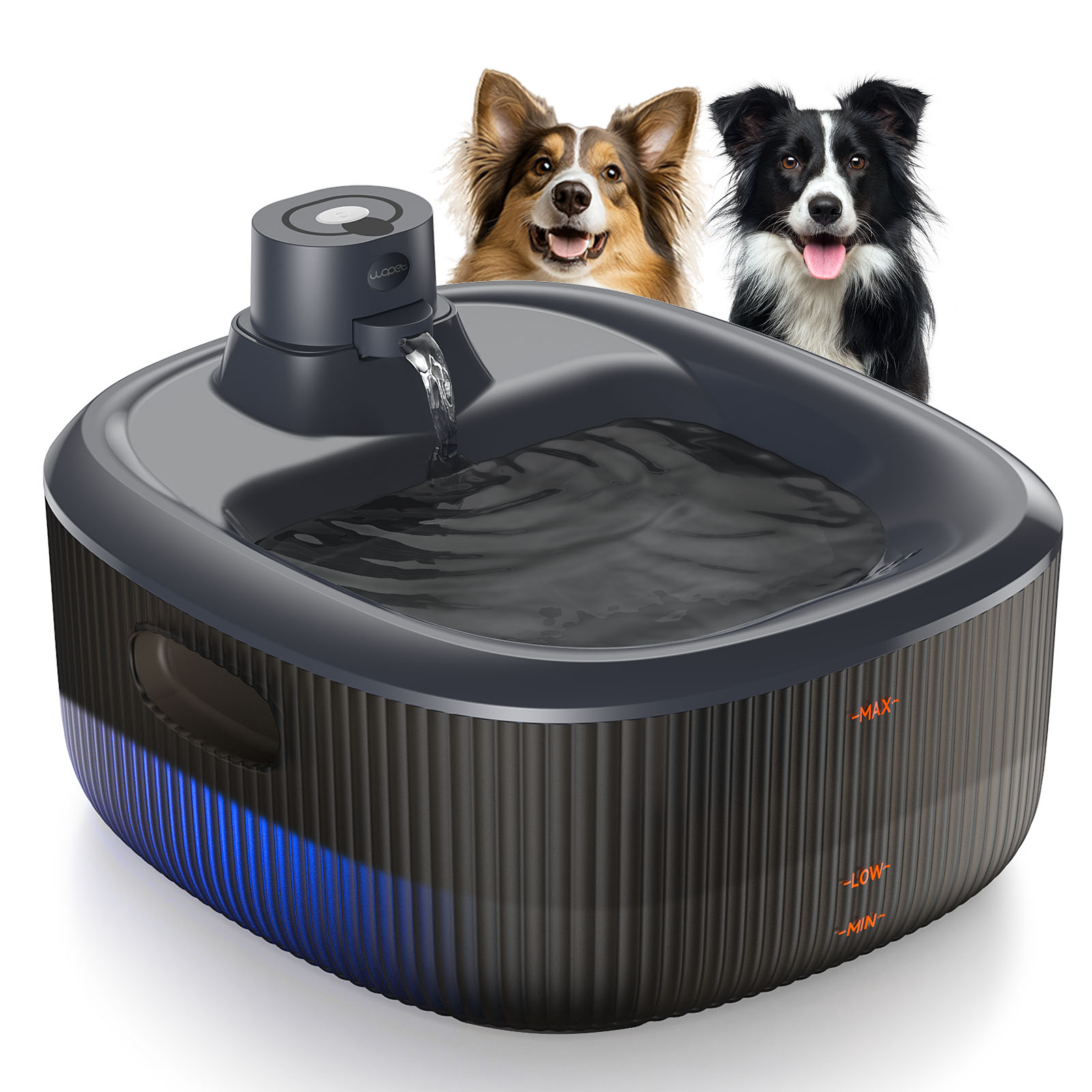
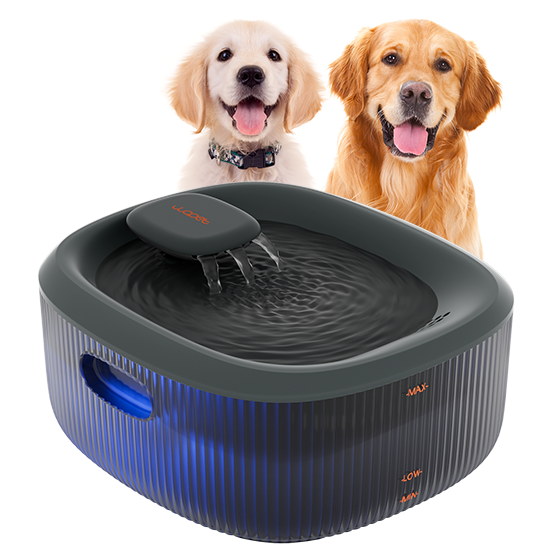
The WOPET W600 is a 6L corded dog water fountain.
It may suit households that want a dedicated indoor drinking station near a convenient power outlet.
Its basin-style design provides a drinking area intended for dogs.
Consider the W600 if:
Your fountain will remain in one location.
You have a suitable power outlet.
You want a 6L reservoir.
You are comfortable maintaining a filtered circulation system.
The WOPET W600 Pro is a 6L rechargeable dog water fountain.
Its rechargeable design provides greater placement flexibility without requiring a permanently connected power cord during cordless operation.
It may be useful when you want to position the drinking station away from an outlet.
Consider the W600 Pro if:
You prefer a rechargeable design.
You want to reduce exposed cords around the drinking area.
You value flexible placement.
You can monitor battery status and recharge when needed.
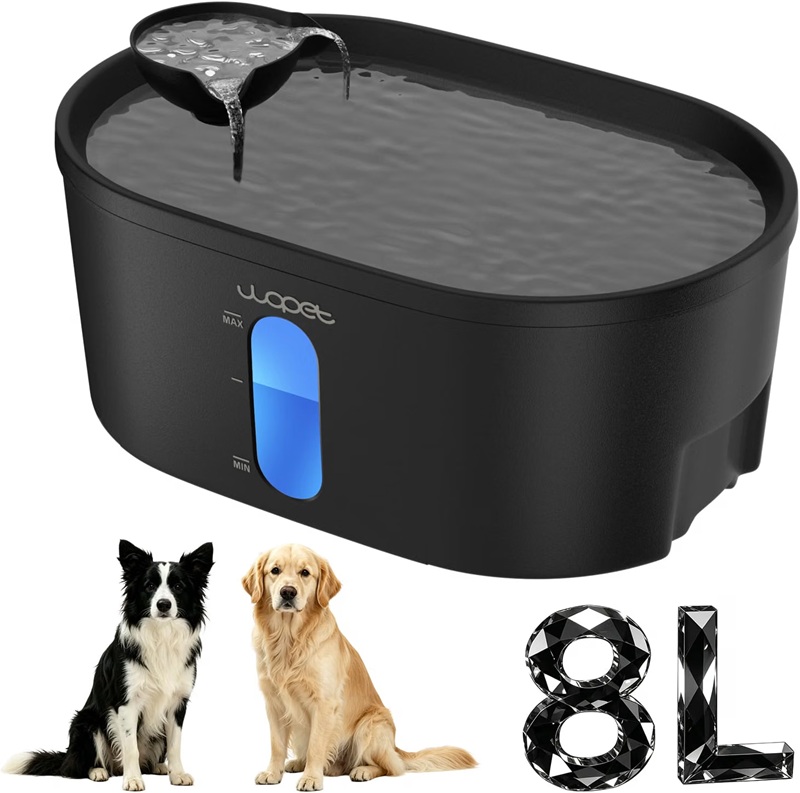
The WOPET A08 is an 8L pet water fountain designed for dogs and multi-cat households.
Its larger reservoir may be helpful where several pets share a drinking area.
However, an 8L capacity does not eliminate the need for regular cleaning or additional water stations.
Consider the A08 if:
You have multiple pets.
You prefer a larger water reservoir.
You need a drinking station suitable for dogs or several cats.
You can maintain the reservoir and filtration system consistently.
| Model | Water Capacity | Main Feature | Potential Household Fit |
|---|---|---|---|
| WOPET W600 | 6L | Corded basin-style fountain | Fixed indoor drinking station |
| WOPET W600 Pro | 6L | Rechargeable operation | Flexible placement |
| WOPET A08 | 8L | Larger reservoir | Dogs and multi-cat homes |
Choose a fountain based on your pets' needs rather than capacity alone.
Some dogs begin using a fountain immediately.
Others need time to become comfortable with a new drinking station.
Do not remove your dog's familiar water bowl when introducing a fountain.
This ensures your dog can continue drinking normally.
Position the fountain in a quiet, accessible area.
Avoid crowded locations or places where the dog may feel trapped.
Let your dog approach the fountain voluntarily.
Avoid forcing its nose toward the water.
If the fountain offers different circulation modes, choose one that does not frighten your dog.
Watch for signs of comfort or hesitation.
Your dog should be able to drink without unusual stress.
Even after your dog accepts the fountain, keeping a separate bowl can provide a useful backup.
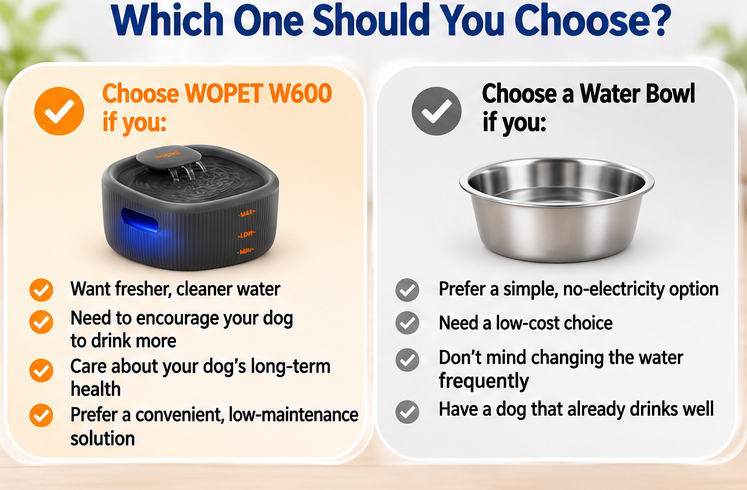
A large reservoir is useful only if the drinking area is comfortable and the water is maintained properly.
Circulation and filtration do not replace washing.
Some fountains require regular filter replacement.
Include these costs in your purchasing decision.
A dog may need time to become comfortable with a fountain.
Keep a familiar water source available during the transition.
Some dogs are sensitive to operating sounds.
Choose a design that suits your pet's behavior.
Fountains can experience low water levels, clogged filters, power interruptions, or mechanical problems.
Check the water source daily.
Not necessarily.
A fountain may offer circulation and filtration, while a regular bowl is simpler and easier to clean.
The better choice depends on your dog's preferences and your maintenance routine.
Some dogs may be more interested in moving water.
However, there is no guarantee that a fountain will increase an individual dog's total water intake.
A filtered fountain may capture some debris, but it still requires regular cleaning.
A clean bowl can be just as practical for providing drinking water.
It may be worthwhile if your dog enjoys it and you value features such as circulation, filtration, or reservoir capacity.
A regular bowl remains a cost-effective alternative.
Yes, many dogs can share a suitable fountain.
However, provide additional water stations when necessary, particularly if pets compete over resources.
Follow the manufacturer's instructions for the specific model.
Some fountains are designed for continuous circulation, while others offer timed or sensor-controlled operation.
Many small powered fountains have relatively modest electricity requirements, but actual consumption varies by model and operating mode.
Check the product's rated power and your local electricity cost.
Check the water daily and clean the fountain according to the manufacturer's instructions.
Clean sooner if the water becomes dirty, residue develops, or several pets use the fountain.
Material alone does not determine which drinking station is better.
Consider surface condition, cleanability, product quality, and maintenance.
Replace drinking equipment that becomes cracked, damaged, or difficult to clean.
Yes.
Using both can provide an additional drinking location, a backup during power interruptions, and more choice for your dog.
So, which is better for dogs: a water fountain or a traditional water bowl?
The best choice is the one that provides reliable access to fresh water and suits your dog's drinking preferences.
A regular bowl is affordable, quiet, easy to clean, and independent of electricity.
A dog water fountain adds circulating water and may offer filtration, larger capacity, or flexible placement depending on the model.
For some households, the fountain's added features justify its higher cost and maintenance requirements.
For others, a simple water bowl is entirely sufficient.
And in many homes, using both offers the greatest flexibility.
If you're considering a fountain, explore the WOPET pet water fountain collection and compare models such as the W600, W600 Pro, and A08 based on your dog's size, drinking habits, and household needs.
Whatever you choose, the most important habit remains the same: provide fresh drinking water, check it regularly, and keep the drinking station clean.
Read more:
Label:
Popular Post
The Ultimate Guide to Tabby Cats: Patterns, Personalities, and More
Mar 27, 2025

Top 8 Reasons Why Does My Cat Sleep Between My Legs?
Mar 03, 2025

What to Do If My Dog's Poop Is Black But Not Tarry
Feb 04, 2023
Superfecundation Cats: When Kittens in One Litter Have Different Fathers
Jul 11, 2025
How Long Does Dry Cat Food Last Once Opened? A Comprehensive Guide
Mar 19, 2025
[Blue] W03L 3L Premium Ceramic Cat Water Fountain
Model: W03 LITE
$59.99
$69.99
Basin Pet Water Fountain-W600
Model: W600
$43.99
$69.99
[Basic] Ceramic Pet Water Fountain with Power Cable
Model: W03L
$59.99
$99.00
[Black] W03L 3L Premium Ceramic Cat Water Fountain
Model: W03L Black
$59.99
$69.99

WOPET 8L Pet Water Fountain For Multiple Cats or Large Dogs A08
Model: A08
$49.99
$59.99
WOPET A08 Dog Water Fountain Filters
Model: A08 Filter
$19.99
$29.99

DOWNLOAD APP

WOpet life




Copyright © 2026 WOPET. All Rights Reserved.