Nov 04, 2026
Author:Amanda Lyu
A dog water fountain can be a convenient way to keep fresh, circulating water available throughout the day. But if you're considering leaving one running continuously, you may wonder whether it will noticeably increase your electricity bill.
How much electricity does a dog water fountain use?
The good news is that many small pet water fountains consume relatively little electricity. For example, a fountain drawing 2–5 watts continuously would use approximately 1.44–3.6 kilowatt-hours (kWh) over 30 days. At an illustrative electricity rate of $0.16 per kWh, that works out to roughly $0.23–$0.58 per month.
However, actual power consumption depends on the fountain's design, circulation system, operating mode, and electrical specifications.
In this guide, we'll explain how much electricity dog water fountains use, how to calculate daily and annual running costs, and what to consider when choosing between corded and rechargeable models.
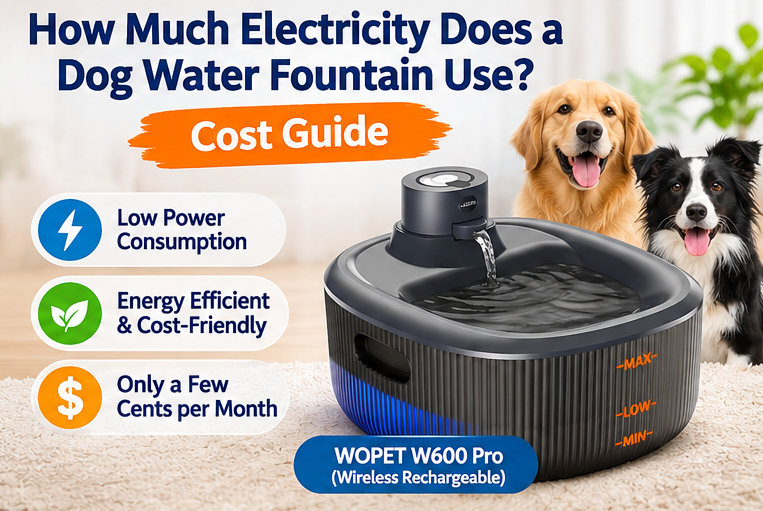
Dog water fountains typically use small electrical circulation systems to move water through the reservoir and drinking area.
Many compact pet fountains operate at relatively low power levels, although larger models and those with additional features may consume more electricity.
The amount of energy a fountain uses depends on its power draw, measured in watts, and how long it operates.
For example:
A 2W fountain running continuously uses 0.048 kWh per day.
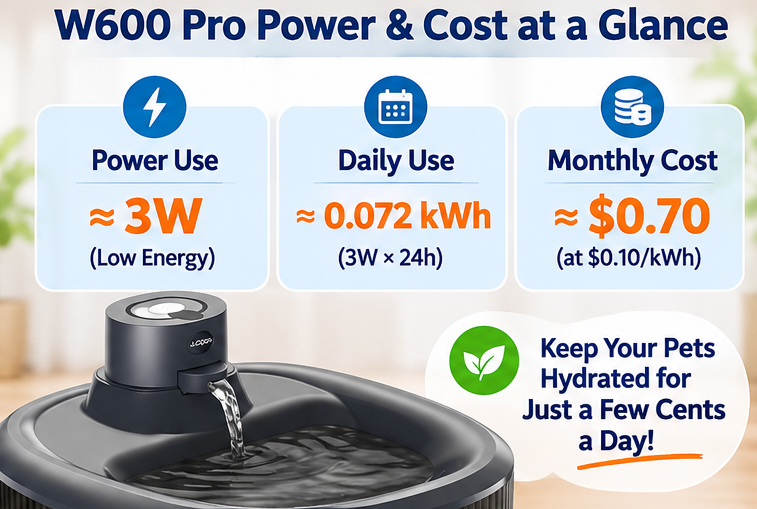
A 3W fountain running continuously uses 0.072 kWh per day.
A 5W fountain running continuously uses 0.12 kWh per day.
A 10W fountain running continuously uses 0.24 kWh per day.
These figures are calculations based on hypothetical constant power draws, not measurements of specific WOPET models.
A fountain that operates intermittently may use less electricity than one that continuously draws its rated power.
In many cases, no.
For perspective, a 5W fountain operating 24 hours a day uses 3.6 kWh over 30 days.
At $0.16 per kWh, the estimated monthly electricity cost is approximately $0.58.
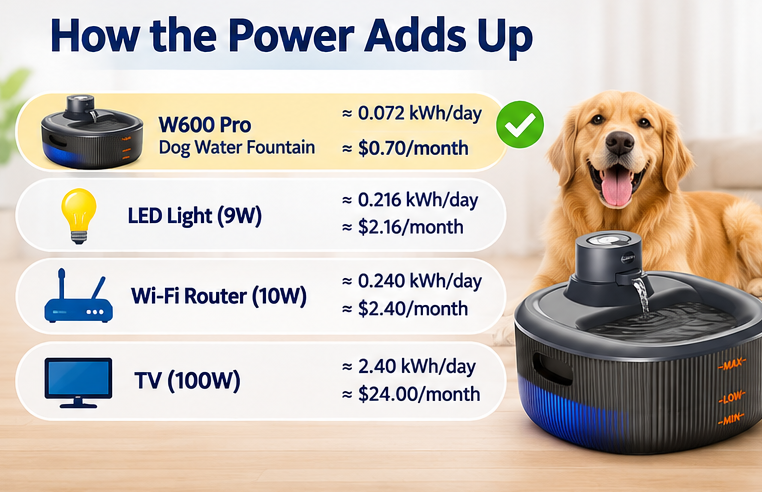
That is relatively small compared with many household appliances.
However, the actual cost depends on your electricity rate and the fountain's measured energy consumption.
You don't need specialized equipment to estimate your fountain's electricity cost if you know its power consumption.
The basic formula is:
Electricity Used (kWh) = Power (Watts) × Operating Hours ÷ 1,000
To calculate the cost:
Electricity Cost = Electricity Used (kWh) × Electricity Rate ($/kWh)
Let's look at an example.
Suppose your fountain draws 5 watts and operates continuously.
Daily electricity use:
5 × 24 ÷ 1,000 = 0.12 kWh
Monthly electricity use (30 days):
0.12 × 30 = 3.6 kWh
Monthly electricity cost:
3.6 × $0.16 = $0.576
That's approximately $0.58 per month.
Annual electricity use:
0.12 × 365 = 43.8 kWh
Annual electricity cost:
43.8 × $0.16 = $7.01
This example shows why electricity costs are often a relatively small part of maintaining a pet fountain.
Check the following:
The fountain's product specifications.
The manufacturer's instruction manual.
The power adapter or product label.
The manufacturer's customer support information.
Be aware that an adapter's maximum rated output does not necessarily equal the fountain's actual operating power.
For a more accurate estimate, a compatible plug-in electricity meter can measure energy consumption for a corded fountain.
The following table estimates electricity consumption for fountains operating continuously at several example power levels.
All calculations assume an electricity rate of $0.16 per kWh.
| Power Draw | Daily Electricity Use | Monthly Cost (30 Days) | Annual Cost |
|---|---|---|---|
| 2W | 0.048 kWh | $0.23 | $2.80 |
| 3W | 0.072 kWh | $0.35 | $4.20 |
| 5W | 0.120 kWh | $0.58 | $7.01 |
| 8W | 0.192 kWh | $0.92 | $11.21 |
| 10W | 0.240 kWh | $1.15 | $14.02 |
These estimates assume the fountain draws the same amount of power whenever it is operating.
Actual energy use may vary because of standby consumption, operating modes, charging losses, and differences between rated and measured power.
Running a fountain continuously does not necessarily mean a high electricity bill.
For example, at $0.16 per kWh:
A 3W fountain costs approximately $0.35 per 30-day month.
A 5W fountain costs approximately $0.58 per 30-day month.
An 8W fountain costs approximately $0.92 per 30-day month.
Even so, you should only operate a fountain continuously if the manufacturer supports that usage.
Maintain the recommended water level and inspect the fountain regularly.
Not all fountains consume electricity in the same way.
Several design and operating factors influence their energy use.
A fountain's circulation system is one of the primary factors affecting power consumption.
Some fountains use conventional water pumps, while others use different water-moving mechanisms.
Their electrical requirements depend on the specific design.
A larger reservoir does not automatically require a more powerful circulation system.
Some fountains circulate water continuously.
Others operate periodically or use sensors to activate circulation.
An intermittent system may consume less electricity overall if its average power draw is lower.
However, sensor electronics and standby functions may also consume energy.
The best way to compare models is to look at actual energy consumption rather than operating mode alone.
Dog water fountains come in different sizes, from compact models for smaller pets to large-capacity fountains designed for multiple animals.
A larger reservoir holds more water, but its capacity alone does not determine electricity use.
For example, an 8L fountain is not necessarily twice as power-hungry as a 4L fountain.
Power consumption depends on the complete electrical design.
Some fountains include features such as:
Motion sensors.
Indicator lights.
Water-level monitoring.
Rechargeable batteries.
Electronic control systems.
These features may contribute to electricity consumption.
Their actual impact depends on the model and how frequently they operate.
Power adapters convert electricity from a wall outlet into the form required by the fountain.
Some energy is lost during this conversion.
As a result, the electricity drawn from the wall may be higher than the power delivered to the circulation system.
Debris, mineral deposits, and low water levels can interfere with normal fountain operation.
However, a clogged pump does not always consume more electricity; its power draw may increase or decrease depending on its design.
The main reason to clean the circulation system is to maintain reliable, hygienic, and safe operation—not to assume that cleaning will always reduce electricity costs.
Not necessarily.
Dog fountains are often designed with larger reservoirs or wider drinking areas, but these features do not automatically mean higher power consumption.
A compact cat fountain with additional electronic features could consume more power than a simple dog fountain.
When comparing electricity use, consider:
Actual operating wattage.
Circulation frequency.
Standby power.
Charging requirements.
Additional electronic features.
The animal a fountain is marketed for is less important than its electrical specifications.
Both corded and rechargeable fountains use electricity, but they obtain it differently.
A corded fountain receives electricity through a power adapter connected to a wall outlet.
Depending on the design, it may circulate water continuously or operate in scheduled modes.
Advantages can include:
No need to recharge a battery.
Convenient operation near a suitable outlet.
No battery-capacity decline affecting runtime.
However, the fountain must remain connected to an appropriate power source.
Rechargeable fountains store electrical energy in a battery.
They can be placed in locations where a nearby outlet is inconvenient.
Potential advantages include:
Flexible placement.
Fewer exposed cords around the drinking area.
Operation between charging sessions.
Sensor-controlled or intermittent circulation on supported models.
However, rechargeable fountains still consume electricity when charging.
Battery charging also involves energy losses.
Neither type is automatically more efficient.
A rechargeable fountain operating intermittently may consume less energy than a corded fountain running continuously.
But a rechargeable model with frequent circulation and charging losses may not offer a meaningful electricity-cost advantage.
Compare measured energy use and operating modes rather than assuming wireless means energy-saving.
WOPET offers dog water fountains with different capacities and power arrangements.
When choosing a fountain, consider placement, operating convenience, maintenance, and long-term ownership costs.
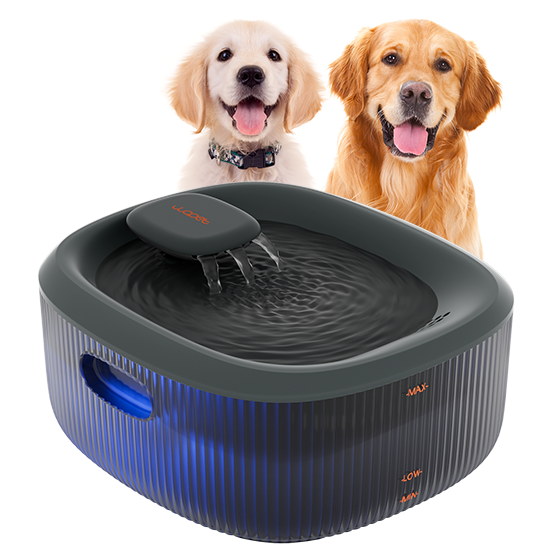
The WOPET W600 is a 6L basin-style dog water fountain designed for convenient daily access to circulating water.
Its corded design makes it suitable for locations with access to an appropriate power outlet.
When estimating electricity costs:
Check the electrical specifications for your exact model.
Identify whether circulation is continuous or intermittent.
Calculate energy consumption using the fountain's operating power.
Include any standby consumption when relevant.
For households where the fountain stays in a fixed location, a corded model can be a practical option.
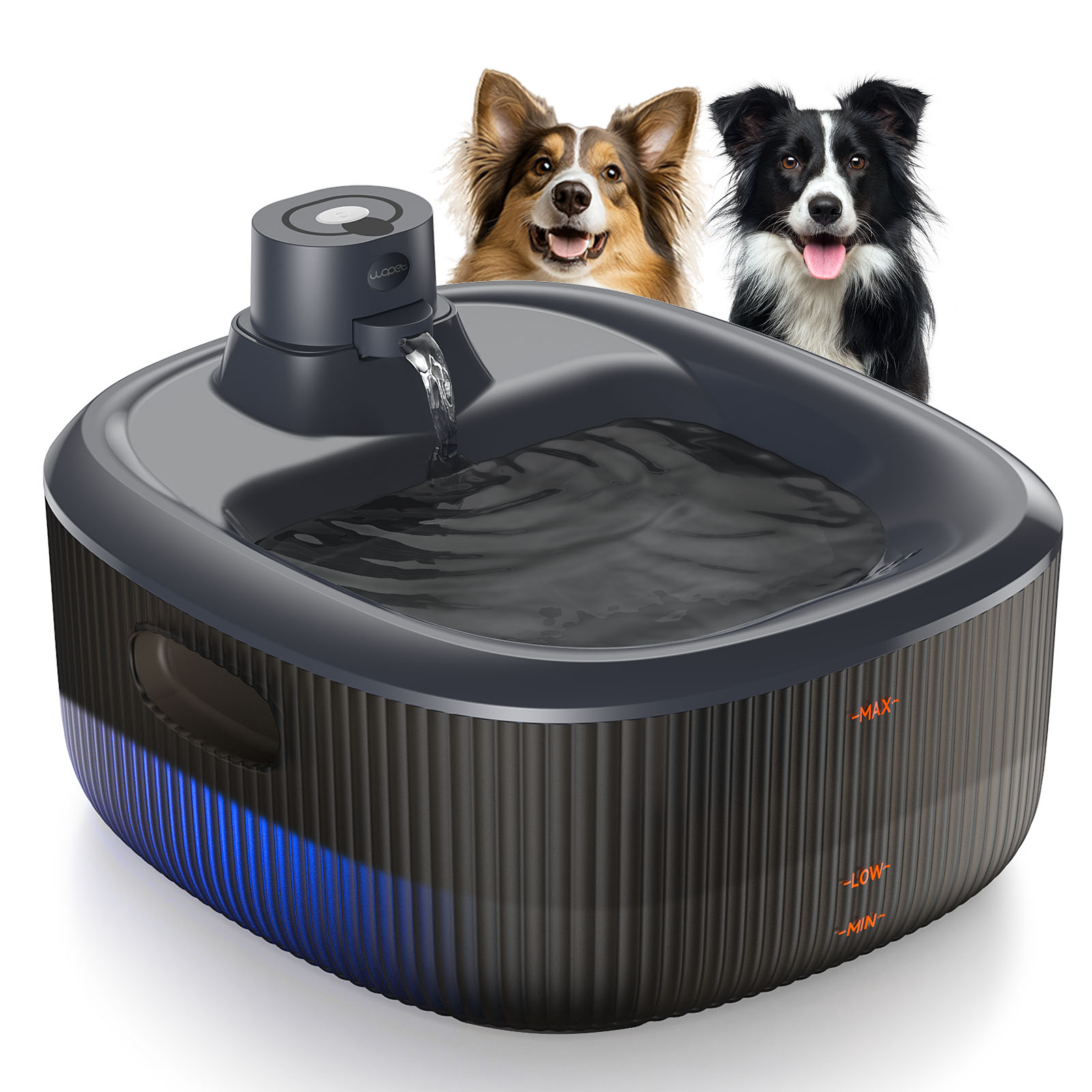
The WOPET W600 Pro is a rechargeable 6L fountain.
Its rechargeable design provides greater flexibility when choosing a location.
When uating electricity use, consider:
Energy consumed during charging.
How frequently charging is required.
Operating modes.
Battery condition.
Changes in runtime as the battery ages.
Battery runtime and electricity consumption are related but different measurements.
A fountain that runs for several days between charges does not necessarily consume less total energy than another model.

The WOPET A08 is an 8L water fountain designed for dogs and multi-cat households.
Its larger reservoir can be convenient when several pets share a drinking station.
However, reservoir size should not be used as a substitute for actual wattage when estimating electricity costs.
For multi-pet households, also consider:
Water consumption.
Cleaning frequency.
Filter replacement expenses.
Circulation reliability.
Placement near a suitable power source.
| Model | Capacity | Power Consideration |
|---|---|---|
| WOPET W600 | 6L | Corded operation and electricity usage |
| WOPET W600 Pro | 6L | Rechargeable battery and charging consumption |
| WOPET A08 | 8L | Check electrical specifications and operating mode |
Specific electricity costs should be calculated from verified electrical ratings or measured consumption for each model.
Although many fountains use relatively little electricity, choosing and maintaining the right model can help avoid unnecessary energy use.
Look for clear electrical specifications.
Compare power consumption alongside capacity, noise, cleaning requirements, and filtration costs.
If your fountain offers intermittent or sensor-controlled circulation, review whether that mode suits your dog's drinking habits.
Do not assume an intermittent setting always uses less energy without considering standby consumption.
Clean the reservoir and accessible circulation components according to the manufacturer's instructions.
This supports reliable operation and helps prevent debris-related problems.
Check the water level daily.
Low water can interfere with circulation and may damage some pump systems.
Never rely solely on low-water protection features.
Use the manufacturer-approved adapter and charging equipment.
An incompatible adapter can create electrical and safety problems.
Electricity is only one expense.
Also account for:
Replacement filters.
Cleaning supplies.
Replacement pumps or components.
Battery servicing where applicable.
The initial purchase price.
For many households, filter replacement costs may exceed electricity expenses.
Electricity is not always the biggest ongoing expense of a filtered pet fountain.
Consider an illustrative 5W fountain operating continuously at $0.16 per kWh.
Its annual electricity cost would be approximately $7.01.
Now consider replacement filters costing $5 each.
| Expense | Estimated Annual Cost |
|---|---|
| Electricity at 5W, 24/7 | $7.01 |
| Filters replaced every 4 weeks | $65 |
| Filters replaced every 2 weeks | $130 |
The electricity figure is a hypothetical calculation, while the filter examples use an illustrative $5 unit cost.
This comparison shows why uating the total cost of ownership is more useful than focusing on electricity alone.
A fountain with a slightly higher power draw may still be economical if its filters and replacement components are affordable.
Calculations based on wattage provide useful estimates, but measurements can be more accurate.
A compatible plug-in electricity meter can measure energy consumed at the wall outlet.
To measure usage:
Confirm that the meter is compatible with your outlet and fountain.
Connect the fountain through the meter according to its instructions.
Operate the fountain normally.
Measure energy consumption over several days.
Divide the total kWh by the number of days measured.
Multiply by 30 for an estimated monthly figure.
This method can capture variations in operating cycles and adapter consumption.
Rechargeable fountains are more complicated to measure because electricity is consumed during charging rather than continuously from the outlet.
A compatible energy meter may help measure charging energy, but the measurement period should include enough charging cycles to represent normal use.
For an accurate monthly estimate, measure the total electricity used for charging over a representative period.
Do not use an incompatible electrical meter or modify charging connections.
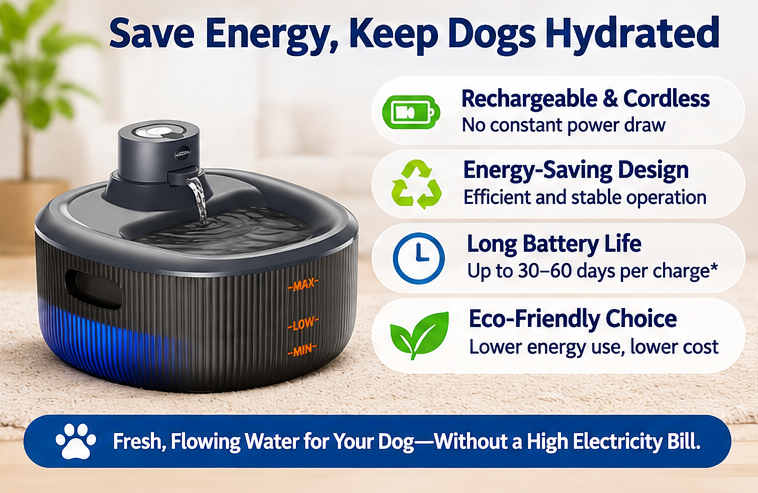
Many small pet fountains consume relatively little electricity.
For example, a fountain drawing 5W continuously uses approximately 3.6 kWh over 30 days.
Actual consumption varies by model.
At $0.16 per kWh, a fountain drawing 5W continuously costs approximately $0.58 per 30-day month.
Your actual cost depends on the fountain's power draw, operating time, and local electricity rate.
Wattage varies by product.
Check the manufacturer's specifications or measure energy use with suitable equipment.
Do not assume that all dog fountains use the same amount of power.
Some fountains are designed for continuous operation.
Follow the manufacturer's instructions, maintain the correct water level, and inspect the fountain regularly.
Not necessarily.
Rechargeable models still consume electricity during charging.
Total energy use depends on operating modes, charging losses, and device efficiency.
Not automatically.
A larger reservoir does not necessarily mean higher wattage.
Compare actual electrical specifications rather than capacity alone.
Follow the manufacturer's operating instructions and consider your dog's access to drinking water.
If the fountain is switched off, make sure your dog still has access to an appropriate source of fresh water.
Do not restrict water access simply to save electricity.
A dirty filter can restrict water flow, but it does not always increase electrical consumption.
The effect depends on the circulation system.
Replace filters and clean the fountain according to the manufacturer's recommendations.
Multiply its power in watts by the daily operating hours and 365, divide by 1,000, then multiply by your electricity rate per kWh.
For fountains with variable power consumption, measured energy use provides a better estimate.
For many households, a dog water fountain adds only a modest amount to the electricity bill.
A hypothetical fountain drawing 5 watts continuously would cost approximately $0.58 per month or $7.01 per year at an electricity rate of $0.16 per kWh.
However, the actual expense depends on the fountain's power consumption, operating mode, and local electricity prices.
Corded and rechargeable models can both be practical choices, and neither is automatically more energy-efficient.
When comparing fountains such as the WOPET W600, W600 Pro, and A08, consider not only electricity costs but also water capacity, cleaning requirements, replacement filters, and daily convenience.
Ultimately, the best dog water fountain is one that provides reliable access to drinking water while fitting your household's routine and maintenance budget.
Explore WOPET pet water fountains to find a model that suits your dog's needs.
Read more:
Label:
Popular Post

The Ultimate Guide to Tabby Cats: Patterns, Personalities, and More
Mar 27, 2025

Top 8 Reasons Why Does My Cat Sleep Between My Legs?
Mar 03, 2025

What to Do If My Dog's Poop Is Black But Not Tarry
Feb 04, 2023

Superfecundation Cats: When Kittens in One Litter Have Different Fathers
Jul 11, 2025

How Long Does Dry Cat Food Last Once Opened? A Comprehensive Guide
Mar 19, 2025
[Blue] W03L 3L Premium Ceramic Cat Water Fountain
Model: W03 LITE
$59.99
$69.99

Basin Pet Water Fountain-W600
Model: W600
$43.99
$69.99
[Basic] Ceramic Pet Water Fountain with Power Cable
Model: W03L
$59.99
$99.00
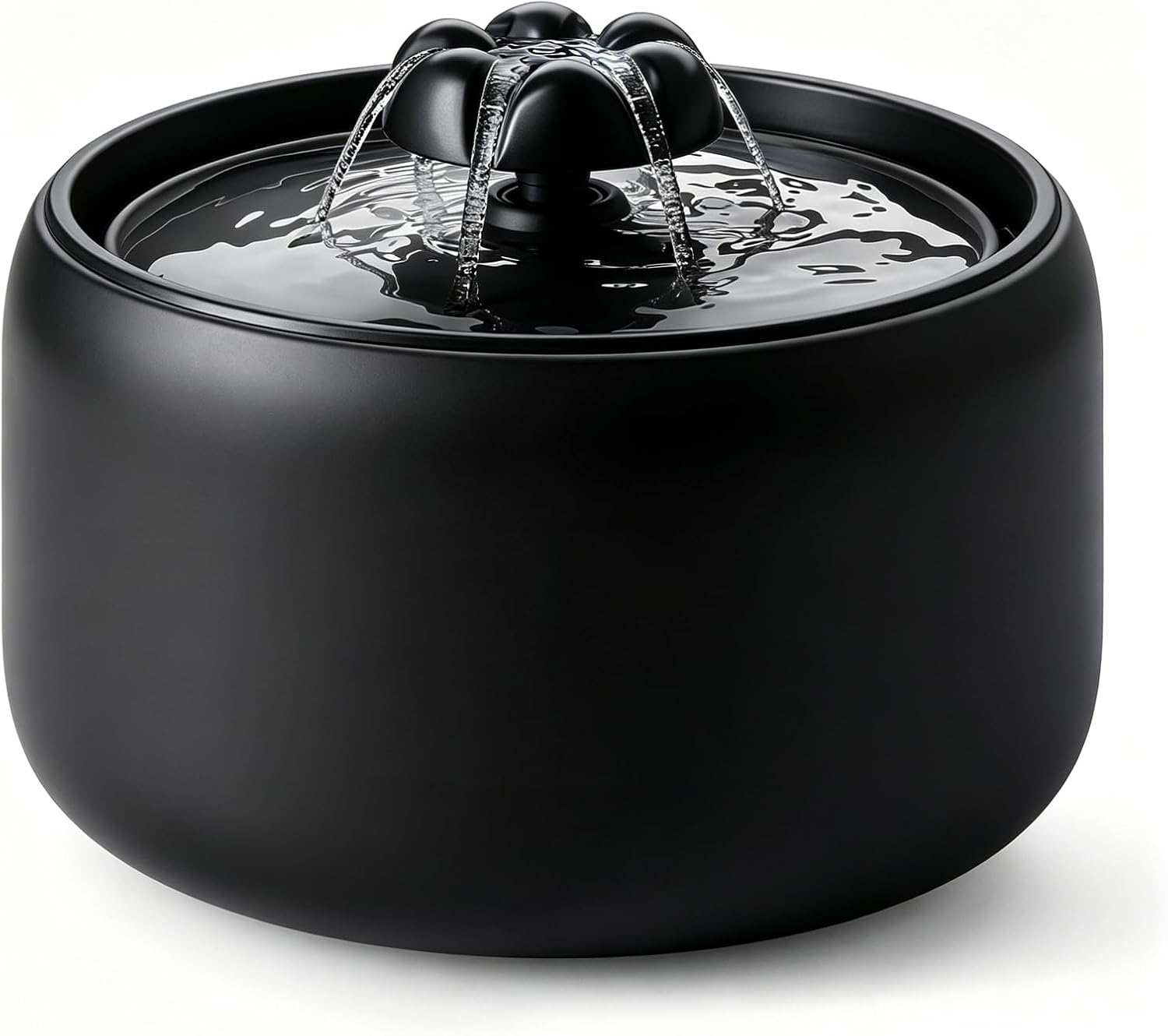
[Black] W03L 3L Premium Ceramic Cat Water Fountain
Model: W03L Black
$59.99
$69.99

WOPET 8L Pet Water Fountain For Multiple Cats or Large Dogs A08
Model: A08
$49.99
$59.99
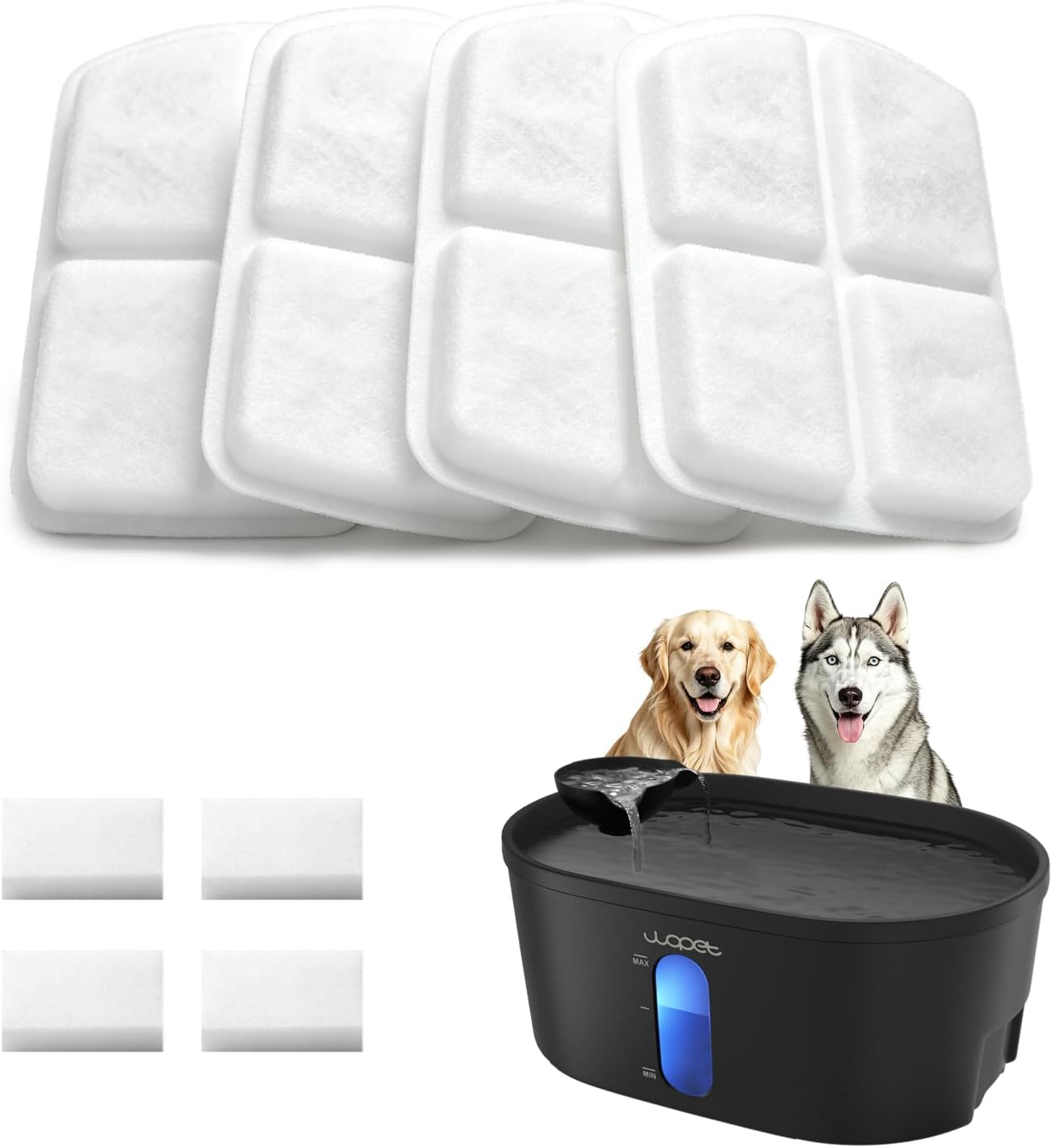
WOPET A08 Dog Water Fountain Filters
Model: A08 Filter
$19.99
$29.99

DOWNLOAD APP

WOpet life




Copyright © 2026 WOPET. All Rights Reserved.