Nov 04, 2026
Author:Jackson Watson
A dog water fountain can make everyday hydration more convenient, but like any pet appliance, it won't last forever.
If you've noticed weaker water flow, unusual noises, or a fountain that occasionally stops working, you may be wondering: How long does a dog water fountain last?
The short answer is that a well-maintained dog water fountain may last several years, but there is no universal lifespan. Durability depends on the fountain's materials, circulation system, water quality, usage patterns, and maintenance.
Importantly, the fountain itself and its individual components may have very different lifespans. A filter might need replacing every few weeks, while the reservoir can remain usable much longer. A failed pump also doesn't necessarily mean you need an entirely new fountain.
This guide explains what affects a dog water fountain's lifespan, which parts tend to wear out first, how to recognize problems, and when repairing or replacing your fountain makes the most sense.

There is no single replacement timeline that applies to every dog water fountain.
Some fountains remain functional for years with appropriate care, while others develop problems sooner because of mineral buildup, mechanical wear, damaged components, or operating conditions.
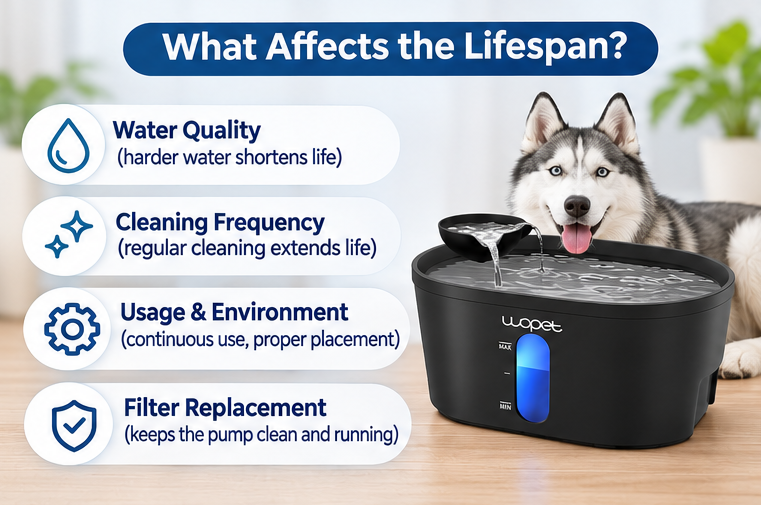
The lifespan of a fountain depends on several factors:
Build quality: The durability of the reservoir, connections, and circulation components.
Water quality: Hard water may cause mineral deposits that interfere with moving parts.
Operating habits: Water levels, operating modes, and charging practices can affect components.
Cleaning frequency: Hair, food particles, and biofilm can accumulate without regular maintenance.
Number of pets: More pets can mean greater water use and more debris.
Availability of replacement parts: A replaceable pump can extend the useful life of the complete fountain.
Instead of focusing on a specific number of years, uate whether your fountain remains safe, cleanable, and reliable.
| Component | Lifespan or Replacement Consideration |
|---|---|
| Reservoir and housing | Can remain usable for years if undamaged and cleanable |
| Disposable filter | Replace according to the manufacturer; some models recommend every 2–4 weeks |
| Pump or circulation mechanism | Variable lifespan; affected by water quality, debris, and maintenance |
| Rechargeable battery | Capacity gradually declines with age and charging cycles |
| Power adapter and cable | Replace if damaged, overheating, or malfunctioning |
| Seals and gaskets | Replace when worn, deformed, or leaking |
| Drinking tray | Replace if cracked, damaged, or no longer hygienic |
These are maintenance guidelines, not guaranteed component lifespans.
Understanding what causes wear can help you prevent avoidable problems.
Dog water fountains are commonly made from plastic, stainless steel, ceramic, or a combination of materials.
Each has different durability characteristics.
Plastic fountains are often lightweight and resistant to shattering, but scratches, cracks, and long-term wear can make some surfaces harder to clean.
Stainless steel fountains can provide durable water-contact surfaces, although corrosion resistance depends on the material grade and maintenance.
Ceramic fountains often have smooth, glazed surfaces but can chip or crack if dropped.
No material guarantees a longer product lifespan on its own.
Construction quality, component design, and maintenance are equally important.
Hard water contains dissolved minerals that can leave deposits on fountain surfaces.
Over time, these deposits may accumulate around water outlets, narrow channels, or pump components.
In conventional pump designs, buildup can interfere with the impeller's movement.
Signs of mineral buildup include:
White or chalky residue.
Reduced water flow.
Unusual pump noise.
Deposits around water outlets.
More frequent circulation problems.
Use drinking water appropriate for your pet and clean mineral deposits using methods approved for your fountain.
Some dog water fountains operate continuously, while others use intermittent circulation or sensor-controlled modes.
Continuous operation does not automatically mean a fountain will fail quickly.
However, the circulation system should be designed for the intended operating pattern.
Follow the manufacturer's instructions instead of assuming every fountain is designed to run continuously.
Operating with insufficient water can cause problems in fountains that depend on water for cooling or proper circulation.
Some models include low-water protection, but this feature should not replace regular water-level checks.
Always maintain water within the manufacturer's recommended range.
Pet hair, food debris, saliva, and mineral deposits can accumulate inside a fountain.
Without cleaning, these materials may obstruct circulation and increase wear.
Regular maintenance can help prevent some avoidable failures.
A fountain shared by three dogs may require more frequent attention than one used by a single small dog.
Multi-pet households can experience:
Faster water consumption.
More hair in the reservoir.
Greater accumulation of food particles.
More frequent filter contamination.
Choose an appropriate reservoir capacity and adjust maintenance to actual usage.
Corded and rechargeable fountains have different maintenance considerations.
For corded fountains, inspect the adapter and cable for damage.
For rechargeable models, follow the manufacturer's charging and storage instructions.
Avoid exposing electrical connections to water.
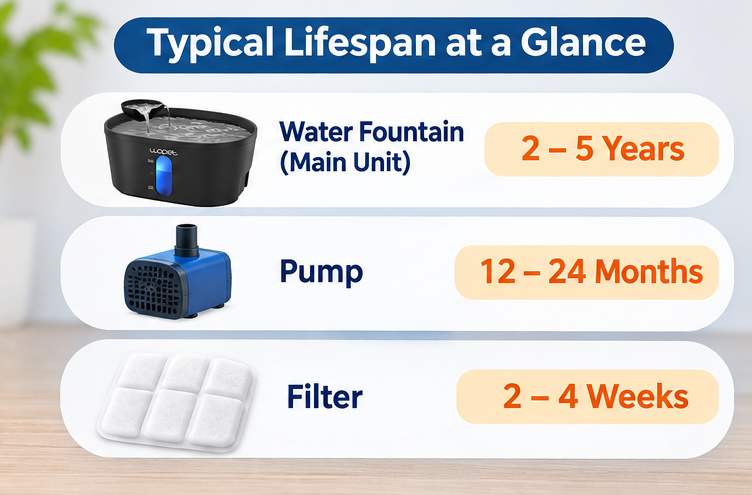
Not every component needs replacing at the same time.
Understanding the difference between consumable parts and durable components can prevent unnecessary replacement costs.
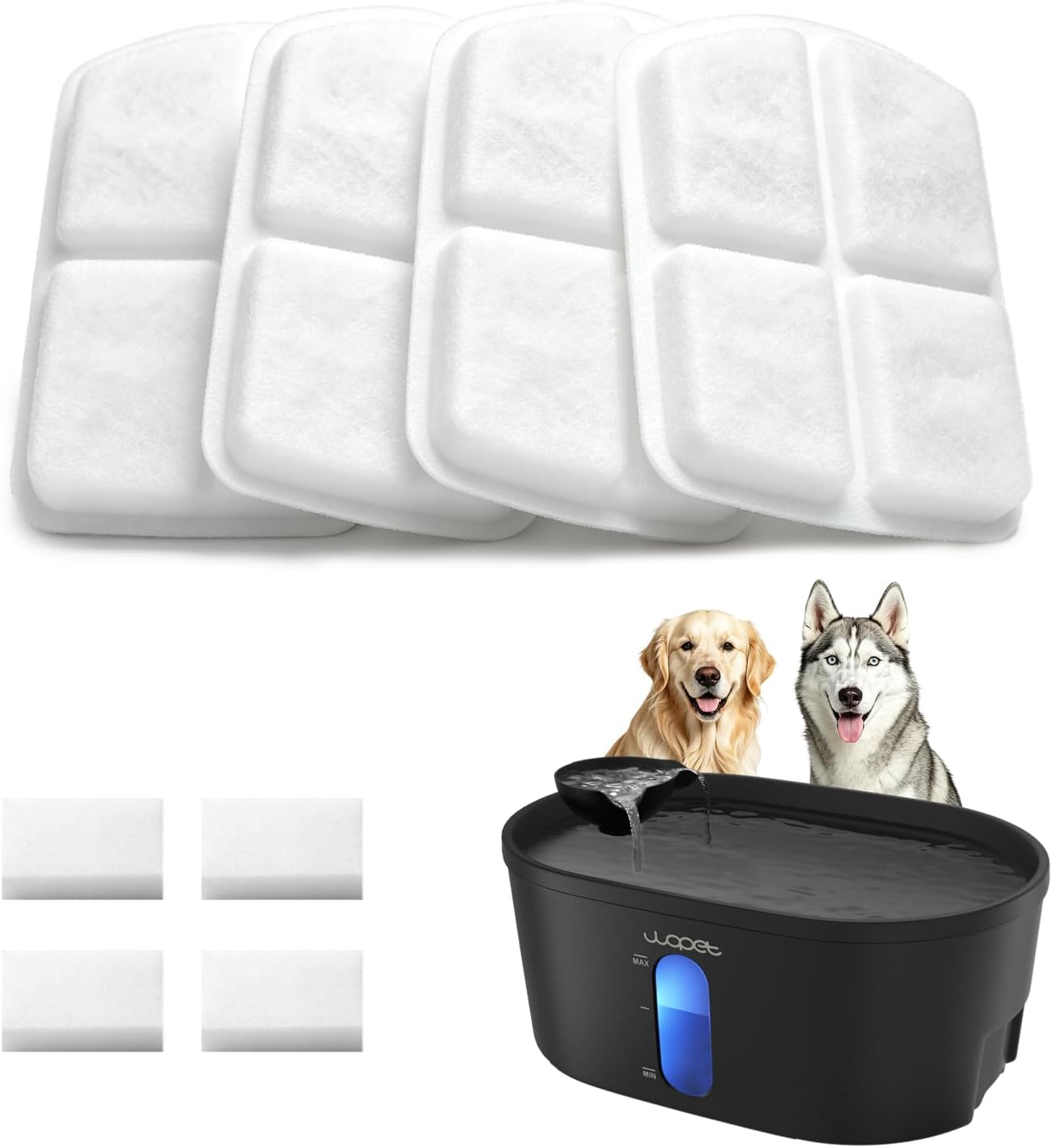
Filters are consumable parts designed for regular replacement.
Depending on the fountain, they may contain activated carbon, foam, mesh, or other filtration media.
For example, WOPET recommends replacing W600 filters every two to four weeks, depending on the number of pets using the fountain.
Other models may have different schedules.
A dirty filter can restrict water flow, but replacing it does not automatically fix every circulation problem.
Pumps and water-moving components are more durable than disposable filters, but they can eventually fail.
Potential causes include:
Debris obstructing moving parts.
Mineral buildup.
Operation below the recommended water level.
Wear in mechanical components.
Electrical faults.
Some fountains use conventional impeller pumps, while others use different circulation designs.
Always follow the maintenance instructions for your exact model.
Rechargeable batteries gradually lose capacity with age and charging cycles.
You may notice that a fountain runs for less time between charges than it did when new.
This does not necessarily mean the reservoir or circulation system is damaged.
Check whether the battery is serviceable or replaceable through the manufacturer.
Do not attempt to open a sealed battery compartment or replace internal cells unless the manufacturer specifically authorizes the procedure.
Damaged cables and adapters should not be repaired with tape or improvised connections.
Stop using the fountain if you notice:
Exposed wiring.
Damaged insulation.
Burn marks.
Unusual overheating.
Intermittent power caused by a damaged connection.
Use compatible replacement components approved by the manufacturer.
A fountain's pump or circulation system is one of its most important components.
Unfortunately, there is no reliable universal lifespan measured in months or years.
Pump durability depends on design, manufacturing quality, water conditions, operating time, and maintenance.
A pump that stops circulating water may not be permanently damaged.
Sometimes, the problem is simply a clogged intake, dirty impeller, low water level, or incorrectly assembled component.
Common warning signs include:
Water stops circulating.
Flow becomes noticeably weaker.
The fountain makes a new rattling or grinding sound.
Circulation starts and stops unexpectedly.
The system fails to restart after cleaning and reassembly.
Before replacing the pump:
Turn off the fountain and disconnect it from power.
Confirm that the water level is within the recommended range.
Inspect the filter for debris.
Check accessible water channels for blockages.
Clean pump components only as permitted by the manual.
Reassemble everything correctly.
Test the fountain using the manufacturer's instructions.
If the fountain still fails, contact the manufacturer about replacement parts or warranty support.
Important: Never open sealed electrical components or operate damaged equipment while troubleshooting.
A consistent maintenance routine is one of the most practical ways to protect your investment.
Check the reservoir daily.
Do not allow the fountain to operate below the minimum water level specified by the manufacturer.
Even models with automatic low-water protection should be monitored.
Refresh the water regularly and remove visible debris.
Thoroughly clean the fountain according to its manual.
Clean sooner if you notice slime, cloudiness, odor, or heavy debris.
Multi-pet households may need more frequent maintenance.
A clogged filter can reduce circulation performance.
Use compatible filters and follow the recommended replacement interval.
Do not attempt to extend a disposable filter's lifespan indefinitely.
When cleaning the fountain, check accessible water-moving components for debris or mineral buildup.
Only disassemble parts the manufacturer identifies as user-serviceable.
If you live in an area with hard water, inspect the reservoir and water channels for deposits.
Use only manufacturer-approved cleaning methods.
Do not soak electrical or battery components in cleaning solutions.
Keep adapters, charging ports, and electrical connections dry.
Route cords away from areas where dogs may chew them or people may trip.
Avoid placing the fountain where splashing can reach a power strip.
A worn seal, cracked tray, or damaged power cable can cause larger problems if ignored.
Replacing an appropriate user-serviceable component may prevent the need to replace the entire fountain.
Some problems can be fixed through cleaning or replacing parts.
Others indicate that continued use may be unsafe.
Check whether the reservoir, tray, or seals are damaged or incorrectly assembled.
If a structural crack causes persistent leaking, replacing the damaged component or fountain may be necessary.
Cracked plastic or chipped ceramic may be difficult to clean properly.
Sharp edges can also create an injury risk.
Stop using damaged drinking components.
If cleaning, correct assembly, and approved troubleshooting do not restore normal operation, the circulation system may need replacement.
Stop using the fountain immediately if you notice burning smells, sparking, damaged cables, or abnormal overheating.
Do not continue testing a fountain with suspected electrical damage.
If a component has deep damage or inaccessible areas that cannot be cleaned adequately, replacement may be the safer option.
A rechargeable fountain that no longer provides reliable runtime may need battery service or replacement.
Check the manufacturer's available repair options.
A malfunctioning fountain does not always need to be thrown away.
Before buying a replacement, identify the problem and determine whether a compatible part is available.
| Problem | First Action | Repair or Replace? |
|---|---|---|
| Weak water flow | Check water level, filter, and channels | Usually troubleshoot first |
| Loud circulation noise | Inspect for debris, low water, or vibration | Often repairable |
| Dirty or clogged filter | Install a compatible replacement filter | Replace filter |
| Failed pump | Follow approved troubleshooting | Replace pump if supported |
| Worn seal | Check for compatible replacement | Replace seal if available |
| Cracked reservoir | Stop using damaged component | Replace component or fountain |
| Damaged power cable | Disconnect immediately | Replace approved cable or adapter |
| Burning smell or sparking | Stop use immediately | Seek manufacturer support; do not operate |
| Short battery runtime | Check charging and operating mode | Seek approved battery service or replacement |
Repair is often worth considering when:
The reservoir and housing remain in good condition.
The issue involves a replaceable filter or pump.
Compatible parts are available.
The repair is straightforward and manufacturer-approved.
The repair cost is substantially lower than replacing the fountain.
Replacing the complete fountain may be more practical when:
Structural damage affects the reservoir.
Electrical safety is compromised.
Replacement parts are unavailable.
Multiple components have failed.
Repair costs approach the price of a replacement fountain.
Consider both cost and safety before deciding.
Different WOPET fountains have different power designs and capacities, so their maintenance priorities are not identical.
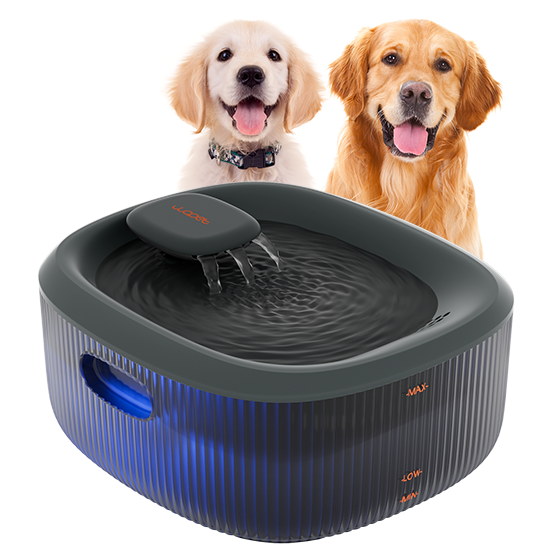
The WOPET W600 is a 6L corded basin-style dog water fountain.
For this type of fountain, pay particular attention to:
Maintaining the recommended water level.
Keeping the filter clean and replacing it on schedule.
Checking the circulation system for debris.
Inspecting the power cable and adapter.
Cleaning the reservoir and drinking tray.
If water stops flowing, check the filter, water level, and approved pump-cleaning procedures before assuming the entire fountain has failed.
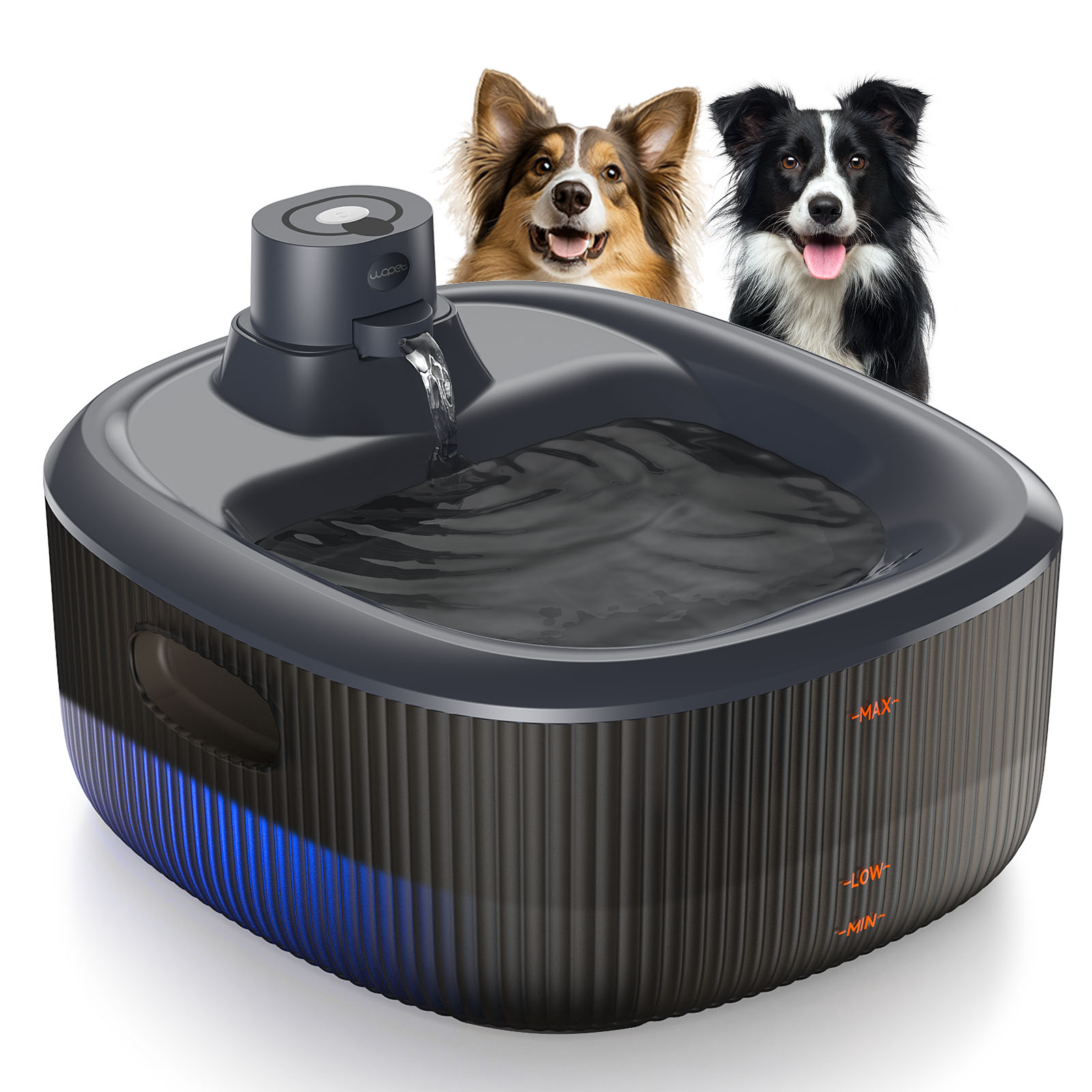
The WOPET W600 Pro is a rechargeable 6L fountain.
Along with regular cleaning and filtration maintenance, monitor its charging performance.
Helpful habits include:
Using the recommended charging equipment.
Keeping charging connections dry.
Monitoring changes in battery runtime.
Following storage instructions when the fountain will not be used for an extended period.
Avoiding unauthorized battery disassembly.
A shorter runtime does not necessarily mean the entire fountain needs replacement.

The WOPET A08 is an 8L fountain designed for dogs and multi-cat households.
Its larger capacity can be convenient, but the reservoir still requires regular attention.
In multi-pet homes:
Check the water level daily.
Remove visible hair and debris.
Inspect filters more frequently when necessary.
Clean the reservoir and drinking area thoroughly.
Monitor water flow for signs of blockage.
| Model | Capacity | Main Maintenance Priority |
|---|---|---|
| WOPET W600 | 6L | Pump, filters, water level, power cable |
| WOPET W600 Pro | 6L | Filters, circulation, battery and charging |
| WOPET A08 | 8L | Filters, water channels, multi-pet cleaning |
Always use the current instructions for your exact model.
A practical routine can help you detect problems before they become serious.
| Frequency | Recommended Action |
|---|---|
| Daily | Check water level, water quality, and normal circulation |
| As needed | Refresh water and remove visible debris |
| Weekly | Inspect and clean water-contact surfaces as needed |
| Every 2–4 weeks | Replace filters if specified by your model |
| According to manual | Thoroughly clean circulation components |
| Periodically | Inspect seals, cables, housing, and battery performance |
This schedule is a general checklist, not a replacement for model-specific instructions.
Some fountains may remain functional for five years or longer, but that is not a guaranteed or universal lifespan.
Actual durability depends on the model, materials, maintenance, and replacement of worn components.
There is no fixed replacement interval.
Replace the fountain when it becomes unsafe, cannot be cleaned adequately, or can no longer operate reliably and economically.
Yes.
Pumps and other circulation components can wear out over time.
However, weak flow or noise may also result from debris, mineral deposits, or insufficient water.
Some fountains are designed for continuous operation, while others use intermittent circulation modes.
Follow the manufacturer's operating instructions and maintain the recommended water level.
Hard water can cause mineral buildup that interferes with circulation components.
Regular inspection and approved cleaning can help reduce this problem.
Battery longevity varies with battery chemistry, charging cycles, operating conditions, and storage.
Rechargeable batteries gradually lose capacity over time.
Check the manufacturer's specifications and service options for your model.
Follow the manufacturer's instructions.
For example, WOPET recommends changing W600 filters every two to four weeks, depending on the number of pets.
Other fountains may have different requirements.
Often, yes, when the pump is replaceable, the reservoir remains in good condition, and a compatible replacement is available.
Compare the replacement cost with the cost of a new fountain.
You may be able to extend its useful life by maintaining the correct water level, cleaning regularly, replacing filters, preventing mineral buildup, and addressing component problems early.
A dog water fountain can provide years of useful service, but its lifespan depends on how it is built, operated, and maintained.
Filters require regular replacement, pumps may eventually wear out, and rechargeable batteries gradually lose capacity.
That does not mean every component failure requires replacing the entire fountain.
In many cases, cleaning or replacing a compatible part can restore normal operation.
For WOPET owners, the W600, W600 Pro, and A08 each have maintenance needs related to their circulation systems, capacity, and power design.
The best way to get long-term value from your fountain is to follow the manufacturer's instructions, inspect it regularly, and replace damaged components promptly.
A well-maintained fountain should provide dependable access to drinking water while remaining safe and convenient for everyday use.
Explore the WOPET pet water fountain collection to compare models, replacement filters, and available accessories.
Read more:
Label:
Popular Post

The Ultimate Guide to Tabby Cats: Patterns, Personalities, and More
Mar 27, 2025

Top 8 Reasons Why Does My Cat Sleep Between My Legs?
Mar 03, 2025

What to Do If My Dog's Poop Is Black But Not Tarry
Feb 04, 2023

Superfecundation Cats: When Kittens in One Litter Have Different Fathers
Jul 11, 2025
How Long Does Dry Cat Food Last Once Opened? A Comprehensive Guide
Mar 19, 2025
[Blue] W03L 3L Premium Ceramic Cat Water Fountain
Model: W03 LITE
$59.99
$69.99

Basin Pet Water Fountain-W600
Model: W600
$43.99
$69.99
[Basic] Ceramic Pet Water Fountain with Power Cable
Model: W03L
$59.99
$99.00
[Black] W03L 3L Premium Ceramic Cat Water Fountain
Model: W03L Black
$59.99
$69.99

WOPET 8L Pet Water Fountain For Multiple Cats or Large Dogs A08
Model: A08
$49.99
$59.99
WOPET A08 Dog Water Fountain Filters
Model: A08 Filter
$19.99
$29.99

DOWNLOAD APP

WOpet life




Copyright © 2026 WOPET. All Rights Reserved.