Nov 04, 2026
Author:Lisa Martinez
A dog water fountain helps keep water circulating throughout the day, but what happens when the water suddenly stops flowing, the fountain starts making unusual noises, or the pump refuses to turn on?
Your first thought might be that the pump needs replacing.
However, not every water fountain problem means the pump has failed. A clogged filter, low water level, mineral buildup, or incorrectly assembled component can produce symptoms similar to a damaged pump.
So, when should you replace a dog water fountain pump?
You should consider replacing the pump when it remains unreliable after proper cleaning, water-level checks, and manufacturer-approved troubleshooting—or when the pump has physical or electrical damage that makes continued use unsafe.
In this guide, we'll explain seven warning signs of a failing dog water fountain pump, how to distinguish a blockage from a genuine malfunction, and when repairing or replacing the pump makes the most sense.
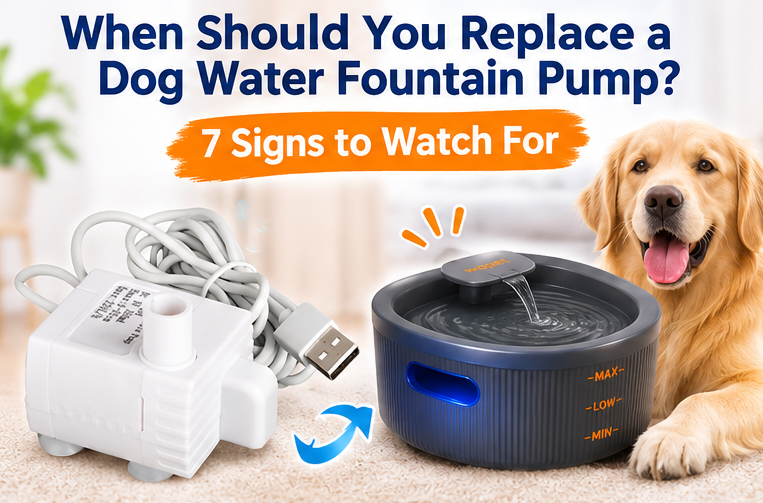
A dog water fountain pump doesn't need to be replaced simply because it has been used for a certain number of months.
Instead, replacement should depend on its condition and performance.
You may need a replacement pump if:
Water no longer circulates despite correct setup and adequate water levels.
Flow remains weak after cleaning and replacing a clogged filter.
Unusual grinding or rattling continues after approved maintenance.
The pump repeatedly stops without an identifiable external cause.
The pump fails to restart after troubleshooting.
The pump housing or electrical connections are damaged.
The same malfunction keeps returning despite proper cleaning and maintenance.
Some fountains use conventional impeller pumps, while others use different circulation mechanisms. The correct troubleshooting procedure depends on the model.
Before purchasing replacement parts, always check the manufacturer's instructions.
There is no universal lifespan for dog water fountain pumps.
A well-maintained pump may operate for years, but actual durability depends on its construction, operating conditions, water quality, and maintenance.
Several factors can affect pump longevity.
Hard water can leave mineral deposits inside water channels and around pump components.
In conventional impeller pumps, these deposits may interfere with moving parts.
Pet hair, food particles, and debris can accumulate around water intakes.
Regular cleaning helps prevent blockages and supports reliable circulation.
Some pumps depend on sufficient water for cooling and proper operation.
Running a fountain below its recommended water level may cause overheating or premature wear.
Continuous operation may create different wear patterns from intermittent operation.
However, a fountain designed for continuous use should not be assumed to have a short pump lifespan simply because it runs all day.
Pump materials, sealing, electrical protection, and construction quality all influence durability.
A fountain shared by several dogs may collect more hair and debris than one used by a single pet.
This can increase cleaning requirements.
The key takeaway: Pump replacement should be based on persistent faults or damage, not an arbitrary replacement date.
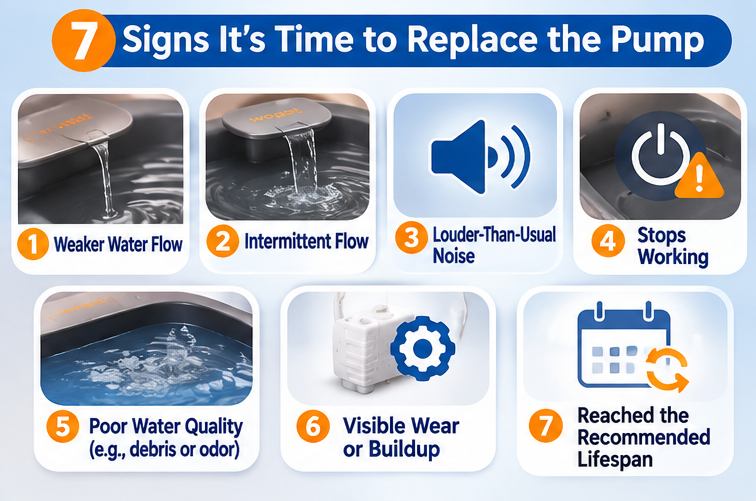
The following warning signs can help you determine whether a pump needs attention.
Some indicate a potentially serious problem, while others can often be resolved through cleaning or maintenance.
One of the most obvious signs of a problem is when water stops circulating.
Possible causes include:
Insufficient water in the reservoir.
A clogged filter.
Debris blocking the water intake.
Incorrect component assembly.
A disconnected power supply.
A circulation-system malfunction.
What to do:
First, turn off and disconnect the fountain.
Check the water level and inspect the filter and accessible water channels.
Clean and reassemble the fountain according to the manufacturer's instructions.
If the pump still fails to circulate water after approved troubleshooting, replacement may be necessary.
A fountain that previously produced a steady flow may gradually begin circulating less water.
This can happen when debris or mineral deposits restrict the water path.
A dirty filter can also reduce circulation.
What to do:
Check whether the filter needs replacing.
Inspect accessible water passages and clean approved pump components.
If the flow remains weak despite correct maintenance, the circulation system may be worn or damaged.
However, weak flow alone does not prove that the pump has failed.
A dog water fountain should not suddenly begin making harsh grinding or rattling sounds.
Possible causes include:
Debris caught in moving components.
Low water levels.
Loose or incorrectly assembled parts.
Vibration against the reservoir.
Mechanical wear.
What to do:
Disconnect the fountain before inspection.
Confirm the correct water level and assembly.
Remove accessible debris and clean the pump only as permitted by the manual.
If the sound continues, stop using the fountain and contact the manufacturer.
Persistent mechanical noise may indicate a component that needs replacing.
Intermittent circulation can be normal on fountains with timed or sensor-controlled modes.
However, unexpected shutdowns may indicate a problem.
Possible causes include:
Low-water protection.
A loose electrical connection.
Battery depletion in rechargeable models.
A malfunctioning sensor.
An internal circulation-system fault.
What to do:
First, verify the selected operating mode.
Check the water level and power supply.
For rechargeable fountains, check battery status and charging instructions.
If unexpected shutdowns continue after these checks, seek manufacturer support.
Sometimes a fountain stops working immediately after cleaning.
This does not necessarily mean the pump is broken.
A component may have been installed incorrectly, or an electrical connector may not be properly seated.
What to do:
Check the assembly instructions.
Confirm that all user-serviceable components are correctly positioned.
Inspect accessible connectors only when the fountain is disconnected from power.
If the pump still won't restart after approved troubleshooting, a replacement may be appropriate.
Never bypass safety mechanisms or open sealed electrical components.
Visible damage is one of the clearest reasons to stop using a pump.
Examples include:
Cracked housing.
Exposed electrical wires.
Damaged insulation.
Broken connectors.
Burn marks.
Melted or deformed components.
What to do:
Stop using the fountain immediately.
Do not attempt to repair electrical damage with tape, glue, or improvised parts.
Contact the manufacturer about an approved replacement pump or service option.
A pump that repeatedly fails despite cleaning and correct operation may be reaching the end of its useful life.
For example, you may notice that:
Water flow repeatedly weakens.
The pump stops every few days.
Noise returns shortly after cleaning.
The circulation system requires frequent restarting.
What to do:
Confirm that the problem is not caused by recurring debris, mineral buildup, or incorrect maintenance.
If the pump continues to malfunction after those causes have been addressed, replacement may be more practical than repeated troubleshooting.
A blocked pump and a failed pump can produce similar symptoms.
The distinction matters because a blockage may be resolved without purchasing replacement parts.
A blockage may be more likely when:
Water flow decreases gradually.
Visible debris collects near the intake.
The filter appears dirty.
Flow improves after cleaning.
Mineral deposits are visible around accessible water channels.
A genuine pump malfunction may be more likely when:
The pump does not operate after correct setup.
Flow remains absent after approved cleaning.
Mechanical noise persists.
Electrical components show damage.
The pump repeatedly stops despite adequate water and power.
| Symptom | Possible Blockage | Possible Pump Failure |
|---|---|---|
| Weak water flow | Common | Possible |
| Visible hair or debris | Common | May coexist |
| Flow improves after cleaning | Likely | Less likely |
| Persistent grinding | Possible | Possible |
| No circulation after troubleshooting | Less likely | More likely |
| Cracked pump housing | Not a blockage | Replacement or service needed |
| Burning smell | Not a blockage | Stop use immediately |
This table is a guide, not a definitive diagnostic test.
Before replacing the pump, follow a safe, step-by-step troubleshooting process.
Always disconnect the fountain from electrical power before cleaning or inspection.
For rechargeable models, follow the manufacturer's instructions for switching the device off.
Never handle electrical connectors with wet hands.
Confirm that the reservoir contains enough water for normal operation.
If the water is below the recommended minimum level, refill it.
Some fountains include low-water protection that stops circulation automatically.
A dirty or incorrectly installed filter can restrict water flow.
Check whether the filter needs cleaning or replacement according to the manufacturer's instructions.
Do not assume disposable filters can be reused indefinitely.
Look for hair, food particles, or other debris around the water intake and outlet.
Remove visible blockages using the approved cleaning procedure.
If your fountain uses a removable impeller pump, the manufacturer may provide instructions for cleaning its accessible components.
Only remove parts specifically identified as user-serviceable.
Do not open sealed motor housings or battery compartments.
Check that the reservoir, filter, water channels, and circulation components are installed properly.
Incorrect assembly can prevent normal water flow.
Restore power and test the fountain according to the manufacturer's instructions.
Observe whether:
Water circulates normally.
Noise has returned to normal.
The fountain remains operating.
Error indicators appear.
If the problem persists, contact the manufacturer before purchasing replacement parts.
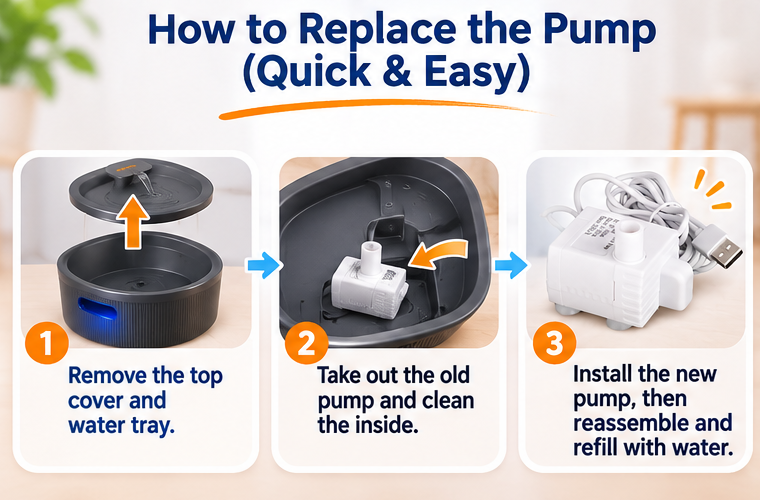
Some pump-related problems can be resolved through routine maintenance.
Others require replacement.
Examples include:
Debris blocking an intake.
Mineral deposits on accessible components.
A dirty filter.
Incorrect assembly.
Low water level.
A loose external connection.
These issues may not require a new pump.
Replacement may be necessary when:
The pump motor has failed.
Internal components are damaged.
The housing is cracked.
Electrical connections are unsafe.
The circulation system remains unreliable after troubleshooting.
Whether a pump can be repaired depends on its design.
Many compact fountain pumps are not intended for internal motor repair by consumers.
| Problem | Recommended Action |
|---|---|
| Clogged filter | Replace the filter |
| Low water level | Refill the reservoir |
| Debris in water intake | Clean according to manual |
| Mineral buildup | Use approved cleaning method |
| Incorrect assembly | Reassemble correctly |
| Damaged adapter | Stop use and obtain an approved replacement |
| Failed circulation component | Check replacement-part availability |
| Cracked or electrically damaged pump | Stop use and seek replacement or service |
Replacement costs vary by brand, pump design, and availability.
Some fountains use relatively simple removable pumps.
Others have integrated circulation systems that may require manufacturer service or replacement of a larger assembly.
The total cost may include:
Replacement pump or circulation module.
Shipping.
Applicable taxes.
Service charges, if professional repair is required.
Often, replacing a compatible pump can be more economical than replacing an entire fountain.
However, this depends on the cost and condition of the remaining components.
Consider these questions:
Is the reservoir still in good condition?
Are compatible replacement pumps available?
Is the pump user-replaceable?
Is the fountain still under warranty?
Are other components also damaged?
How much would a replacement fountain cost?
If the fountain is otherwise functional and the pump is inexpensive to replace, repairing it may make sense.
If the reservoir is cracked or several components have failed, a complete replacement may be more practical.
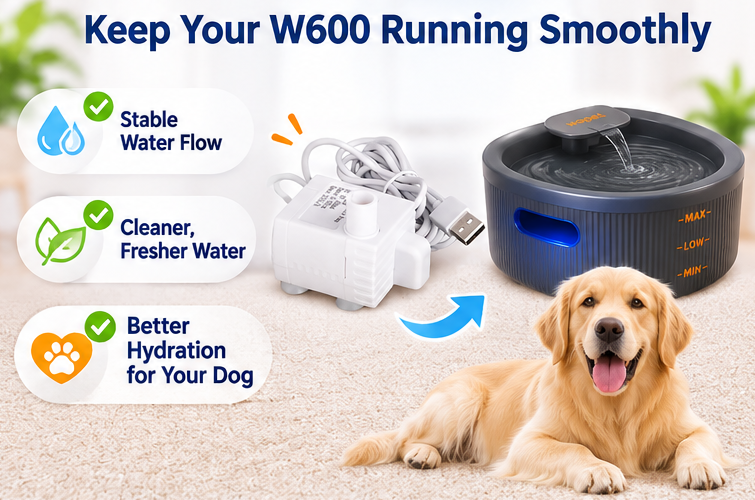
Different WOPET fountains have different power arrangements and circulation designs.
Owners should follow the instructions for their exact model rather than assuming all fountains use identical pumps.
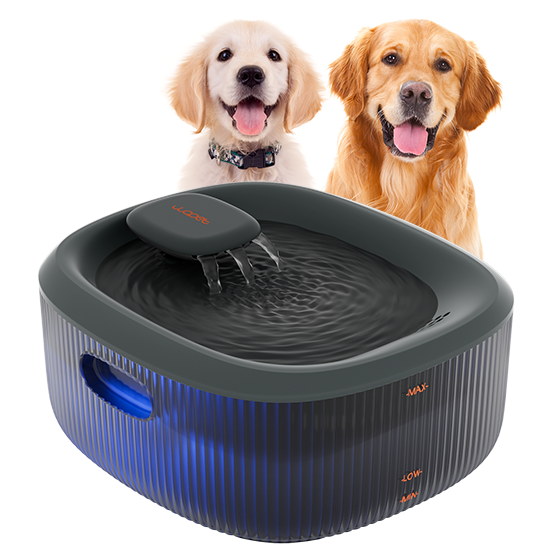
The WOPET W600 is a 6L corded dog water fountain.
For this type of fountain, important maintenance tasks include:
Maintaining the recommended water level.
Replacing filters on schedule.
Cleaning accessible circulation components.
Checking for hair and debris.
Inspecting the power cable and adapter.
If water stops flowing, begin with water-level and filter checks before assuming the pump needs replacing.
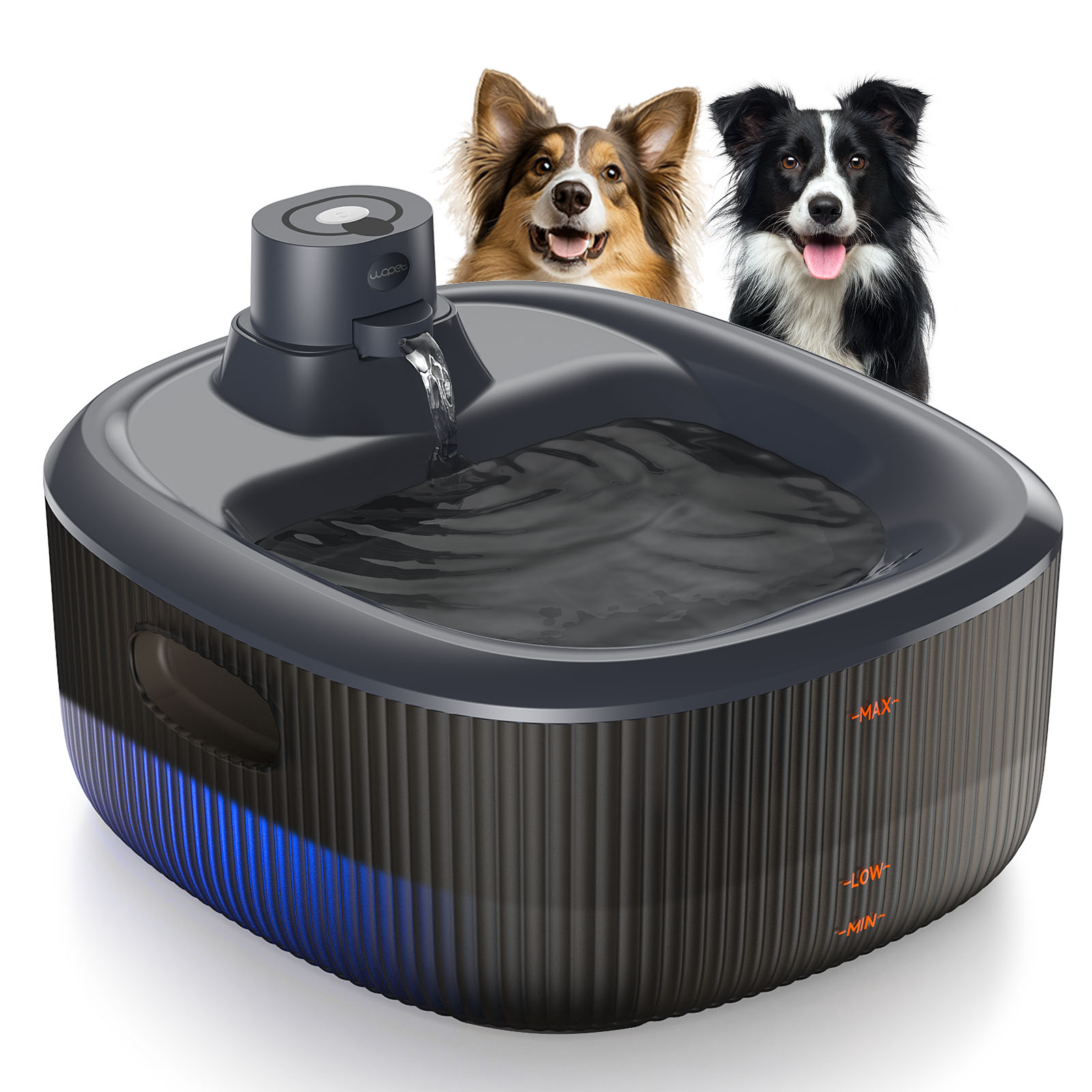
The WOPET W600 Pro is a 6L rechargeable dog water fountain.
Because it uses a rechargeable power system, owners should also check battery and operating-mode settings when circulation stops.
For example, a fountain operating in induction mode may not circulate water continuously.
Before assuming the circulation system has failed:
Confirm the selected operating mode.
Check battery status.
Verify that the fountain is charged.
Check water level and filter condition.
Follow the manufacturer's troubleshooting instructions.
Unexpected shutdowns are not always pump failures.
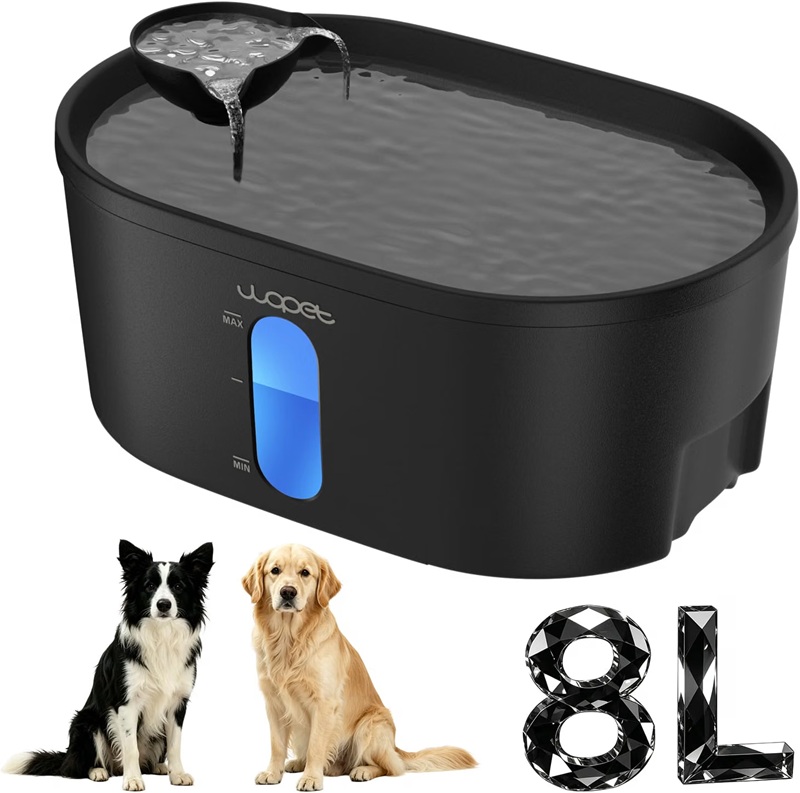
The WOPET A08 is an 8L fountain designed for dogs and multi-cat households.
In homes with several pets, water may collect hair, saliva, and food debris more quickly.
To support reliable circulation:
Check the drinking area daily.
Remove visible debris.
Clean the reservoir regularly.
Replace filters according to the manual.
Inspect accessible water channels for obstructions.
A larger reservoir does not eliminate the need for cleaning.
| Model | Capacity | Main Troubleshooting Consideration |
|---|---|---|
| WOPET W600 | 6L | Water level, filters, circulation, power supply |
| WOPET W600 Pro | 6L | Battery status, operating mode, filters, circulation |
| WOPET A08 | 8L | Debris, filtration, water channels, multi-pet maintenance |
Before ordering a replacement pump, confirm that the part is compatible with the exact fountain model.
Regular maintenance can help prevent avoidable circulation problems.
Check the water level every day.
Do not allow the fountain to operate below its minimum recommended level.
Remove hair, food particles, and visible debris.
Clean the reservoir and accessible circulation components according to the manufacturer's instructions.
A dirty filter may restrict water flow.
Follow the recommended replacement interval for your specific fountain.
Inspect the water channels and accessible pump components for mineral deposits.
Use manufacturer-approved cleaning methods.
Use compatible adapters and charging accessories.
Incorrect electrical equipment can damage the fountain or create safety risks.
Do not open sealed electrical components or remove parts that are not intended for user maintenance.
If the fountain develops weak flow, abnormal noise, or intermittent operation, investigate promptly.
Continuing to operate a malfunctioning fountain may cause further damage.
Sometimes replacing the pump is not enough.
Consider replacing the entire fountain when:
The reservoir is cracked or leaking.
Multiple electrical components are damaged.
Replacement parts are unavailable.
The fountain cannot be cleaned adequately.
Repair costs approach the price of a new fountain.
The manufacturer advises against further use.
A fountain should provide reliable access to drinking water without creating unnecessary electrical or hygiene risks.
If the fountain is out of service, provide your dog with a clean water bowl or another suitable drinking station.
There is no fixed replacement interval.
Replace the pump when it is damaged or no longer functions reliably after approved troubleshooting.
Possible signs include persistent loss of water flow, unusual mechanical noise, repeated shutdowns, or failure to restart after cleaning.
However, these symptoms can also have other causes.
Common causes include low water levels, clogged filters, debris, incorrect assembly, power problems, and circulation-system faults.
A severely restricted water path may interfere with normal circulation, depending on the pump design.
Replace filters according to the manufacturer's instructions and address flow problems promptly.
Often, yes.
If debris or mineral buildup is causing the problem, approved cleaning may restore normal operation.
A slight operating sound may be normal.
However, new grinding, rattling, or unusually loud noise should be investigated.
Stop using the fountain if you suspect mechanical or electrical damage.
Only if the manufacturer identifies the pump as user-replaceable and provides appropriate instructions.
Do not open sealed electrical components.
No.
Pump dimensions, electrical ratings, connectors, and circulation designs vary.
Use a compatible replacement approved for your specific model.
If the fountain is otherwise in good condition and a compatible pump is available, replacing the pump may be more economical.
If multiple components are damaged or replacement parts are unavailable, buying a new fountain may make more sense.
A fountain designed for active circulation generally cannot provide its intended flowing-water function without a working circulation system.
If the pump fails, provide a separate clean water source until the issue is resolved.
A dog water fountain pump should not be replaced simply because it has reached a certain age.
Instead, look for persistent circulation problems, unusual noise, repeated shutdowns, or visible damage.
Before buying a replacement, check the water level, filter, accessible water channels, and power supply.
Many common problems can be resolved through cleaning or correct assembly.
However, a pump that remains unreliable after approved troubleshooting—or shows physical or electrical damage—may need replacement.
For WOPET owners, maintenance priorities vary by model. The W600, W600 Pro, and A08 each have different power and usage considerations.
The best approach is to follow the manufacturer's instructions, replace worn components when appropriate, and maintain a reliable source of fresh drinking water for your dog.
Explore WOPET pet water fountains to learn more about fountain designs, maintenance, and compatible accessories.
Read more:
Label:
Popular Post

The Ultimate Guide to Tabby Cats: Patterns, Personalities, and More
Mar 27, 2025

Top 8 Reasons Why Does My Cat Sleep Between My Legs?
Mar 03, 2025

What to Do If My Dog's Poop Is Black But Not Tarry
Feb 04, 2023

Superfecundation Cats: When Kittens in One Litter Have Different Fathers
Jul 11, 2025
How Long Does Dry Cat Food Last Once Opened? A Comprehensive Guide
Mar 19, 2025
[Blue] W03L 3L Premium Ceramic Cat Water Fountain
Model: W03 LITE
$59.99
$69.99

Basin Pet Water Fountain-W600
Model: W600
$43.99
$69.99
[Basic] Ceramic Pet Water Fountain with Power Cable
Model: W03L
$59.99
$99.00
[Black] W03L 3L Premium Ceramic Cat Water Fountain
Model: W03L Black
$59.99
$69.99

WOPET 8L Pet Water Fountain For Multiple Cats or Large Dogs A08
Model: A08
$49.99
$59.99
WOPET A08 Dog Water Fountain Filters
Model: A08 Filter
$19.99
$29.99

DOWNLOAD APP

WOpet life




Copyright © 2026 WOPET. All Rights Reserved.