Oct 28, 2026
Author:Lisa Martinez
Quick Answer: An automatic dog water fountain can be worth buying if you want a convenient way to provide circulating drinking water, reduce frequent refilling, and offer your dog an alternative to a traditional water bowl. However, it isn't essential for every dog. The right choice depends on your pet's drinking habits, your household, and your willingness to maintain the fountain.
Every dog owner knows the familiar routine: fill the water bowl, watch your dog take a drink, and discover a few hours later that the water contains fur, food crumbs, or dirt.
For busy pet parents, keeping drinking water fresh and accessible can feel like another daily chore.
That's where an automatic dog water fountain comes in.
These devices circulate water through a drinking area and often include filtration systems designed to capture debris. Some also offer rechargeable batteries, larger reservoirs, and convenient water-level indicators.
But is an automatic dog water fountain actually better than a regular bowl?
Let's explore the advantages, disadvantages, ongoing costs, and features that matter before you decide.
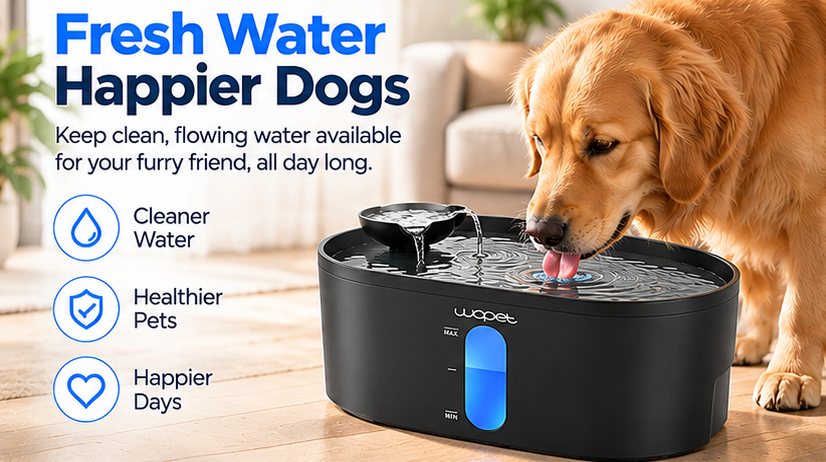
An automatic dog water fountain is a powered drinking system that moves water through a reservoir and drinking area.
Most models use a small electric pump to circulate water, while some include filters to capture hair, food particles, and other debris.
Unlike a traditional bowl, a fountain creates water movement through a stream, spout, or circulating basin.
Depending on the model, features may include:
Continuous or intermittent water circulation
Replaceable water filters
Large-capacity reservoirs
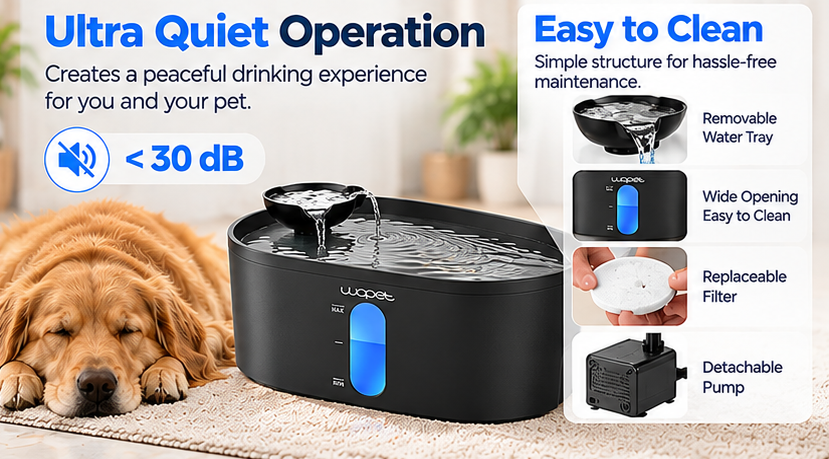
Quiet water pumps
Water-level indicators
Rechargeable or corded operation
Removable components for cleaning
Automatic fountains are available in different sizes, making them suitable for a range of dogs and household arrangements.
However, the word automatic doesn't mean the fountain cleans or refills itself. Owners still need to replace water, clean components, and maintain filters.
Some dogs are naturally curious about flowing water.
You may have noticed your dog trying to drink from a garden hose, a running faucet, or a stream during a walk.
A water fountain provides a similar moving-water experience at home.
However, not every dog prefers running water. Veterinary behavior experts note that there is insufficient evidence to conclude that dogs generally drink more from fountains.
The practical benefit is giving your dog another option, rather than guaranteeing increased water intake.
Traditional water bowls may collect loose fur, food particles, dust, and other debris.
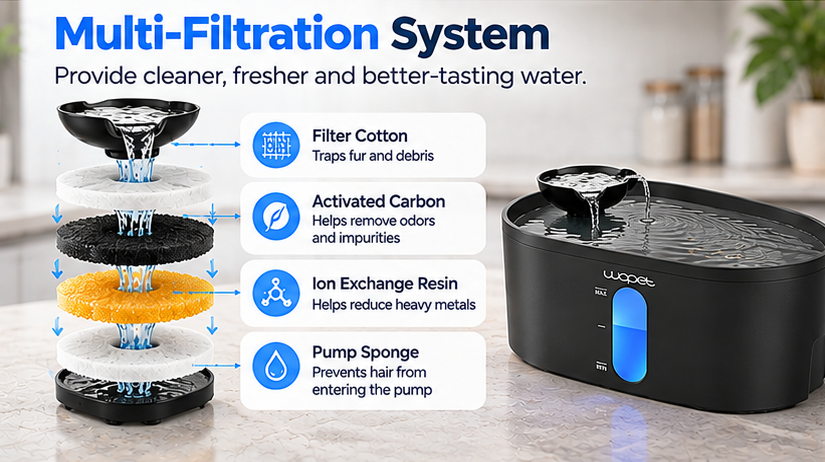
Many automatic fountains use filtration components to help capture some of these particles.
Depending on the filter design, materials may include mesh, filter cotton, and activated carbon.
Filtration can support water maintenance, but it does not sterilize water or replace regular cleaning.
Large dogs and multi-pet households can go through substantial amounts of drinking water.
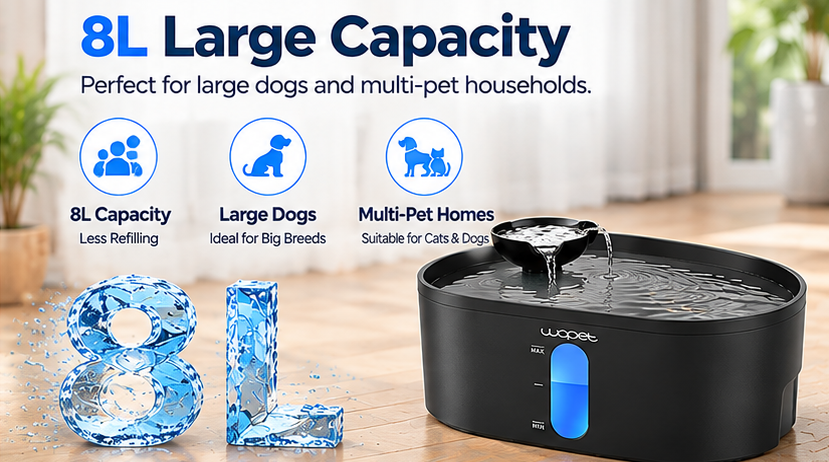
A fountain with a 6L or 8L reservoir provides more storage than many standard bowls.
For example, a household with two active dogs may appreciate the additional capacity during a busy day.
However, larger capacity should never be interpreted as permission to leave water unchanged for several days.
Some fountains include transparent windows or indicator lights to help owners check the reservoir.
This can be useful when the water tank is opaque or positioned in a corner.
Monitoring the water level also helps prevent a pump from operating without sufficient water.
Rechargeable dog water fountains can provide more flexibility when choosing a location.
A cordless design may allow you to place the fountain away from a permanent electrical outlet.
This can be helpful in living rooms, kitchens, or other suitable indoor locations.
Always check battery requirements, charging instructions, and the manufacturer's operating guidance.
Although automatic fountains offer useful features, they also have limitations.
A traditional water bowl is generally less expensive than a powered fountain.
Automatic models include pumps, filtration components, and sometimes rechargeable batteries, which increase manufacturing and purchase costs.
Some fountains require replacement filters every few weeks.
This creates an ongoing expense that should be considered before purchasing.
Water circulation does not prevent bacterial buildup.
Owners still need to clean the drinking basin, reservoir, and accessible water-moving components.
A fountain with too many difficult-to-reach parts can become inconvenient.
Corded fountains need electricity, while rechargeable models need battery charging.
If the system stops working, the fountain may no longer circulate water.
Always keep another clean drinking-water source available.
Some dogs may be cautious around the sound or movement of a fountain.
Gradual introductions and positive reinforcement can help, but a fountain may not suit every pet.
| Feature | Automatic Water Fountain | Traditional Bowl |
|---|---|---|
| Water movement | Circulating or intermittent | Still water |
| Filtration | Often included | Usually none |
| Power required | Usually yes | No |
| Capacity | Varies; often larger | Varies |
| Cleaning | Multiple components | Generally simpler |
| Ongoing costs | Filters, electricity or charging | Usually minimal |
| Placement | Depends on power design | Highly flexible |
| Best for | Owners wanting circulation and added features | Owners preferring simplicity |
Which is better?
Neither option is universally superior.
A traditional bowl may be sufficient for a dog that drinks comfortably and has consistent access to fresh water.
An automatic fountain may be worthwhile when you value circulation, filtration, larger capacity, or flexible placement.
The total cost of ownership includes more than the purchase price.
Consider four categories.
Initial purchase: The fountain itself.
Replacement filters: Costs depend on the model, filter price, and replacement frequency.
Electricity or charging: Most household fountains use relatively low-power pumps, but consumption depends on operating mode and specifications.
Replacement parts: Pumps, adapters, and other components may eventually require replacement.
Suppose a fountain uses a 1.5W pump operating continuously.
Its theoretical annual electricity use would be:
1.5 watts × 24 hours × 365 days ÷ 1,000 = 13.14 kWh per year.
At an illustrative electricity rate of $0.20 per kWh, that would equal approximately $2.63 per year for the pump alone.
Actual consumption and cost depend on the fountain, operating schedule, charging losses, and local electricity rates.
For many owners, replacement filters and cleaning convenience may be more important considerations than electricity expense.
Choose a reservoir that fits your dog's drinking habits and the number of pets in your home.
Large dogs and multi-pet households may benefit from a 6L or 8L fountain.
The basin should be wide enough for your dog to drink comfortably.
A large reservoir is less useful if the drinking area is too small.
Check which filter materials are included and how frequently they need replacement.
Consider pump vibration and water-flow noise, especially if your dog is sensitive to sound.
Look for removable components, accessible surfaces, and clear maintenance instructions.
Decide whether a corded or rechargeable fountain better suits your home.
Check whether compatible filters, pumps, and other parts are available.
WOPET offers different fountain designs for various household needs.
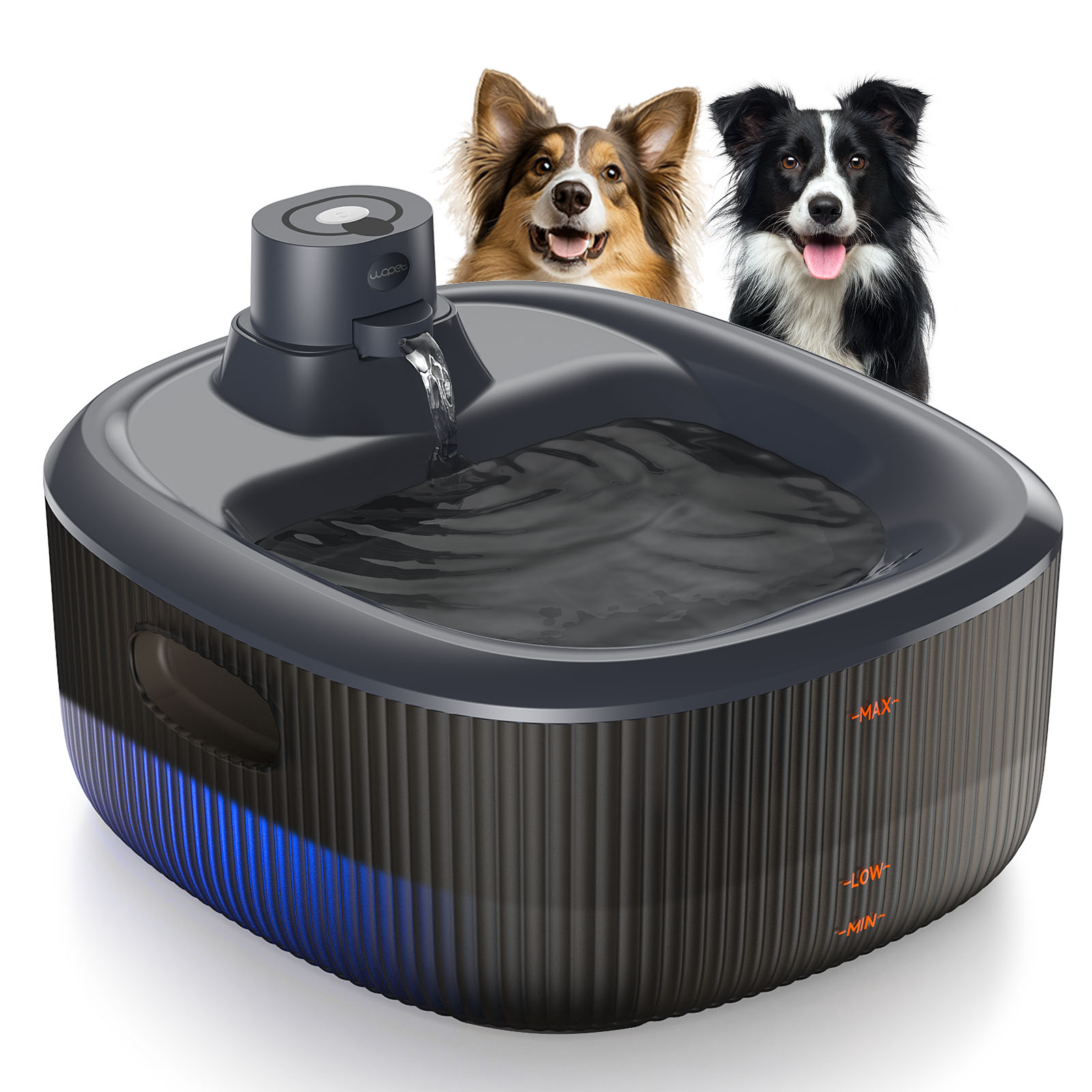
The WOPET W600 is a 6L basin-style dog water fountain designed for larger dogs.
Its broad drinking area provides space for comfortable lapping, while its water-level window makes monitoring easier.
According to WOPET's published specifications, the W600 uses a 1.5W pump and a corded power connection.
Best for: Owners seeking a permanent drinking station with a spacious basin.
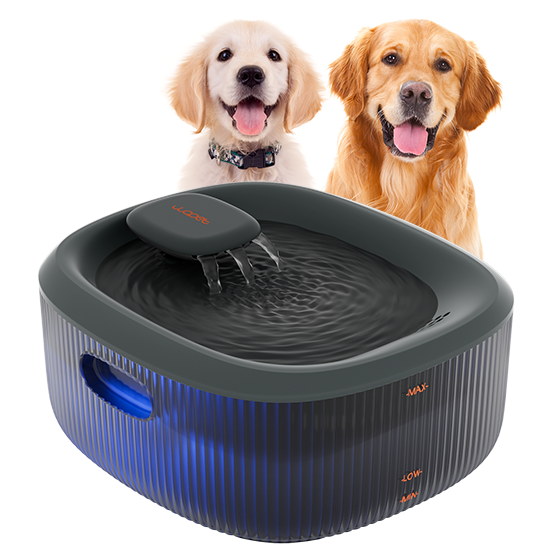
The WOPET W600 Pro offers a 6L reservoir with a built-in 5,000mAh rechargeable battery.
Its cordless design makes it an option for households that want more flexibility in where the fountain is placed.
Owners should review its charging requirements and operating modes before purchasing.
Best for: Owners prioritizing rechargeable operation and flexible placement.
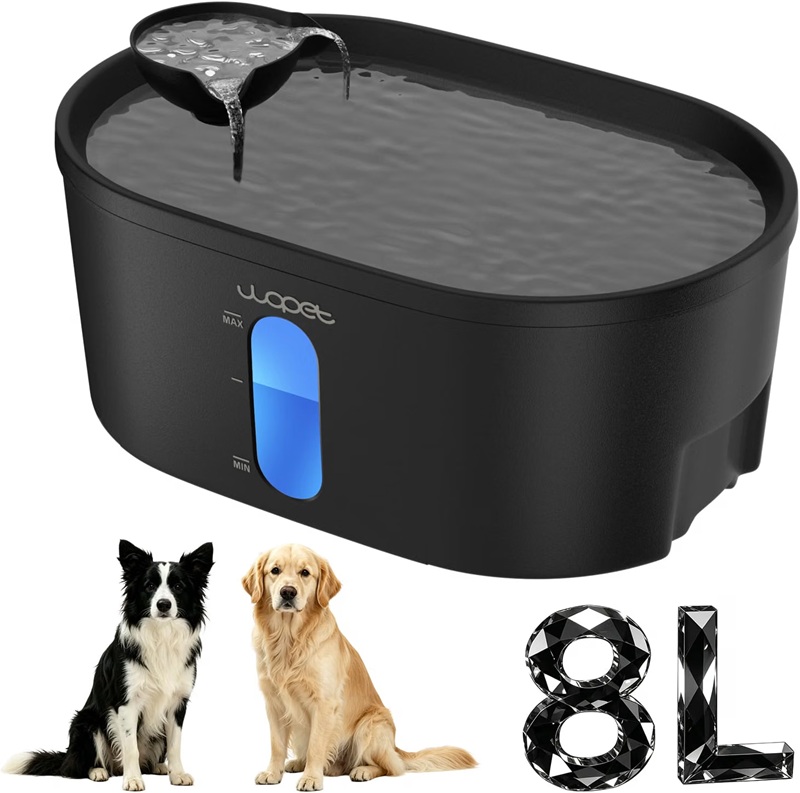
The WOPET A08 is an 8L pet water fountain positioned for large dogs and households with multiple pets.
Its larger reservoir can be useful when several animals share a drinking station.
Best for: Large dogs, multiple dogs, and busy multi-pet households.
| Model | Capacity | Main Advantage |
|---|---|---|
| WOPET W600 | 6L | Spacious everyday drinking basin |
| WOPET W600 Pro | 6L | Rechargeable cordless convenience |
| WOPET A08 | 8L | Larger reservoir for multiple pets |
These suggestions reflect product specifications and intended use, not independent comparative testing.
Some dogs will approach a fountain immediately. Others need time to become comfortable.
Start by placing the fountain in a quiet, familiar area.
Let your dog investigate it while it is turned off.
Next, activate the water flow and allow your dog to approach voluntarily.
Reward calm interest with praise or treats.
Avoid forcing your dog to drink from the fountain.
Keep their familiar water bowl available throughout the transition.
Check the water and drinking area every day.
Replace water regularly and clean visible debris or residue promptly.
For a full cleaning:
Turn off and disconnect the fountain.
Empty the reservoir.
Remove components according to the manual.
Wash approved water-contact surfaces.
Inspect the filter and accessible pump components.
Rinse thoroughly.
Reassemble, refill, and check operation.
WOPET recommends replacing W600 filters approximately every two to four weeks, depending on usage and the number of pets.
Follow the instructions for your specific model, and clean more frequently when necessary.
An automatic fountain may be particularly worthwhile when:
Your dog shows interest in moving water.
You have a large dog or multiple pets.
You want a larger drinking-water reservoir.
You value a filtration system for capturing debris.
You want a dedicated water station with additional features.
You prefer a rechargeable option for flexible placement.
It may be less worthwhile when:
Your dog strongly prefers a traditional bowl.
You want the simplest possible cleaning routine.
You do not want recurring filter expenses.
You have limited space for a powered device.
The decision should be based on practical needs rather than marketing claims.
They can be worthwhile for owners who value circulating water, filtration, larger capacity, or rechargeable convenience. A traditional bowl can also provide adequate drinking water when maintained properly.
Some dogs may prefer moving water, but there is insufficient evidence to say that fountains consistently increase water intake in dogs.
A properly designed fountain used according to the manufacturer's instructions can be suitable for everyday use. Follow electrical safety, cleaning, and maintenance guidance.
Some models are designed for continuous operation, while others use intermittent modes. Follow the manufacturer's instructions and maintain the required water level.
Many use low-power pumps. Actual electricity consumption depends on the rated power and operating schedule.
Yes, provided the fountain has appropriate capacity and accessibility. Additional water stations may be helpful when pets compete for access.
A wireless model offers more placement flexibility, while a corded model avoids the need to recharge a battery. The better option depends on your home.
For many pet owners, an automatic dog water fountain is a convenient upgrade to a traditional drinking bowl.
It can offer circulating water, filtration, larger reservoir capacity, and features that make everyday water monitoring easier.
However, a fountain is not a substitute for regular cleaning, fresh water, or attentive pet care.
If you want a practical everyday fountain, the WOPET W600 is worth considering.
If you prefer cordless placement, the W600 Pro offers a rechargeable alternative.
And if you need additional capacity for large dogs or multiple pets, the WOPET A08 provides an 8L option.
Ultimately, the best dog water fountain is the one your dog will comfortably use and that you can maintain consistently.
Explore WOPET Dog Water Fountains to compare models and find the right fit for your household.
Label:
Popular Post

The Ultimate Guide to Tabby Cats: Patterns, Personalities, and More
Mar 27, 2025

Top 10 Most Expensive Cat Breeds in The World
May 07, 2025

Can Cats Have Ice Cream? Dangers, Safe Flavors & Healthy Cat Treats
Sep 02, 2025

My Cat Only Eats A Little at A Time - What to Do?
Feb 27, 2023

Top 8 Reasons Why Does My Cat Sleep Between My Legs?
Mar 03, 2025
[Blue] W03L 3L Premium Ceramic Cat Water Fountain
Model: W03 LITE
$59.99
$69.99

Basin Pet Water Fountain-W600
Model: W600
$43.99
$69.99
[Basic] Ceramic Pet Water Fountain with Power Cable
Model: W03L
$59.99
$99.00
[Black] W03L 3L Premium Ceramic Cat Water Fountain
Model: W03L Black
$59.99
$69.99

WOPET 8L Pet Water Fountain For Multiple Cats or Large Dogs A08
Model: A08
$49.99
$59.99
WOPET A08 Dog Water Fountain Filters
Model: A08 Filter
$19.99
$29.99

DOWNLOAD APP

WOpet life




Copyright © 2026 WOPET. All Rights Reserved.