Nov 04, 2026
Author:Lisa Martinez
If you have both a cat and a dog at home, you've probably noticed them drinking from each other's water bowls. Your cat might take a few sips from the dog's bowl, while your dog may show interest in the cat water fountain.
This raises a common question: Can cats and dogs share a water fountain safely?
Yes, healthy cats and dogs can often share a water fountain, provided they are comfortable around each other, the fountain is cleaned regularly, and both pets have reliable access to fresh drinking water.
However, sharing isn't always the best arrangement.
Some cats prefer drinking away from dogs, while certain dogs may guard water bowls or create a mess when drinking. Hygiene, differences in body size, and individual health needs can also affect whether sharing is appropriate.
In this guide, we'll explain when a shared pet water fountain makes sense, when separate drinking stations are better, and how to choose a fountain that works for a multi-pet household.
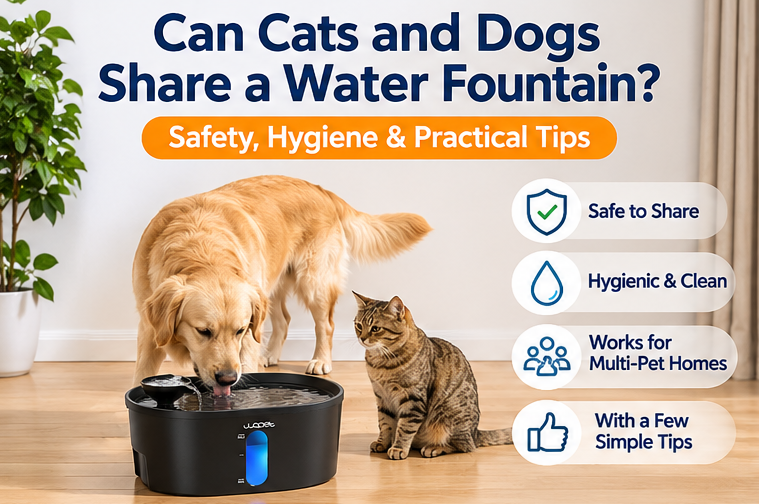
For many households, sharing a water fountain is a practical option.
Healthy cats and dogs living together may already use the same water sources without problems.
There is no general rule requiring every cat and dog to have a completely separate water bowl.
However, three conditions are important:
Both pets must have comfortable access. Neither animal should prevent the other from drinking.
The fountain must be kept clean. Shared water can accumulate saliva, hair, food particles, and other debris.
Additional water sources should remain available. A shared fountain should not be the only drinking option.
A cat that avoids the fountain because a dog frequently approaches it may drink less than usual.
Similarly, a small dog may have difficulty reaching water in a fountain designed for larger animals.
The best arrangement is one that accommodates each pet's needs rather than assuming they will naturally share.
A shared fountain can be maintained hygienically, but it requires consistent care.
Whenever a cat or dog drinks, saliva and small amounts of debris may enter the water.
In multi-pet households, these materials can accumulate more quickly because several animals use the same reservoir.
Pets may drink shortly after eating.
Small food particles can enter the fountain and collect around the drinking area or filtration system.
Remove visible debris promptly and refresh the water regularly.
Dogs and cats shed hair throughout the year, and some breeds shed heavily during seasonal changes.
Hair can collect in the reservoir or obstruct filters and water channels.
A suitable filtration system may help capture loose particles, but it does not eliminate the need for cleaning.
Biofilm is a layer of microorganisms that can develop on wet surfaces.
It may appear as a slippery coating inside the reservoir, on the drinking tray, or around water channels.
Circulating water does not prevent biofilm from forming.
Regular cleaning of water-contact surfaces is essential.
No.
Standard pet water fountain filters may capture particles and reduce certain odor- or taste-related compounds.
However, they should not be assumed to sterilize water or remove all disease-causing organisms.
A filter is a maintenance aid, not a replacement for fresh water and proper cleaning.
Some infectious organisms can potentially spread through contaminated water or shared drinking equipment.
However, not every illness affecting a cat or dog can be transmitted between species.
The actual risk depends on the organism, the animals' health, and the level of contamination.
Bacteria can enter drinking water through saliva, environmental contamination, or dirty surfaces.
Some bacteria may multiply when a fountain is not cleaned adequately.
Routine cleaning and fresh water help reduce contamination.
Certain intestinal parasites can affect both cats and dogs.
Transmission usually depends on the parasite's life cycle and exposure to infectious material, rather than simply sharing a clean water bowl.
For example, Giardia can spread through fecal contamination, including contaminated water, although not every Giardia type infects both species equally.
Many common respiratory infections in cats and dogs are species-specific or have different transmission patterns.
Sharing a fountain does not automatically mean a cat will catch a dog's respiratory illness or vice versa.
Nevertheless, if a pet has a suspected contagious illness, avoid shared drinking equipment until your veterinarian advises that normal contact can resume.
If your cat or dog has vomiting, diarrhea, oral infections, or another potentially contagious condition:
Provide separate drinking containers.
Clean and disinfect shared equipment according to veterinary and manufacturer guidance.
Monitor the other pets for symptoms.
Contact your veterinarian for advice.
Separate water stations are especially important when a veterinarian recommends isolation or individual monitoring.
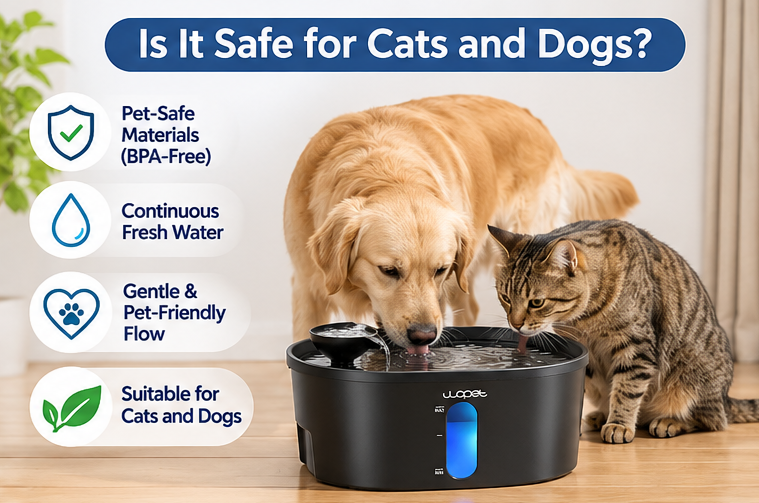
Even when sharing is medically reasonable, it may not be comfortable for every pet.
Watch for these five situations.
Some dogs or cats may stand near a fountain and prevent another animal from approaching.
Signs can include blocking access, staring, growling, hissing, or chasing.
If this happens, provide drinking stations in separate locations.
Do not force animals to share a resource they are competing over.
Cats often prefer drinking in quiet areas where they feel secure.
A cat may hesitate to approach a fountain in a busy location or one frequently occupied by a dog.
Providing a separate cat-friendly water station can help reduce competition.
Some conditions require careful monitoring of water intake.
If a veterinarian asks you to measure how much an individual pet drinks, a shared fountain makes accurate monitoring difficult.
Separate measured water containers may be more appropriate.
A large dog may prefer a wide basin, while a small cat may find a lower, shallower drinking surface more accessible.
A single fountain may not accommodate both equally well.
When a pet has a suspected infectious illness, separate drinking equipment may help reduce contamination and support individual care.
Follow your veterinarian's instructions.
| Household Situation | Recommended Setup |
|---|---|
| Healthy pets that share comfortably | Shared fountain plus backup water sources |
| Dog guards the fountain | Separate drinking locations |
| Cat avoids the dog's drinking area | Dedicated cat-friendly station |
| One pet has a suspected contagious illness | Separate equipment and veterinary guidance |
| Large dog and small cat | Multiple accessible drinking heights |
| Individual water intake must be measured | Separate, measurable water sources |
If you decide to use a shared fountain, choose one that suits both species.
The right model should provide enough capacity, comfortable access, reliable circulation, and easy cleaning.
A multi-pet household may use water faster than a single-pet home.
A larger reservoir can reduce the frequency of refilling.
However, the correct capacity depends on the number and size of pets.
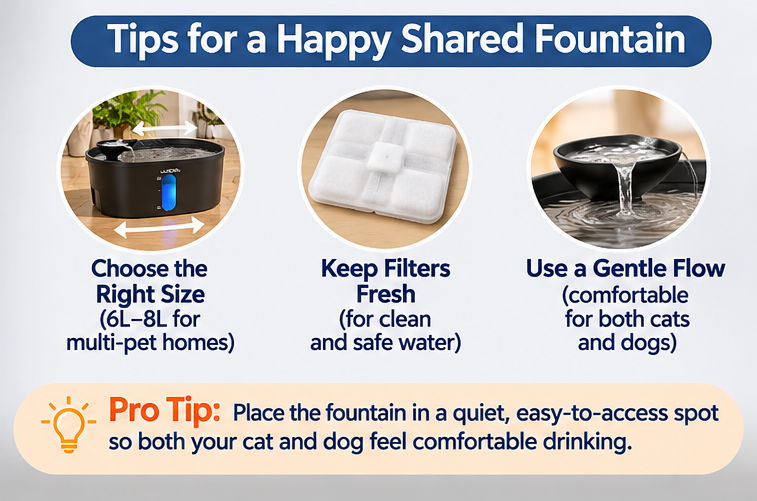
A 6L or 8L fountain may be convenient for some multi-pet households, but reservoir size alone does not determine suitability.
Dogs and cats have different muzzle shapes and drinking behaviors.
A wide basin may be comfortable for dogs, while some cats prefer a smaller or calmer drinking area.
Make sure both pets can reach the water without awkward positioning.
A tall drinking surface may be inconvenient for a small cat or dog.
Check the height of the accessible water surface, not just the overall product height.
A shared fountain may accumulate more hair and debris.
Choose a model with compatible filters that are easy to inspect and replace.
Some cats are cautious around unfamiliar sounds.
A relatively quiet fountain may be easier to introduce into a shared household.
Large dogs may bump a fountain while drinking.
A stable base and appropriate placement can reduce unwanted movement and spills.
A fountain with accessible water-contact surfaces and removable components can make routine maintenance more manageable.
For shared use, ease of cleaning is especially important.
WOPET offers several fountain designs that may suit different multi-pet household arrangements.
The following recommendations focus on published product positioning and practical use cases rather than independent comparison testing.
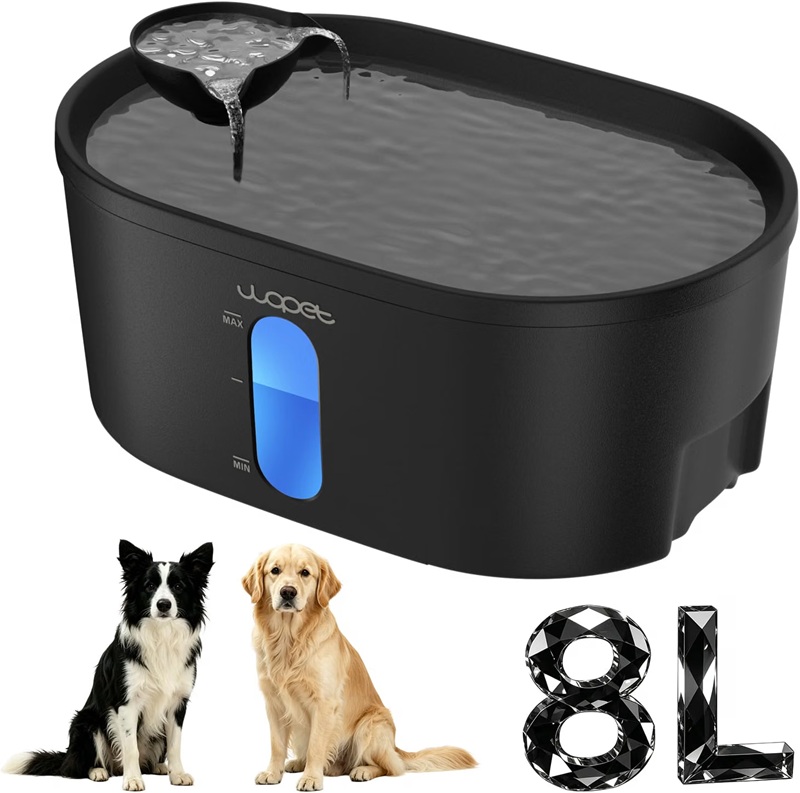
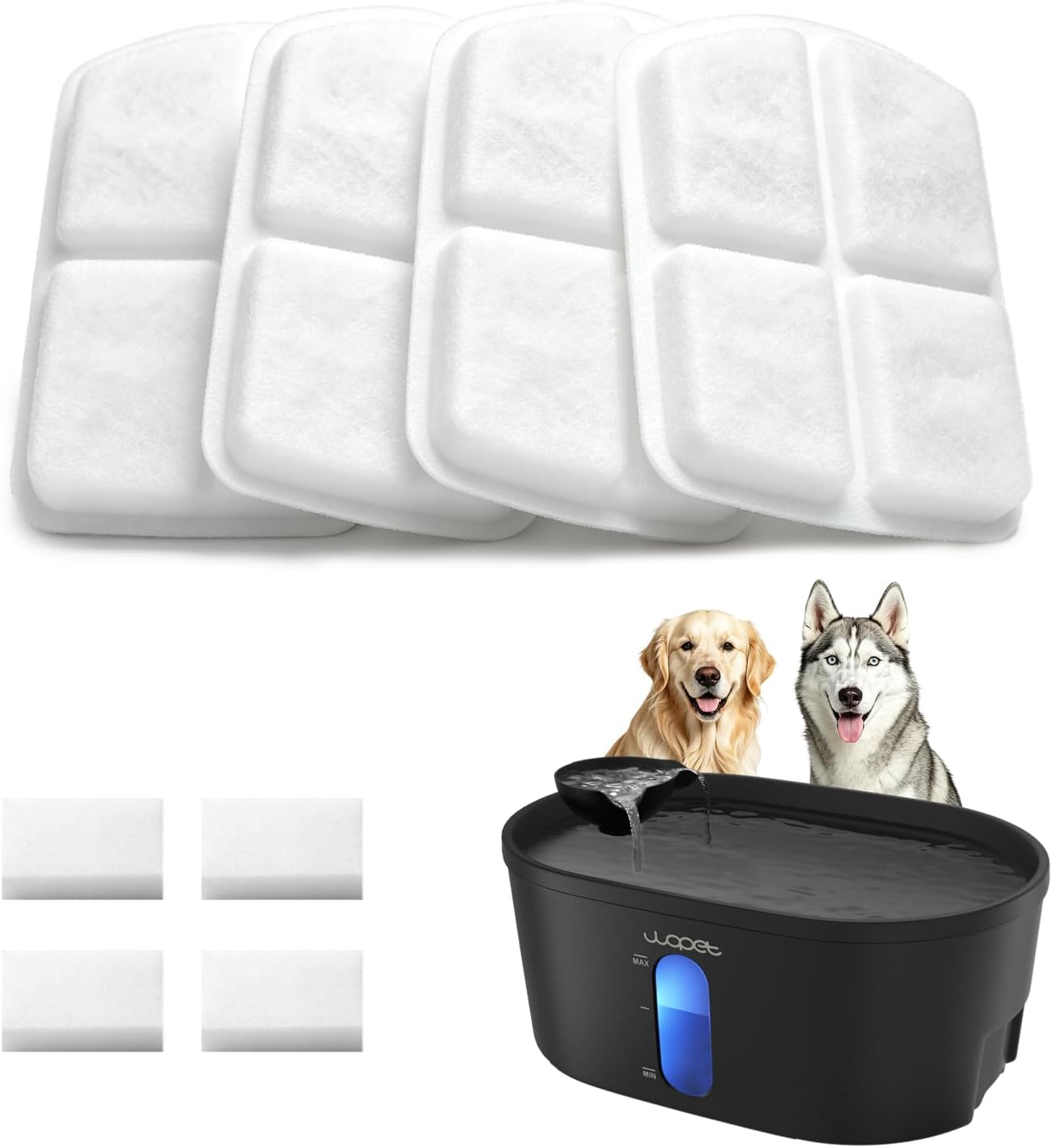
The WOPET A08 is an 8L pet water fountain designed for dogs and multi-cat households.
Its larger reservoir makes it a useful option to consider when several animals share a drinking station.
Key Features:
8L reservoir capacity.
Multi-stage filtration system.
Water-level monitoring features.
Design intended for larger pets and multi-pet households.
Why Consider It?
The A08 offers more stored water than a 6L fountain.
This can be convenient in households with multiple dogs or a combination of dogs and cats.
Best for: Homes that prioritize larger reservoir capacity and shared pet hydration.
Before buying: Confirm that the drinking area is accessible to the smallest pet in your household.
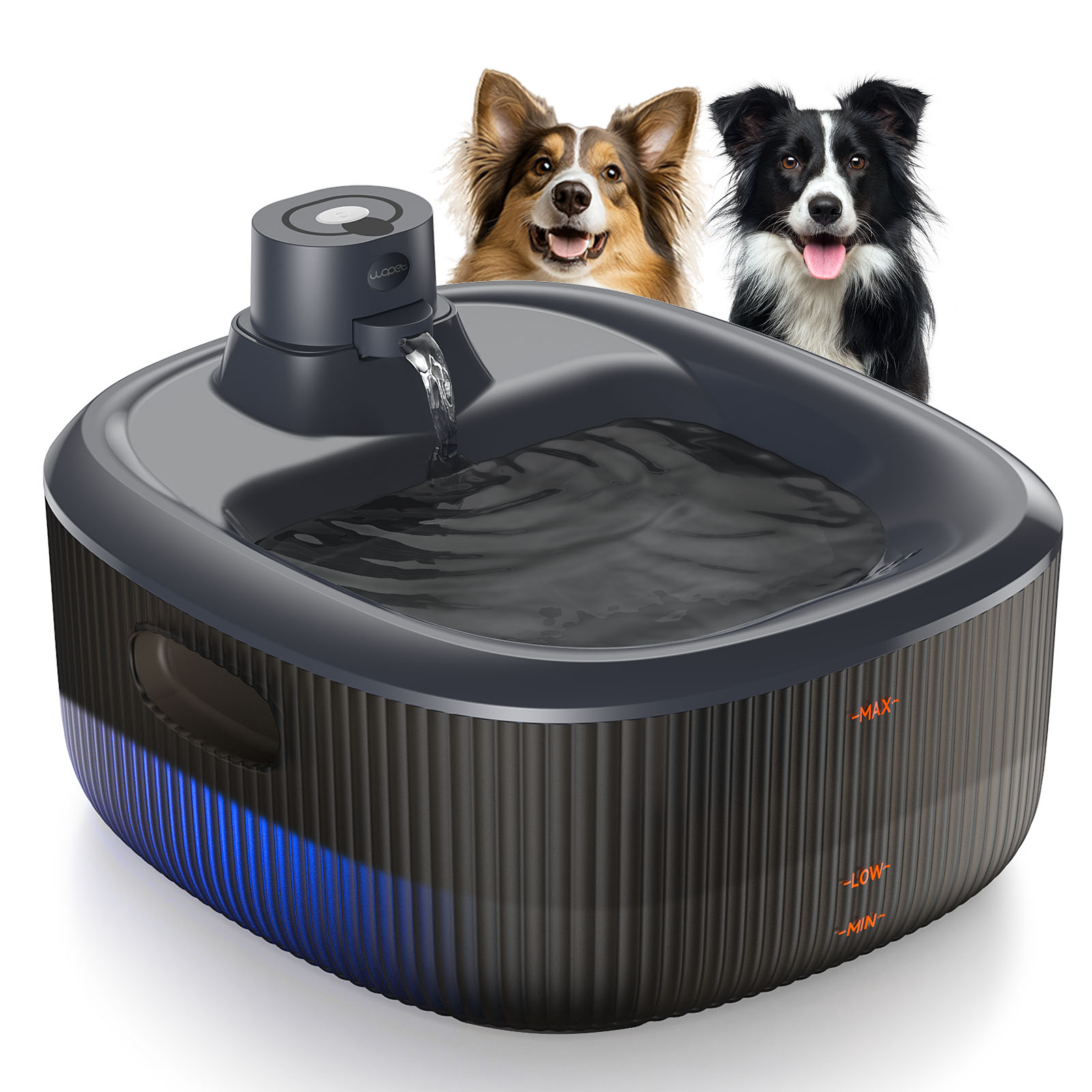
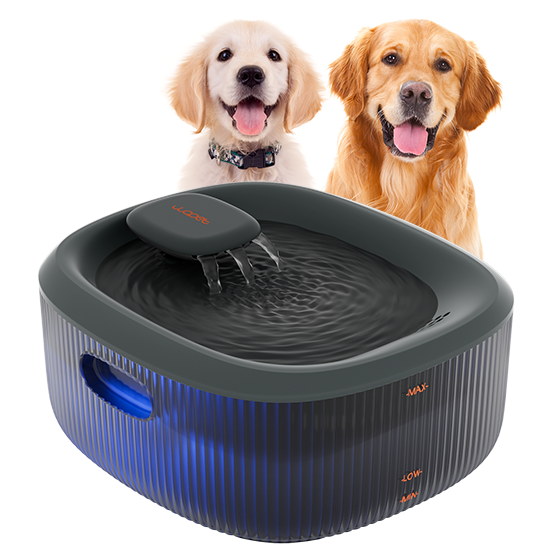
The WOPET W600 Pro is a 6L rechargeable basin-style fountain.
Its cordless operation can provide more flexibility when choosing where to place a drinking station.
Key Features:
6L reservoir capacity.
Rechargeable power system.
5,000mAh battery specification.
Basin-style drinking area.
Flexible placement during battery operation.
Why Consider It?
A rechargeable fountain can be useful when the preferred drinking location is away from a wall outlet.
It may also help reduce exposed power cables during cordless operation.
Best for: Households that want a flexible drinking station, particularly where dogs and cats share living spaces.
Before buying: Check the drinking height, circulation modes, and charging requirements to determine whether the fountain suits both species.
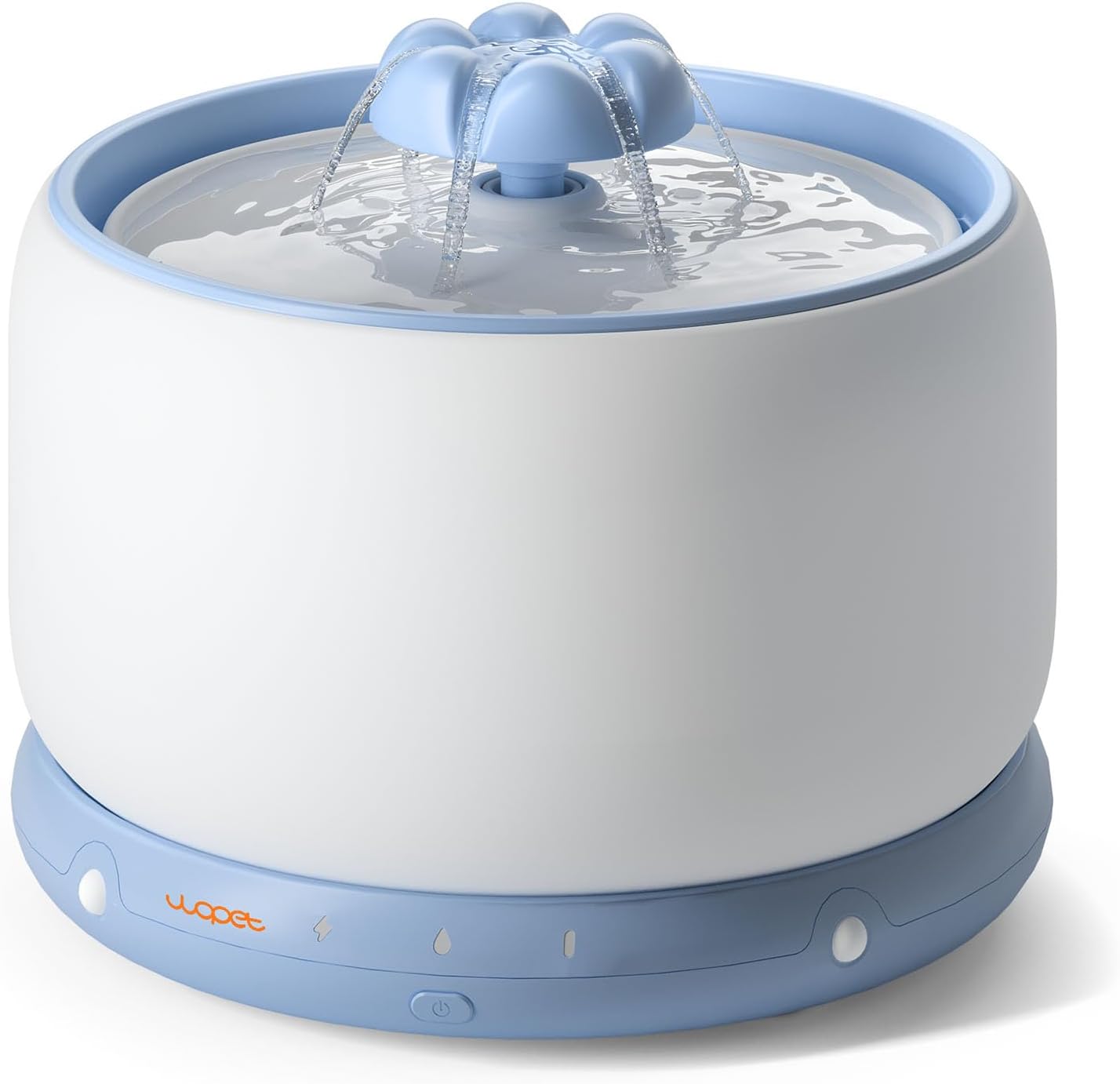
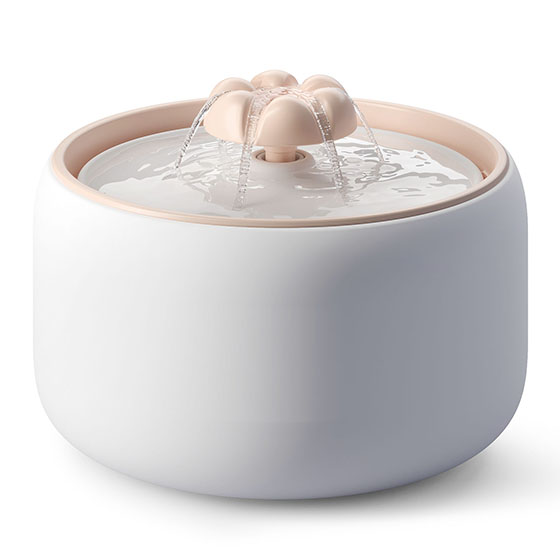
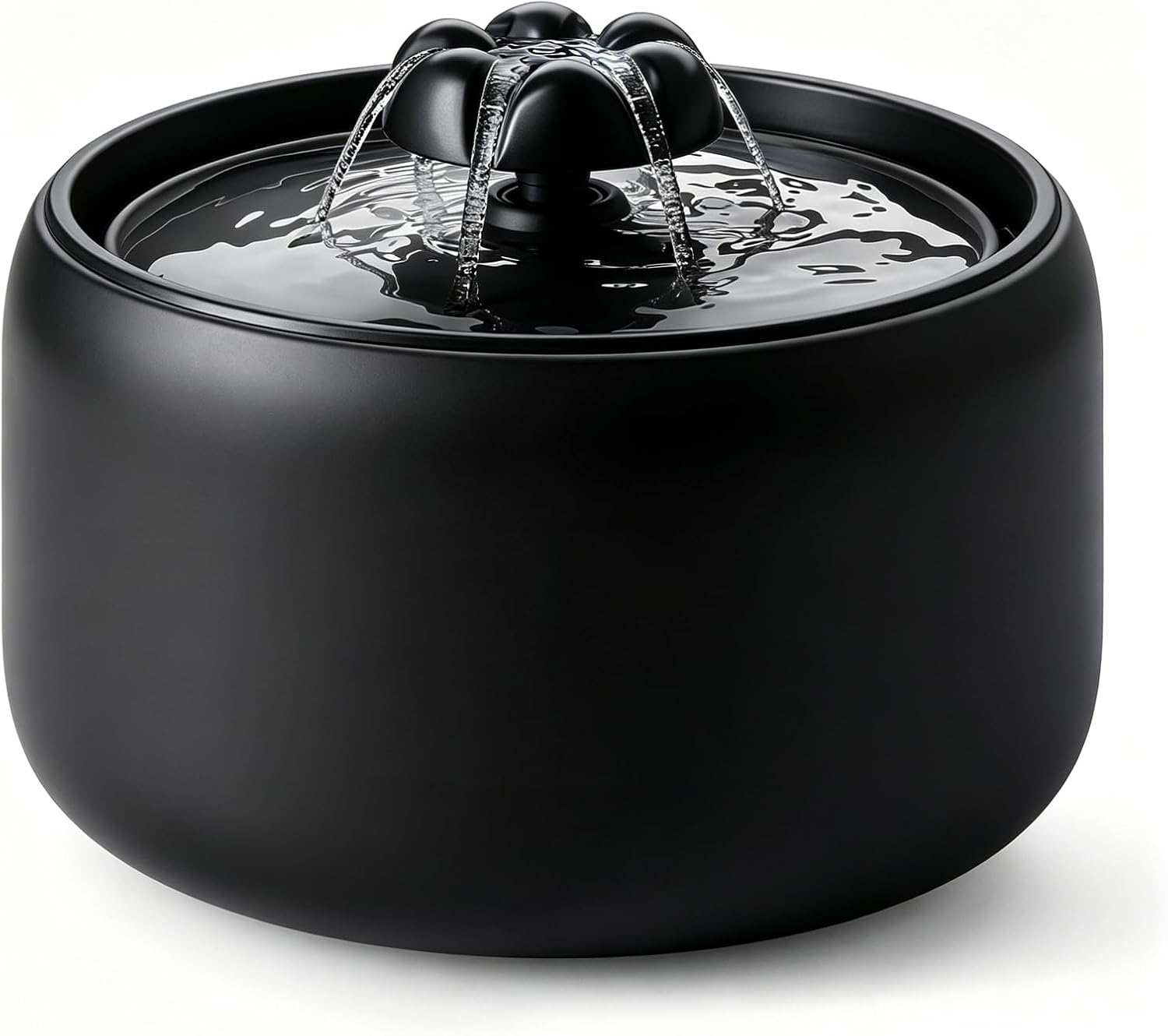
The WOPET W03 is a ceramic wireless pet water fountain primarily positioned for cats.
Rather than treating it as a universal fountain for dogs and cats, it may be particularly useful as a dedicated cat-friendly drinking station in a mixed-pet home.
Key Features:
Ceramic fountain design.
Wireless placement convenience.
A drinking setup primarily intended for cats.
Why Consider It?
Cats may prefer a quieter, separate drinking location away from a larger dog's main water station.
A dedicated fountain can help provide that option.
Best for: Households that want a separate cat drinking station alongside a larger dog fountain.
Before buying: Verify the current model's specifications and ensure the drinking surface suits your cat.
| Feature | WOPET A08 | WOPET W600 Pro | WOPET W03 |
|---|---|---|---|
| Main use case | Larger multi-pet households | Flexible shared drinking station | Dedicated cat-friendly station |
| Reservoir capacity | 8L | 6L | Check current model |
| Power design | Corded | Rechargeable | Wireless |
| Main advantage | Extra capacity | Flexible placement | Ceramic drinking setup |
| Important consideration | Accessibility for smaller pets | Charging and drinking height | Not designed as a large-dog fountain |
For a household with a large dog and one or more cats, consider a larger dog-friendly fountain in the main living area and a separate cat-friendly water station in a quieter location.
For a household with a small dog and a cat that already drink comfortably together, one shared fountain may work well, provided both animals have alternative water sources.
The goal is to create reliable access to water for every pet.
Cats and dogs may respond differently to a new fountain.
Some pets begin drinking immediately, while others need time to adjust.
Place the fountain in a quiet area that both pets can access.
Avoid locations where one animal regularly blocks the other's movement.
Do not remove familiar water bowls during the introduction.
Allow both pets to continue drinking normally while exploring the new fountain.
Let each pet investigate the fountain voluntarily.
Do not force either animal to approach or drink.
Watch for signs of hesitation, competition, or resource guarding.
If one pet consistently avoids the fountain, provide another drinking station.
Even after both pets begin using the fountain, keep additional clean water available.
This is especially helpful in larger homes or households with several pets.
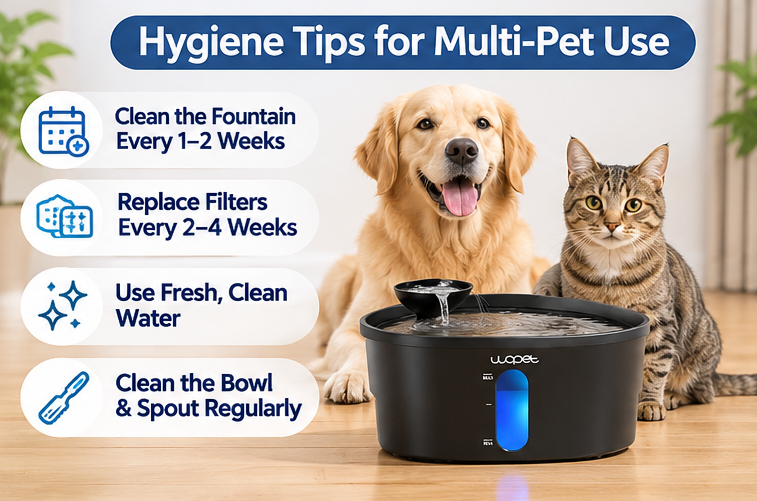
Buy WOPET A08 DOG WATER FOUNTAIN ON AMAZON
A shared fountain may collect more saliva, hair, and debris than one used by a single pet.
Routine maintenance is essential.
Check the fountain every day.
Confirm that enough water is available.
Remove visible hair and food particles.
Inspect the drinking area.
Refresh the drinking water regularly.
Watch for unusual odors or cloudiness.
If the water becomes visibly contaminated, replace it immediately.
As a practical starting point, thoroughly clean the fountain at least weekly, or more frequently when necessary.
Follow the manufacturer's instructions for your model.
A typical cleaning process includes:
Turn off and disconnect the fountain.
Empty the reservoir.
Remove washable components.
Clean the drinking tray and reservoir.
Inspect accessible water channels.
Rinse thoroughly.
Reassemble and refill with fresh water.
Follow the manufacturer's recommended filter replacement schedule.
Some disposable filters require replacement approximately every two to four weeks, but intervals vary.
Heavy shedding, multiple pets, and visible debris may justify more frequent filter inspection.
Never assume that filtration alone makes contaminated water safe.
Even friendly cats and dogs may prefer separate drinking areas.
Observe individual behavior.
A large reservoir is useful, but drinking height and basin accessibility matter just as much.
If one animal prevents another from drinking, separate the water stations.
Filters do not replace fresh water or routine cleaning.
A shared fountain can become empty, lose power, or require maintenance.
Provide backup drinking options.
If a pet requires water-intake monitoring or special care, a shared fountain may not be appropriate.
Yes, healthy cats and dogs can often drink from the same water bowl.
However, the bowl should be cleaned regularly, and each pet should have comfortable access to fresh water.
In many healthy households, occasional shared drinking is not necessarily a problem.
However, saliva and other debris can contaminate shared water, so regular cleaning and water replacement are important.
A dog does not automatically become sick from drinking water used by a cat.
The main concern is whether the water or drinking equipment is contaminated.
If either pet is ill, consult your veterinarian about separate water sources.
They can use the same installed filter when sharing a compatible fountain.
However, the filter must match the fountain model and be replaced according to the manufacturer's instructions.
Not necessarily.
A shared fountain may be convenient, but separate bowls can provide more flexibility and reduce competition.
The best setup depends on the animals' behavior and health needs.
A separate cat fountain can be helpful when a cat avoids a dog's drinking area or prefers a quieter location.
It is not universally required, but providing multiple drinking stations is often beneficial.
They may be able to, but the drinking height and basin design must accommodate both animals.
A separate cat-friendly station may be more practical.
Check the water daily and refresh it regularly.
Replace the water immediately if it becomes dirty, cloudy, or contaminated.
Follow the manufacturer's cleaning instructions.
Giardia can spread through fecal contamination, including contaminated water.
However, transmission depends on the organism and exposure conditions.
If Giardia is suspected or diagnosed, follow your veterinarian's advice about hygiene, treatment, and separate drinking equipment.
Cats and dogs can often share a water fountain safely when they are healthy, comfortable around each other, and provided with clean drinking water.
However, sharing should be an option—not a requirement.
A shared fountain should have enough capacity, an accessible drinking area, appropriate filtration, and a design that is easy to maintain.
For WOPET shoppers, the A08 may suit households needing a larger reservoir, the W600 Pro offers rechargeable placement flexibility, and the W03 can serve as a dedicated cat-friendly drinking station.
The most important goal is not to make every pet use the same fountain.
It is to ensure that every cat and dog in your home has reliable, comfortable access to fresh water.
Explore the WOPET pet water fountain collection to compare available models and find the right setup for your household.
Read more:
Label:
Popular Post
The Ultimate Guide to Tabby Cats: Patterns, Personalities, and More
Mar 27, 2025
Top 8 Reasons Why Does My Cat Sleep Between My Legs?
Mar 03, 2025

What to Do If My Dog's Poop Is Black But Not Tarry
Feb 04, 2023
Superfecundation Cats: When Kittens in One Litter Have Different Fathers
Jul 11, 2025
How Long Does Dry Cat Food Last Once Opened? A Comprehensive Guide
Mar 19, 2025
[Blue] W03L 3L Premium Ceramic Cat Water Fountain
Model: W03 LITE
$59.99
$69.99
Basin Pet Water Fountain-W600
Model: W600
$43.99
$69.99
[Basic] Ceramic Pet Water Fountain with Power Cable
Model: W03L
$59.99
$99.00
[Black] W03L 3L Premium Ceramic Cat Water Fountain
Model: W03L Black
$59.99
$69.99

WOPET 8L Pet Water Fountain For Multiple Cats or Large Dogs A08
Model: A08
$49.99
$59.99
WOPET A08 Dog Water Fountain Filters
Model: A08 Filter
$19.99
$29.99

DOWNLOAD APP

WOpet life




Copyright © 2026 WOPET. All Rights Reserved.