Nov 04, 2026
Author:Jackson Watson
A dog water fountain can make it easier to keep fresh drinking water available throughout the day. But even the best fountain needs regular maintenance, and one of the most important tasks is replacing its water filter.
If you've ever wondered, "How often should I change my dog water fountain filter?" you're not alone. Many pet owners aren't sure whether they should replace the filter every week, once a month, or only when it looks dirty.
The answer depends on the fountain model, filter material, water quality, and how many pets use it.
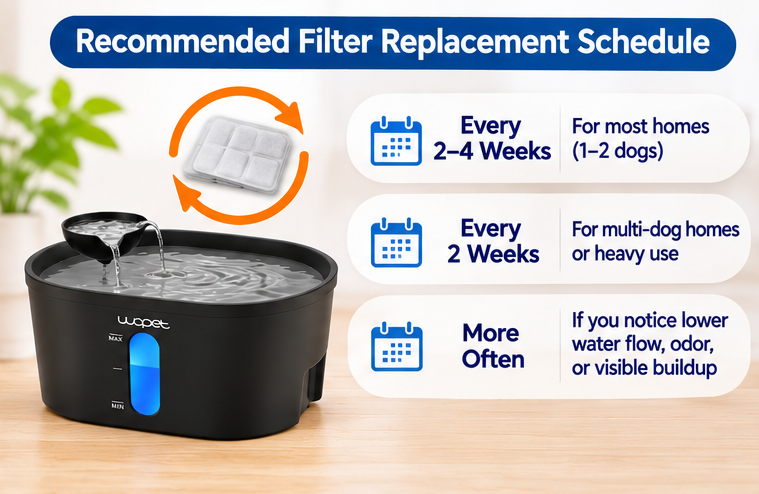
For many pet water fountains, replacing the filter approximately every 2–4 weeks is a common starting point, but this is not a universal rule. Always follow the manufacturer's recommended replacement schedule, and replace the filter sooner if it becomes clogged, damaged, or visibly contaminated.
In this guide, we'll explain how long dog water fountain filters typically last, what affects their lifespan, how to recognize when replacement is needed, and how to maintain your fountain between filter changes.
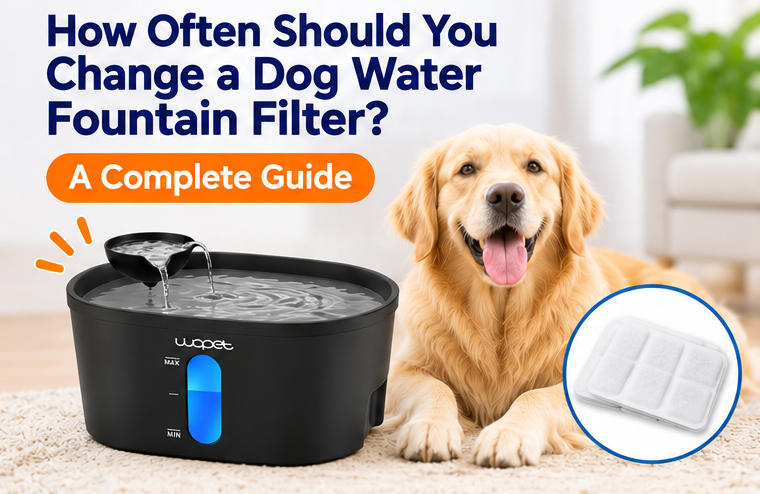
Most dog water fountain filters need periodic replacement because they collect debris and gradually lose filtration effectiveness.
A 2–4 week replacement interval is often used as general guidance for certain disposable pet fountain filters. However, some products require more frequent changes, while others use different filtration systems or longer-lasting components.
The correct schedule depends on the specific filter.
For example, a household with one small dog may experience less debris accumulation than a home with several large, heavy-shedding dogs.
Similarly, a fountain that uses multiple filtration layers may have different maintenance requirements from one that uses a simple mesh screen.
| Household Situation | General Starting Point | Maintenance Considerations |
|---|---|---|
| One small dog | 2–4 weeks | Inspect the filter weekly |
| One large dog | 2–4 weeks | Monitor debris and water flow |
| Two or more dogs | 2–3 weeks | Check the filter more frequently |
| Dogs and cats sharing a fountain | 2–3 weeks | Watch for accumulated hair |
| Heavy shedding or visible debris | Replace sooner when needed | Inspect several times per week |
These intervals are illustrative rather than manufacturer-specific recommendations. A model's official replacement schedule takes priority.
Important: Replacing a filter does not replace the need to clean the fountain itself. The reservoir, drinking tray, and accessible water channels still require regular washing.
A dog water fountain filter helps manage certain contaminants that enter the water during everyday use.
Dogs may introduce saliva, food particles, loose hair, and other debris while drinking.
Even when the fountain circulates water continuously, these materials can accumulate in the reservoir and filtration system.
Over time, a filter may become less effective or restrict water movement.
Many fountains use mechanical filtration materials that capture visible particles.
As hair and debris accumulate, water may have more difficulty passing through the filter.
This can lead to reduced circulation and additional strain on some pump systems.
Some dog water fountain filters contain activated carbon.
Activated carbon can help reduce certain odors and compounds that affect water taste, depending on the filter design and water conditions.
However, its adsorption capacity is limited.
Once the carbon becomes exhausted, it may no longer provide the same level of performance.
A filter that looks clean is not necessarily functioning at its original capacity.
Moist filtration materials can support microbial growth, particularly when organic debris accumulates.
Replacing filters and cleaning the fountain regularly helps manage contamination, but filtration alone does not sterilize drinking water.
A pet fountain should never be considered a substitute for safe drinking water and proper hygiene.
When a filter becomes heavily restricted, the fountain may circulate water more slowly.
In some designs, this can contribute to irregular water movement or unusual operating sounds.
If your fountain suddenly stops flowing, checking the filter is one useful troubleshooting step.
Not every dog water fountain filter wears out at the same rate.
Understanding the factors that influence filter lifespan can help you choose a more appropriate replacement schedule.
A fountain shared by several pets may collect more saliva, hair, and debris than one used by a single dog.
Multi-pet households should inspect filters more frequently.
Large dogs may consume more water than smaller dogs, although actual water needs depend on many factors.
Greater water use can increase the amount of water passing through the filtration system.
Dogs that frequently introduce food particles or debris into the reservoir may also require more frequent maintenance.
The quality of the water used in your fountain can influence filter performance.
Water containing sediment or other particles may clog mechanical filtration materials more quickly.
Hard water can also contribute to mineral deposits on fountain components.
Importantly, not every pet fountain filter is designed to remove dissolved minerals or reduce water hardness.
Different filters serve different purposes.
Common filtration materials include:
Mechanical mesh or foam: Helps capture larger particles and debris.
Activated carbon: May reduce certain odors and taste-related compounds.
Ion-exchange resin: Can reduce selected dissolved ions when included in a properly designed filter.
Multi-layer filter cartridges: Combine different materials to address multiple filtration needs.
Each material has different maintenance and replacement requirements.
Regular cleaning helps prevent debris from accumulating throughout the fountain.
However, washing the reservoir does not restore exhausted activated carbon or make a disposable filter last indefinitely.
Filter replacement and fountain cleaning should be treated as separate maintenance tasks.
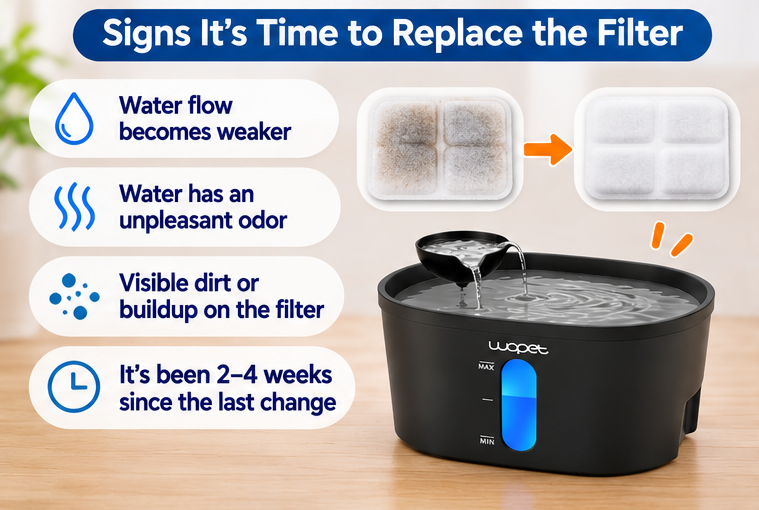
Even if you follow a regular replacement schedule, some situations call for changing the filter earlier.
Here are seven signs worth watching.
A heavily clogged filter can restrict circulation.
If the fountain's water stream becomes weaker than usual, inspect the filter along with the water intake and circulation system.
Large amounts of accumulated debris are a good reason to inspect the filter.
If the filter cannot be adequately maintained according to its instructions, replace it.
An unpleasant smell may indicate contamination in the reservoir, filter, or water channels.
Replace the water, clean the fountain thoroughly, and inspect or replace the filter.
Do not assume that changing the filter alone will resolve a hygiene problem.
A torn, cracked, or misshapen filter may no longer fit correctly or perform as intended.
Replace damaged filter cartridges rather than attempting to repair them.
A restricted filter may contribute to changes in water movement.
If your fountain starts gurgling, buzzing, or making irregular sounds, inspect the filter as part of a broader troubleshooting process.
Noise can also result from low water levels, trapped air, or pump problems.
Cloudy water, visible particles, or slime are signs that the fountain needs immediate attention.
Discard the water, clean and disinfect the fountain using a manufacturer-approved method, and replace contaminated disposable filters.
Do not continue offering visibly contaminated water to your dog.
Some filters lose effectiveness without obvious visual changes.
If the manufacturer recommends replacing the cartridge after a certain period, follow that schedule even if the filter still looks clean.
Creating a simple maintenance routine can help you avoid forgetting filter changes.
The schedule below is a general example, not a replacement for your fountain's user manual.
| Maintenance Task | Suggested Frequency |
|---|---|
| Check water level | Daily |
| Inspect water clarity and odor | Daily |
| Replace drinking water | Daily, or more often when needed |
| Remove visible hair and debris | As needed |
| Inspect the filter | Weekly or more frequently |
| Clean the reservoir and drinking tray | At least weekly as a starting point; sooner if dirty |
| Inspect accessible circulation components | During routine cleaning |
| Replace disposable filter | According to the manufacturer; often around 2–4 weeks for certain models |
For dogs that shed heavily or frequently introduce food into the water, more frequent cleaning may be necessary.
The most important principle is to respond to actual water and fountain conditions rather than relying only on a calendar.
Replacing a dog water fountain filter is usually straightforward, although the exact process varies by model.
Before removing any components, switch off the fountain and disconnect it from its power source.
For rechargeable models, follow the manufacturer's instructions for safely turning off the circulation system.
Open the filter compartment and carefully remove the old cartridge.
Inspect the compartment for trapped hair, sediment, or slime.
Discard disposable filters according to local waste guidance.
Empty the reservoir and wash the drinking tray, filter holder, and other washable components.
Use a cleaning method and products approved by the manufacturer.
Pay particular attention to corners and water channels where debris may accumulate.
Rinse thoroughly before reassembly.
Some replacement filters require rinsing or soaking before installation.
Follow the instructions provided with the filter.
This step may help remove loose manufacturing dust from certain filter media, but preparation requirements vary.
Do not assume every filter needs soaking.
Place the new filter in the correct orientation.
Make sure it fits securely without blocking the intended water pathway.
Use only filters confirmed to be compatible with your fountain model.
Fill the reservoir to the recommended level using clean, potable water.
Avoid overfilling or operating below the minimum water level.
Reassemble the fountain and restart it according to the user manual.
Observe the water circulation and check for leaks or unusual noises.
If the water does not flow normally, turn the fountain off and check the filter position and assembly.
Whether a filter can be reused depends on its design.
Many pet fountains use disposable filter cartridges containing activated carbon, foam, or other filtration media.
These cartridges are intended for periodic replacement.
Rinsing may remove loose debris when permitted, but it does not reliably restore exhausted activated carbon or fully sanitize the filter.
Do not attempt to extend the life of a disposable filter beyond the manufacturer's recommendations.
Some fountains include reusable mesh screens or other washable pre-filters.
These components may be cleaned and reused when the manufacturer explicitly allows it.
Inspect them regularly for damage and replace them when necessary.
Avoid using soap or detergents directly on disposable filter media unless the manufacturer specifically instructs you to do so.
Cleaning products may remain trapped in porous materials.
For reusable components, use only approved cleaning methods and rinse thoroughly.
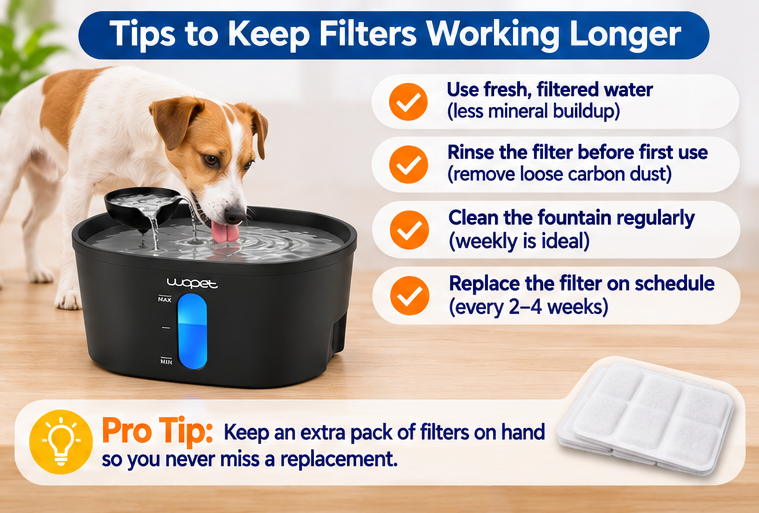
You cannot prevent a filter from eventually needing replacement, but good maintenance habits can help prevent premature clogging.
Use potable water from a reliable source.
Avoid filling the fountain with water containing visible sediment or debris.
Regular water replacement helps prevent contaminants from accumulating in the reservoir.
If the water becomes dirty, replace it immediately.
A dirty reservoir can quickly contaminate a newly installed filter.
Clean the fountain according to the manufacturer's recommendations.
Check the water surface and intake areas for accumulated debris.
Removing visible contaminants can help reduce the amount of material reaching the filter.
Filters that do not fit properly may allow water to bypass the intended filtration pathway or restrict circulation.
Always verify model compatibility before purchasing replacements.
Record the date whenever you install a new filter.
A phone reminder or simple maintenance calendar can make replacement easier to manage.
Buy WOPET A08 DOG WATER FOUNTAIN ON AMAZON
When purchasing replacement filters, compatibility should be your first consideration.
A filter designed for one fountain may not fit another model, even if the cartridges look similar.
Model compatibility
Confirm the exact model name and filter part number.
Filter dimensions
Check that the replacement cartridge matches the required size and shape.
Filtration materials
Understand whether the filter contains mechanical media, activated carbon, ion-exchange resin, or a combination.
Replacement instructions
Review the manufacturer's recommended installation and replacement schedule.
Availability
Consider whether replacement cartridges are readily available for future maintenance.
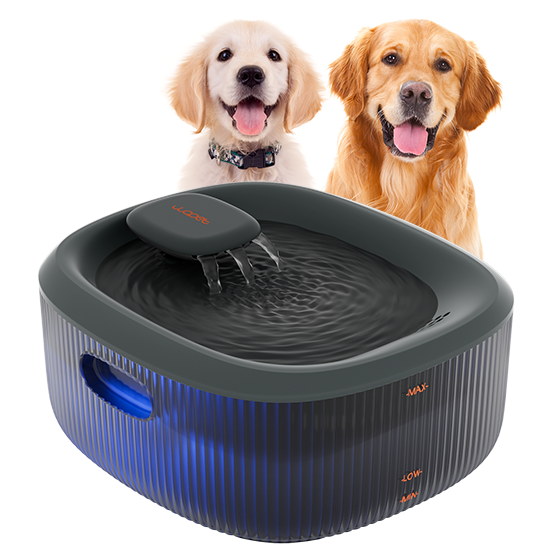
WOPET offers pet water fountain models for different household needs, including the W600 series and the A08, which is designed for dogs and multi-cat households.
When choosing replacement filters for a WOPET W600, W600 Pro, or A08, confirm the specific model's compatible filter type and official maintenance instructions.
Do not assume that filters are interchangeable across different WOPET fountains.
Using the correct filter and maintaining the fountain regularly can help preserve normal water circulation and make everyday pet care more convenient.
Explore WOPET products and available accessories at WOPET.
Not necessarily.
Some filters may require frequent replacement under heavy use, but many disposable pet fountain filters have longer manufacturer-recommended intervals.
Follow the instructions for your model and replace the filter sooner if it becomes contaminated, damaged, or clogged.
It may be sufficient for some models and households, but not all.
If your fountain's manufacturer recommends a shorter interval, follow that guidance.
Multi-pet households or fountains that accumulate debris quickly may require more frequent changes.
An old filter may accumulate debris, restrict water circulation, lose filtration effectiveness, and contribute to poor fountain hygiene.
In severe cases, restricted water flow may interfere with normal fountain operation.
That depends on the fountain design.
Some fountains require a filter or filter holder for proper circulation, while others may operate differently.
Do not remove the filter during normal use unless the manufacturer confirms that the fountain can safely operate without it.
Standard pet fountain filters should not be assumed to remove or kill harmful bacteria.
Mechanical and carbon filtration can address certain particles and compounds, but they do not automatically make contaminated water microbiologically safe.
Regular cleaning and fresh potable water remain essential.
Discoloration can result from trapped debris, sediment, or the filter materials themselves.
However, color alone does not establish whether a filter is safe or effective.
Follow the manufacturer's instructions and replace the filter if it is contaminated or due for replacement.
Common signs include reduced water flow, visible debris, or water collecting around the filter compartment.
Inspect the filter and other water pathways because a weak stream can also result from pump or circulation problems.
Only if the replacement is confirmed to be compatible with your fountain and meets the manufacturer's requirements.
A poorly fitting filter may interfere with circulation or fail to provide the intended filtration performance.
Not automatically.
Large dogs may drink more water, but filter lifespan also depends on debris accumulation, water quality, filter design, and the number of pets using the fountain.
Inspect the filter regularly and adjust maintenance based on actual conditions.
Changing your dog water fountain filter regularly is an important part of maintaining a clean and reliable drinking-water setup.
For some fountains, a replacement interval of approximately 2–4 weeks is a useful general reference, but the correct schedule always depends on the specific model and manufacturer's instructions.
Pay attention to visible debris, water flow, unusual odors, and the condition of the filter.
Remember that replacing the filter is only one part of proper fountain maintenance. Regularly refreshing the water, washing the reservoir, and inspecting circulation components are equally important.
With a consistent cleaning routine and the right replacement filters, you can help keep your dog's water fountain functioning as intended and provide convenient access to fresh drinking water every day.
Read More:
Label:
Popular Post
The Ultimate Guide to Tabby Cats: Patterns, Personalities, and More
Mar 27, 2025

Top 8 Reasons Why Does My Cat Sleep Between My Legs?
Mar 03, 2025

What to Do If My Dog's Poop Is Black But Not Tarry
Feb 04, 2023

Superfecundation Cats: When Kittens in One Litter Have Different Fathers
Jul 11, 2025
How Long Does Dry Cat Food Last Once Opened? A Comprehensive Guide
Mar 19, 2025
[Blue] W03L 3L Premium Ceramic Cat Water Fountain
Model: W03 LITE
$59.99
$69.99
Basin Pet Water Fountain-W600
Model: W600
$43.99
$69.99
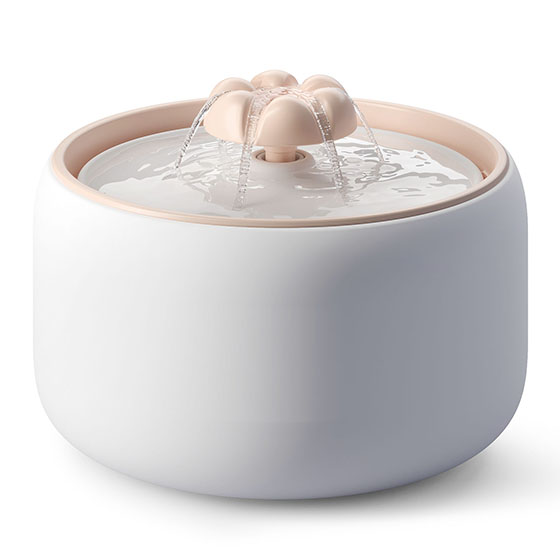
[Basic] Ceramic Pet Water Fountain with Power Cable
Model: W03L
$59.99
$99.00
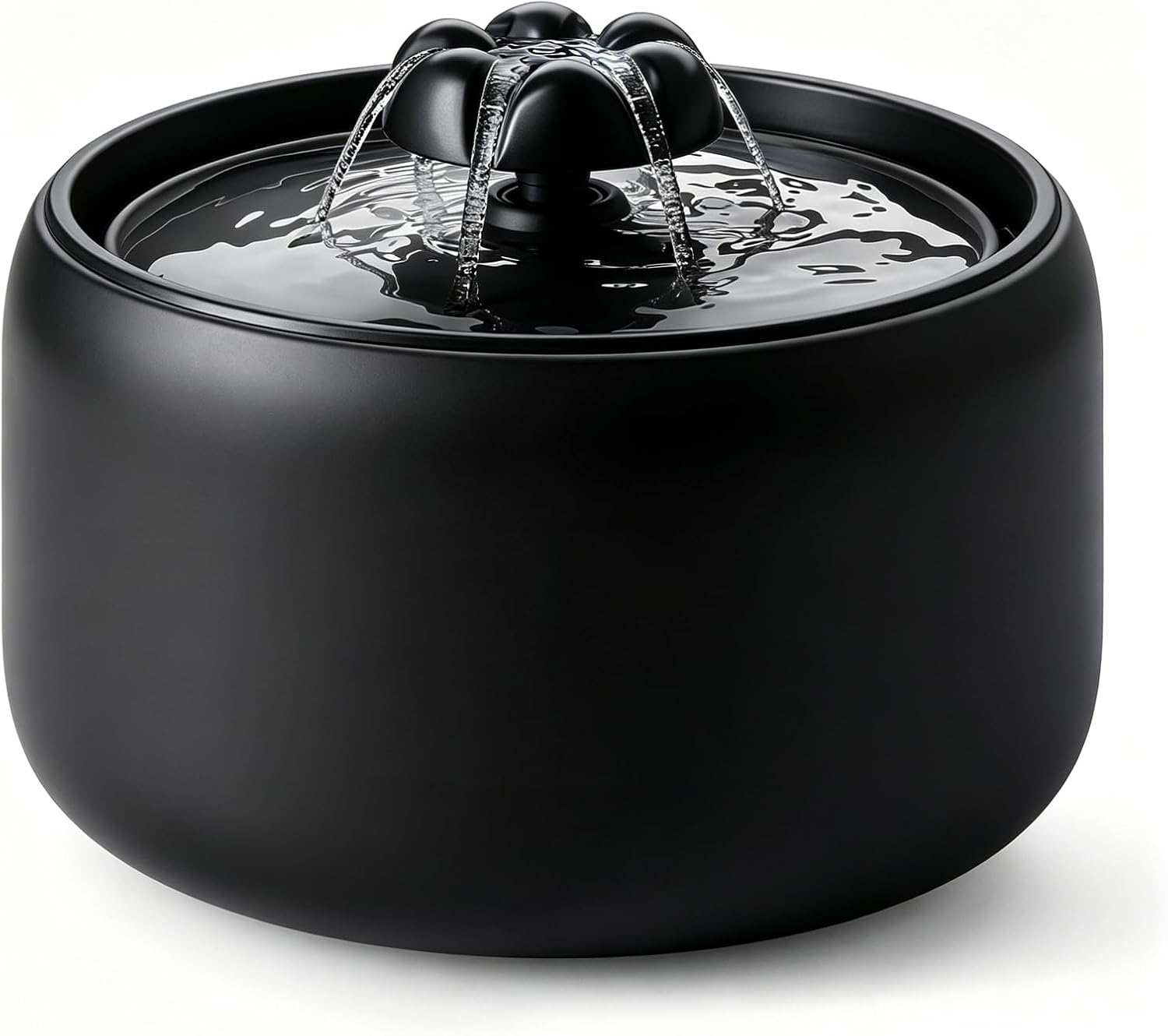
[Black] W03L 3L Premium Ceramic Cat Water Fountain
Model: W03L Black
$59.99
$69.99

WOPET 8L Pet Water Fountain For Multiple Cats or Large Dogs A08
Model: A08
$49.99
$59.99
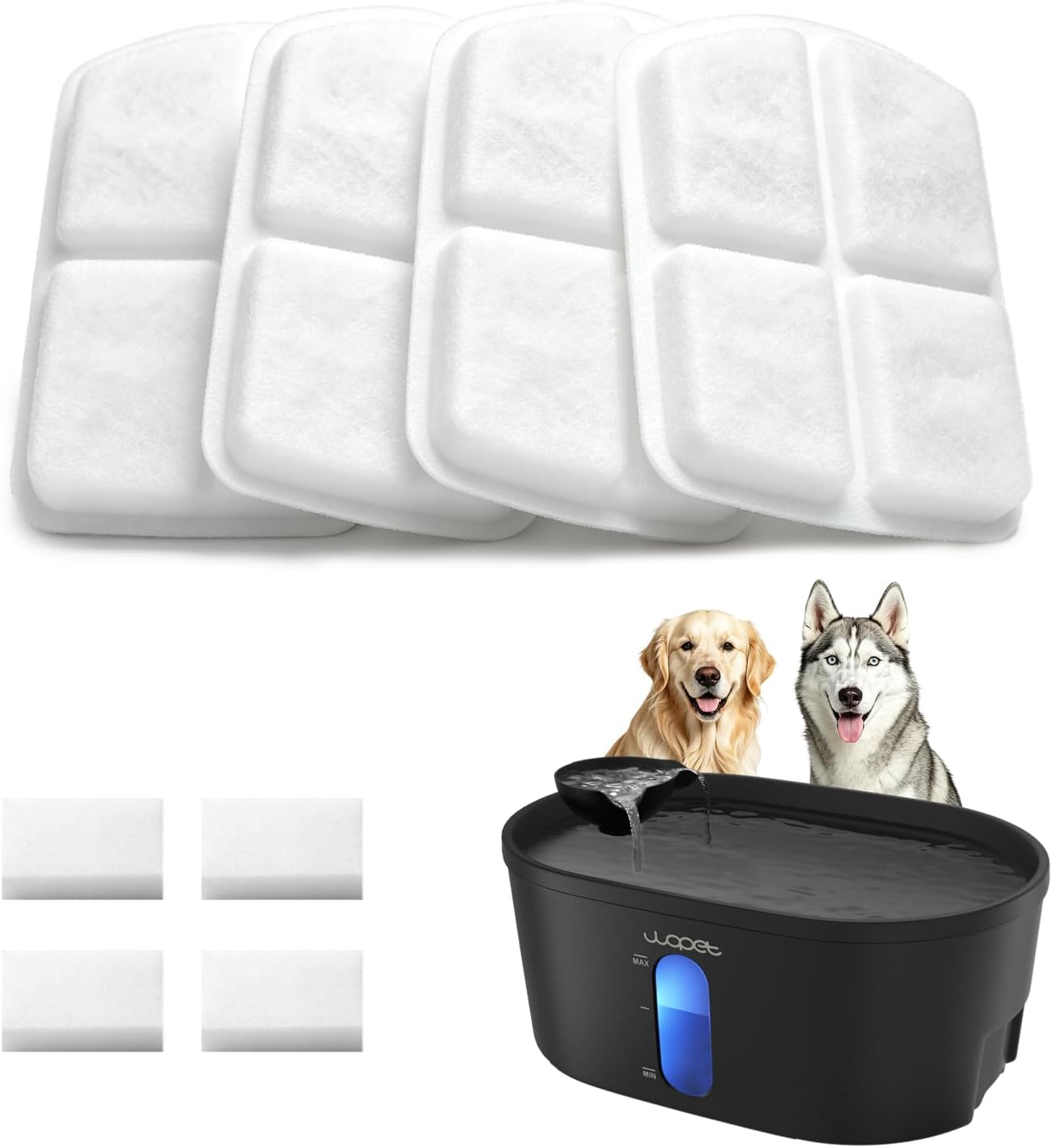
WOPET A08 Dog Water Fountain Filters
Model: A08 Filter
$19.99
$29.99

DOWNLOAD APP

WOpet life




Copyright © 2026 WOPET. All Rights Reserved.