Nov 04, 2026
Author:Jackson Watson
Providing fresh drinking water is one of the most important parts of caring for your dog. But when you're choosing a water station for your home, two popular options may seem surprisingly similar: a dog water fountain and an automatic water dispenser.
Both can store water and reduce how often you need to refill a small drinking bowl. However, they work in different ways.
A dog water fountain circulates water through a powered system and may include filtration, while a gravity-fed automatic water dispenser replenishes still water as the level in its drinking bowl drops.
So, which is better for your dog?
The answer depends on your dog's drinking preferences, your household's needs, and how much maintenance you're comfortable managing.
This guide explains seven key differences between dog water fountains and automatic water dispensers, compares hygiene and long-term costs, and helps you choose a practical drinking solution.
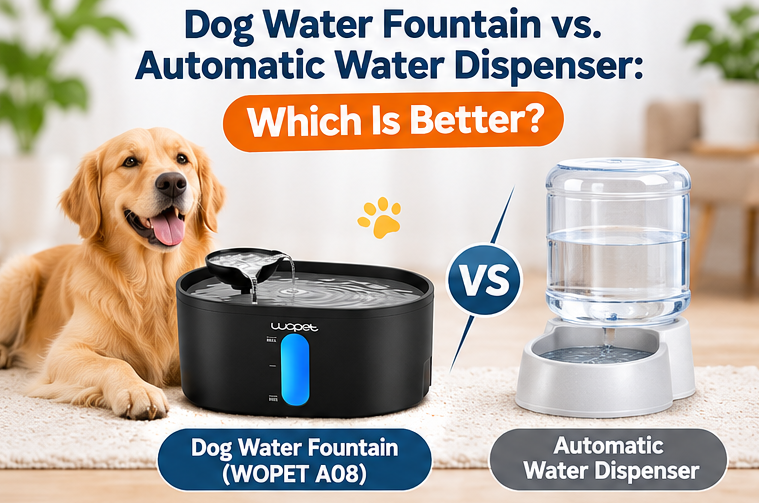
Here's a side-by-side comparison of a typical powered dog water fountain and a gravity-fed automatic dispenser.
| Feature | Dog Water Fountain | Gravity Water Dispenser |
|---|---|---|
| Water movement | Circulating water | Still water replenished automatically |
| Power source | Electricity or rechargeable battery | Gravity; no electricity |
| Filtration | Common on filtered models | Usually not included |
| Water delivery | Circulation system | Gravity-fed reservoir |
| Operating noise | May produce a gentle sound | Usually silent |
| Cleaning | Reservoir, filter, and circulation components | Storage container and drinking bowl |
| Initial cost | Often higher | Often lower |
| Ongoing costs | Filters, electricity, and possible parts | Usually minimal |
| Power outage | Circulation may stop | Gravity feeding continues |
| Placement | Depends on power source | Generally flexible |
| Best for | Dogs comfortable with moving water | Owners wanting simple automatic refilling |
Quick answer: Choose a water fountain if you want circulating water and features such as filtration. Choose a gravity dispenser if you prefer a simple, electricity-free system that automatically replenishes a bowl.
Neither option replaces daily water checks or regular cleaning.
A dog water fountain is a drinking device that uses a powered circulation system to move water through a reservoir and drinking area.
Depending on the model, it may provide continuous, timed, or sensor-controlled water movement.
A typical fountain operates through the following process:
Water is stored in a reservoir.
A pump or other circulation mechanism moves water.
Water passes through a drinking area and, on some models, a filter.
Water returns to the reservoir.
The cycle repeats according to the fountain's operating mode.
The circulation system may help keep water moving through filtration media.
However, filtration performance depends on the materials and design.
A fountain may offer:
Circulating water that some dogs find appealing.
Filtration designed to capture certain debris.
A larger reservoir than some ordinary bowls.
Different operating modes.
Corded or rechargeable power options.
A fountain also introduces additional responsibilities:
Regular cleaning of water channels.
Filter replacement.
Electricity or battery charging.
Inspection of circulation components.
Potential repair or replacement costs.
A fountain is most useful when its features fit your dog's preferences and your maintenance routine.
An automatic dog water dispenser is a device that replenishes drinking water without requiring you to pour water into the bowl each time the level drops.
However, not every automatic dispenser uses the same technology.
Gravity dispensers are among the simplest and most common designs.
They typically use a storage container positioned above or connected to a drinking tray.
As the water level in the tray drops, additional water flows from the reservoir until the system reaches its normal operating level.
These dispensers generally do not require electricity.
Some automatic dispensers connect to a household water supply.
They may use mechanical float valves or other control mechanisms to maintain water levels.
These systems require appropriate installation and leak prevention.
Some devices use sensors, electric valves, or electronic controls to manage water delivery.
Their operation and maintenance differ from basic gravity dispensers.
For this comparison, we'll focus mainly on gravity-fed dispensers, since they are widely used and offer a clear alternative to powered water fountains.
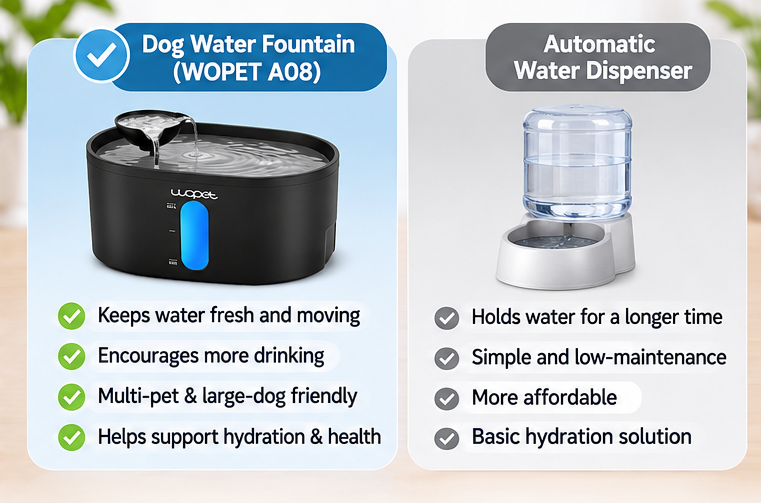
The most noticeable difference is how water behaves in the drinking area.
A fountain actively circulates water.
A gravity dispenser usually maintains a bowl of still water and replenishes it as the level falls.
Some dogs are curious about moving water.
The sound or motion may encourage them to investigate the drinking station.
However, this does not mean every dog prefers circulating water.
A gravity dispenser offers a more familiar drinking experience.
Water remains still in the tray until it is disturbed or replenished.
This may suit dogs that prefer a quiet, traditional bowl.
Which is better?
Choose based on your dog's behavior rather than assuming moving water is universally preferred.
A fountain and gravity dispenser use different mechanisms to deliver water.
A fountain typically moves water around a closed circulation path.
The same reservoir water may pass through the drinking area repeatedly until it is replaced.
A gravity dispenser releases stored water into the drinking tray as needed.
It does not continuously circulate water through a powered system.
This distinction is important because automatic replenishment is not the same as filtration or active circulation.
Many dog water fountains include replaceable filters.
These may contain materials designed to capture hair, food particles, and certain impurities.
However, a filter's capabilities depend on its design.
A standard pet fountain filter should not be assumed to remove every contaminant or sterilize water.
Most basic gravity dispensers do not include an active filtration system.
Some specialty models may include filtration, but it is not a universal feature.
Not automatically.
A fountain with a neglected filter can become dirty.
A gravity dispenser that is emptied, washed, and refilled regularly may provide a perfectly suitable water source.
The key factor is consistent hygiene, not simply whether a device has a filter.
A dog water fountain usually requires electrical power to circulate water.
This may come from:
A wall outlet.
A rechargeable battery.
Another manufacturer-supported power source.
A basic gravity dispenser works without electricity.
A gravity dispenser can continue replenishing water during a power outage, provided its reservoir and feeding mechanism are functioning correctly.
A wired fountain generally stops circulating when electricity is unavailable.
A rechargeable fountain may continue operating while its battery has sufficient charge.
However, both types should be checked regularly to confirm that water remains accessible.
Both systems need cleaning, but the maintenance tasks differ.
A fountain may require cleaning of:
The drinking basin.
The reservoir.
Accessible circulation components.
Water channels.
Filter compartments.
Filters also need replacement according to the manufacturer's instructions.
A gravity dispenser generally requires:
Emptying the storage container.
Washing the drinking tray.
Cleaning the reservoir opening.
Removing residue from accessible surfaces.
Rinsing and refilling with fresh water.
A narrow storage container may be difficult to scrub thoroughly, so cleanability is an important purchasing consideration.
| Task | Water Fountain | Gravity Dispenser |
|---|---|---|
| Check water daily | Yes | Yes |
| Wash drinking area | Yes | Yes |
| Clean storage reservoir | Yes | Yes |
| Replace filter | If applicable | Usually no |
| Clean circulation system | Yes | No |
| Check power system | Yes | No |
| Inspect for blockages | Yes | Yes |
Which is easier?
A basic gravity dispenser generally has fewer components.
However, the easiest product to maintain is one with accessible surfaces and a design you can clean thoroughly.
A water fountain often has more recurring expenses than a gravity dispenser.
Potential expenses include:
Initial purchase price.
Replacement filters.
Electricity or battery charging.
Replacement circulation components.
Other compatible accessories.
Potential expenses include:
Initial purchase price.
Cleaning supplies.
Replacement seals or components if needed.
Replacement of the dispenser if damaged.
The following figures are hypothetical examples, not actual WOPET product prices.
| Expense | Dog Water Fountain | Gravity Dispenser |
|---|---|---|
| Initial purchase | $55 | $20 |
| Filters over 3 years | $90 | $0 |
| Electricity over 3 years | $12 | $0 |
| Replacement parts | $15 | $5 |
| Illustrative total | $172 | $25 |
Actual expenses depend on product quality, filter replacement frequency, electricity rates, and component lifespan.
A fountain's additional cost may be worthwhile if you value its circulation and filtration features.
A gravity dispenser may be more economical if automatic refilling is your main priority.
Both systems can experience problems.
Possible issues include:
Power interruption.
Depleted battery.
Clogged filter.
Circulation-system failure.
Low water level.
Incorrect assembly.
Possible issues include:
An empty storage reservoir.
A blocked dispensing opening.
An airlock or feeding problem.
A leaking seal.
Incorrect assembly.
Contaminated water.
A gravity dispenser has fewer electronic components, but that does not mean it can never fail.
Best practice: Check your dog's drinking water every day and provide an additional clean water source when appropriate.
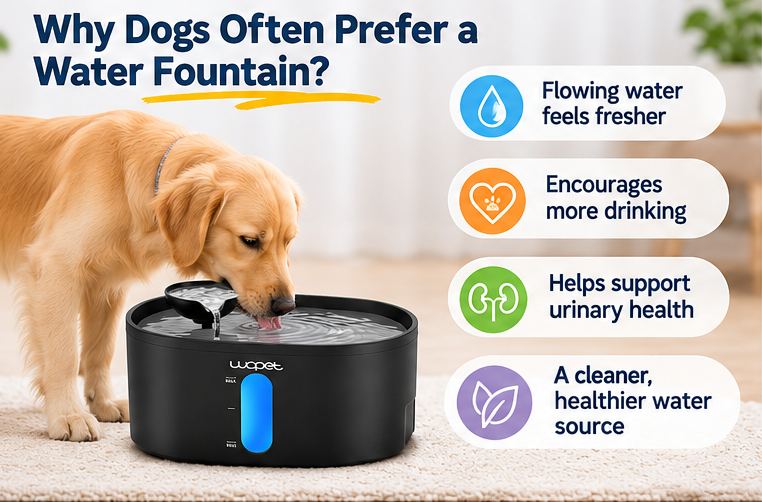
Neither system is automatically more hygienic.
The main hygiene concerns include bacteria, biofilm, food residue, pet saliva, and debris.
A fountain may capture some debris through filtration.
However, water continuously moves through a system containing multiple surfaces.
If those surfaces are not cleaned, buildup can develop.
A gravity dispenser stores water in a reservoir and replenishes the drinking tray.
Although the reservoir may be partially enclosed, the drinking area is still exposed to saliva, food particles, and environmental debris.
Contamination can also occur during handling and refilling.
Inspect the water daily.
Wash accessible drinking surfaces regularly.
Replace dirty water promptly.
Follow manufacturer cleaning instructions.
Replace filters when required.
Clean sooner if several pets share the system.
For most households, cleaning consistency matters more than the type of device.
Some dogs may show greater interest in moving water.
Others may prefer a quiet gravity dispenser.
Individual drinking preferences vary.
Possible reasons include:
Interest in moving water.
Familiarity with a fountain.
Comfortable drinking-area design.
Preference for the fountain's location.
Possible reasons include:
Quiet operation.
Familiar still-water drinking experience.
Simple bowl-like design.
Lack of mechanical vibration.
There is no guarantee that either device will increase your dog's total daily water intake.
If your dog suddenly drinks much less or substantially more than usual, consult your veterinarian.
Multi-dog households often benefit from larger water reservoirs and multiple drinking locations.
Both fountains and gravity dispensers can be suitable.
A larger fountain may provide:
A spacious drinking area.
Circulating water.
Filtration on supported models.
A reservoir that reduces frequent refilling.
A large gravity dispenser may provide:
Simple automatic replenishment.
No charging or electrical connection.
Quiet operation.
Fewer electronic components.
In homes with several dogs, one pet may block access to a shared drinking station.
Even if the reservoir is large, a single station may not be ideal.
Provide additional water bowls or dispensers in separate accessible locations.
The goal is to ensure that every dog can drink comfortably. Dog Water Fountain vs. Water Bowl: Which Is Better?
If you prefer circulating water, WOPET offers several fountain designs for different home environments.
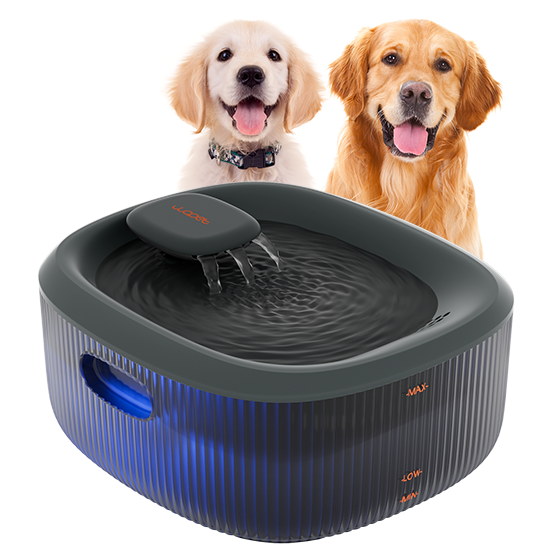
The WOPET W600 is a 6L corded dog water fountain.
It may suit households with a fixed indoor drinking station near a suitable electrical outlet.
Its basin-style design provides a dedicated drinking area for dogs.
Consider the W600 if:
You prefer a corded fountain.
Your drinking station will remain in one location.
You want a 6L reservoir.
You're comfortable with regular filter and circulation-system maintenance.
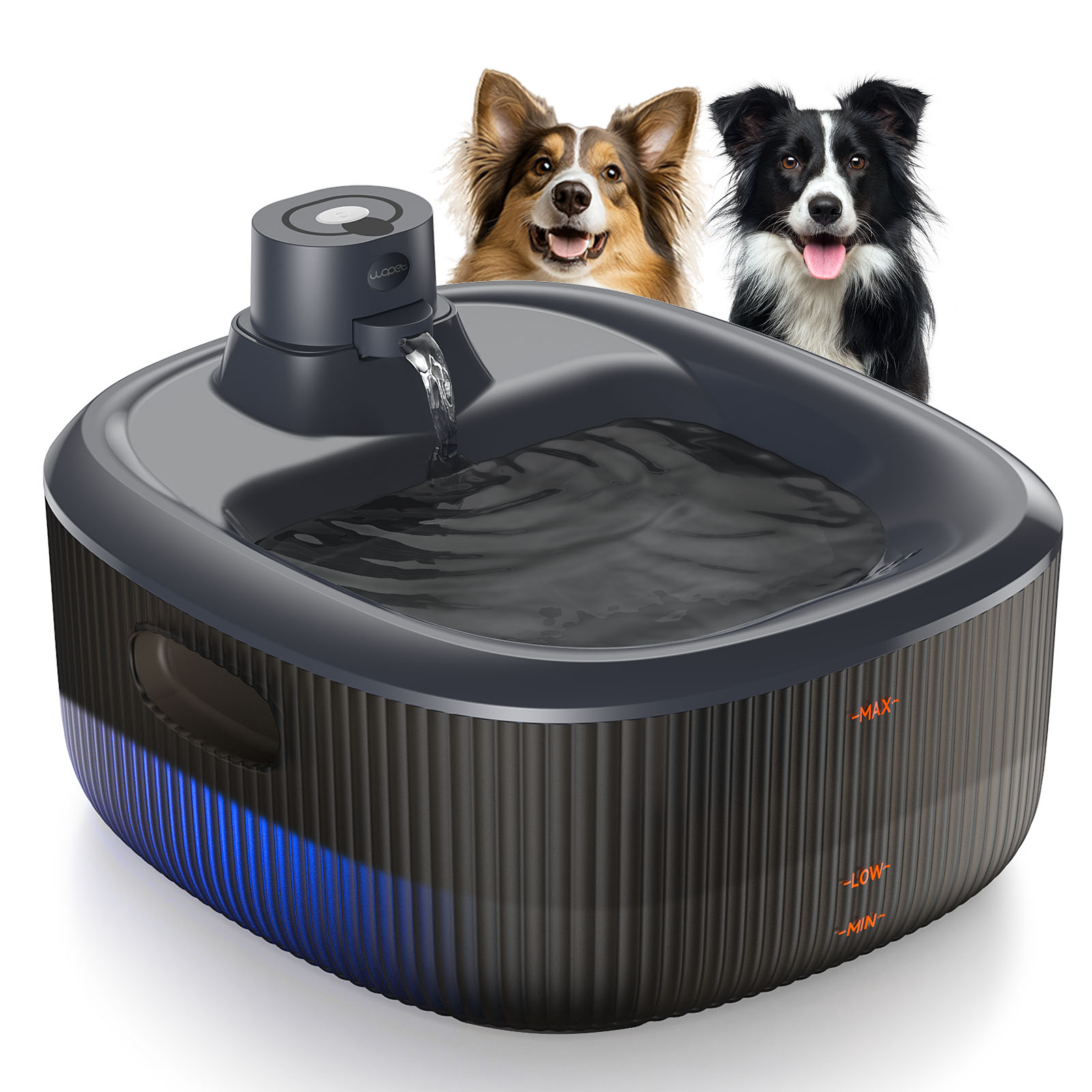
The WOPET W600 Pro is a 6L rechargeable dog water fountain.
Its cordless design allows greater flexibility when choosing a drinking location.
It also offers induction operation, which can activate water circulation when a nearby pet is detected.
Consider the W600 Pro if:
You prefer cordless placement.
You want to reduce exposed operating cables.
You are comfortable monitoring battery status.
You want a rechargeable fountain rather than a gravity dispenser.
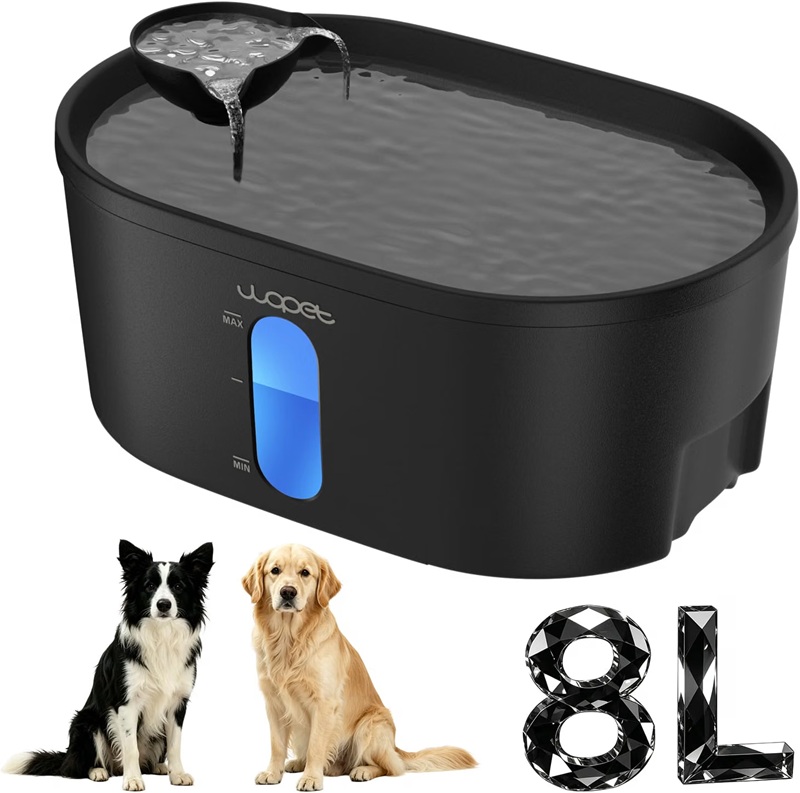
The WOPET A08 is an 8L fountain designed for dogs and multi-cat households.
Its larger reservoir may be useful where several pets share a drinking area.
However, additional drinking stations may still be necessary.
Consider the A08 if:
You have dogs or multiple cats.
You prefer a larger reservoir.
You want a circulating water system.
You can maintain the reservoir and filtration components regularly.
| Model | Capacity | Power Design | Potential Household Fit |
|---|---|---|---|
| WOPET W600 | 6L | Corded | Fixed indoor drinking station |
| WOPET W600 Pro | 6L | Rechargeable | Flexible cordless placement |
| WOPET A08 | 8L | Check current model specifications | Dogs and multi-cat households |
The best model depends on your pets' drinking needs, available space, and preferred maintenance routine.
Before purchasing, ask yourself the following questions.
If your dog seems interested in circulating water, a fountain may be worth considering.
If your dog prefers still water, a gravity dispenser may be sufficient.
If filtration is important, look for a fountain with a clearly described filter system.
Remember that filters still require replacement.
A corded fountain needs a suitable outlet.
A rechargeable fountain needs periodic charging.
A gravity dispenser does not require electricity.
A fountain generally has more components to maintain.
A gravity dispenser is simpler but still requires thorough cleaning.
Choose an appropriate reservoir and drinking-area design.
For multiple pets, consider additional water stations.
Compare purchase prices, filter expenses, electricity, and replacement parts.
Consider whether your dog will still have access to water if circulation stops or the dispenser becomes blocked.
A separate clean bowl is a practical backup.
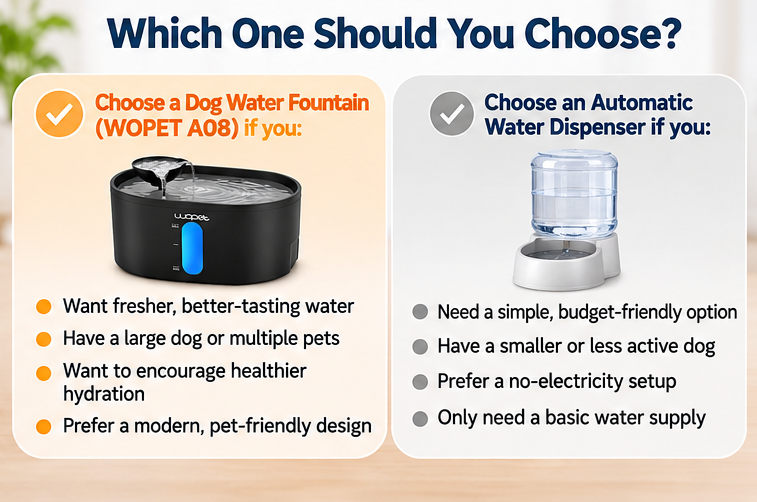
Both fountains and dispensers need cleaning, refilling, and inspection.
A filter does not automatically eliminate microorganisms.
A large reservoir is useful only if the drinking area is accessible and the water remains properly maintained.
Some dogs prefer moving water, while others prefer still water.
Filters, electrical components, and other parts can affect long-term ownership costs.
Equipment can fail or become empty.
Providing a backup water bowl can improve reliability.
Not necessarily.
A fountain offers circulating water and may include filtration.
A gravity dispenser provides automatic replenishment without electricity.
The better option depends on your dog's preferences and your household's needs.
A gravity dispenser replenishes the drinking tray from a reservoir.
However, it does not automatically clean or sterilize the water.
Regular cleaning and water replacement are still necessary.
Basic gravity-fed dispensers do not require electricity.
Other automatic dispenser designs may use electronic controls.
Not automatically.
Hygiene depends on water quality, cleaning frequency, and maintenance.
Yes.
A properly designed and maintained gravity dispenser can provide drinking water for dogs.
Reservoir capacity, drinking-area dimensions, stability, and accessibility are important.
Either system can work if appropriately sized.
Both may be suitable.
Provide enough drinking locations to prevent crowding or competition.
Many small fountains have relatively modest electrical requirements, but consumption varies by model and operating mode.
Check the manufacturer's power specifications.
Inspect the water daily and clean the dispenser regularly according to the manufacturer's instructions.
Clean immediately if you notice residue, contamination, or unpleasant odors.
Yes.
Using both can provide different drinking experiences and an additional water source if one device stops working.
The main difference between a dog water fountain and an automatic water dispenser is how they deliver water.
A dog water fountain circulates water through a powered system and may provide filtration.
A gravity-fed automatic water dispenser replenishes still water from a storage reservoir without electricity.
Choose a fountain if you value circulating water, filtration features, or a particular fountain design.
Choose a gravity dispenser if you want simple automatic refilling with fewer electronic components.
For some households, using both may be the most practical solution.
If you're considering a circulating water system, explore WOPET pet water fountains and compare models such as the W600, W600 Pro, and A08.
Whatever you choose, remember that the best drinking station is one that your dog can use comfortably and that you can keep clean, filled, and functioning reliably.
Read more:
Label:
Popular Post

The Ultimate Guide to Tabby Cats: Patterns, Personalities, and More
Mar 27, 2025

Top 8 Reasons Why Does My Cat Sleep Between My Legs?
Mar 03, 2025

What to Do If My Dog's Poop Is Black But Not Tarry
Feb 04, 2023

Superfecundation Cats: When Kittens in One Litter Have Different Fathers
Jul 11, 2025
How Long Does Dry Cat Food Last Once Opened? A Comprehensive Guide
Mar 19, 2025
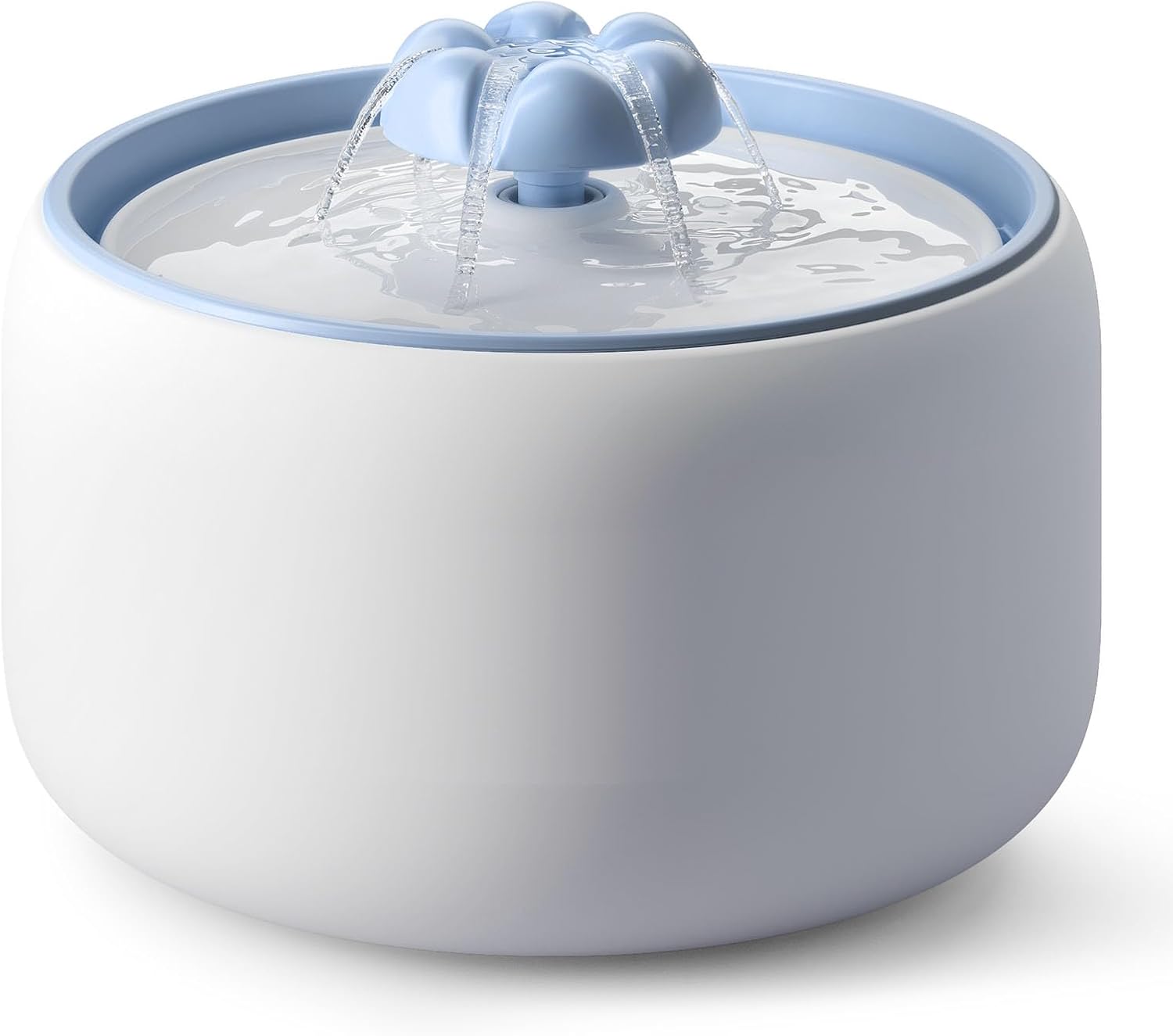
[Blue] W03L 3L Premium Ceramic Cat Water Fountain
Model: W03 LITE
$59.99
$69.99
Basin Pet Water Fountain-W600
Model: W600
$43.99
$69.99
[Basic] Ceramic Pet Water Fountain with Power Cable
Model: W03L
$59.99
$99.00
[Black] W03L 3L Premium Ceramic Cat Water Fountain
Model: W03L Black
$59.99
$69.99

WOPET 8L Pet Water Fountain For Multiple Cats or Large Dogs A08
Model: A08
$49.99
$59.99
WOPET A08 Dog Water Fountain Filters
Model: A08 Filter
$19.99
$29.99

DOWNLOAD APP

WOpet life




Copyright © 2026 WOPET. All Rights Reserved.