Nov 03, 2026
Author:Amanda Lyu
A dog water fountain can make fresh drinking water more accessible throughout the day. But when the fountain starts humming, rattling, or splashing loudly, it can quickly become a distraction.
For pet owners living in apartments, working from home, or sharing a bedroom with their dog, fountain noise can be particularly noticeable.
Some dogs may also hesitate to approach a drinking station that makes unfamiliar mechanical sounds.
That's why choosing a quiet dog water fountain involves more than finding a product advertised as "silent."
A fountain's noise level depends on several factors, including its circulation mechanism, water flow, reservoir level, basin design, vibration control, and maintenance.
Even a fountain with a quiet motor can become noisy when its water level drops or debris accumulates inside the circulation system.
So, how do you choose a quiet dog water fountain that works well in everyday life?
This guide explains seven essential features to consider, the differences between traditional and magnetic-drive circulation systems, and practical ways to reduce fountain noise at home.
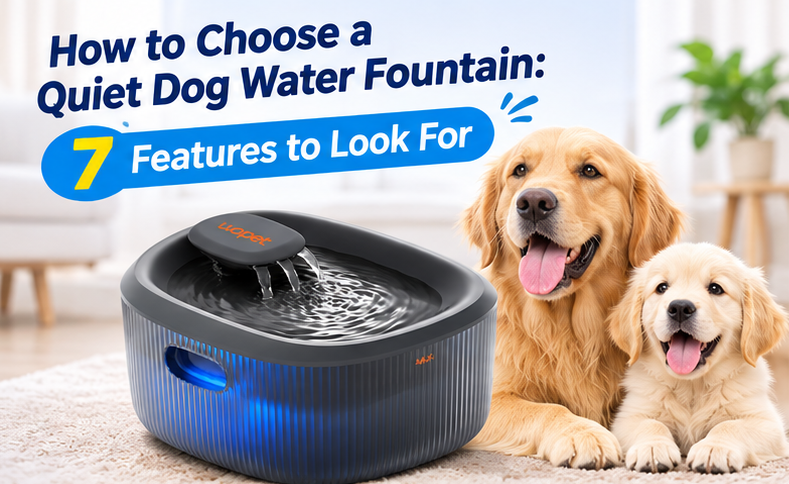
A quiet drinking station can benefit both dogs and their owners.
Dogs respond differently to sound.
Some are comfortable around moving water, while others may be cautious when they hear humming, bubbling, or vibration.
A fountain with gentle circulation and limited mechanical noise may be easier for a noise-sensitive dog to approach.
However, quieter operation does not guarantee that every dog will prefer a fountain.
A fountain may operate for long periods, making even moderate noise noticeable in a quiet room.
This can matter in:
Apartments
Bedrooms
Home offices
Small living spaces
Open-plan kitchens
Shared pet areas
Unusual noise can also indicate a maintenance issue.
A fountain that suddenly becomes louder may have a low water level, loose components, mineral buildup, or debris inside its circulation system.
Recognizing these changes can help owners address problems before they become more serious.
Dog water fountain noise generally comes from two sources: mechanical movement and flowing water.
Understanding the difference can help you choose a better design.
Mechanical noise may come from the circulation motor, impeller, or vibrating components.
It can sound like:
Humming
Buzzing
Rattling
Clicking
Grinding
The exact sound depends on the circulation mechanism and its condition.
Water movement creates another category of sound.
Common examples include:
Splashing
Gurgling
Bubbling
Trickling
Water striking the basin
Some gentle water sounds may be pleasant, while others can become distracting.
A fountain may also transmit vibration into the surface beneath it.
For example, a lightweight fountain placed on a hollow wooden shelf may sound louder than the same fountain placed on a stable countertop.
Key takeaway: A quiet fountain requires more than a low-noise motor. The entire water circulation and drinking system matters.
The circulation mechanism is one of the most important components affecting fountain noise.
Many traditional fountains use a small electric motor to rotate an impeller and move water.
Other designs use magnetic coupling to transfer motion to a water-moving component.
Both approaches can operate quietly when properly designed.
Consider:
Smooth circulation
Securely fitted components
Minimal vibration
Easy access to the impeller or water-moving parts
Clear maintenance instructions
Availability of replacement components
A circulation system that is difficult to clean may become noisier as debris accumulates.
Not necessarily.
Magnetic-drive systems can offer design advantages, but actual noise depends on the complete assembly, motor control, water flow, and installation.
A poorly designed magnetic-drive system may be louder than a well-designed traditional pump.
Buying tip: Look for operating demonstrations and reliable noise measurements instead of assuming a particular circulation technology is silent.
Water flow can have a significant effect on the sound of a dog fountain.
A strong stream falling from a raised outlet may create more splashing than water flowing gently across a surface.
Gentle surface flow
Water moves across a shallow drinking area with a relatively small drop.
This can reduce splashing in some designs.
Raised stream
Water falls from an elevated outlet into the basin.
The sound depends on the height, flow rate, and landing surface.
Bubble-style flow
Water rises through an outlet and moves back into the drinking area.
Noise varies depending on the design and water level.
Often, higher flow rates or greater falling distances can increase splashing sounds.
However, the shape of the outlet and basin also matters.
A carefully designed fountain may provide noticeable water movement without excessive noise.
Some dogs enjoy moving streams, while others prefer a calm drinking surface.
Choose a fountain that balances water movement with drinking comfort.
Buying tip: A gentle, consistent water flow is often a good starting point for households that prioritize quiet operation.
A fountain can become noisy when its components vibrate against the reservoir, base, or surrounding surface.
Even a quiet circulation mechanism may produce noticeable sound if the fountain is unstable.
Loose components
Uneven surfaces
Lightweight construction
Poorly fitted reservoir parts
Contact between moving components and the housing
Hard surfaces that amplify vibration
A stable base can help reduce movement.
Some designs use rubber feet or other vibration-reducing features.
However, overall stability depends on the fountain's weight, shape, and construction.
Choose a level, stable surface.
Avoid locations where the fountain may vibrate against furniture or nearby objects.
A suitable non-slip mat may help reduce transmitted vibration, provided it does not obstruct ventilation or interfere with the product's operation.
Buying tip: Check the base design and component fit, not just the advertised motor noise level.
Low water levels are among the most common reasons a fountain becomes noisy.
When the reservoir contains too little water, air may enter the circulation system.
This can create bubbling, gurgling, or irregular mechanical sounds.
Many circulation systems are designed to operate with a sufficient water supply.
When water drops below the recommended level, circulation may become unstable.
Depending on the design, this can increase noise or damage components.
Large dogs generally consume more water than small dogs.
A fountain with insufficient capacity may require frequent refilling.
| Dog Weight | Approximate Daily Water Intake |
|---|---|
| 10 lbs | 300 mL |
| 25 lbs | 740 mL |
| 50 lbs | 1.5 L |
| 75 lbs | 2.2 L |
| 100 lbs | 3.0 L |
These are general planning estimates, not fixed requirements.
Actual water needs vary with diet, exercise, temperature, age, and health.
A fountain with adequate capacity may be less likely to reach a low water level between routine checks.
However, a larger reservoir does not automatically make a fountain quieter.
Buying tip: Choose sufficient water capacity and keep the reservoir above the manufacturer's minimum operating level.
A quiet fountain can become noisy when its circulation system accumulates debris.
Dog hair, saliva, food particles, and mineral deposits may interfere with water movement.
Humming: May be associated with motor vibration or restricted circulation.
Rattling: May indicate loose components or debris.
Gurgling: Often associated with air entering the water path.
Grinding: May indicate debris or wear in moving components.
Choose a fountain that allows access to:
Drinking basin
Reservoir
Filter compartment
Water channels
Impeller or circulation components
Removable covers and seals
A design that is easy to disassemble can make regular maintenance more manageable.
Filtration may help capture debris before it reaches sensitive components.
However, a clogged filter can restrict water movement and potentially contribute to unusual sounds.
Replace filters according to the manufacturer's instructions.
Buying tip: A fountain with accessible circulation components is often easier to keep operating quietly over time.
The material of a fountain can influence how water sounds when it contacts the drinking surface.
Plastic, ceramic, and stainless steel each have different physical properties.
However, material alone does not determine noise level.
Plastic is lightweight and can be molded into many shapes.
A well-designed plastic basin may help manage water flow and reduce splashing.
However, lightweight construction may allow more noticeable vibration if the base is unstable.
Ceramic is generally heavier than plastic.
This additional weight may help keep the fountain stable.
However, ceramic can chip or break if dropped.
Stainless steel offers durability and a smooth drinking surface.
In some designs, water striking a thin metal basin may produce a noticeable sound.
The actual noise depends on the thickness, shape, and construction.
There is no universal winner.
A well-designed plastic fountain may operate more quietly than a poorly designed ceramic or stainless steel fountain.
Likewise, a stable ceramic fountain may produce less vibration than a lightweight plastic model.
Buying tip: Evaluate the complete fountain design rather than choosing solely by material.
Some dog water fountains offer multiple circulation modes.
These settings can affect how frequently the fountain produces sound.
The fountain circulates water for extended periods.
This provides regular water movement but also means circulation-related sounds may be present for longer.
The fountain operates at scheduled intervals.
This may reduce the total time the circulation mechanism runs.
However, some owners may notice the repeated starting and stopping.
Some fountains use sensors to activate circulation when activity is detected.
This can reduce operation when no pet is nearby.
However, sensor performance depends on the model and placement.
Intermittent or sensor operation may reduce the amount of time the fountain makes circulation sounds.
However, neither mode guarantees lower noise while the system is running.
Buying tip: Choose a mode that balances household noise preferences with your dog's drinking habits and reliable water access.
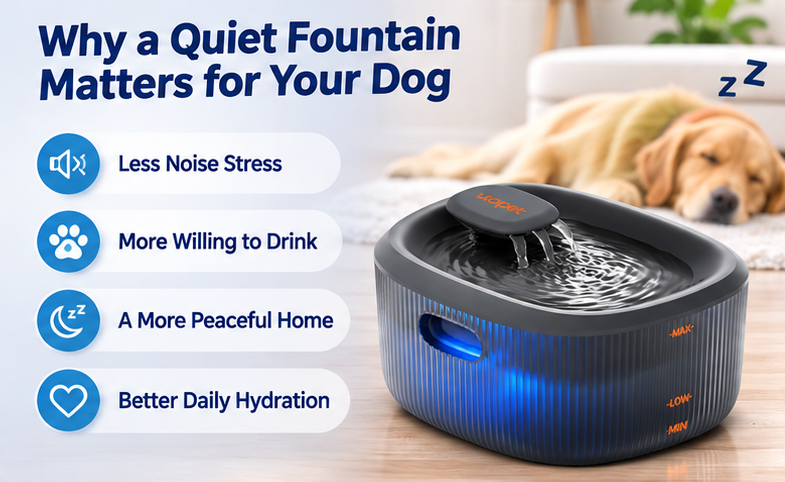
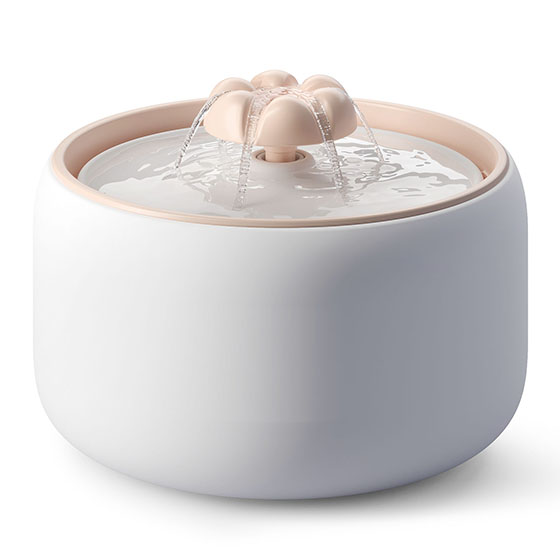
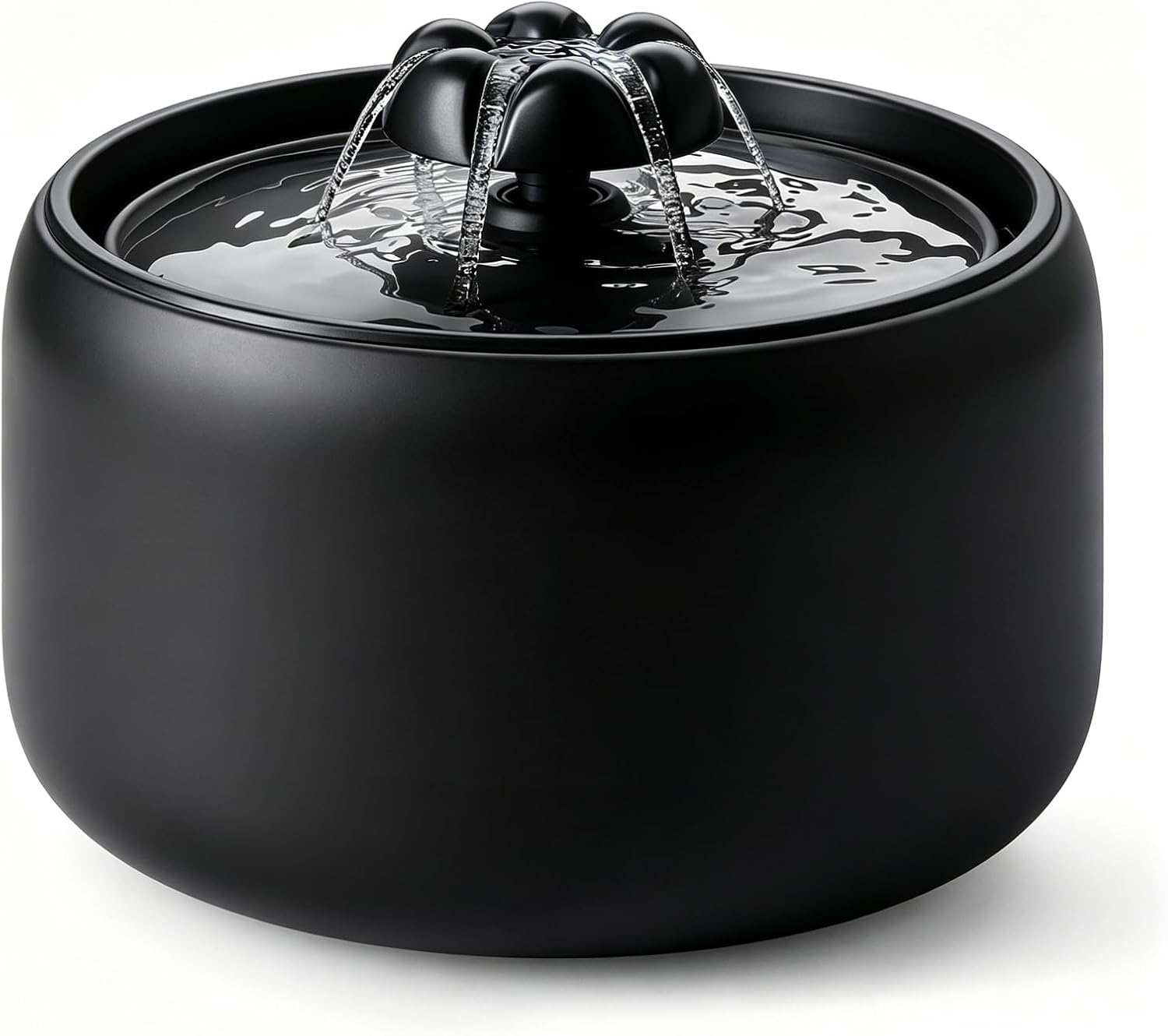
Both traditional and magnetic-drive circulation systems can be used in pet water fountains.
Their noise characteristics depend on engineering and maintenance.
| Feature | Traditional Pump | Magnetic-Drive System |
|---|---|---|
| Water movement | Motor-driven impeller | Magnetically coupled water-moving component |
| Motor placement | Often within submerged pump assembly | Depends on design |
| Noise | Varies by product | Varies by product |
| Cleaning | May require opening pump housing | Depends on component accessibility |
| Vibration | Possible | Possible |
| Maintenance | Regular cleaning required | Regular cleaning required |
| Automatically silent? | No | No |
Magnetic coupling changes how motion is transferred, but it does not eliminate all sources of sound.
Noise may still come from:
Motor operation
Impeller movement
Water turbulence
Loose components
Vibration
Air in the circulation path
The most reliable way to compare products is through consistent noise testing under similar conditions.
Some manufacturers publish noise levels in decibels (dB).
These figures can be useful, but they should be interpreted carefully.
A decibel rating describes sound level under particular measurement conditions.
However, published figures may not be directly comparable unless testing conditions are similar.
Important variables include:
Distance from the fountain
Background noise
Water level
Operating mode
Surface material
Measurement equipment
Room acoustics
A fountain measured at one distance may produce a different reading at another.
There is no universal decibel threshold that guarantees a dog fountain will be quiet enough for every household.
A sound that is barely noticeable in a busy kitchen may be distracting in a silent bedroom.
Instead of focusing on a single number, consider how the fountain sounds in a real living environment.
When watching product demonstrations, pay attention to:
Continuous humming
Intermittent rattling
Water splashing
Changes in sound as the water level drops
Noise after several days of use
A demonstration recorded in a quiet room may provide more useful context than an isolated marketing claim.
Wireless dog water fountains are often associated with modern circulation technology.
However, wireless operation does not automatically mean quieter operation.
A battery-powered fountain may use a traditional circulation mechanism.
Likewise, a plug-in fountain may use a quiet magnetic-drive design.
A rechargeable fountain can operate without a permanent external power cable.
This provides placement flexibility.
Some models also include intermittent or sensor-activated operating modes to conserve battery energy.
These modes may reduce the total time the fountain circulates water.
The main factors remain:
Circulation mechanism
Water flow
Vibration control
Basin construction
Water level
Maintenance
Operating mode
Verdict: Choose a wireless fountain for placement convenience, and uate its noise performance separately.
Apartment living creates several practical considerations.
A fountain may be positioned close to a sofa, desk, bedroom, or shared living space.
Even modest sounds can become noticeable in a small room.
Gentle circulation: Helps limit excessive splashing.
Stable base: Reduces movement and vibration.
Easy cleaning: Helps prevent noise caused by debris.
Appropriate capacity: Reduces the chance of low-water operation.
Flexible placement: Makes it easier to find a suitable location.
Suitable operating modes: May help reduce circulation time when appropriate.
A quiet corner of the kitchen or living room may work well.
Avoid placing the fountain against furniture that could amplify vibration.
Make sure your dog can approach the drinking area comfortably.
If using a rechargeable fountain, choose a location that also allows convenient charging and routine maintenance.
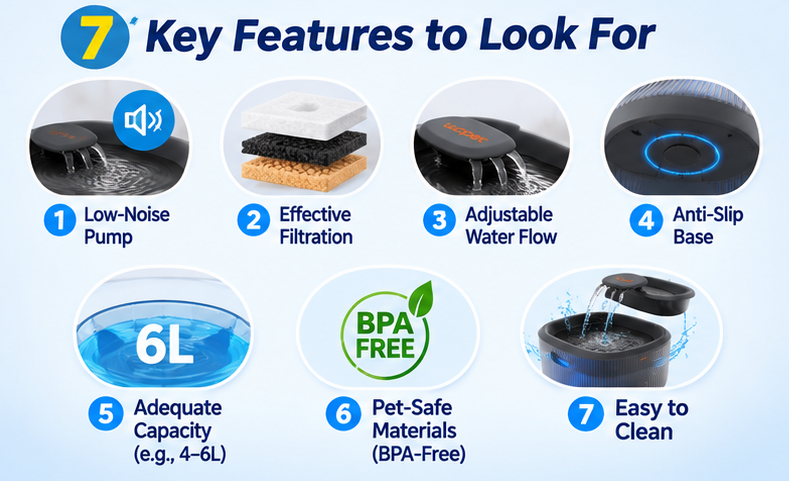
Even a well-designed fountain may become noisier over time.
Before replacing the product, try identifying the source of the sound.
| Noise | Possible Cause | What to Try |
|---|---|---|
| Humming | Motor vibration or restricted circulation | Check water level and component fit |
| Gurgling | Air entering the water path | Refill and inspect circulation |
| Splashing | Excessive water drop or low basin level | Check flow settings and water level |
| Rattling | Loose components or debris | Reassemble and clean |
| Grinding | Debris or wear in moving parts | Turn off and inspect |
| Buzzing | Vibration or electrical component issue | Check instructions; contact support if persistent |
Refill the reservoir to the recommended operating level.
Never operate the fountain below the manufacturer's minimum water level.
A clogged filter may restrict circulation.
Replace it when required.
Turn off the fountain before removing components.
Check for hair, debris, and mineral buildup.
Make sure all removable parts are correctly positioned.
Loose components can create rattling sounds.
A level, stable surface may reduce vibration.
If supported, try a different circulation mode.
Observe whether the sound becomes less noticeable.
If the fountain produces persistent grinding, unusual electrical buzzing, or signs of overheating, stop using it.
Contact the manufacturer for troubleshooting or replacement guidance.
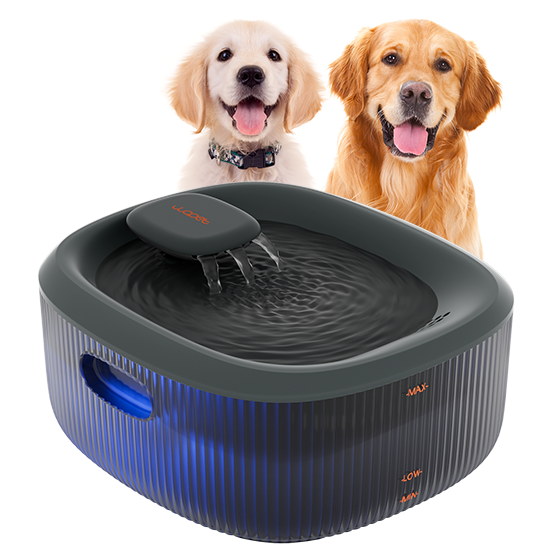
When comparing fountains for quieter operation, WOPET offers models with different designs and intended uses.
Two options worth considering are the WOPET W600 Pro and WOPET A08.
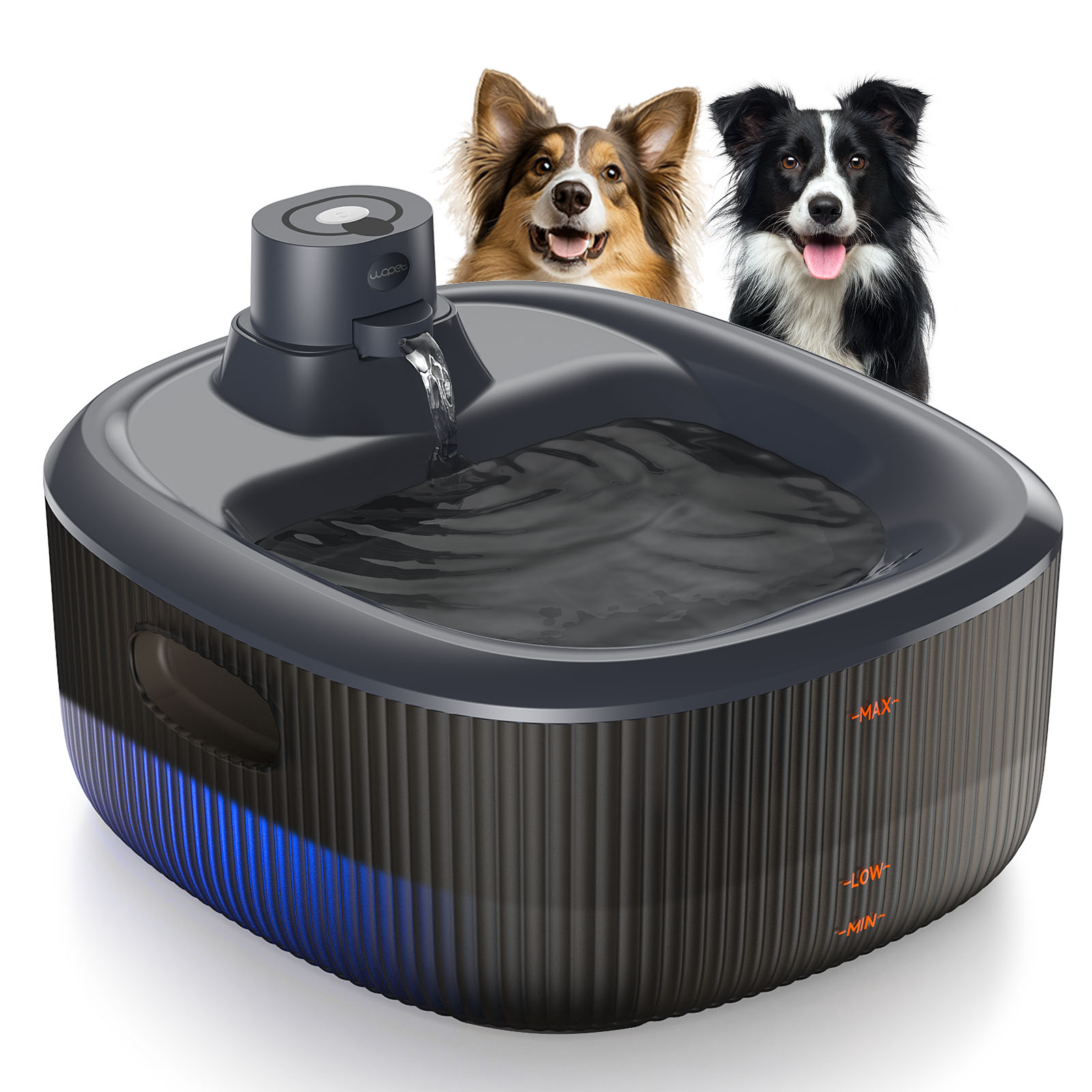
The WOPET W600 Pro is a wireless fountain option for pet owners who value flexible placement.
A cordless design can make it easier to position the drinking station away from inconvenient electrical outlets.
For noise-sensitive households, placement flexibility may be useful because the fountain can be positioned on a stable surface in a suitable location.
When uating the W600 Pro, check:
Water circulation design
Official noise specifications, if available
Operating modes
Water capacity
Cleaning instructions
Battery runtime and charging requirements
Do not assume that wireless operation alone guarantees quieter performance.
Best for: Dog owners who want a wireless drinking station and greater placement flexibility.

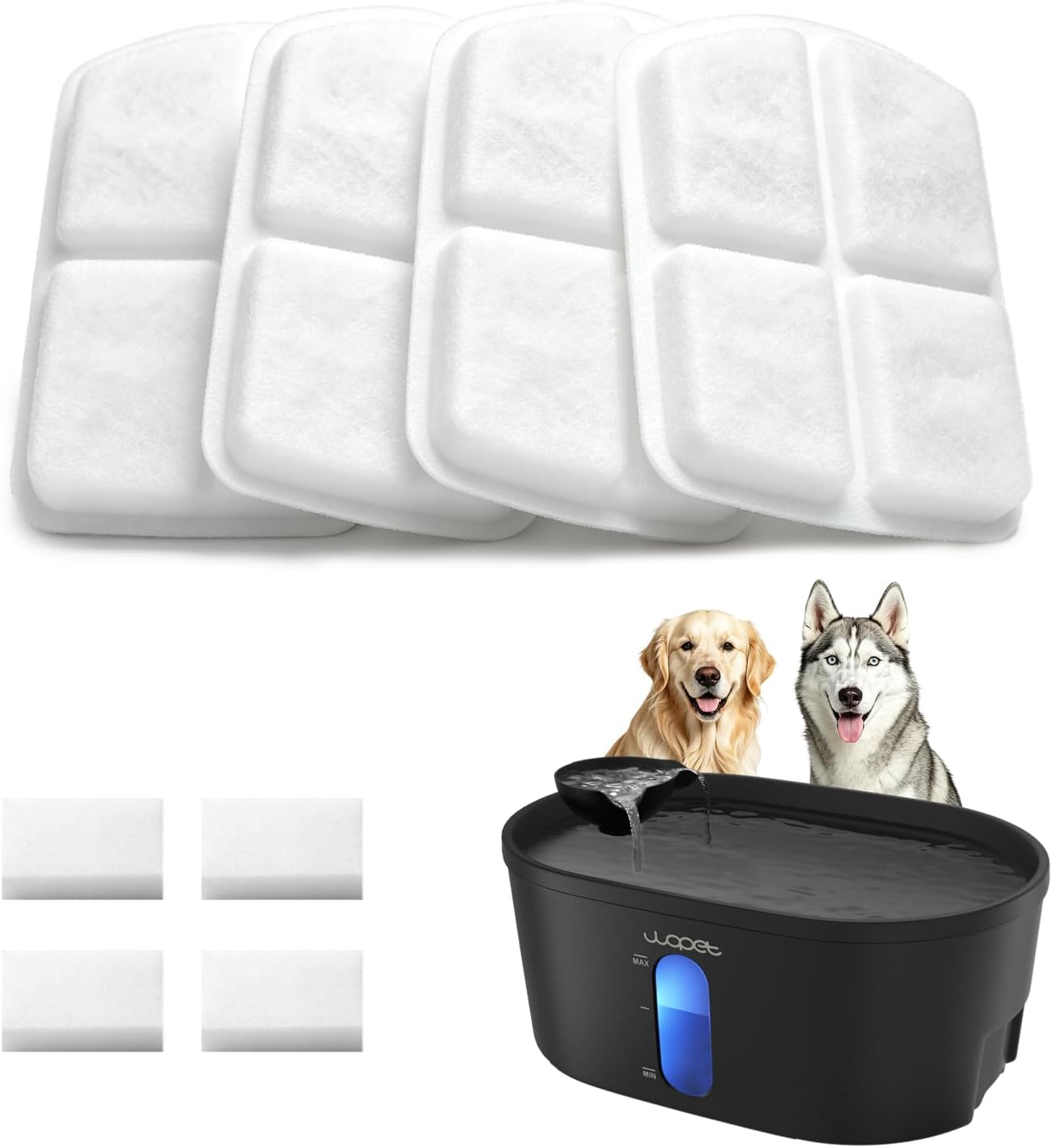
The WOPET A08 is designed for dogs and multi-cat households.
Its plastic construction may appeal to owners who prefer a lightweight fountain that is convenient to handle.
When considering the A08 for a quiet home, uate:
Water flow behavior
Drinking basin design
Stability
Reservoir capacity
Circulation noise
Cleaning accessibility
The A08 may be worth comparing with other fountains when your priority is a practical drinking station for multiple pets.
Best for: Dog owners and multi-cat households looking for a practical plastic fountain.
| Consideration | WOPET W600 Pro | WOPET A08 |
|---|---|---|
| Main positioning | Wireless convenience | Dogs and multi-cat homes |
| Material | Plastic | Plastic |
| Key consideration | Flexible placement | Multi-pet suitability |
| Noise performance | Verify official testing | Verify official testing |
| Cleaning | Follow model instructions | Follow model instructions |
Neither model should be described as quieter than the other without comparable testing data.
Explore WOPET Pet Water Fountains: https://wopet.com/
Noise measurements may use different testing methods.
Compare products carefully.
Battery power and noise performance are separate features.
A fountain that frequently runs low on water may produce more noise.
Debris and mineral deposits can make circulation systems louder.
A narrow or uncomfortable drinking area may discourage your dog from using the fountain.
A vibrating fountain may sound louder on certain furniture or flooring.
Most circulating fountains produce some mechanical or water-related sound.
The goal is comfortable, unobtrusive operation rather than an unrealistic guarantee of complete silence.
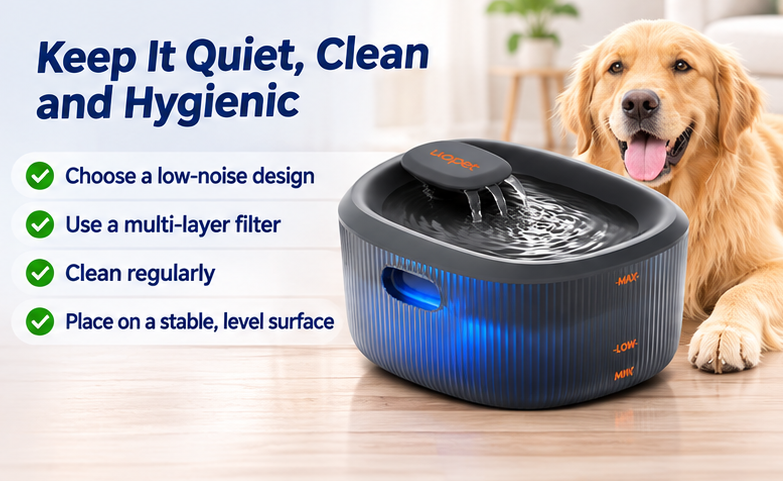
There is no universally quietest type. Noise depends on the circulation mechanism, water flow, construction, placement, and maintenance.
Some magnetic-drive designs may offer noise-related advantages, but they are not automatically quieter than traditional pumps. Actual performance depends on the product.
Humming may result from motor vibration, component contact, or restricted circulation. Check the water level, assembly, and maintenance instructions.
Gurgling often occurs when air enters the water path, sometimes because the reservoir is too low.
Ceramic's weight may help stability, but actual noise depends on the complete design. Ceramic is not automatically quieter than plastic or stainless steel.
Not necessarily. Battery operation affects the power source, while noise depends on circulation and construction.
Maintain the recommended water level, clean the circulation components, replace clogged filters, and place the fountain on a stable surface.
Some dogs may be cautious around unfamiliar sounds. A quieter fountain and gradual introduction may help them become comfortable.
Yes, provided it has adequate capacity, a comfortable drinking area, and stable construction.
Some sound is normal because the fountain moves water. Persistent grinding, loud rattling, or unusual buzzing may indicate a problem.
Choosing a quiet dog water fountain involves more than selecting a product with a low-noise motor.
The best designs balance seven important features:
Low-noise circulation
Gentle water flow
Stable construction
Adequate water capacity
Easy-to-clean components
Suitable materials and basin design
Practical operating modes
Regular maintenance is equally important.
Even a quiet fountain may become noisy when the reservoir runs low, the filter becomes clogged, or debris accumulates inside the circulation system.
For pet owners comparing WOPET products, the WOPET W600 offers wireless placement flexibility, while the WOPET A08 is designed for dogs and multi-cat households.
Choose a fountain that fits your dog's drinking needs, your household environment, and your cleaning routine.
The best quiet dog water fountain is one that provides comfortable water access while keeping mechanical vibration and splashing to a manageable level.
Label:
Popular Post

Top 8 Reasons Why Does My Cat Sleep Between My Legs?
Mar 03, 2025

What to Do If My Dog's Poop Is Black But Not Tarry
Feb 04, 2023

Superfecundation Cats: When Kittens in One Litter Have Different Fathers
Jul 11, 2025
Can Cats Have Orange Eyes? Genetics, Breeds, and Care Guide
May 20, 2025
How Long Does Dry Cat Food Last Once Opened? A Comprehensive Guide
Mar 19, 2025
[Blue] W03L 3L Premium Ceramic Cat Water Fountain
Model: W03 LITE
$59.99
$69.99
Basin Pet Water Fountain-W600
Model: W600
$43.99
$69.99
[Basic] Ceramic Pet Water Fountain with Power Cable
Model: W03L
$59.99
$99.00
[Black] W03L 3L Premium Ceramic Cat Water Fountain
Model: W03L Black
$59.99
$69.99

WOPET 8L Pet Water Fountain For Multiple Cats or Large Dogs A08
Model: A08
$49.99
$59.99
WOPET A08 Dog Water Fountain Filters
Model: A08 Filter
$19.99
$29.99

DOWNLOAD APP

WOpet life




Copyright © 2026 WOPET. All Rights Reserved.