Nov 04, 2026
Author:Jackson Watson
Choosing a dog water fountain isn't simply about finding the largest reservoir or the most compact design. The right size depends on how much water your dog drinks, how comfortably they can reach the drinking area, and how the fountain fits into your daily routine.
A small dog water fountain may be convenient for a single small breed or a household with limited space. A larger fountain can provide more stored water, making it practical for large dogs or homes with multiple pets.
But is a larger dog water fountain always better?
Not necessarily.
A large reservoir doesn't guarantee a comfortable drinking experience, and a small fountain isn't automatically unsuitable for a bigger dog.
In this guide, we'll compare large and small dog water fountains, explain how to estimate capacity needs, and explore the features that matter most when choosing a fountain for your dog.
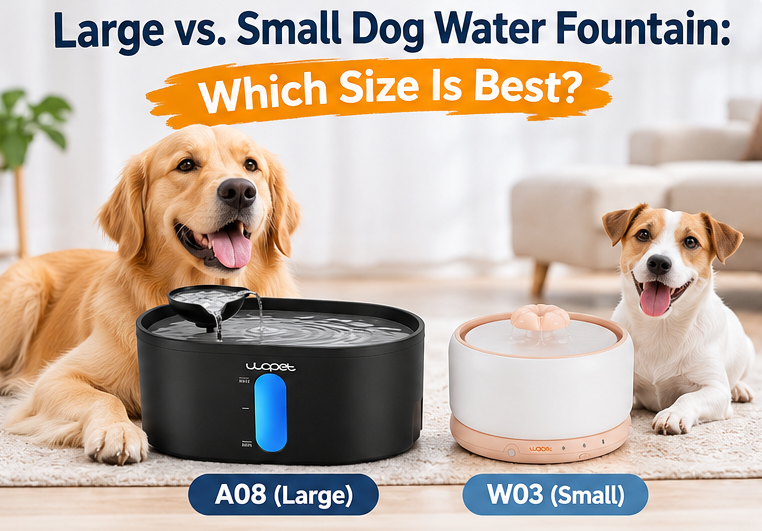
Buy WOPET W03 WIRELESS DOG WATER FOUNTAIN ON AMAZON
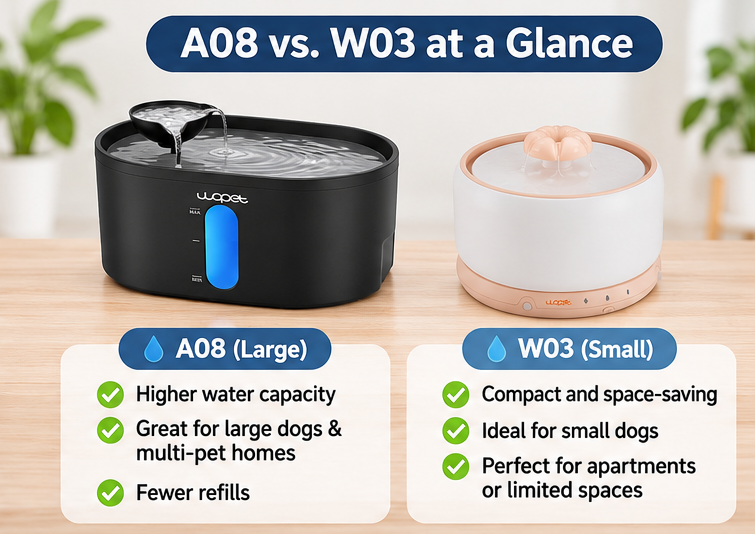
Here's how small and large dog water fountains typically compare.
| Feature | Small Dog Water Fountain | Large Dog Water Fountain |
|---|---|---|
| Reservoir capacity | Generally lower | Generally higher |
| Physical footprint | Usually more compact | Often larger |
| Refill frequency | May require more frequent refilling | May reduce refill frequency |
| Drinking area | Depends on design | May offer more space |
| Weight when full | Usually lighter | Often heavier |
| Cleaning | Smaller components | Larger reservoir and components |
| Multi-pet suitability | Depends on household needs | Often more practical |
| Placement flexibility | Usually easier in tight spaces | Requires adequate floor space |
| Best for | Lower water demand and compact areas | Higher water demand and multi-pet homes |
Quick answer: A smaller fountain may be sufficient for a small dog with modest water needs, while a larger fountain may be more convenient for large breeds or multiple pets. However, drinking-area dimensions, ease of cleaning, and reliable water access are just as important as reservoir capacity.
There is no universal industry standard defining a small or large dog water fountain.
Manufacturers may describe products based on reservoir capacity, physical dimensions, or intended pet size.
For general comparison, the following ranges can be useful.
| Fountain Capacity | General Description | Potential Use |
|---|---|---|
| Under 2L | Compact | Lower water demand, limited space |
| 2–4L | Small to medium | Single-pet households |
| 4–6L | Medium to large | Dogs with higher water demand |
| 6–8L | Large capacity | Larger dogs or multiple pets |
| Over 8L | Extra-large capacity | Higher-demand multi-pet households |
These are illustrative shopping categories, not official standards or veterinary recommendations.
A 2L fountain might be suitable for one dog in one household but inadequate for another dog with similar body weight.
Likewise, a 6L fountain can be useful for a small dog if its drinking area is accessible and the owner maintains the water properly.
A fountain with a tall reservoir may store more water without providing a wider drinking basin.
Another model may have a relatively shallow reservoir but a spacious drinking area.
This distinction matters because your dog interacts with the drinking surface, not the reservoir capacity printed on the product listing.
Before choosing a fountain size, estimate how much water your dog typically consumes.
A commonly used starting estimate for healthy adult dogs is approximately 40–60 milliliters of total water per kilogram of body weight per day.
Actual needs vary considerably.
Factors that influence water requirements include:
Body weight.
Activity level.
Temperature and humidity.
Dry versus wet food.
Age.
Pregnancy or nursing.
Medications.
Health conditions.
Water from food contributes to total intake, so the amount a dog drinks directly from a fountain may be lower than the estimated total.
The following figures are illustrative estimates, not fixed daily targets.
| Dog Weight | Approximate Total Daily Water |
|---|---|
| 5 kg / 11 lb | 200–300 mL |
| 10 kg / 22 lb | 400–600 mL |
| 20 kg / 44 lb | 800–1,200 mL |
| 30 kg / 66 lb | 1,200–1,800 mL |
| 40 kg / 88 lb | 1,600–2,400 mL |
These estimates should not be used to restrict drinking water.
Dogs should have access to fresh water, and unusual changes in thirst should be discussed with a veterinarian.
Suppose a 30 kg dog consumes approximately 1.5L of water per day.
A 2L fountain might require frequent refilling.
A 6L fountain provides a larger reservoir, potentially reducing how often the owner needs to add water.
However, this doesn't mean you should leave the same water in the fountain for several days without checking or refreshing it.
A larger reservoir is a convenience feature, not a substitute for regular water changes.
Reservoir capacity is the most obvious difference.
A small fountain stores less water.
A larger fountain can store more, which may be convenient when water demand is higher.
A compact reservoir may be:
Easier to lift.
Faster to empty.
More convenient to wash in a small sink.
Suitable for lower-demand households.
A larger reservoir may:
Reduce refill frequency.
Support higher household water demand.
Be useful for multiple pets.
Provide more capacity during busy periods.
However, the stated capacity may not equal the amount of water available for drinking before the fountain reaches its minimum operating level.
Always follow the manufacturer's minimum and maximum fill markings.
Which is better?
Choose capacity based on actual water demand and your ability to maintain the fountain.
The drinking basin is where your dog actually drinks.
A large reservoir doesn't necessarily mean a wide drinking surface.
Dogs need enough room to comfortably lower their muzzle and lap water.
A narrow basin may feel restrictive to some large breeds.
Dogs with broad muzzles may particularly benefit from a more spacious drinking area.
A basin should allow comfortable drinking without requiring awkward positioning.
A shallow basin may be accessible for small dogs, while other dogs may prefer a deeper or broader drinking area.
The ideal design depends on the dog's size, muzzle shape, and mobility.
Larger fountains may reduce the number of times you need to refill the reservoir.
But refill frequency depends on more than capacity.
Consider:
How many dogs use the fountain.
How much they drink.
Whether cats share the water station.
Water lost through splashing.
Evaporation.
The fountain's minimum operating level.
Imagine two dogs consuming approximately 2.5L of drinking water combined each day.
A 3L fountain may require frequent refilling to remain above its minimum operating level.
A 6L fountain offers more stored water.
However, daily checks and regular cleaning remain necessary.
Which is better?
A larger fountain is often more convenient for households with higher water demand.
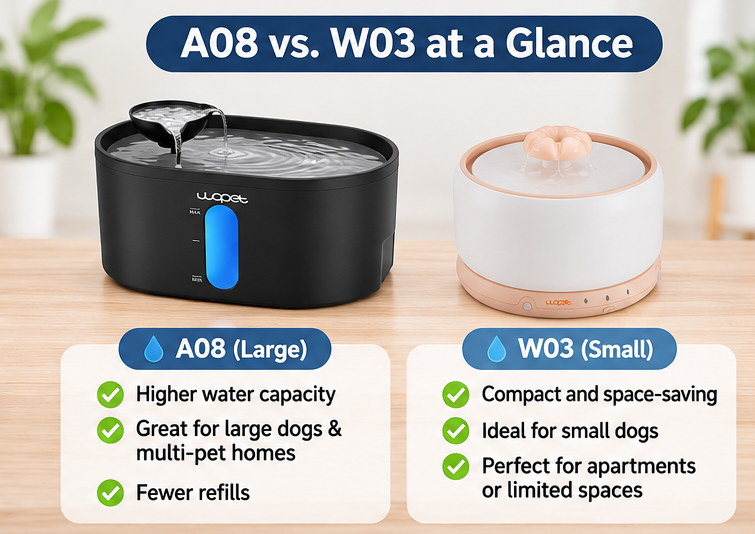
Buy WOPET A08 Dog Water fountain on Amazon
The amount of floor space a fountain occupies can affect where you place it.
Compact fountains may fit more easily in:
Apartments.
Smaller kitchens.
Dedicated pet corners.
Narrow indoor spaces.
However, avoid placing fountains where they block walkways.
Larger fountains may offer broader bases and more substantial drinking areas.
Some are designed for use in fixed indoor locations.
Before purchasing, check:
Overall length and width.
Available floor space.
Distance from electrical outlets, if required.
Access for cleaning.
Whether your dog can approach comfortably.
Both large and small fountains require regular maintenance.
A smaller fountain may be easier to lift and wash.
A larger fountain may have more surface area to clean.
However, actual cleaning convenience depends on design.
Look for:
Removable reservoirs.
Accessible water channels.
Smooth interior surfaces.
Easy-to-remove drinking basins.
Clearly explained filter replacement.
Components that can be cleaned without specialized tools.
Not necessarily.
Water can become contaminated regardless of reservoir size.
Pet saliva, food residue, dust, and biofilm may accumulate in either design.
A large fountain should still be inspected daily and cleaned according to its instructions. How to Clean a Dog Water Fountain: Step-by-Step Guide
A fountain becomes heavier when filled with water.
Since one liter of water weighs approximately one kilogram, an 8L reservoir can hold roughly 8 kg of water when full, excluding the fountain itself.
This matters when moving or cleaning the unit.
A compact fountain may be easier to:
Lift.
Carry.
Empty.
Reposition.
A large fountain may be more practical as a permanent drinking station.
For safe handling, empty the reservoir before moving it whenever the manufacturer recommends doing so.
Avoid carrying a full fountain by components not designed as handles.
Large fountains sometimes cost more initially, but capacity alone does not determine total ownership cost.
Other expenses may include:
Replacement filters.
Electricity or charging.
Replacement circulation components.
Cleaning supplies.
Compatible accessories.
A larger fountain isn't automatically more expensive to operate.
Energy consumption depends on the circulation system, operating mode, and actual power requirements.
Similarly, filter costs depend on the model rather than reservoir size alone.
Which is better?
Choose the fountain that meets your needs without paying for capacity or features you won't use.
One of the biggest mistakes when shopping for a dog water fountain is focusing only on liters.
Reservoir capacity tells you how much water the fountain can store.
Basin dimensions tell you how much space your dog has to drink.
These are separate characteristics.
Imagine two fountains with identical 6L reservoirs.
Fountain A has a narrow drinking opening.
Fountain B has a wide, accessible basin.
A large dog with a broad muzzle may find Fountain B more comfortable, even though both store the same amount of water.
Before purchasing, review:
Reservoir capacity.
Drinking basin width.
Drinking basin depth.
Overall fountain height.
Floor footprint.
Minimum operating water level.
A product that fits your dog's body and drinking behavior is more useful than one chosen by capacity alone.
Different dogs have different drinking needs, but body size is only a starting point.
Small dogs may do well with compact fountains.
Important features include:
Accessible drinking height.
Stable construction.
Comfortable basin dimensions.
Easy cleaning.
Quiet operation.
A small dog does not necessarily need a small reservoir.
A larger fountain may still be convenient if it is accessible and properly maintained. Best Dog Water Fountain for Small Dogs: 7 Key Features
Medium-sized dogs may benefit from a wider range of fountain capacities.
Focus on:
Daily water consumption.
Drinking-area comfort.
Available space.
Refill frequency.
Ease of maintenance.
For many households, a medium or large reservoir may offer a practical balance.
Large dogs often have higher total water needs. Best Water Fountain for Large Dogs: Size, Capacity & Features
A larger reservoir may reduce frequent refilling.
However, the drinking basin must also be comfortable.
Look for:
Spacious drinking areas.
Stable bases.
Accessible water surfaces.
Suitable reservoir capacity.
Easy cleaning and refilling.
For older dogs, drinking height and accessibility may be more important than reservoir capacity.
Dogs with mobility limitations may need a drinking station that doesn't require uncomfortable bending or stretching.
Consult your veterinarian if your dog has difficulty drinking.
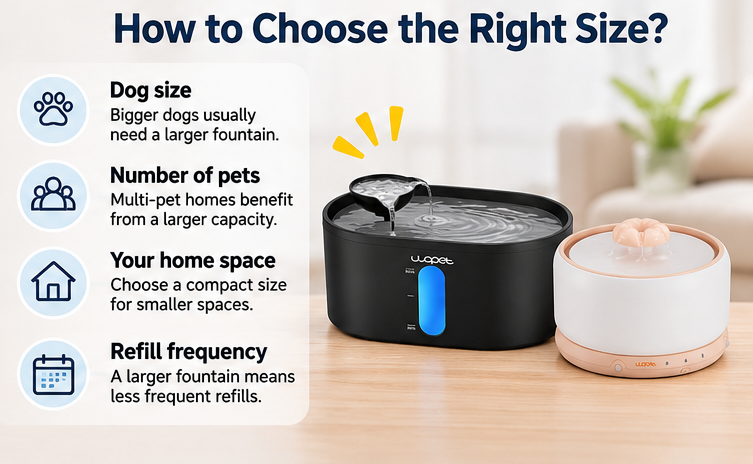
In multi-dog households, calculate the combined water demand rather than considering only the largest dog.
Suppose your household includes:
One 10 kg dog.
One 20 kg dog.
One 30 kg dog.
Using the illustrative 40–60 mL/kg/day estimate, their combined total daily water requirement may be approximately 2.4–3.6L.
A 6L or 8L reservoir could offer more capacity than a compact fountain.
However, the actual amount they drink from the fountain will depend partly on their diets and other conditions.
Even a very large fountain provides only one drinking location.
Some dogs may avoid approaching it when another pet is nearby.
Providing additional water bowls or fountains can help reduce competition.
Consider:
Total household water demand.
Number of drinking locations.
Drinking-area accessibility.
Reservoir capacity.
Cleaning frequency.
Pet behavior around shared resources.
The goal is reliable access, not simply maximum capacity.
No.
A larger fountain can offer convenience, but it may also introduce disadvantages.
Greater stored water capacity.
Less frequent refilling in some households.
Possible suitability for higher-demand homes.
Potentially more spacious drinking areas, depending on design.
Larger floor footprint.
Greater weight when filled.
More water to empty during cleaning.
Potentially higher purchase cost.
Unnecessary capacity for some households.
A compact fountain may be the better choice when:
You have one small dog.
Space is limited.
You prefer lightweight equipment.
You refill and clean the fountain frequently.
The drinking basin is comfortable for your pet.
The best fountain is appropriately sized, not simply the largest available.
WOPET offers several fountain options for households with different water-capacity and placement needs.
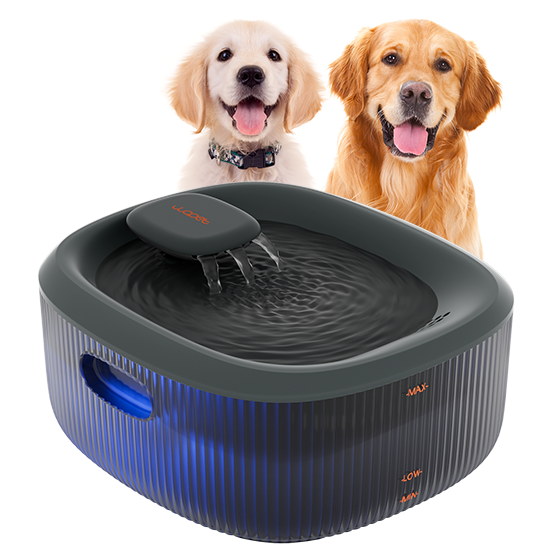
The WOPET W600 is a 6L corded dog water fountain.
It may be suitable for households that want a fixed indoor drinking station with a relatively large reservoir.
Its basin-style design is intended for dogs.
Consider the W600 if:
You have a convenient power outlet.
You prefer a stationary drinking setup.
You want a 6L reservoir.
You're looking for a dog-focused basin-style fountain.
The WOPET W600 Pro offers a 6L reservoir with rechargeable operation.
Its cordless design provides greater flexibility when choosing where to place the fountain.
Consider the W600 Pro if:
You prefer cordless placement.
You want a 6L water reservoir.
You have limited outlet access near the drinking area.
You're comfortable managing battery charging.
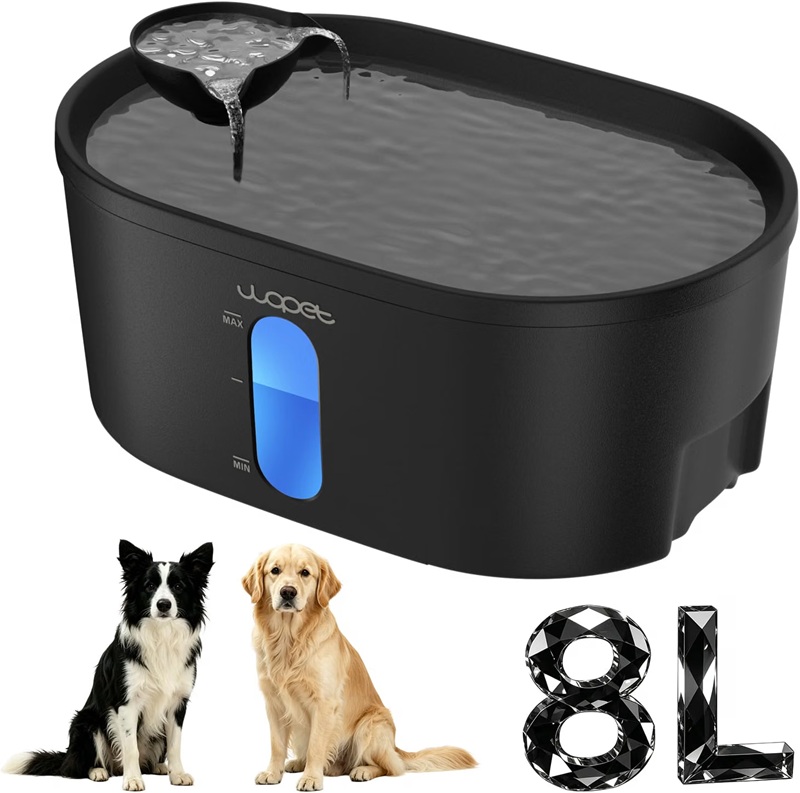
The WOPET A08 is an 8L pet water fountain designed for dogs and multi-cat households.
Its larger reservoir may be useful where total household water demand is higher.
However, capacity alone does not determine how many pets can comfortably share a drinking station.
Consider the A08 if:
You want an 8L reservoir.
You have dogs or multiple cats.
Your household has relatively high water demand.
You can accommodate a larger drinking station.
| Model | Reservoir Capacity | Power Type | Potential Household Fit |
|---|---|---|---|
| WOPET W600 | 6L | Corded | Fixed indoor dog drinking station |
| WOPET W600 Pro | 6L | Rechargeable | Flexible cordless placement |
| WOPET A08 | 8L | Check current model specifications | Dogs and multi-cat households |
When comparing these models, check the current product dimensions and drinking-basin measurements before purchasing.
A practical buying decision starts with your dog's needs and your household routine.
Consider your dog's weight, diet, activity level, and normal drinking behavior.
For multiple pets, estimate their combined needs.
Select a capacity that fits your preferred refill routine.
Remember that the full reservoir volume may not be usable before reaching the fountain's minimum operating level.
Make sure your dog can drink comfortably.
For large dogs, basin width and accessibility may be especially important.
Check the fountain's footprint and ensure it fits without obstructing movement.
Choose a design you can disassemble and clean regularly.
Decide whether you prefer a corded or rechargeable fountain.
Keep a separate clean water bowl available when appropriate.
This is particularly helpful during cleaning, power interruptions, or equipment problems.
More capacity isn't always necessary.
Consider drinking comfort, maintenance, and available space.
A high-capacity fountain may still have a narrow drinking opening.
Stored water still needs regular inspection and replacement.
Large reservoirs can be heavy when filled.
Multiple drinking stations may be necessary even when one fountain has sufficient capacity.
A fountain that is difficult to clean may be inconvenient regardless of its size.
Choose based on your dog's daily water demand, drinking-area comfort, and the number of pets using the fountain.
Reservoir capacity alone is not enough.
It may be enough for some small dogs, depending on water consumption and refill frequency.
Check the fountain's minimum operating level and your dog's actual needs.
A 6L fountain may be practical for many large-dog households.
However, drinking-basin dimensions and maintenance requirements also matter.
Not necessarily.
An 8L reservoir may be convenient, but it can take up more space and be heavier to clean.
Choose based on practical needs.
Many large dogs benefit from a spacious, accessible drinking area.
However, the ideal dimensions depend on muzzle shape, body size, and individual preferences.
A larger reservoir may help meet higher water demand.
But multiple drinking locations may still be needed.
Not necessarily.
Electricity use depends on the circulation system, operating mode, and power specifications rather than capacity alone.
They may be easier to lift and handle, but cleaning convenience depends on the design and accessibility of the components.
Yes, if the drinking area is comfortable for both and there are enough water stations to avoid competition.
Check water levels daily and refill as needed.
Do not rely on reservoir capacity alone to determine when water should be refreshed or the fountain cleaned.
When comparing a large vs. small dog water fountain, the most important consideration is whether the fountain fits your dog's drinking needs and your household routine.
A small fountain may be ideal for limited spaces and lower water demand.
A larger fountain may offer more convenience for large dogs or multi-pet households.
But bigger doesn't automatically mean better.
The best fountain combines suitable reservoir capacity, a comfortable drinking basin, easy cleaning, and reliable operation.
For households looking for larger reservoirs, WOPET offers options such as the 6L W600, 6L W600 Pro, and 8L A08.
Explore WOPET pet water fountains to compare designs and find a drinking station that fits your pets.
Whatever size you choose, provide fresh water, inspect the drinking station daily, and maintain the fountain according to its instructions.
Label:
Popular Post
The Ultimate Guide to Tabby Cats: Patterns, Personalities, and More
Mar 27, 2025

Top 8 Reasons Why Does My Cat Sleep Between My Legs?
Mar 03, 2025

What to Do If My Dog's Poop Is Black But Not Tarry
Feb 04, 2023
Superfecundation Cats: When Kittens in One Litter Have Different Fathers
Jul 11, 2025
How Long Does Dry Cat Food Last Once Opened? A Comprehensive Guide
Mar 19, 2025
[Blue] W03L 3L Premium Ceramic Cat Water Fountain
Model: W03 LITE
$59.99
$69.99
Basin Pet Water Fountain-W600
Model: W600
$43.99
$69.99
[Basic] Ceramic Pet Water Fountain with Power Cable
Model: W03L
$59.99
$99.00
[Black] W03L 3L Premium Ceramic Cat Water Fountain
Model: W03L Black
$59.99
$69.99
WOPET 8L Pet Water Fountain For Multiple Cats or Large Dogs A08
Model: A08
$49.99
$59.99
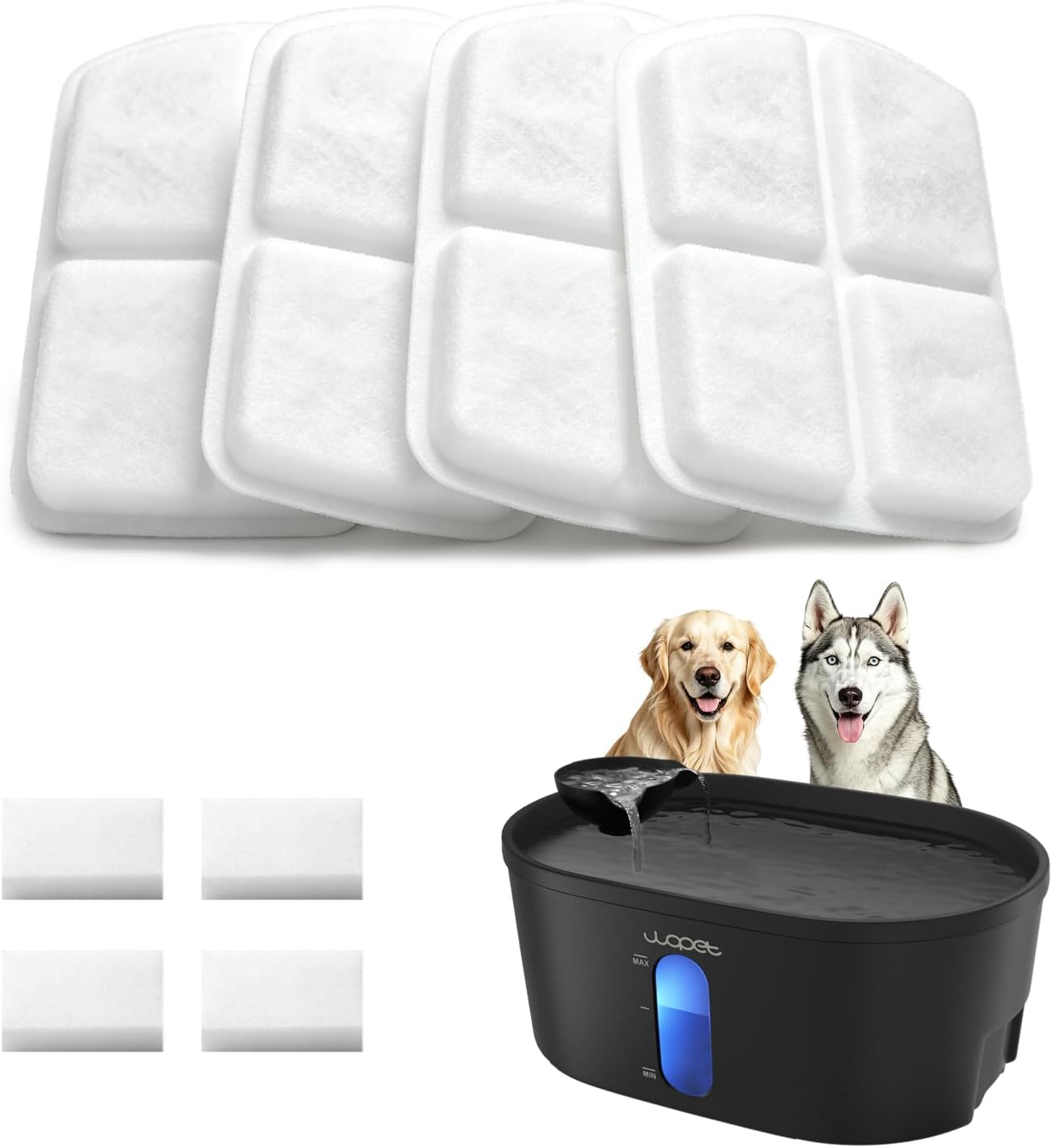
WOPET A08 Dog Water Fountain Filters
Model: A08 Filter
$19.99
$29.99

DOWNLOAD APP

WOpet life




Copyright © 2026 WOPET. All Rights Reserved.