Nov 03, 2026
Author:Amanda Lyu
Your dog walks over to the water bowl, takes a few drinks, and wanders away. Later, after a long walk, they return and drink much more.
But how much water should a dog actually drink per day?
Is one bowl enough? Does a 50-pound dog need twice as much water as a 25-pound dog? And should you worry if your dog suddenly drinks more or less than usual?
Water is essential for nearly every function in your dog's body. It helps regulate temperature, transport nutrients, support digestion, lubricate joints, and remove waste products.
However, there is no single daily water amount that works for every dog.
A dog's water requirements depend on body weight, diet, activity level, weather, age, and overall health.
In this guide, you'll learn how to estimate your dog's daily water needs, understand the factors that influence hydration, recognize warning signs, and choose a practical drinking setup for your home.
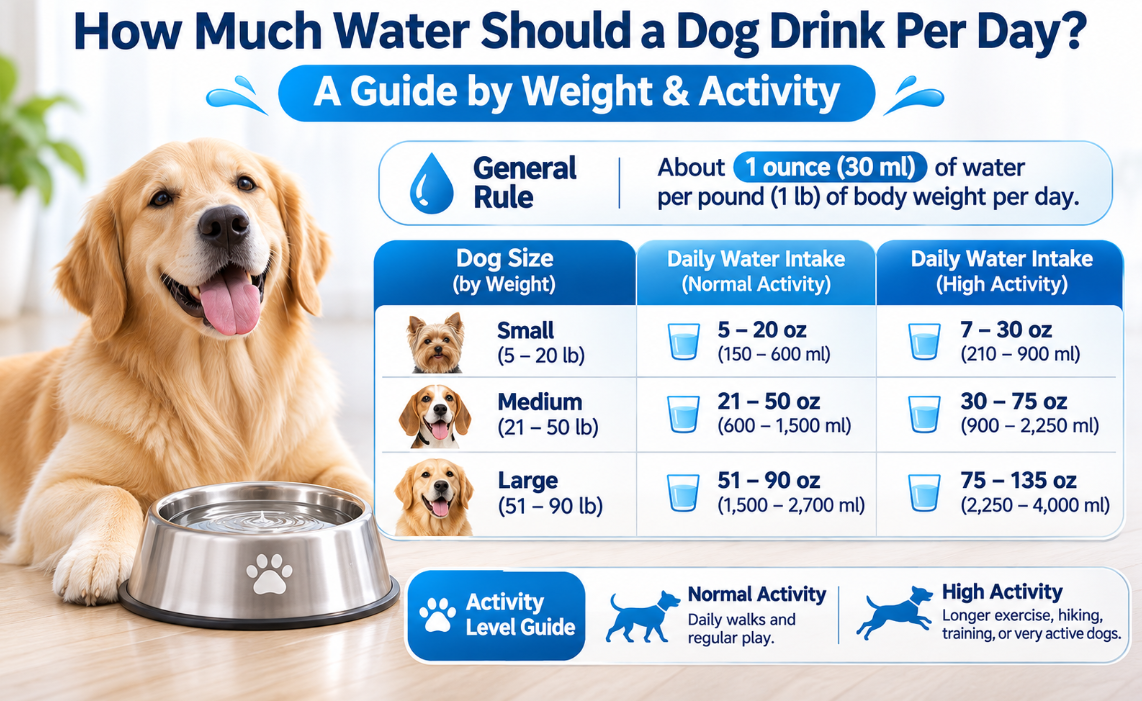
For many healthy adult dogs, approximately 40–60 milliliters of water per kilogram of body weight per day can serve as a rough starting estimate.
This range is intended for general planning rather than a fixed drinking target.
For example:
A 10 kg dog may need approximately 400–600 mL daily.
A 20 kg dog may need approximately 800–1,200 mL daily.
A 30 kg dog may need approximately 1.2–1.8 liters daily.
These estimates describe a general water requirement, not necessarily the exact amount a dog must drink from a bowl.
Dogs also obtain water through their food.
A dog eating moisture-rich wet food may drink substantially less from a bowl than a similar dog eating dry kibble.
Two dogs of the same weight can have different water requirements.
Consider two 40-pound dogs.
One spends most of the day resting indoors in an air-conditioned home.
The other spends an hour running outdoors in warm weather.
Even though both dogs weigh the same, their water needs may differ considerably.
Rather than forcing your dog to drink a predetermined amount, focus on providing reliable access to fresh water and recognizing changes from their usual drinking pattern.
The following chart provides approximate daily water requirements for healthy adult dogs using the 40–60 mL/kg planning range.
| Dog Weight | Approximate Daily Water |
|---|---|
| 5 lbs (2.3 kg) | 90–140 mL |
| 10 lbs (4.5 kg) | 180–270 mL |
| 15 lbs (6.8 kg) | 270–410 mL |
| 20 lbs (9.1 kg) | 360–550 mL |
| 30 lbs (13.6 kg) | 540–820 mL |
| 40 lbs (18.1 kg) | 720–1,090 mL |
| 50 lbs (22.7 kg) | 910–1,360 mL |
| 60 lbs (27.2 kg) | 1.1–1.6 L |
| 70 lbs (31.8 kg) | 1.3–1.9 L |
| 80 lbs (36.3 kg) | 1.5–2.2 L |
| 100 lbs (45.4 kg) | 1.8–2.7 L |
Important: This chart is a general reference, not a medical standard. A dog's actual needs may fall outside these ranges, particularly during hot weather, heavy exercise, illness, pregnancy, or nursing.
A 10-pound dog may require approximately 180–270 mL of water daily under ordinary conditions.
This is roughly three-quarters to just over one US cup.
Actual drinking-water consumption may be lower when the dog eats wet food.
A 20-pound dog may require approximately 360–550 mL daily.
That is roughly 1.5–2.3 US cups.
Monitor your dog's individual drinking habits rather than treating this range as a strict target.
A 50-pound dog may require approximately 910–1,360 mL daily.
That is about 0.9–1.4 liters.
An active dog in warm weather may require more.
A 100-pound dog may require approximately 1.8–2.7 liters daily.
Large breeds often benefit from drinking stations with adequate capacity and comfortable basin dimensions.
However, a larger fountain does not eliminate the need to refill and refresh the water.
You can estimate your dog's baseline water requirement using a simple formula.
Estimated daily water (mL) = Body weight (kg) × 40–60
If your dog's weight is measured in pounds:
Weight in pounds ÷ 2.205 = Weight in kilograms.
For example, a 44-pound dog weighs approximately 20 kg.
20 kg × 40 mL = 800 mL.
20 kg × 60 mL = 1,200 mL.
The resulting estimate is approximately 800–1,200 mL daily.
But this is only a starting point.
Consider whether your dog:
Eats wet or dry food
Exercises frequently
Lives in a hot environment
Is pregnant or nursing
Takes medications
Has a medical condition
Suppose you have:
A 20 kg dog
A 10 kg dog
Using the general estimate:
20 kg dog: 800–1,200 mL daily.
10 kg dog: 400–600 mL daily.
Combined estimated daily water requirement: 1.2–1.8 liters.
If both dogs share a fountain, consider their combined needs when selecting reservoir capacity.
Remember that water may also be lost through spilling and evaporation.
Body weight is important, but it is only one part of the equation.
Exercise can increase water requirements.
Dogs lose water through panting and other normal physiological processes.
An active dog may need additional water during and after exercise.
Provide water opportunities and appropriate rest breaks.
Avoid using a fixed formula to determine exactly how much additional water every dog needs during exercise.
Dogs often require more water during hot weather.
Panting helps regulate body temperature but also contributes to water loss.
During warm conditions:
Keep fresh water available.
Provide shade.
Avoid strenuous activity during extreme heat.
Allow frequent rest breaks.
Watch for signs of overheating.
If your dog develops severe weakness, collapse, confusion, or signs of heatstroke, seek emergency veterinary care.
Food moisture can significantly influence direct drinking-water consumption.
Dry kibble generally contains relatively little moisture.
Wet food contains substantially more.
As a result, dogs eating wet food may obtain more water through meals and drink less from a bowl.
Puppies, adults, and senior dogs may have different hydration needs and drinking patterns.
Age alone does not determine the correct amount.
Certain illnesses can increase or decrease water consumption.
Examples include kidney disease, diabetes, gastrointestinal illness, and conditions affecting fluid balance.
Some medications affect thirst or urination.
If your dog's drinking changes after starting medication, contact your veterinarian.
Do not change prescribed medication without professional guidance.
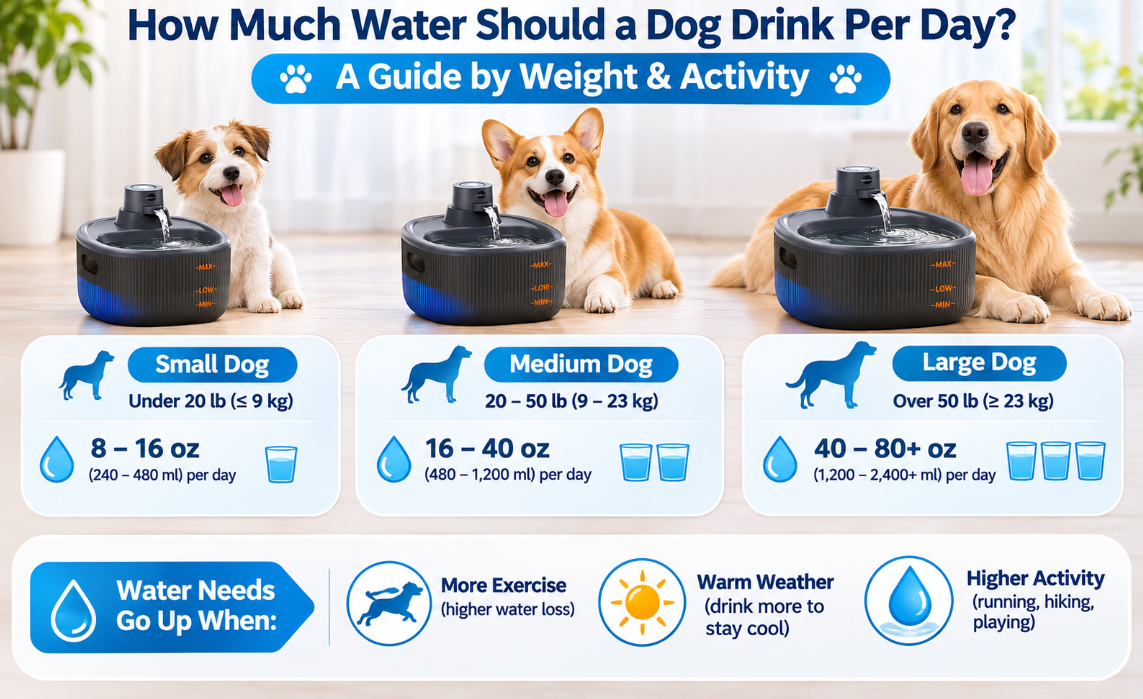
Puppies need consistent access to fresh water, but their hydration requirements are not always the same as those of adult dogs.
Their needs depend on:
Age
Body weight
Growth rate
Diet
Activity
Environmental temperature
Puppies may also drink smaller amounts more frequently.
Young puppies can become dehydrated more quickly than healthy adult dogs, particularly when experiencing vomiting, diarrhea, or illness.
Because puppies are still developing, a significant change in drinking behavior deserves prompt attention.
Provide accessible water: Use a stable, shallow bowl appropriate for the puppy's size.
Refresh water regularly: Keep the drinking area clean.
Observe drinking behavior: Learn what is typical for your puppy.
Monitor illness: Contact your veterinarian promptly if your puppy refuses water, vomits repeatedly, develops diarrhea, or becomes lethargic.
Avoid unnecessary restriction: Do not limit water simply to reduce house-training accidents.
If you need a specific drinking or feeding schedule for a young puppy, ask your veterinarian for guidance appropriate to its age and health.
Older dogs still require adequate hydration, but their drinking behavior may change.
Some senior dogs become less active.
Others develop medical conditions that increase thirst or urination.
Mobility problems can also make reaching a water bowl more difficult.
Difficulty bending down
Arthritis or joint discomfort
Reduced mobility
Changes in appetite
Medication effects
Kidney or endocrine conditions
Place water in an accessible location.
Use a stable bowl or fountain with a comfortable drinking height.
Consider providing more than one drinking station.
Keep the surrounding floor dry and easy to navigate.
Most importantly, do not assume a major increase or decrease in drinking is simply a normal part of aging.
Contact your veterinarian if your senior dog's water consumption changes noticeably.
Hot weather can increase a dog's water requirements, sometimes substantially.
However, there is no universal percentage that can be safely added to every dog's daily water estimate.
The additional amount depends on temperature, humidity, exercise intensity, breed characteristics, and individual health.
Carry water on walks: Bring a portable drinking container when exercising outdoors.
Offer regular breaks: Allow your dog to rest in a cool area.
Avoid excessive heat exposure: Adjust walking times during hot weather.
Keep water accessible: Provide fresh water at home and outdoors.
Watch for heatstroke: Excessive panting, weakness, collapse, or altered behavior can indicate an emergency.
A water fountain can be a convenient home drinking station, but it cannot prevent heatstroke or replace appropriate heat-safety precautions.
Wet food contributes water to your dog's overall intake.
For example, imagine a dog eats 500 grams of food containing 75% moisture.
That food provides approximately:
500 × 0.75 = 375 grams of water.
This is approximately 375 mL of water.
The dog may therefore drink less directly from a bowl than a dog eating dry kibble.
| Factor | Wet Food | Dry Kibble |
|---|---|---|
| Moisture content | Generally higher | Generally lower |
| Water obtained through food | More | Less |
| Direct drinking-water intake | May be lower | May be higher |
| Need for fresh drinking water | Always | Always |
These are general differences; exact moisture content varies by product.
Never remove or restrict drinking water because your dog eats wet food.
Monitoring water intake can help you recognize unusual changes.
This is especially useful when your dog begins drinking substantially more or less than normal.
Use a measuring cup to record the amount of water placed in the bowl or fountain.
Example:
Morning water added: 2,000 mL.
If you add water during the day, include those amounts.
Example:
Afternoon refill: 500 mL.
Total added: 2,500 mL.
At the end of the measurement period, record the amount remaining.
Example:
Remaining water: 1,200 mL.
2,500 − 1,200 = 1,300 mL.
Estimated drinking-water consumption: 1.3 liters.
The calculation may overestimate consumption if water was:
Spilled
Lost through splashing
Removed during cleaning
Consumed by other pets
Lost through evaporation
For multi-pet households, a shared fountain cannot reliably measure each animal's individual intake.
If your veterinarian recommends individual monitoring, ask how best to measure water consumption without limiting access.
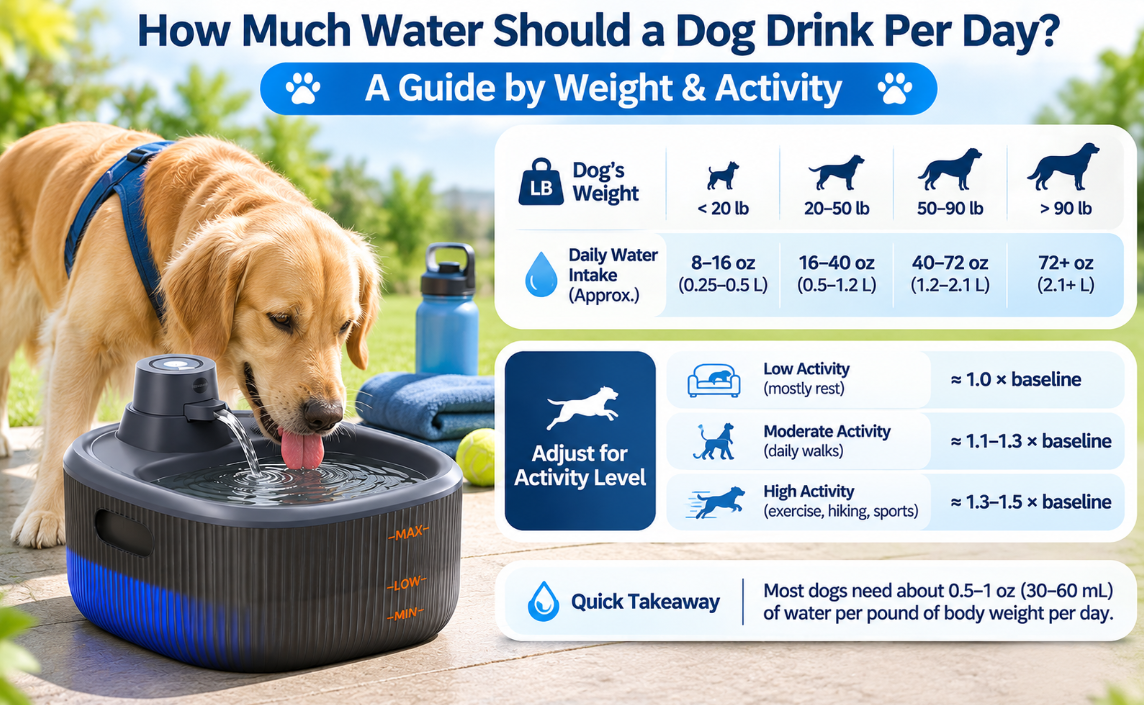
A dog that drinks substantially less than usual may be at risk of dehydration, especially if fluid losses are increased.
Dry or tacky gums
Reduced energy
Sunken-looking eyes
Reduced urination
Weakness
Changes in skin elasticity
These signs are not always reliable when assessed individually.
For example, skin elasticity can be affected by age and body condition.
Contact your veterinarian promptly if your dog:
Suddenly refuses water
Drinks significantly less than usual
Has vomiting or diarrhea
Appears weak or lethargic
Has difficulty drinking
Shows signs of pain
Seek emergency care for collapse, severe weakness, breathing difficulty, or other serious symptoms.
Do not force water into your dog's mouth unless a veterinarian has specifically instructed you to do so. Forced administration can cause choking or aspiration.
Excessive thirst is called polydipsia.
A dog may drink more because of heat, exercise, diet, or medication effects.
However, persistent unexplained increases can also indicate illness.
Veterinarians sometimes use sustained water intake above approximately 100 mL/kg/day as a reference point when uating polydipsia.
For example:
| Dog Weight | Approximate Reference Threshold |
|---|---|
| 10 kg | 1.0 L/day |
| 20 kg | 2.0 L/day |
| 30 kg | 3.0 L/day |
| 40 kg | 4.0 L/day |
This is not a diagnostic cutoff.
A smaller but significant increase from your dog's usual drinking pattern may still warrant uation.
Diabetes mellitus
Kidney disease
Cushing's disease
Certain medications
Some infections
Other metabolic or hormonal conditions
Increased urination
Accidents indoors
Weight loss
Appetite changes
Vomiting
Lethargy
If your dog suddenly begins drinking much more water, contact your veterinarian.
Never restrict water to control excessive drinking or urination unless specifically directed by a veterinarian.
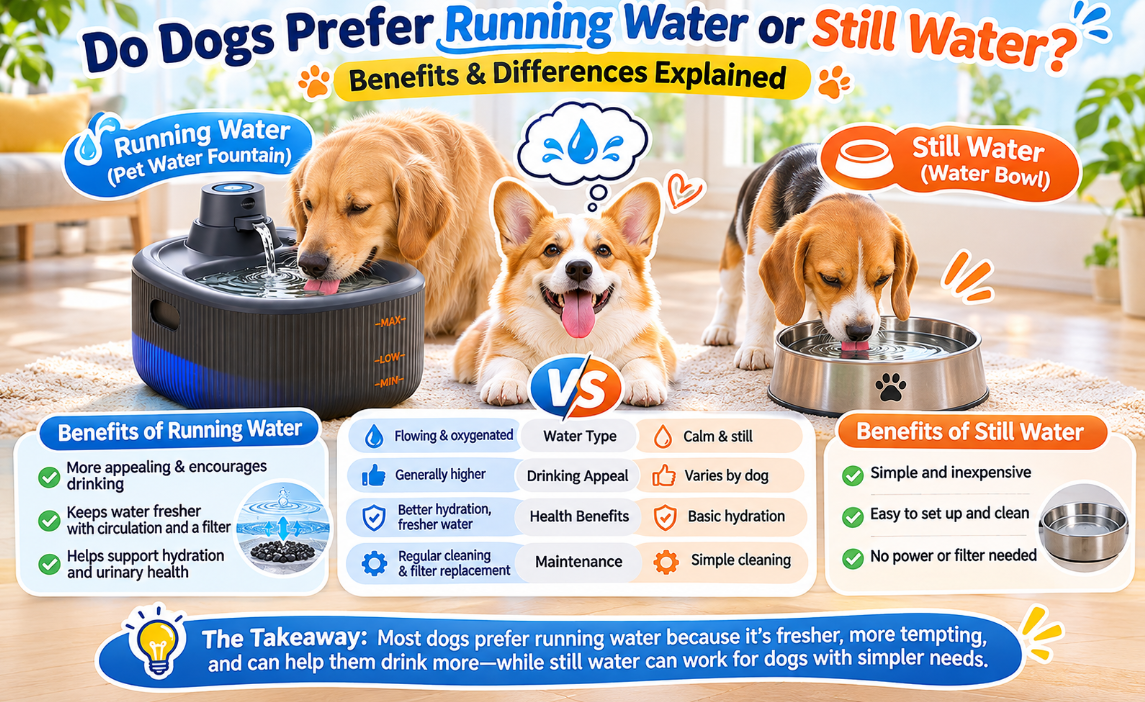
Healthy hydration begins with reliable access to fresh water.
Provide clean drinking water throughout the day.
Remove food residue, saliva, and debris.
Place water where your dog can reach it easily.
Avoid locations where other pets may block access.
Large homes and multi-pet households may benefit from additional bowls or fountains.
Choose a bowl or fountain with an appropriate drinking height and basin size.
Some dogs prefer still water.
Others may be interested in gently circulating water.
Learn your dog's normal drinking pattern so you can recognize unusual increases or decreases.
A water fountain should provide enough usable water for your dog's needs between refills.
However, fountain capacity and daily water requirements are not the same thing.
If your dog drinks approximately 1.5 liters daily, a fountain with a nominal capacity of 1.5 liters may not provide enough usable water between refills.
Some fountains require a minimum water level for normal circulation.
| Dog Size | Approximate Weight | Suggested Fountain Capacity |
|---|---|---|
| Small dogs | Under 30 lbs | 2–3L |
| Medium dogs | 30–50 lbs | 3–4L |
| Large dogs | 50–80 lbs | 4–6L |
| Giant breeds | Over 80 lbs | 6L or larger |
| Multiple dogs | Varies | Based on combined consumption |
These are convenience-based starting points, not medical recommendations.
A smaller fountain may work with more frequent refilling.
A larger fountain may provide more reserve capacity.
Regardless of size, water should be checked and refreshed regularly.
A fountain with a large reservoir may still have a narrow drinking surface.
Large dogs may need a wider basin, while smaller dogs may benefit from a lower drinking height.
Always consider both capacity and physical comfort.
WOPET offers water fountain designs for different pets and household needs.
Choosing the right model involves considering drinking comfort, placement, reservoir capacity, and cleaning requirements.
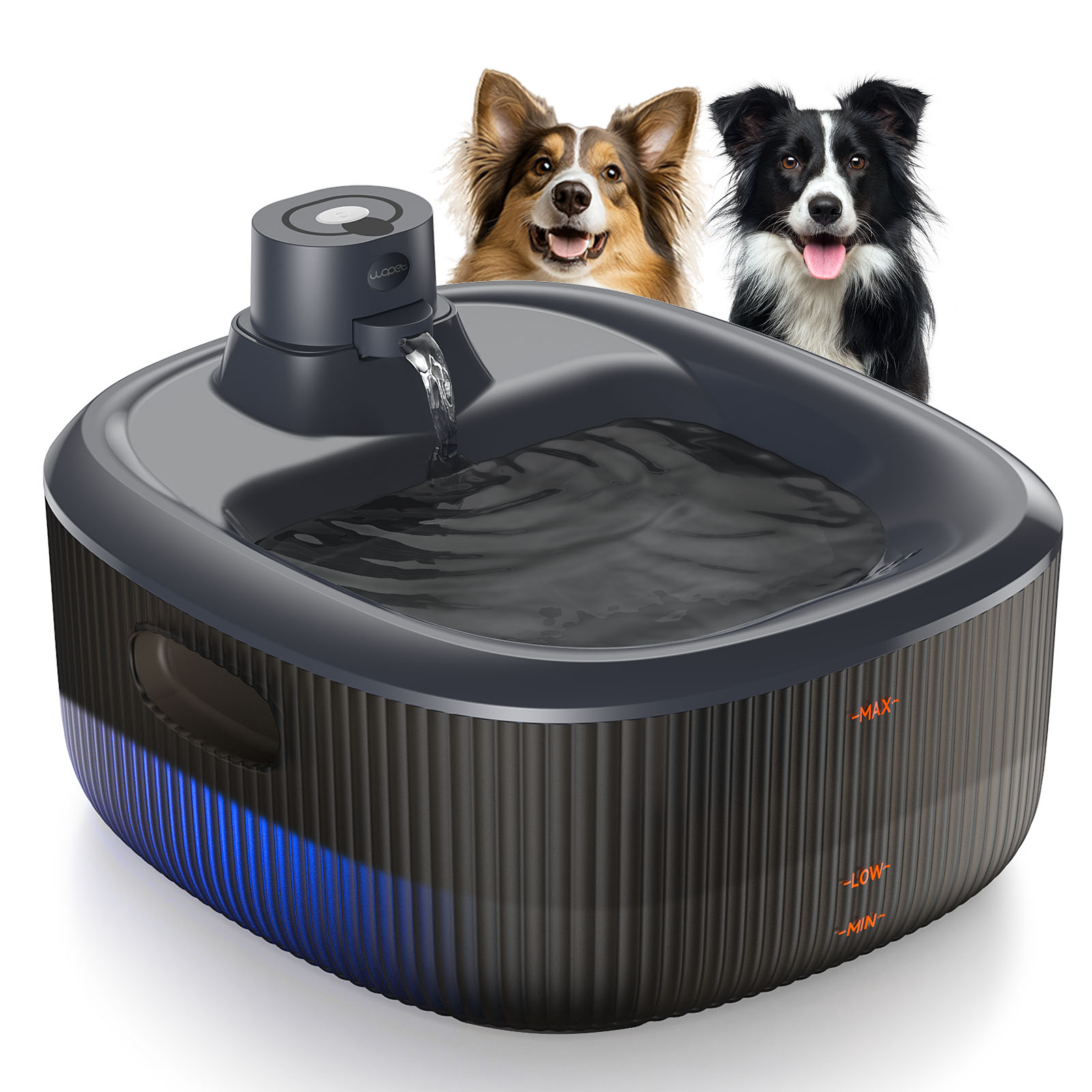
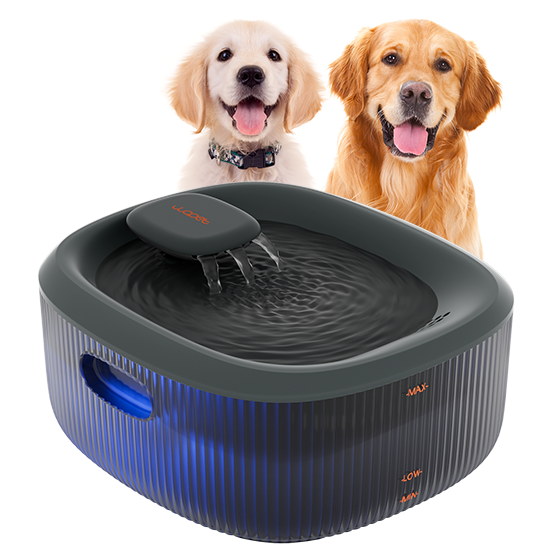
The WOPET W600 Pro is a wireless dog water fountain option for owners who want flexible placement.
A cordless design can make it easier to position the drinking station in a convenient location.
When uating the W600 Pro, consider:
Published reservoir capacity
Usable water volume
Drinking basin dimensions
Water level visibility
Cleaning accessibility
Battery maintenance
Best for: Dog owners seeking a wireless drinking station that fits their dog's size and household layout.
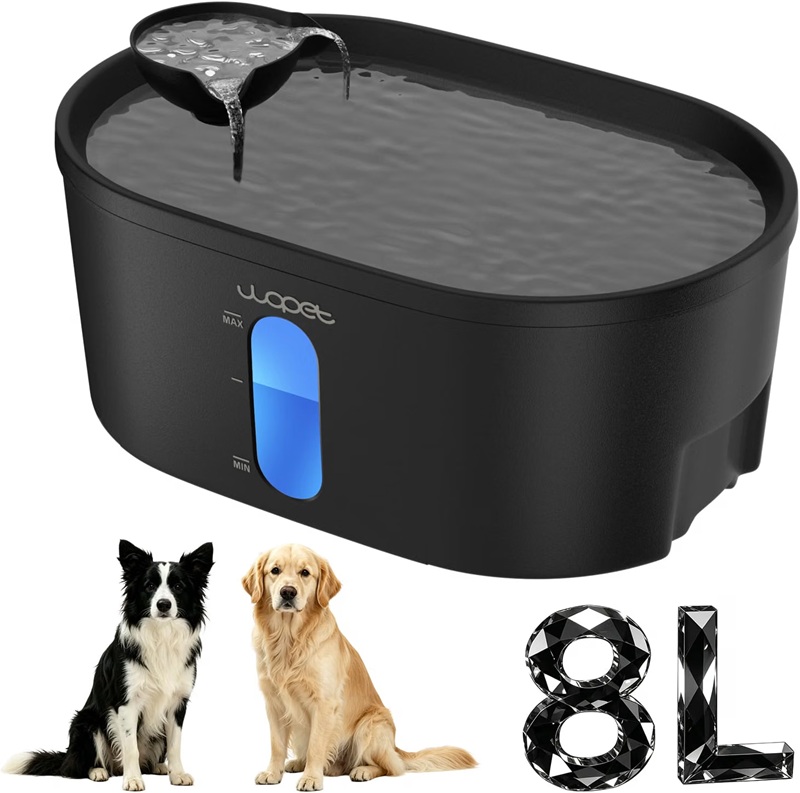
The WOPET A08 is designed for dogs and multi-cat households.
It may be worth considering when multiple pets share a drinking area.
Important factors include:
Combined daily water requirements
Reservoir capacity
Drinking surface accessibility
Stable placement
Ease of cleaning
Best for: Dog owners and multi-cat households looking for a shared drinking station.
| Feature to Consider | WOPET W600 Pro | WOPET A08 |
|---|---|---|
| Main positioning | Wireless placement convenience | Dogs and multi-cat households |
| Drinking accessibility | Check basin dimensions | Check basin dimensions |
| Capacity | Verify current specifications | Verify current specifications |
| Cleaning | Regular maintenance required | Regular maintenance required |
| Water intake monitoring | Manual measurement needed | Manual measurement needed |
A fountain may help create a convenient drinking environment, but it cannot diagnose or treat hydration-related medical problems.
Many healthy adult dogs require approximately 40–60 mL of water per kilogram of body weight daily as a rough planning estimate. Actual needs vary with diet, activity, weather, and health.
A 20-pound dog may require approximately 360–550 mL daily under ordinary conditions, although individual needs vary.
A 50-pound dog may require approximately 910–1,360 mL daily as a general estimate.
A 100-pound dog may require approximately 1.8–2.7 liters daily, depending on individual circumstances.
Puppies have different hydration needs related to growth, activity, diet, and age. Their requirements should not be determined solely from an adult-dog chart.
Often, yes. Heat and increased panting can raise water requirements.
Yes. Wet food contributes moisture to the diet, so dogs eating it may drink less water directly.
Possible signs include tacky gums, weakness, reduced urination, and sunken-looking eyes. Veterinary assessment is important when dehydration is suspected.
Sustained intake above approximately 100 mL/kg/day is one reference used in veterinary uation, but sudden increases below that level can also be concerning.
No. Do not restrict water unless your veterinarian specifically instructs you to do so.
It depends on your dog's preferences and your household's needs. Some dogs prefer circulating water, while others prefer still water. Both can provide suitable drinking access when maintained properly.
Check the water level daily and refill as needed. Refresh the water and clean the fountain according to the manufacturer's instructions. Do not rely on reservoir size as a reason to leave water unchanged for several days.
There is no single perfect daily water amount for every dog.
Body weight provides a useful starting point, but diet, activity, temperature, age, and health all influence hydration needs.
For many healthy adult dogs, approximately 40–60 mL/kg/day can be used as a rough planning estimate.
However, the most important habits are simple:
Provide fresh drinking water throughout the day.
Choose a comfortable and accessible drinking station.
Monitor changes in normal water consumption.
Consider moisture obtained through food.
Never restrict water without veterinary direction.
Contact your veterinarian when drinking behavior changes unexpectedly.
For everyday convenience, a suitable water fountain such as the WOPET W600 Pro or WOPET A08 may provide a practical drinking station.
The goal isn't to make your dog drink a specific number of milliliters every day. It's to provide reliable access to fresh water and recognize when your dog's drinking habits may signal a problem.
Label:
Popular Post
The Ultimate Guide to Tabby Cats: Patterns, Personalities, and More
Mar 27, 2025

Top 8 Reasons Why Does My Cat Sleep Between My Legs?
Mar 03, 2025

What to Do If My Dog's Poop Is Black But Not Tarry
Feb 04, 2023
Superfecundation Cats: When Kittens in One Litter Have Different Fathers
Jul 11, 2025
Can Cats Have Orange Eyes? Genetics, Breeds, and Care Guide
May 20, 2025
[Blue] W03L 3L Premium Ceramic Cat Water Fountain
Model: W03 LITE
$59.99
$69.99
Basin Pet Water Fountain-W600
Model: W600
$43.99
$69.99
[Basic] Ceramic Pet Water Fountain with Power Cable
Model: W03L
$59.99
$99.00
[Black] W03L 3L Premium Ceramic Cat Water Fountain
Model: W03L Black
$59.99
$69.99

WOPET 8L Pet Water Fountain For Multiple Cats or Large Dogs A08
Model: A08
$49.99
$59.99
WOPET A08 Dog Water Fountain Filters
Model: A08 Filter
$19.99
$29.99

DOWNLOAD APP

WOpet life




Copyright © 2026 WOPET. All Rights Reserved.