Nov 03, 2026
Author:Lisa Martinez
Have you ever noticed your dog ignoring a perfectly clean water bowl but becoming fascinated by water flowing from a garden hose or faucet?
Some dogs eagerly approach moving water, while others seem perfectly happy drinking from a traditional bowl.
This raises an interesting question: Do dogs prefer running water or still water?
The answer depends on the individual dog.
Some dogs appear attracted to moving water because of its sound, movement, or the experience of drinking from a flowing stream. Others prefer still water because it is quiet, predictable, and familiar.
There is no strong evidence that all dogs naturally prefer running water or that drinking from a fountain automatically improves hydration.
However, understanding your dog's preferences can help you create a more comfortable drinking environment.
In this guide, we'll compare running water and still water, explain why dogs may prefer one over the other, explore the benefits and limitations of dog water fountains, and show you how to discover which option works best for your pet.
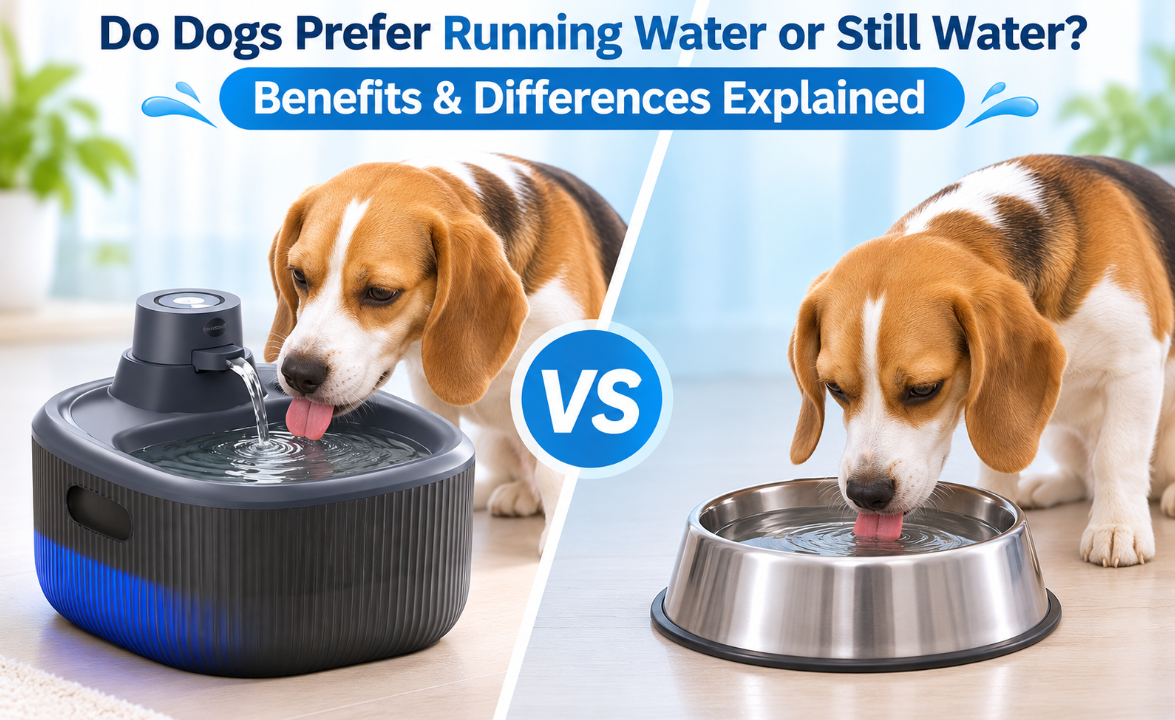
Dogs do not have one universal drinking preference.
Some enjoy moving water, while others are more comfortable drinking from a stationary bowl.
A dog's preference may depend on several factors:
Previous drinking experiences
Familiarity with bowls or fountains
Sensitivity to noise
Drinking surface and basin size
Water temperature
Location of the drinking station
Individual temperament
Ease of access
For example, a dog that has always used a traditional water bowl may initially hesitate when introduced to a fountain.
Another dog may immediately investigate the sound and movement of circulating water.
Neither response is unusual.
Dogs' wild ancestors encountered different water sources, including streams, ponds, and other available freshwater sources.
However, this does not establish that modern domestic dogs universally prefer running water.
It is tempting to assume that flowing water must be more attractive because it resembles a stream, but individual behavior is more complicated.
A familiar, clean bowl may be just as appealing to a dog as a circulating fountain.
The best drinking option is the one your dog willingly uses while maintaining adequate hydration.
Although preferences vary, several factors may explain why some dogs show interest in moving water.
Dogs often investigate changes in their environment.
The movement of water can provide a visual cue that attracts curiosity.
A dog may approach a fountain simply because it notices the water moving.
This does not necessarily mean the dog prefers the water or will drink more of it.
A gently circulating fountain produces sound that may help some dogs locate or notice a drinking station.
For other dogs, the same sound may be distracting or intimidating.
The effect depends on the dog's individual response.
Some dogs appear to prefer cooler drinking water.
Depending on room conditions, fountain design, and water circulation, the temperature of fountain water may differ from that of a traditional bowl.
However, circulation alone does not guarantee that water will remain cooler.
A fountain is not a refrigeration system unless it includes a dedicated cooling mechanism.
A fountain may provide a different drinking experience from a conventional bowl.
For example, some fountains offer a broad, shallow drinking area, while others direct water through a raised outlet.
The basin's shape, depth, and accessibility may influence whether a dog finds it comfortable.
A dog may prefer the design of a particular fountain rather than the movement of the water itself.
Dogs that have previously enjoyed drinking from hoses, outdoor streams, or faucets may show interest in a fountain.
However, interest in one moving water source does not guarantee acceptance of every fountain design.
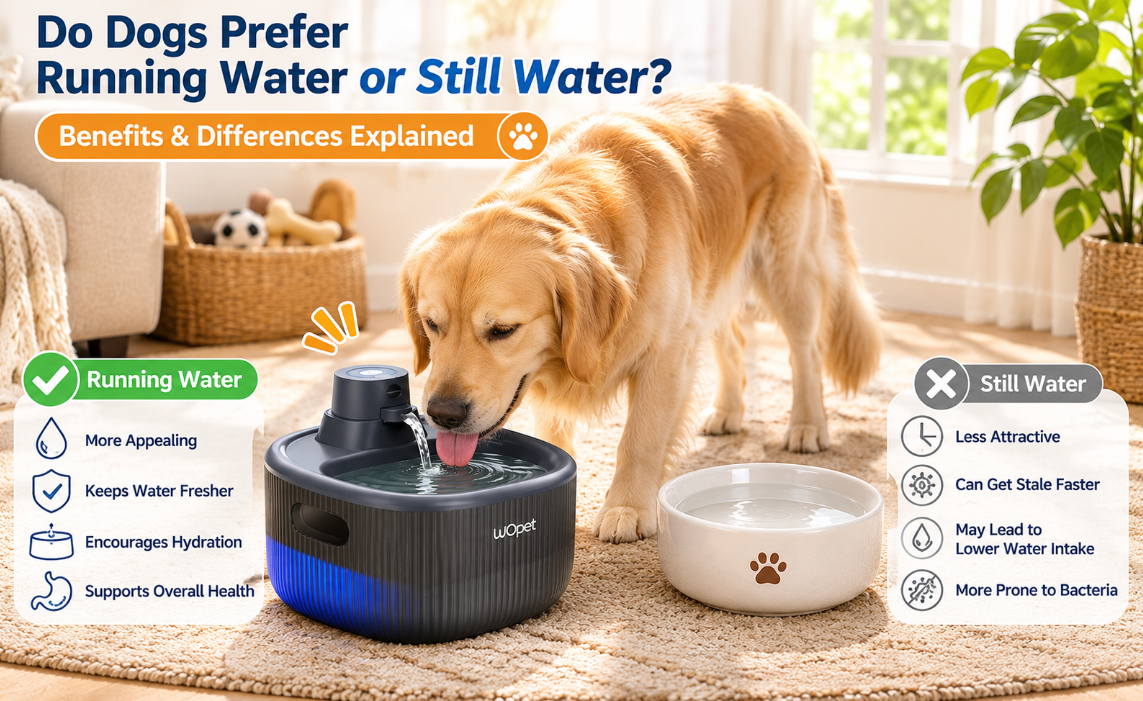
Not every dog enjoys moving water.
Some dogs may actively avoid fountains, especially during their first introduction.
Dogs that have used traditional bowls for years may feel more comfortable with a familiar drinking routine.
A new fountain introduces unfamiliar sounds, movement, and physical features.
Some dogs need time to adjust.
Certain dogs are sensitive to noise.
Even a relatively quiet fountain may produce sounds from water movement, vibration, or its circulation mechanism.
A traditional bowl generally avoids these sounds.
Still water provides a relatively stable drinking surface.
Some dogs may find this easier to approach.
This may be especially relevant for dogs that are cautious around unfamiliar objects.
A dog may dislike a fountain because its basin is too narrow, deep, high, or otherwise uncomfortable.
This is not necessarily a rejection of running water.
It may simply indicate that the fountain does not suit the dog's physical needs.
A fountain that made a sudden noise, moved unexpectedly, or splashed water onto a dog's face may create hesitation.
Gentle introduction can help, but some dogs may continue to prefer a traditional bowl.
Both running and still water can support healthy hydration when the water source is safe and the drinking equipment is properly maintained.
The main differences involve convenience, maintenance, noise, and drinking experience.
| Feature | Running Water Fountain | Traditional Still Water Bowl |
|---|---|---|
| Water movement | Circulating or intermittent flow | Stationary |
| Dog preference | Appeals to some dogs | Appeals to others |
| Noise | May produce sound | Usually quiet |
| Filtration | Some models include filters | Usually no built-in filtration |
| Cleaning | Multiple components may need cleaning | Generally simpler |
| Power | May require electricity or batteries | No power required |
| Placement | Depends on fountain design | Flexible |
| Maintenance costs | Possible filter and component costs | Usually minimal |
| Water safety | Depends on water quality and cleaning | Depends on water quality and cleaning |
A fountain may be convenient for owners who prefer a reservoir-based drinking station.
However, fountains require regular maintenance.
A traditional bowl is often easier to wash and inspect.
Neither option is universally better.
A well-maintained water bowl can provide perfectly suitable drinking water.
A properly maintained fountain can also be a practical option, particularly for dogs that enjoy using it.
The choice should depend on your dog's preferences and your ability to maintain the drinking station.
One common assumption is that moving water is automatically cleaner than still water.
That is not necessarily true.
Water movement alone does not make drinking water safe.
The cleanliness of a fountain depends on several factors:
Quality of the source water
Cleaning frequency
Filter condition
Reservoir design
Accumulation of saliva, hair, and debris
Maintenance of internal circulation components
No.
Circulation does not sterilize water or prevent bacterial growth.
Bacteria and biofilm can develop on fountain surfaces, inside tubing, around outlets, and in other areas exposed to moisture.
Regular cleaning remains essential.
Some pet water fountains include filters designed to capture hair, food particles, and other debris.
Certain filter materials may also help reduce some tastes or odors.
However, performance depends on the filter's actual design and specifications.
A standard pet fountain filter should not be assumed to remove all harmful microorganisms or make contaminated water safe to drink.
Always begin with a safe drinking-water source.
Not inherently.
A clean bowl filled with safe, fresh water can provide an excellent drinking option.
The problem is not that the water is stationary.
The problem arises when water becomes contaminated or the bowl is not cleaned regularly.
Cleanliness matters more than whether water is moving.
Some dogs may drink more readily when offered a fountain they enjoy.
Others may show no meaningful difference.
Some may initially drink less because the fountain is unfamiliar.
There is insufficient evidence to promise that a fountain will increase water intake for every dog.
Consider two dogs.
Dog A enjoys investigating moving objects and quickly becomes comfortable drinking from a fountain.
Dog B is cautious around unfamiliar sounds and prefers a quiet bowl.
For Dog A, a fountain may be a useful drinking option.
For Dog B, a traditional bowl may be more comfortable.
The important outcome is not which product looks more advanced.
It is whether the dog has reliable access to water and drinks normally.
If your dog drinks noticeably less after replacing a bowl with a fountain, restore access to the familiar bowl immediately.
Do not force the dog to use the fountain.
If your dog continues drinking less than usual or shows signs of illness, contact your veterinarian.
A fountain may offer practical advantages for certain dogs and households.
A fountain creates movement that some dogs find interesting or appealing.
Many fountains hold more water than small traditional bowls.
This can provide additional reserve capacity between refills.
However, the reservoir still needs regular checking and cleaning.
Some fountains include replaceable filters that capture debris.
Owners should follow the manufacturer's cleaning and replacement instructions.
Fountains come in different shapes, sizes, and configurations.
Wireless models may offer additional placement flexibility.
A suitably sized fountain may provide a shared drinking station for multiple pets.
However, different animals may have different preferences.
Additional bowls or drinking stations may still be necessary.
Despite the growing popularity of automatic fountains, traditional bowls remain a practical choice.
Most bowls have fewer components than fountains.
This makes routine washing straightforward.
A bowl does not require a power outlet, battery, or circulation mechanism.
Traditional bowls are generally silent.
This may be preferable for dogs sensitive to unfamiliar sounds.
There are no fountain filters or circulation components to replace.
For dogs accustomed to bowls, keeping a familiar drinking station may help maintain consistent habits.
A traditional bowl is not an inferior hydration solution simply because it does not circulate water.
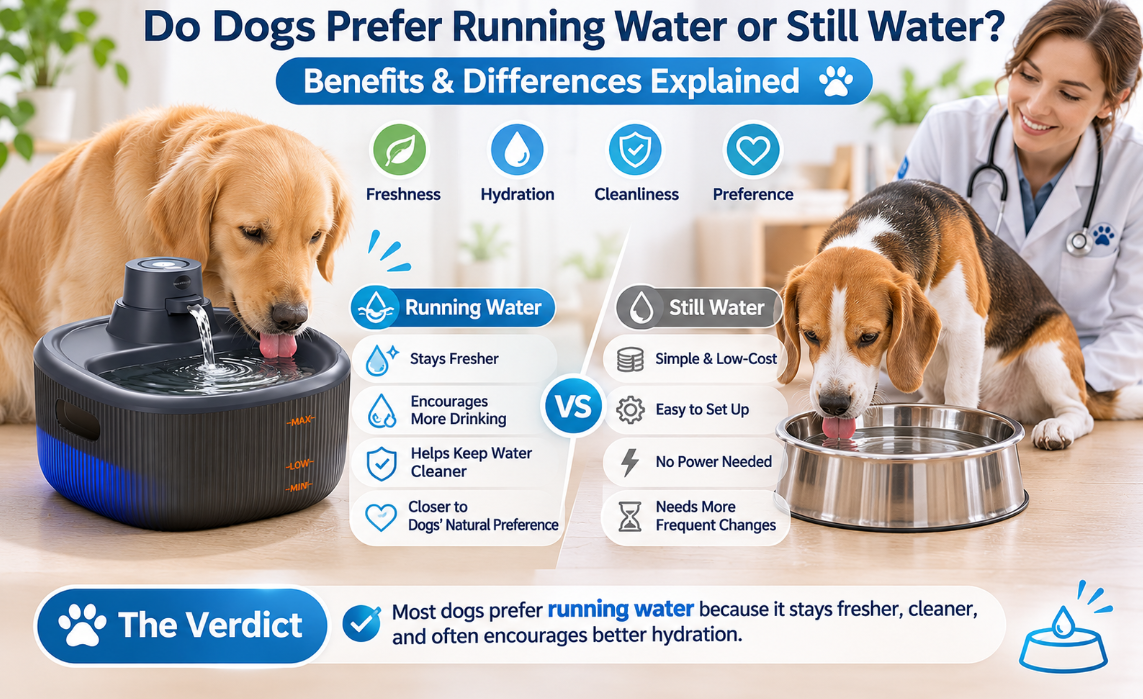
Instead of assuming what your dog prefers, try observing their behavior.
You can conduct a simple home comparison using a clean bowl and a suitable fountain.
This is an informal observation exercise, not a scientific experiment.
Place a traditional water bowl and a fountain in accessible locations.
Use the same safe drinking-water source in both.
Try to use comparable water temperatures.
Avoid placing one option in a noisy, crowded, or difficult-to-reach area.
Let your dog approach either water source voluntarily.
Do not encourage the dog to avoid one option.
Do not restrict access to water.
Over several days, note:
Which water source your dog approaches
Whether your dog drinks comfortably
Whether your dog hesitates
Whether noise affects behavior
Whether your dog returns to the same source
Switch the positions of the bowl and fountain.
This helps you distinguish a possible preference for the water source from a preference for a particular location.
If your dog repeatedly chooses one option, that may indicate a preference.
However, the result can still be affected by location, temperature, novelty, and other environmental factors.
Always keep sufficient water available.
If your dog is reluctant to drink, return to the familiar setup.
Do not use water restriction to test preferences.
Some dogs accept a fountain immediately.
Others require a gradual introduction.
Place the fountain near your dog's usual drinking area.
Allow your dog to investigate it without pressure.
Do not remove your dog's familiar bowl during the introduction.
This ensures the dog always has a comfortable drinking option.
Fill the fountain according to the manufacturer's instructions.
Make sure the water level is appropriate for operation.
If your fountain supports adjustable operation, begin with a gentle setting.
Otherwise, turn it on while your dog is at a comfortable distance.
Use gentle praise or an appropriate reward when your dog voluntarily approaches the fountain.
Never force your dog's face toward the water.
Signs that your dog may be uncomfortable include:
Backing away
Startling at the sound
Refusing to approach
Hesitating to drink
Avoiding the drinking area
If these occur, slow the introduction.
Some dogs may ultimately prefer still water, and that is perfectly acceptable.
If your dog seems comfortable with running water, choosing a suitable fountain involves more than selecting a model with attractive features.
A large dog may need a wider drinking area than a small dog.
Check the basin dimensions, not just the reservoir capacity.
Estimate your dog's typical daily water requirements.
Choose a reservoir that can accommodate those needs with appropriate refill frequency.
Remember that advertised reservoir capacity may differ from the amount usable before reaching the fountain's minimum operating level.
Dogs sensitive to sound may prefer a quieter fountain.
Noise can also change as components become dirty or the water level drops.
Look for a design that allows access to surfaces requiring cleaning.
A fountain that is difficult to maintain may be less practical for everyday use.
Choose a location where your dog feels comfortable drinking.
Wireless models may provide more flexibility than corded designs.
Consider filter replacement, cleaning, charging, and other routine tasks.
A fountain is only useful when it is properly maintained.
WOPET offers water fountain designs for different household needs.
When choosing between models, focus on your dog's size, drinking behavior, and the practical requirements of your home.
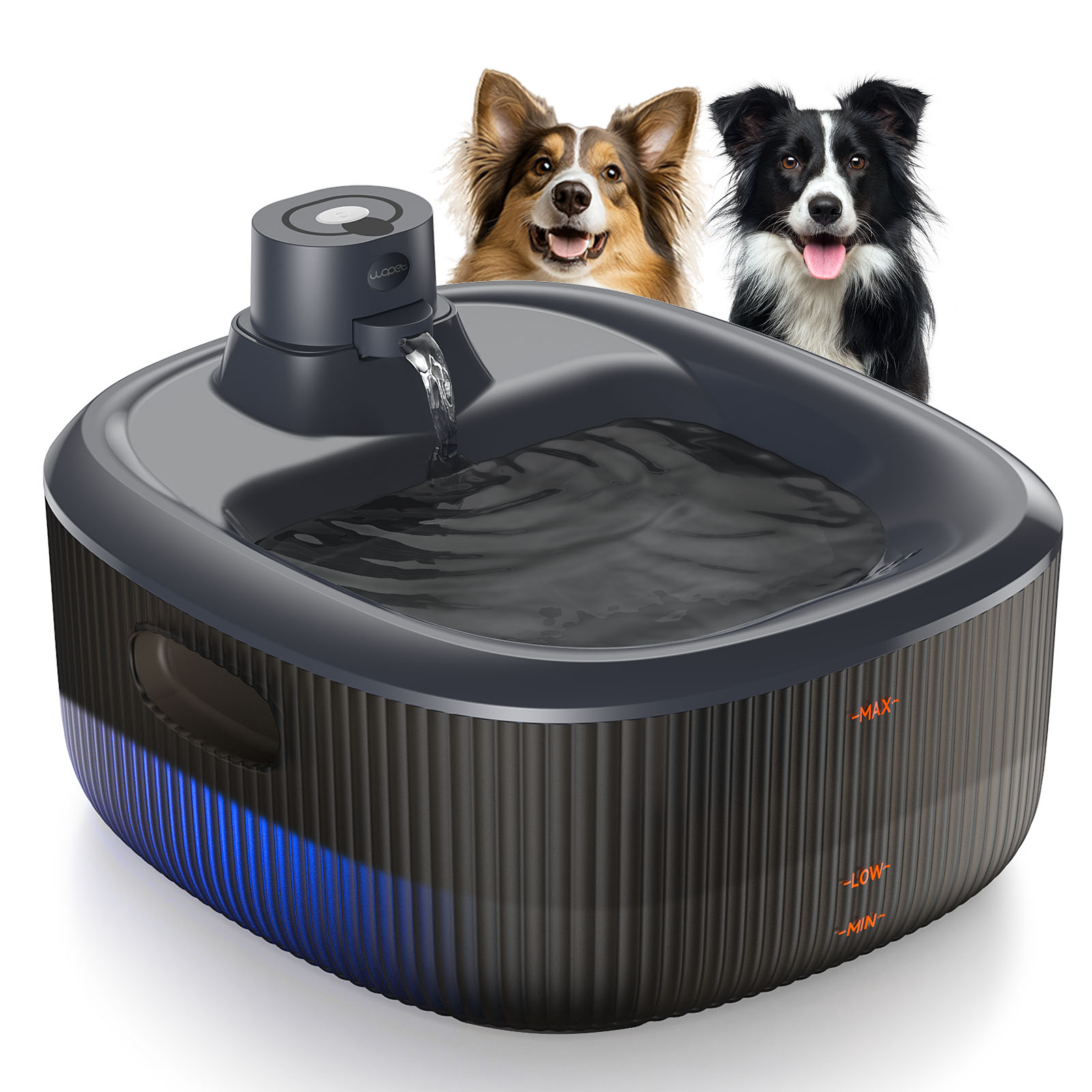
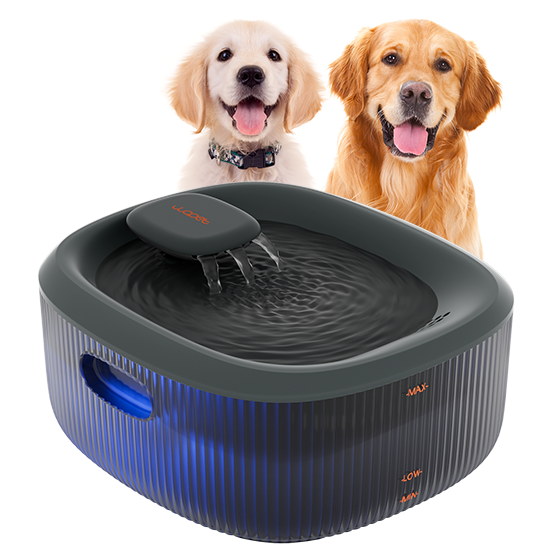
The WOPET W600 Pro is a wireless dog water fountain option for owners who want flexibility when placing a drinking station.
A cordless design may be convenient when the preferred drinking location is away from a power outlet.
When considering the W600 Pro, uate:
Reservoir capacity
Drinking surface dimensions
Water circulation
Cleaning requirements
Battery maintenance
Placement convenience
Best for: Dog owners who want a wireless drinking station and whose dogs are comfortable using a fountain.
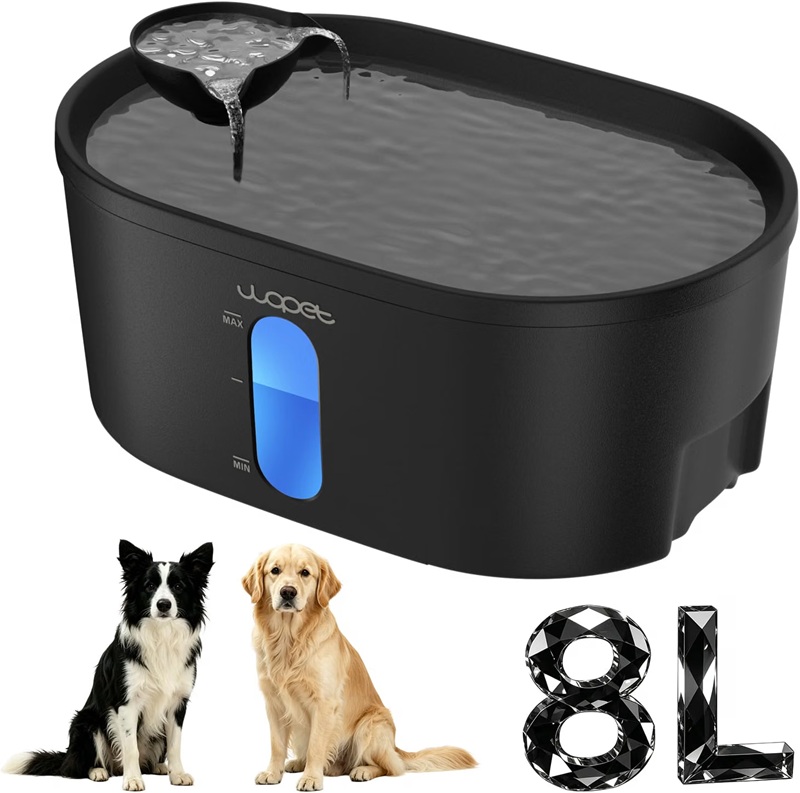
The WOPET A08 is designed for dogs and multi-cat households.
It may be a practical option when multiple pets share a drinking area.
Consider:
Combined daily water requirements
Drinking basin accessibility
Placement
Cleaning frequency
Whether pets are comfortable sharing
In multi-pet homes, offering additional drinking stations can help accommodate individual preferences.
Best for: Households with dogs and multiple cats that need accessible drinking options.
| Feature | WOPET W600 Pro | WOPET A08 |
|---|---|---|
| Main positioning | Wireless dog water fountain | Dogs and multi-cat households |
| Placement | Wireless flexibility | Based on household layout |
| Drinking preferences | Suitable for dogs comfortable with fountains | Suitable for pets comfortable with shared fountain access |
| Cleaning | Regular maintenance required | Regular maintenance required |
| Water monitoring | Requires manual observation | Requires manual observation |
A water fountain can support a convenient drinking routine, but it should not be presented as a treatment for dehydration or other medical conditions.
Some dogs need time to adjust.
Keep the familiar bowl available during the transition.
Water movement does not replace cleaning.
Fountains can develop residue and biofilm if neglected.
A large reservoir does not guarantee a comfortable drinking surface.
Some dogs may avoid a fountain because of vibration or unfamiliar sounds.
A fountain may appeal to some dogs, but there is no guarantee it will increase consumption.
Filters and circulation components require regular attention.
If your dog suddenly drinks too little or too much, contact your veterinarian rather than assuming a new fountain will solve the issue.
Preferences vary. Some dogs enjoy moving water, while others prefer a traditional bowl. Neither option is universally preferred.
Your dog may be interested in the movement, sound, temperature, or novelty of faucet water. This does not necessarily mean it prefers every type of fountain.
Not inherently. Safe source water and proper cleaning are more important than whether the water is moving.
They may encourage some dogs, but others show no change or prefer still water. Individual responses vary.
Yes. Unfamiliar sounds, vibration, movement, or splashing may make some dogs hesitant.
There is no fixed adjustment period. Some dogs accept a fountain quickly, while others need a gradual introduction or never develop a preference for it.
Not automatically. Large dogs need an accessible drinking surface and sufficient water. Either a suitable bowl or fountain can meet those needs.
Follow the manufacturer's instructions for the specific model. Maintain the required water level, clean the fountain, and inspect its components regularly.
Standard pet fountain filters should not be assumed to sterilize water or eliminate harmful microorganisms. Regular cleaning and safe source water remain essential.
Yes, if the fountain is appropriately sized and the dogs can access it comfortably. Additional water stations may be helpful.
Possible reasons include unfamiliarity, noise, basin design, placement, or an individual preference for still water. Keep the original bowl available while introducing the fountain.
Switching is optional. If your dog drinks normally from a clean bowl, there is no universal health requirement to replace it with a fountain.
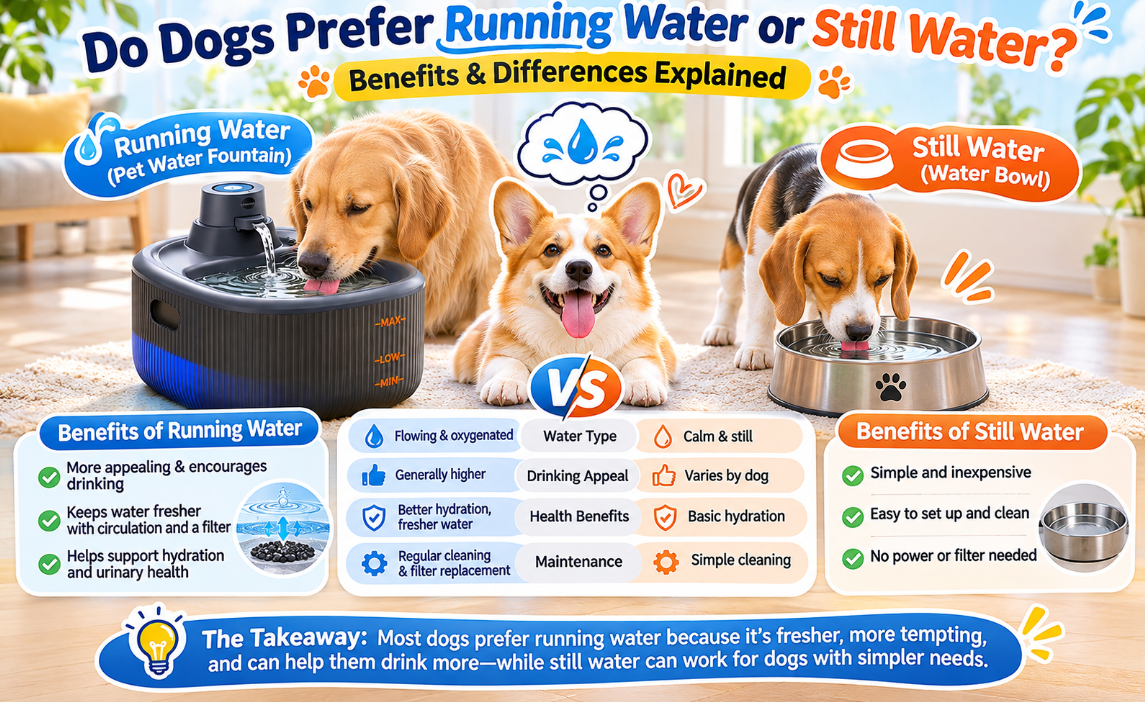
So, do dogs prefer running water or still water?
The answer is simple: it depends on the dog.
Some dogs are curious about moving water and may enjoy using a fountain.
Others prefer the quiet familiarity of a traditional bowl.
Neither option is automatically cleaner, healthier, or better for every pet.
The most important factors are:
Safe, fresh drinking water
Comfortable access
Regular cleaning
Suitable drinking equipment
Your dog's individual preferences
Awareness of unusual drinking behavior
For dogs that enjoy circulating water, a fountain such as the WOPET W600 Pro or WOPET A08 may provide a convenient drinking option.
For dogs that prefer still water, a clean traditional bowl remains an excellent choice.
The best water source isn't necessarily the one that moves. It's the one your dog comfortably and consistently drinks from.
Label:
Popular Post
The Ultimate Guide to Tabby Cats: Patterns, Personalities, and More
Mar 27, 2025

Top 8 Reasons Why Does My Cat Sleep Between My Legs?
Mar 03, 2025

What to Do If My Dog's Poop Is Black But Not Tarry
Feb 04, 2023
Superfecundation Cats: When Kittens in One Litter Have Different Fathers
Jul 11, 2025
Can Cats Have Orange Eyes? Genetics, Breeds, and Care Guide
May 20, 2025
[Blue] W03L 3L Premium Ceramic Cat Water Fountain
Model: W03 LITE
$59.99
$69.99
Basin Pet Water Fountain-W600
Model: W600
$43.99
$69.99
[Basic] Ceramic Pet Water Fountain with Power Cable
Model: W03L
$59.99
$99.00
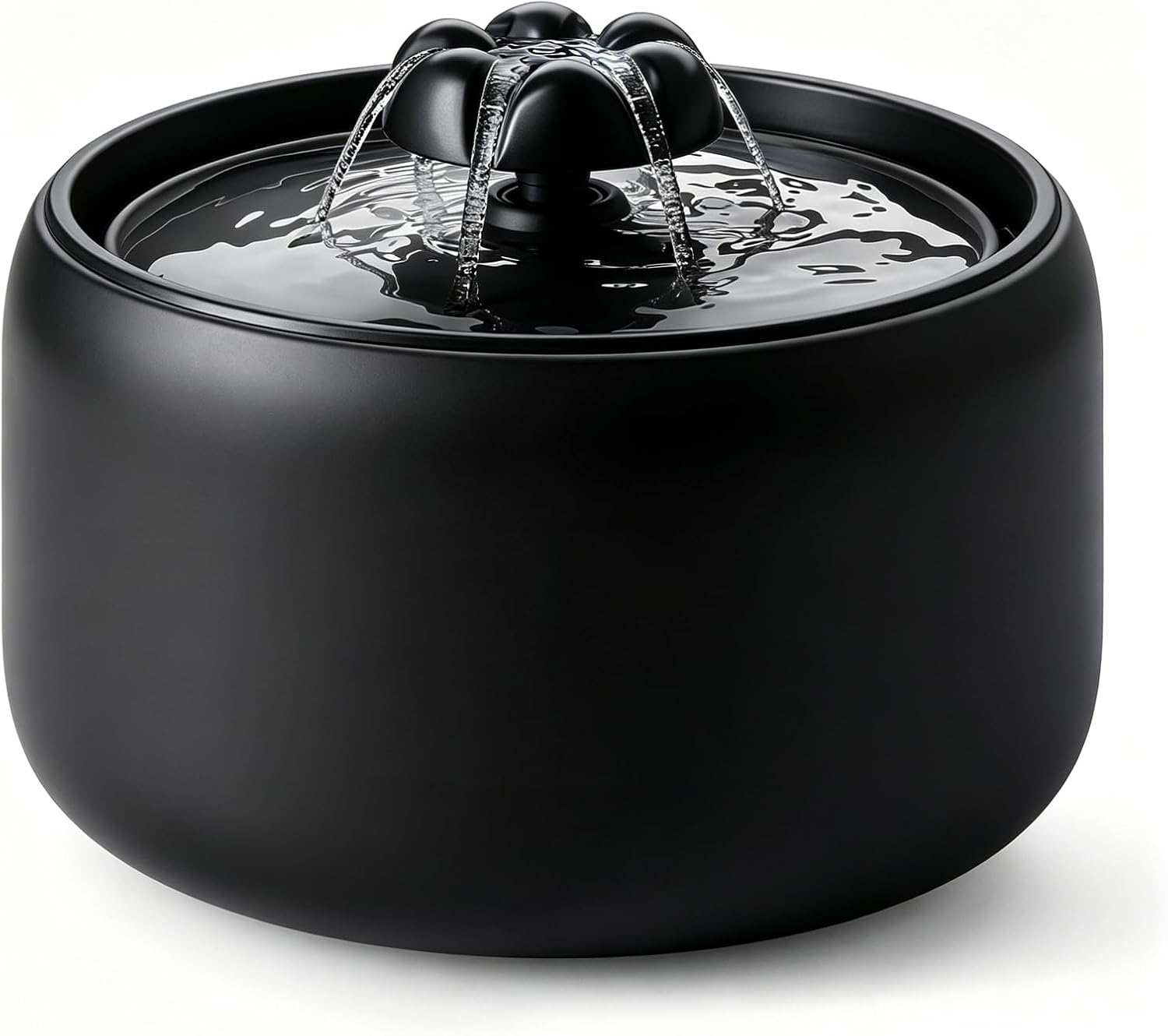
[Black] W03L 3L Premium Ceramic Cat Water Fountain
Model: W03L Black
$59.99
$69.99

WOPET 8L Pet Water Fountain For Multiple Cats or Large Dogs A08
Model: A08
$49.99
$59.99
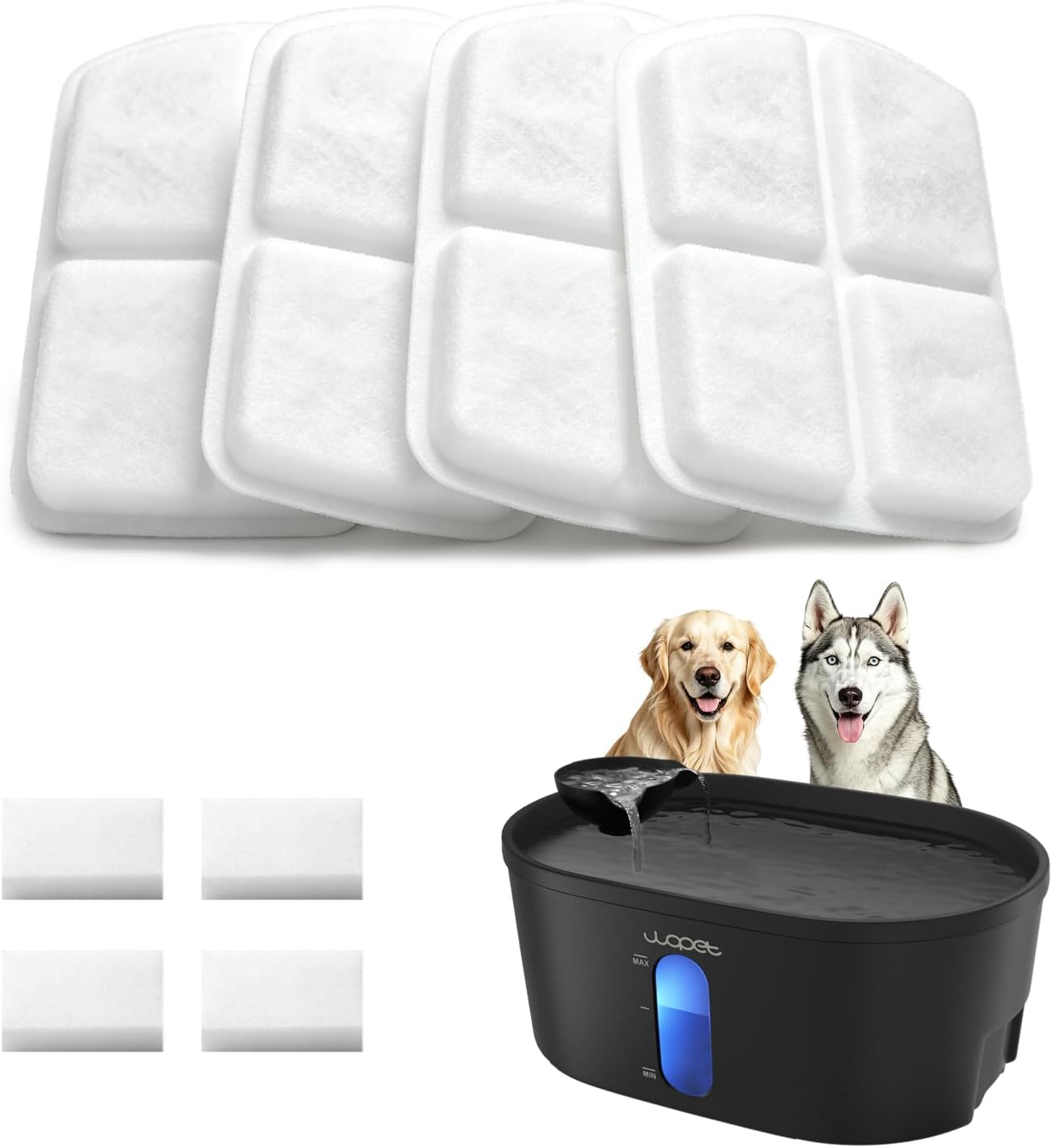
WOPET A08 Dog Water Fountain Filters
Model: A08 Filter
$19.99
$29.99

DOWNLOAD APP

WOpet life




Copyright © 2026 WOPET. All Rights Reserved.