Nov 04, 2026
Author:Sam Wonder
Large dogs need more than just a small bowl of water in the corner. Breeds such as Golden Retrievers, German Shepherds, Labradors, Rottweilers, and Great Danes often have higher daily water requirements than smaller dogs, and their larger muzzles can make compact drinking fountains less comfortable to use.
If you're shopping for a water fountain for large dog breeds, you'll quickly notice that not every pet fountain is designed with big dogs in mind.
Some fountains have small drinking areas, limited reservoir capacity, or lightweight bases that can move when a large dog approaches. Others may be difficult to clean or require frequent refilling.
The best choice is not necessarily the largest or most expensive model. It's a fountain that provides enough water, offers comfortable access, and fits your dog's drinking habits.
In this guide, we'll explore seven essential features to consider, explain how to estimate water capacity, and compare several WOPET water fountains designed for larger pets and multi-pet households.
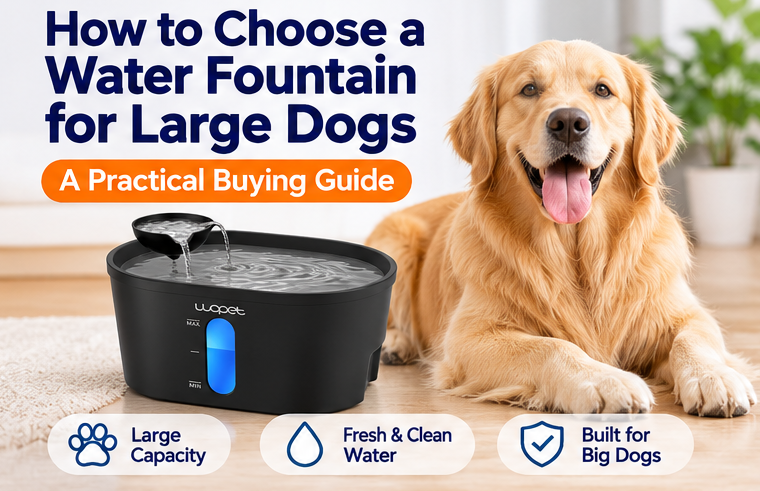
A good large dog water fountain should combine adequate capacity, a comfortable drinking area, reliable water circulation, and practical maintenance features.
Here are seven things to look for:
Large water capacity: Enough stored water to accommodate your dog's daily needs.
Wide drinking basin: Sufficient space for a larger muzzle and comfortable lapping.
Appropriate drinking height and depth: Easy access without awkward positioning.
Stable construction: A secure base that resists movement and accidental tipping.
Effective filtration: A system that helps capture hair, food particles, and debris.
Quiet, reliable circulation: Water movement that suits your home and your dog's preferences.
Easy cleaning and maintenance: Accessible components and readily available replacement filters.
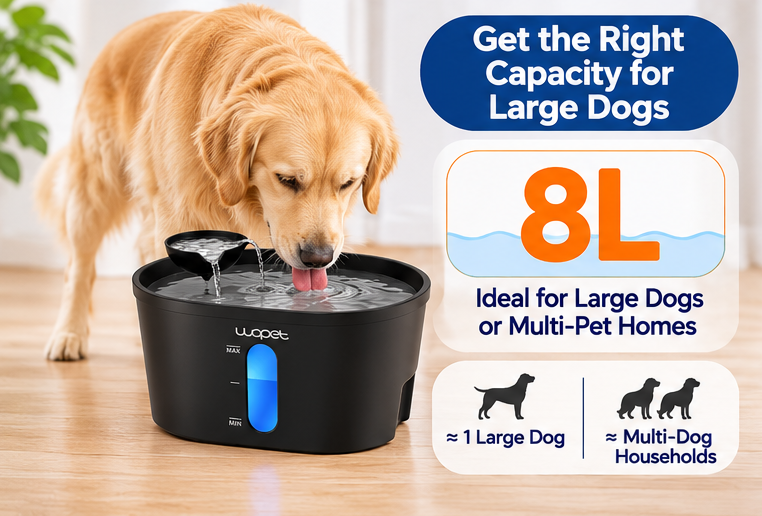
For many large dogs, a 6L or 8L fountain can be a practical starting point. However, the appropriate capacity depends on the dog's weight, activity level, diet, and how often you can refill the reservoir.
Let's examine each feature in more detail.
Reservoir capacity is one of the first specifications to consider when buying a dog water fountain.
A large dog generally requires more water than a small dog because of its greater body mass. Active dogs and those living in warmer environments may also drink more.
A fountain with a small reservoir can empty quickly, especially when used by more than one pet.
A larger reservoir can offer several practical benefits:
Fewer refills during the day.
More stored water for larger dogs.
Greater convenience for multi-pet households.
Reduced likelihood of unexpectedly low water levels between checks.
However, a larger reservoir does not mean the water should remain unchanged for several days.
Fresh drinking water should always be available, and fountains still need regular cleaning.
For many healthy adult large dogs, a 6L reservoir provides substantial capacity compared with a conventional bowl.
For example, a 30 kg Labrador may have an estimated total daily water requirement of roughly 1.5–1.8L using a general planning range of 50–60 mL per kilogram.
A 6L reservoir could hold several times that estimated amount, but actual drinking needs vary, and the full stated reservoir capacity may not be usable during operation.
Always check the fountain daily rather than relying on its theoretical capacity.
An 8L water fountain may be especially useful for:
Households with two or more large dogs.
Giant breeds with higher overall water requirements.
Homes where several pets share a drinking station.
Owners who prefer additional reservoir capacity between checks.
For these situations, a larger model such as the WOPET A08 may be worth considering.
Large dogs need enough room to drink comfortably.
Unlike humans, dogs use rapid tongue movements to pull water into their mouths. Their drinking motion can create splashing, particularly when the available water surface is narrow.
A small fountain designed primarily for cats may not offer enough room for a Labrador, German Shepherd, or Great Dane.
Wide drinking basins can provide:
More room for large muzzles.
Easier access to the water surface.
A more familiar bowl-like drinking experience.
Additional space in households with multiple pets.
Narrow drinking areas may:
Restrict access for dogs with broad muzzles.
Require more precise positioning.
Be less convenient for larger breeds.
Make some dogs reluctant to use the fountain.
That does not mean every narrow fountain is unsuitable.
Some dogs are comfortable drinking from compact outlets. The important factor is whether your dog can reach the water naturally and without difficulty.
When comparing fountains, check the actual drinking-area dimensions rather than relying only on the reservoir capacity.
A fountain may hold several liters of water but still have a relatively small accessible drinking surface.
For large breeds, a wide basin-style design is often worth prioritizing.
The height of a dog water fountain can affect how comfortably a dog reaches the water.
Large dogs differ considerably in body shape.
A Golden Retriever, Great Dane, and English Mastiff may all be classified as large dogs, but their shoulder heights, neck lengths, and muzzle shapes are different.
Not necessarily.
Some owners prefer raised bowls because they believe elevated drinking positions are more comfortable.
However, elevated bowls are not automatically healthier for every large dog.
Research on raised feeding bowls and gastric dilatation-volvulus (GDV), commonly called bloat, has produced conflicting findings, and elevated feeding has not been demonstrated to prevent GDV.
Although feeding-bowl research does not directly establish the effects of elevated water fountains, it is a reason to avoid making broad health claims about raised drinking stations.
For large or giant breeds at increased risk of GDV, discuss appropriate bowl height with your veterinarian.
Observe your dog's natural drinking posture.
A suitable fountain should allow your dog to:
Reach the water without straining.
Drink without awkward neck positioning.
Access the basin without obstruction.
Stand comfortably while drinking.
If your dog has arthritis, mobility limitations, or another medical condition, ask your veterinarian whether a modified drinking height would be helpful.
A basin should provide enough accessible water for comfortable lapping.
However, deeper is not always better.
The ideal depth depends on the dog's muzzle shape, drinking habits, and the fountain's water-level design.
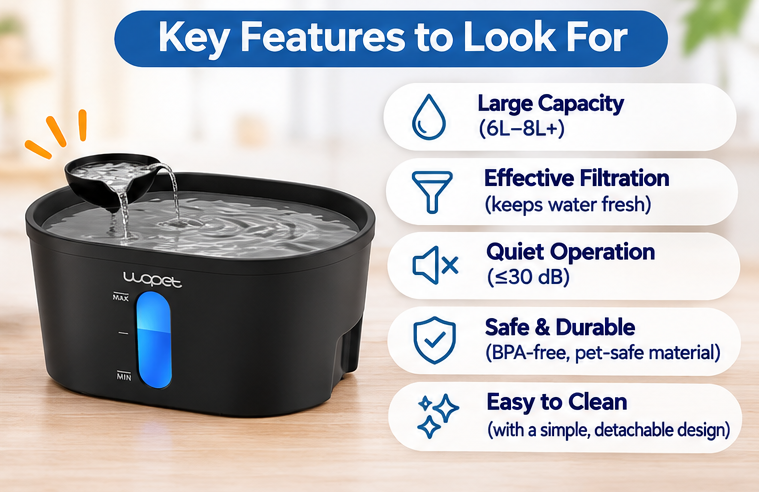
Large dogs can be enthusiastic drinkers.
A powerful Labrador or Rottweiler may accidentally bump a fountain while approaching it, while some dogs use their paws around the water.
An unstable fountain may slide, tip, or spill.
Look for:
A broad, stable base.
Securely fitted components.
Non-slip support feet where available.
Materials suitable for regular pet use.
A design that keeps the center of gravity relatively low.
A wide base can help distribute the fountain's weight and reduce unwanted movement.
Dog water fountains may be made from plastic, stainless steel, ceramic, or combinations of materials.
Each has advantages and limitations.
Plastic fountains are often lightweight and can be designed with larger reservoirs and integrated features. Choose pet-safe materials and replace components that become deeply scratched or damaged.
Stainless steel fountains may offer durable, nonporous water-contact surfaces when properly manufactured and maintained.
Ceramic fountains can provide substantial weight and smooth surfaces but may be heavier and vulnerable to chipping or cracking.
No material is automatically maintenance-free.
Regular cleaning is essential regardless of construction.
Position the fountain on a flat, stable surface away from busy walkways.
A waterproof, non-slip mat may help protect flooring and reduce movement.
Avoid placing electrical cords where dogs can chew or trip over them.
Large dogs may introduce saliva, loose hair, food particles, and other debris into their drinking water.
A filtration system can help capture some of these contaminants and maintain normal water circulation.
However, not all filtration systems work in the same way.
Mechanical filtration
Mesh, foam, or similar materials capture visible particles such as hair and debris.
Activated carbon filtration
Activated carbon may reduce certain compounds associated with unpleasant odors or tastes.
Ion-exchange filtration
Some filters use ion-exchange materials to reduce selected dissolved ions, depending on their design.
Multi-stage filtration
These systems combine different materials to address multiple filtration needs.
Not necessarily.
The effectiveness of a filter depends on its materials, design, flow rate, condition, and maintenance.
A multi-layer filter is not automatically better than a simpler system.
Most importantly, standard pet fountain filters should not be assumed to disinfect water or remove all microorganisms.
Some disposable pet fountain filters use replacement intervals of approximately 2–4 weeks, but the correct schedule depends on the manufacturer.
Households with heavy-shedding dogs or multiple pets may need to inspect filters more frequently.
Always use compatible replacement filters.
A noisy fountain can be distracting for both dogs and owners.
Large dog water fountains often circulate substantial amounts of water, but a larger reservoir does not necessarily mean louder operation.
Noise depends on circulation technology, water level, placement, and maintenance.
A fountain may produce:
Gentle humming from the circulation system.
Flowing-water sounds.
Light splashing.
Occasional bubbling.
These sounds can be normal.
However, loud rattling, grinding, or sudden changes in operating noise may indicate a problem.
Many conventional fountains use submerged pumps to move water.
Other designs use magnetic-drive or different circulation mechanisms.
Each system has its own operating characteristics and cleaning requirements.
When comparing products, review the manufacturer's information about circulation design, maintenance, and operating modes.
Rechargeable fountains can offer more placement flexibility because they do not need a continuous corded power connection during battery operation.
However, wireless does not automatically mean quieter.
Battery capacity, operating modes, and charging requirements are also important considerations.
For owners who want flexible placement, a rechargeable model such as the WOPET W600 Pro may be worth exploring.
A dog water fountain is only practical if you can maintain it consistently.
Large reservoirs can accumulate hair, saliva, mineral deposits, and biofilm over time.
If a fountain is difficult to disassemble or contains inaccessible water channels, cleaning may become frustrating.
Choose a fountain with:
Accessible water-contact surfaces.
Removable drinking trays where applicable.
Filters that are easy to reach.
Water channels that can be inspected.
Clear cleaning instructions.
Compatible replacement parts.
Check the fountain daily and refresh the drinking water regularly.
As a practical starting point, thoroughly clean the fountain at least weekly, or more often if the water becomes dirty or the manufacturer recommends more frequent cleaning.
For multi-dog households, visible contamination may accumulate faster.
Turn off and disconnect the fountain.
Empty the reservoir.
Remove washable components.
Clean the drinking basin and reservoir.
Inspect accessible water channels and circulation parts.
Rinse thoroughly.
Reassemble and refill with fresh drinking water.
Use only cleaning products and procedures approved by the manufacturer.
Understanding your dog's water needs can help you choose a suitable fountain capacity.
A commonly used planning estimate for healthy adult dogs is approximately 50–60 mL of total water intake per kilogram of body weight each day.
Actual needs vary considerably depending on diet, weather, exercise, and health.
Water consumed through food also contributes to total intake.
| Dog Weight | Approximate Total Daily Water Intake |
|---|---|
| 20 kg / 44 lb | 1.0–1.2L |
| 25 kg / 55 lb | 1.25–1.5L |
| 30 kg / 66 lb | 1.5–1.8L |
| 35 kg / 77 lb | 1.75–2.1L |
| 40 kg / 88 lb | 2.0–2.4L |
| 50 kg / 110 lb | 2.5–3.0L |
| 60 kg / 132 lb | 3.0–3.6L |
These figures are rough estimates, not strict limits or individualized veterinary recommendations.
Dogs may need more water after exercise or during hot weather. Never restrict access to drinking water to match a table.
Start by estimating your dog's typical daily intake.
Then consider:
Whether other pets use the fountain.
How often you check and refill it.
The usable water volume rather than just the advertised capacity.
Whether your dog drinks more during particular seasons.
Whether additional water bowls are available.
For example, a household with two 35 kg dogs may have an estimated combined daily total water intake of 3.5–4.2L under ordinary conditions.
A 6L fountain may be useful for that household, but it should still be checked and refilled as necessary.
WOPET offers several fountain designs worth considering for larger dogs.
The following models serve different needs, so the best choice depends on your household rather than a universal ranking.
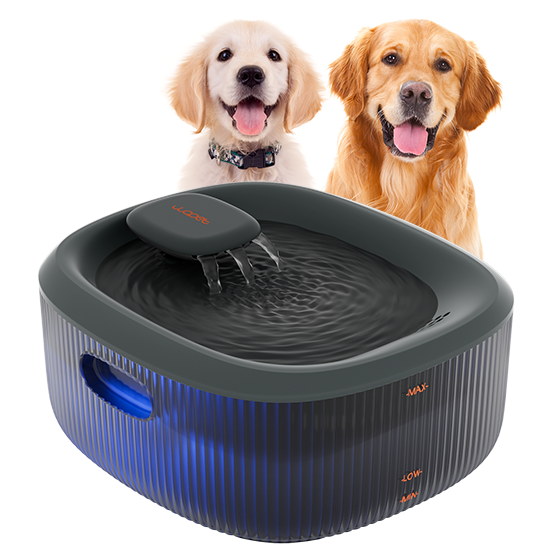
The WOPET W600 is a 6L basin-style dog water fountain designed with a spacious drinking area.
Its wide basin makes it worth considering for dogs that prefer an open water surface.
Key Features
6L reservoir capacity.
Wide basin-style drinking area.
Water-level monitoring features.
Replaceable filtration components.
Corded operation.
Why Consider It?
The W600 is a practical option for a permanent drinking station.
Its basin-style design is particularly relevant for larger dogs that need comfortable access to the water surface.
Best For: Large dogs such as Labradors, Golden Retrievers, and German Shepherds whose owners prefer a stationary water fountain.
Consider Before Buying: Check the drinking-area dimensions, outlet placement, and available space in your home.
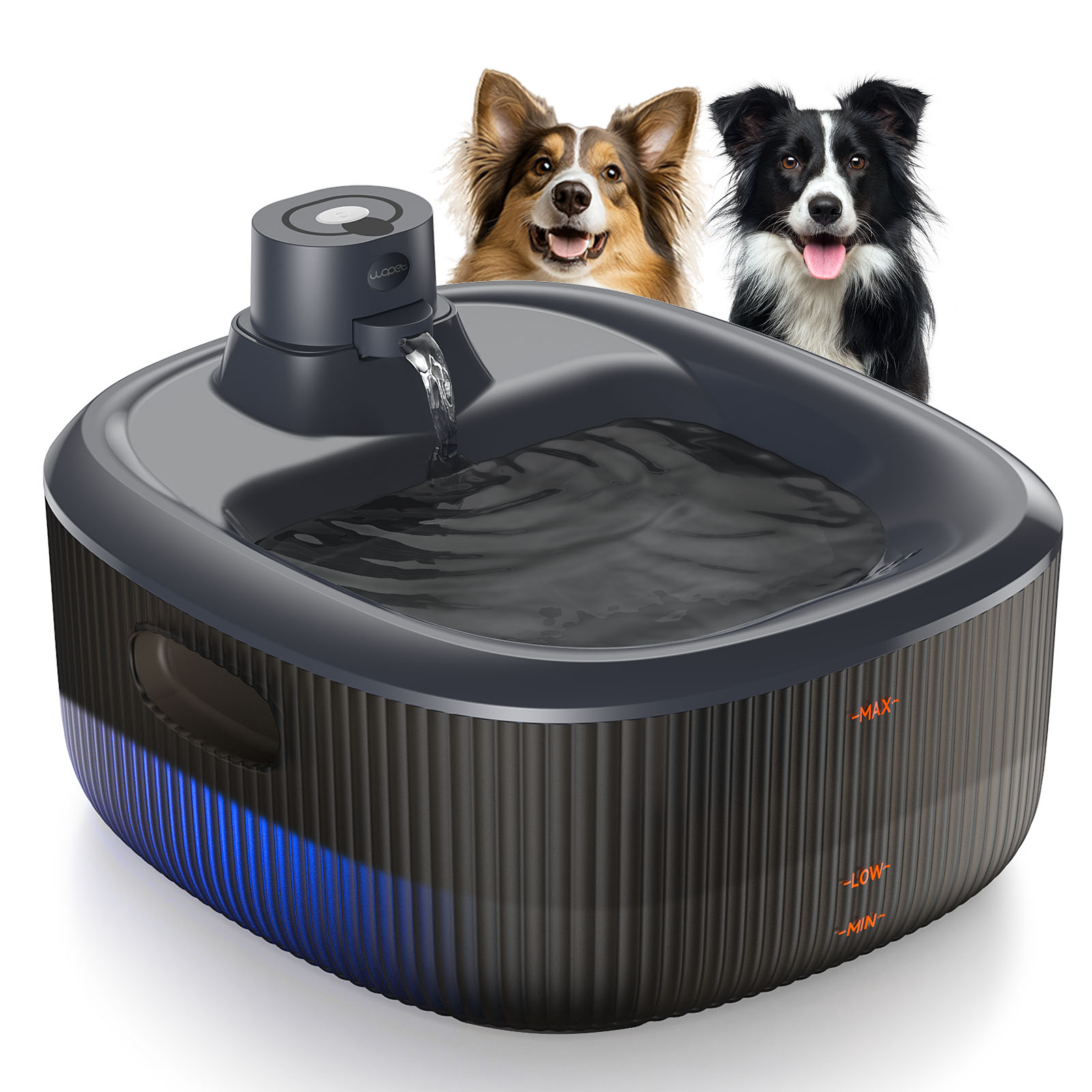
The WOPET W600 Pro is a 6L rechargeable water fountain.
It offers a basin-style drinking area with the convenience of battery-powered operation.
Key Features
6L reservoir capacity.
Rechargeable power system.
5,000mAh battery specification.
Basin-style drinking design.
Flexible placement options.
Why Consider It?
A rechargeable fountain may be useful when you want to place your dog's drinking station away from a wall outlet.
This can be convenient in open living areas or locations where managing a power cable would be difficult.
Best For: Large-dog owners who prioritize flexible placement and rechargeable operation.
Consider Before Buying: Check the battery runtime, charging requirements, and operating modes specified for the product.
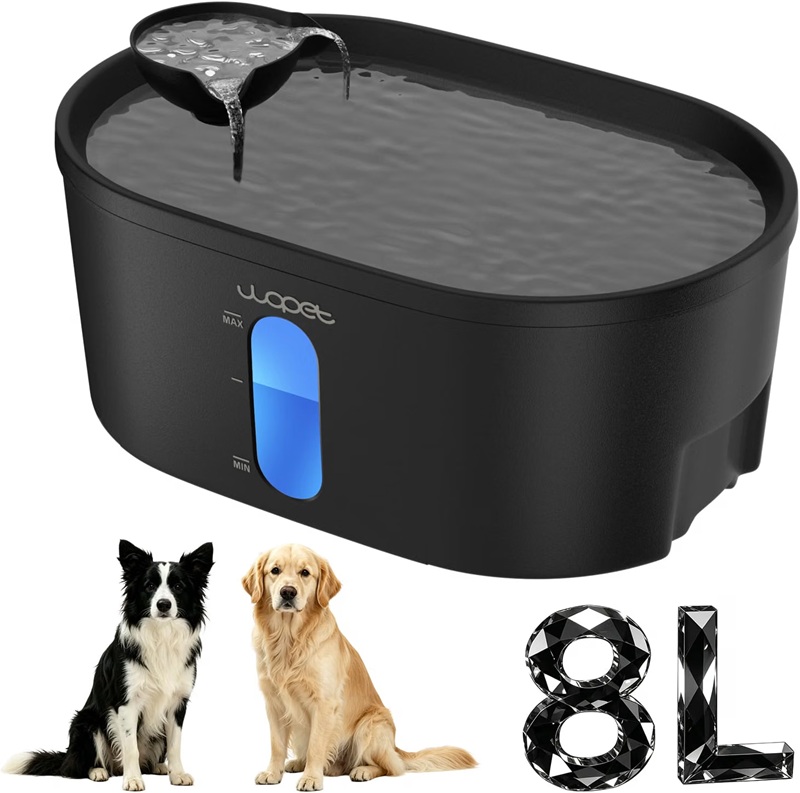
The WOPET A08 is an 8L pet water fountain designed for large dogs and multi-cat households.
Its larger reservoir provides additional capacity compared with the 6L W600 models.
Key Features
8L reservoir capacity.
Multi-stage filtration design.
Water-level monitoring features.
Large-pet and multi-pet positioning.
Reservoir designed for routine refilling and cleaning.
Why Consider It?
The A08 is worth considering when extra stored water capacity is a priority.
It may be especially useful for homes with multiple pets or larger dogs that consume substantial amounts of water.
Best For: Multi-pet households, large dogs, and owners who want a larger reservoir.
Consider Before Buying: A larger reservoir requires more space and still needs regular cleaning and water replacement.
| Feature | WOPET W600 | WOPET W600 Pro | WOPET A08 |
|---|---|---|---|
| Reservoir capacity | 6L | 6L | 8L |
| Main advantage | Wide everyday drinking basin | Rechargeable convenience | Extra reservoir capacity |
| Power design | Corded | Rechargeable | Corded |
| Primary use case | Fixed drinking station | Flexible placement | Large and multi-pet households |
| Best selection reason | Comfortable basin access | Cordless operation | Larger water reserve |
Which one should you choose?
Choose the WOPET W600 if your priority is a spacious basin-style drinking station for everyday use.
Consider the WOPET W600 Pro if you want similar reservoir capacity with rechargeable convenience.
Choose the WOPET A08 if you need more stored water capacity for a large dog or multiple pets.
Before purchasing, verify the current model specifications and replacement filter compatibility on the official WOPET website.
Although large breeds share some general needs, their body shapes and drinking habits differ.
Golden Retrievers are active dogs that may drink substantial amounts after walks, exercise, or outdoor play.
A fountain with a wide basin, adequate capacity, and accessible cleaning components is a practical choice.
Labradors can be enthusiastic drinkers and may splash water around the bowl.
Consider a stable fountain with a spacious drinking surface and a location that is easy to clean.
German Shepherds often benefit from a drinking area that accommodates their longer muzzle.
Look for adequate basin width and a comfortable drinking position.
For Rottweilers, stability and a generously sized drinking area may be particularly useful.
Choose a fountain that remains secure when approached by a large, powerful dog.
Great Danes require careful consideration of drinking-area accessibility, capacity, and placement.
Because giant breeds can have special orthopedic and GDV-related considerations, discuss unusual bowl-height requirements with your veterinarian rather than assuming an elevated fountain is necessary.
Bernese Mountain Dogs have thick coats and may introduce loose hair into shared drinking areas.
Accessible filters and easy-clean components can make maintenance more manageable.
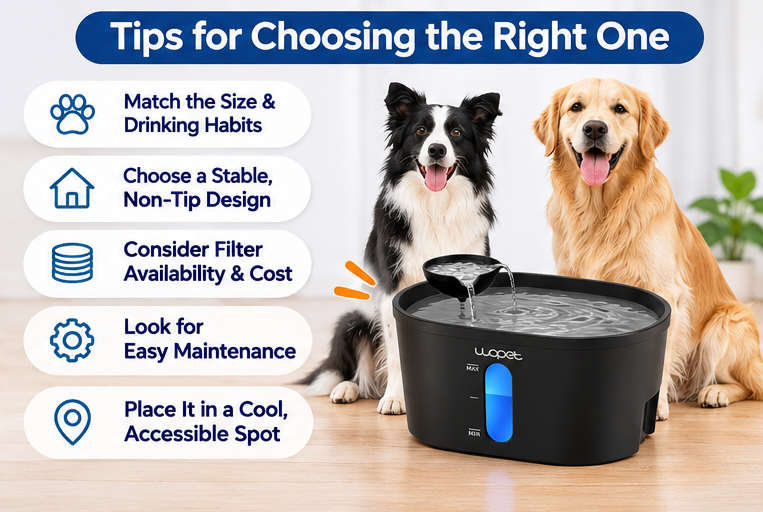
A large reservoir does not guarantee a comfortable drinking area.
Always check the accessible basin dimensions.
A lightweight or poorly positioned fountain may move when a large dog approaches.
Choose a stable design and appropriate placement.
Large dogs do not automatically require elevated water stations.
Consider individual comfort and veterinary guidance.
A fountain with difficult-to-reach components can become inconvenient to maintain.
Look for a practical cleaning design.
Before purchasing, check whether compatible filters are available and how often they need replacement.
A fountain may lose power, become empty, or require cleaning.
Providing an additional clean water bowl ensures your dog has another drinking option.
A 6L or 8L fountain can be a practical option for many large dogs, but the correct capacity depends on body weight, activity, diet, and refill frequency.
A 6L reservoir may provide adequate stored water for a healthy adult German Shepherd under many household conditions.
However, daily monitoring and regular refilling are still necessary.
Wide basins often provide more comfortable access for dogs with larger muzzles.
However, the best design depends on the individual dog's preferences and drinking behavior.
There is no universal requirement for Great Danes to use elevated water fountains.
If your dog has mobility issues or you are concerned about GDV risk, consult your veterinarian about appropriate drinking arrangements.
Not necessarily.
Filter compatibility depends on the fountain model rather than the dog's breed.
However, heavy shedding and higher debris accumulation may require more frequent inspection.
A well-manufactured pet-safe plastic fountain can be a practical option.
Choose appropriate materials, clean the fountain regularly, and replace components that become damaged or heavily scratched.
Wireless fountains can be useful for flexible placement.
However, reservoir capacity, accessible drinking area, charging requirements, and circulation modes are more important than wireless operation alone.
Check the water daily and clean the fountain whenever contamination is visible.
Follow the manufacturer's instructions for routine deep cleaning and filter replacement.
Yes, if both dogs can access it comfortably and enough water is available.
However, additional drinking stations are advisable when pets compete for access or spend time in separate areas.
Choosing a water fountain for a large dog breed is about balancing capacity, comfort, stability, filtration, and maintenance.
A larger reservoir can reduce the need for frequent refilling, but it should not be the only factor in your decision.
A wide drinking basin, stable construction, accessible water channels, and suitable filtration can make a fountain more practical for everyday use.
For WOPET shoppers, the W600 offers a basin-style option for everyday large-dog hydration, the W600 Pro adds rechargeable convenience, and the A08 provides a larger 8L reservoir for households that need additional capacity.
Whichever model you choose, keep fresh drinking water available, clean the fountain regularly, and pay attention to your dog's individual preferences.
The best water fountain is one your dog can use comfortably—and one you can maintain consistently.
Explore the available range at WOPET to find a fountain that fits your dog and your home.
Read more:
Label:
Popular Post
The Ultimate Guide to Tabby Cats: Patterns, Personalities, and More
Mar 27, 2025

Top 8 Reasons Why Does My Cat Sleep Between My Legs?
Mar 03, 2025

What to Do If My Dog's Poop Is Black But Not Tarry
Feb 04, 2023
Superfecundation Cats: When Kittens in One Litter Have Different Fathers
Jul 11, 2025
How Long Does Dry Cat Food Last Once Opened? A Comprehensive Guide
Mar 19, 2025
[Blue] W03L 3L Premium Ceramic Cat Water Fountain
Model: W03 LITE
$59.99
$69.99

Basin Pet Water Fountain-W600
Model: W600
$43.99
$69.99
[Basic] Ceramic Pet Water Fountain with Power Cable
Model: W03L
$59.99
$99.00
[Black] W03L 3L Premium Ceramic Cat Water Fountain
Model: W03L Black
$59.99
$69.99

WOPET 8L Pet Water Fountain For Multiple Cats or Large Dogs A08
Model: A08
$49.99
$59.99
WOPET A08 Dog Water Fountain Filters
Model: A08 Filter
$19.99
$29.99

DOWNLOAD APP

WOpet life




Copyright © 2026 WOPET. All Rights Reserved.