Oct 20, 2026
Author:Amanda Lyu
Quick answer: A wireless pet water fountain stores energy in a rechargeable battery, then uses that energy to run a low-voltage pump. The pump draws water from a reservoir, sends it through a filter or pre-filter, and delivers it to a tray, spout, or shallow drinking area. The water then returns to the reservoir and repeats the cycle. Some models run continuously, while others use timed or motion-activated flow to conserve battery power.
The word wireless can be confusing. It usually means the fountain can operate away from a wall outlet after charging. It does not mean that the fountain charges wirelessly, connects to Wi-Fi, or never needs a cable. In most cases, you still connect the fountain or its battery module to a charging cable periodically.
Brands and retailers may also use cordless, battery-operated, or rechargeable for the same basic idea. Always check the power description instead of relying on the product name alone.
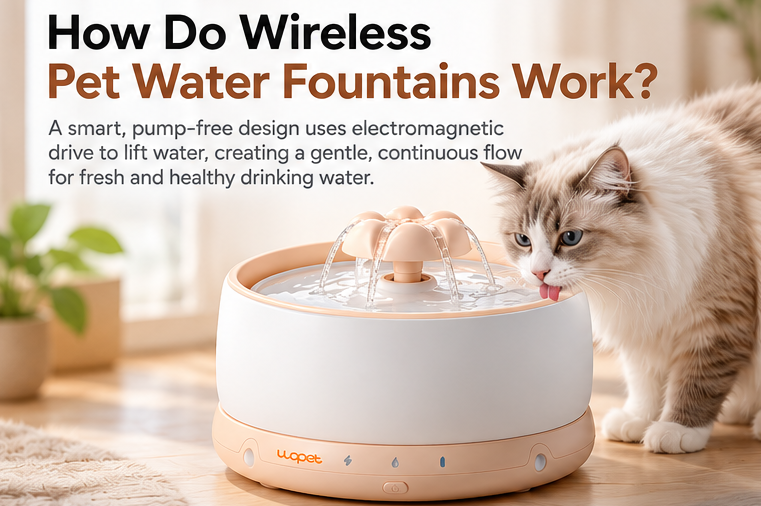
The Five Main Parts of a Wireless Pet Fountain
Although designs vary, most rechargeable fountains rely on the same basic system.
|
Part |
What it does |
What owners need to check |
|
Rechargeable battery |
Powers the pump, sensors, and indicators |
Charge level, approved cable, and signs of damage |
|
Pump |
Moves water from the reservoir to the drinking area |
Water level, noise, flow, and debris around the impeller |
|
Filter or pre-filter |
Traps hair and larger debris; some media may also reduce odors or tastes |
Correct installation and replacement schedule |
|
Reservoir and drinking surface |
Stores water and gives the pet a place to drink |
Daily water level, cleanliness, and easy access |
|
Controller or sensor |
Decides when the pump runs |
Selected mode, activation frequency, and indicator lights |
1. Rechargeable battery
The battery replaces the constant power connection used by a corded fountain. Once charged, it supplies electricity to the pump and, where fitted, indicator lights or sensors.
Battery capacity matters, but it does not determine runtime by itself. A larger battery can still drain quickly if the pump runs continuously. A smaller battery may last longer when the fountain operates only at intervals or in response to motion. That is why published battery capacity and advertised runtime should be considered together with the operating mode used during testing.
For a detailed look at real-world runtime, see how long a wireless cat fountain battery lasts.
2. Water pump
The pump pulls water from the reservoir and pushes it toward the drinking surface. Most pet fountains use a compact, low-voltage pump designed for indoor use.
The pump needs enough water and a clear intake. Hair, mineral deposits, food crumbs, and filter debris can restrict the impeller. When that happens, the pump may sound louder and the flow may weaken.
3. Filter and pre-filter
Filters do not sterilize water. Their job is generally to catch hair and visible debris and, depending on the filter media, reduce some odors or tastes. A foam pre-filter may protect the pump from larger particles, while a replaceable filter sits elsewhere in the water path.
Filtration is useful only when paired with routine care. Water still needs to be replaced, the reservoir still needs to be washed, and the pump still needs to be opened and cleaned according to the product manual. A fountain that circulates old water is not automatically cleaner than a freshly washed bowl.
4. Reservoir and drinking surface
The reservoir stores the main supply of water. Above it, a tray, basin, spout, or shallow channel gives the pet access to the moving water. The shape affects how easy the fountain is to drink from and clean.
Wide, open drinking areas can be comfortable for cats that dislike pressing their whiskers against narrow edges. Capacity should be chosen around the number and size of pets, but a bigger reservoir does not eliminate the need to check the water every day.
5. Controller, timer, or motion sensor
The controller determines when the pump runs. Common modes include:
• Continuous mode: The pump runs steadily until the fountain is switched off or the battery reaches its cutoff point.
• Interval mode: The pump runs on a repeating schedule, such as a short flow period followed by a pause.
• Sensor mode: The pump activates when a motion or proximity sensor detects activity within its operating range.
Not every fountain offers all three. Mode names and timing also differ by model, so owners should use the manual rather than assume two products behave the same way.
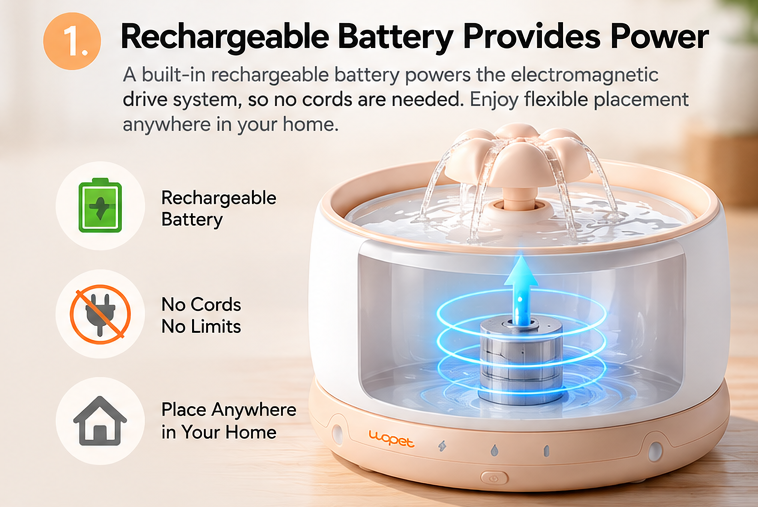
What Happens During One Water Cycle?
In a typical cycle, water moves through the fountain in this order:
1. Water rests in the reservoir.
2. The pump draws water through an intake or pump cover.
3. A pre-filter catches larger particles before they reach the impeller.
4. The pump sends the water through the main filter or toward the outlet.
5. Water reaches the drinking tray, stream, or basin.
6. Gravity returns unused water to the reservoir.
This is a closed recirculating system. It does not connect to household plumbing, and it does not create new water. Owners still need to refill what pets drink and what evaporates.
Does a Wireless Fountain Work During a Power Outage?
Usually, yes—if the battery is charged and that mode works while the fountain is unplugged. This is one practical advantage over a plug-in-only fountain. However, battery operation is not an unlimited emergency water supply.
Before leaving a pet alone, confirm that the fountain is charged, filled, assembled correctly, and flowing normally. A separate bowl of fresh water is a sensible backup, especially during travel, hot weather, or any period when no one will be available to troubleshoot the fountain.
Why Runtime Changes From One Home to Another
Battery estimates are usually based on specific test conditions. Actual runtime may change because of:
• the selected flow mode;
• how often a motion sensor activates;
• pump condition and water level;
• indicator lights or other powered features;
• battery age and charge history;
• room temperature;
• mineral buildup or debris restricting flow.
For that reason, “up to” runtime is a best-case figure, not a guaranteed schedule for every household. Track your own fountain through two or three normal charge cycles before relying on a routine. Our guide to how often to recharge a wireless cat fountain explains how to set a buffer before the battery runs out.
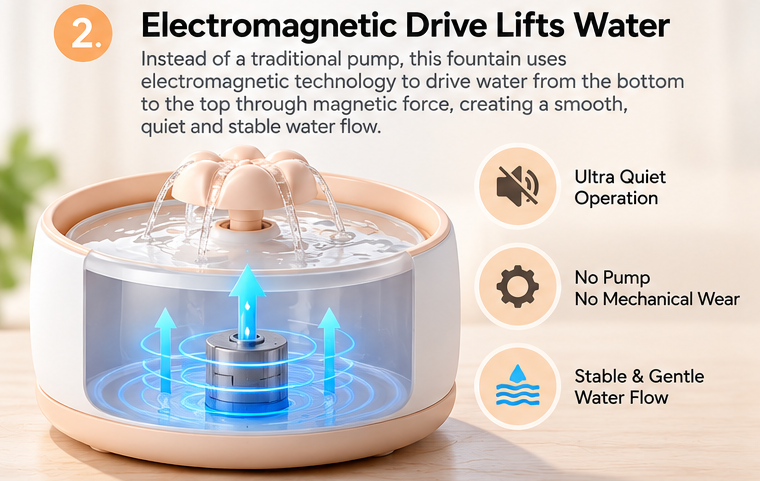
Is Moving Water Better for Every Cat?
Some cats appear more interested in moving water, while others prefer a still bowl. Cat Friendly Homes, an initiative associated with feline veterinary professionals, suggests that a fountain can be one option for cats attracted to movement. It also emphasizes offering suitable water sources around the home. Read more in its guidance on enhancing water intake for cats.
A fountain can be useful, but it is not a medical treatment or a guarantee that a cat will drink more. Keep an ordinary bowl available during the transition and watch what your cat actually uses. If drinking or urination changes suddenly, contact a veterinarian instead of trying to solve the problem only by changing equipment.
How to Use a Wireless Fountain Correctly
1. Wash all washable parts before first use.
2. Assemble the pump, filter, and tray exactly as shown in the manual.
3. Fill to the marked level with fresh drinking water.
4. Dry the charging port and electrical contacts completely.
5. Charge with the cable and the voltage and amperage recommended by the manufacturer.
6. Select the operating mode that suits the pet and your charging routine.
7. Check water level, flow, and cleanliness every day.
8. Clean the reservoir, pump, and drinking surfaces on the schedule in the manual—or sooner if you see slime, hair, or reduced flow.
VCA Animal Hospitals advises keeping a cat’s water source fresh and clean, washing and rinsing bowls daily to help limit buildup. A fountain has more surfaces and hidden passages than a bowl, so it should never be treated as maintenance-free. See VCA’s cat hydration tips for broader water-source guidance.
Choosing Between Wireless and Corded Designs
A wireless fountain is useful when the preferred location has no convenient outlet, when a visible cable would be awkward, or when owners want flexible placement. A corded fountain may suit households that want continuous flow without tracking a charging schedule.
The best choice depends on the pet, room layout, maintenance habits, and desired operating mode. Our rechargeable cat water fountain buying guide provides a practical comparison checklist.
WOPET currently lists wireless and corded options in its pet water fountain collection. Shoppers can compare both power styles instead of assuming one format suits every home.
If you already own the ceramic W03, use WOPET’s W03 support page for the current manual and troubleshooting resources rather than applying instructions from a different model.
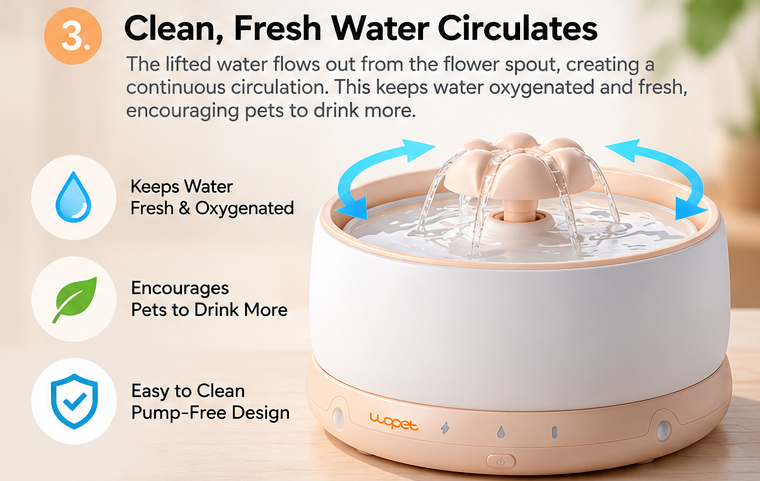
Buy WOPET W03 WIRELESS CAT WATER FOUNTAIN ON AMAZON
Frequently Asked Questions
Do wireless pet fountains need Wi-Fi?
No. In this product category, “wireless” generally describes battery-powered operation without a constant wall connection. A model would need separate smart or app features to require Wi-Fi.
Can a wireless fountain run while charging?
That depends on the product. Check the manual instead of assuming the fountain supports use while charging, and keep the charging port dry.
Does the filter make fountain water safe indefinitely?
No. Filters capture certain debris or affect taste and odor, but they do not replace fresh water, washing, pump cleaning, or scheduled filter replacement.
Will a motion sensor detect every cat?
Sensor performance depends on range, angle, placement, and the pet’s movement. Test the actual setup before relying on it, especially with a cautious cat that approaches slowly.
Are wireless fountains safe to leave on?
They are designed for routine household use when assembled, charged, and maintained according to their instructions. Owners should still inspect the cable, battery area, pump, water level, and charging port regularly. See our complete guide to wireless cat fountain safety.
So, How Does a Wireless Fountain Work?
A wireless pet water fountain uses a rechargeable battery to run a pump that moves water through a closed loop. The filter catches debris, the reservoir stores the water, and the controller decides when the pump runs. It still needs regular charging, refilling, and cleaning. The operating mode—not the word “wireless”—is what tells you how the fountain will behave day to day.
Label:
Popular Post

The Ultimate Guide to Tabby Cats: Patterns, Personalities, and More
Mar 27, 2025

Top 8 Reasons Why Does My Cat Sleep Between My Legs?
Mar 03, 2025

What to Do If My Dog's Poop Is Black But Not Tarry
Feb 04, 2023

Superfecundation Cats: When Kittens in One Litter Have Different Fathers
Jul 11, 2025

How Long Does Dry Cat Food Last Once Opened? A Comprehensive Guide
Mar 19, 2025
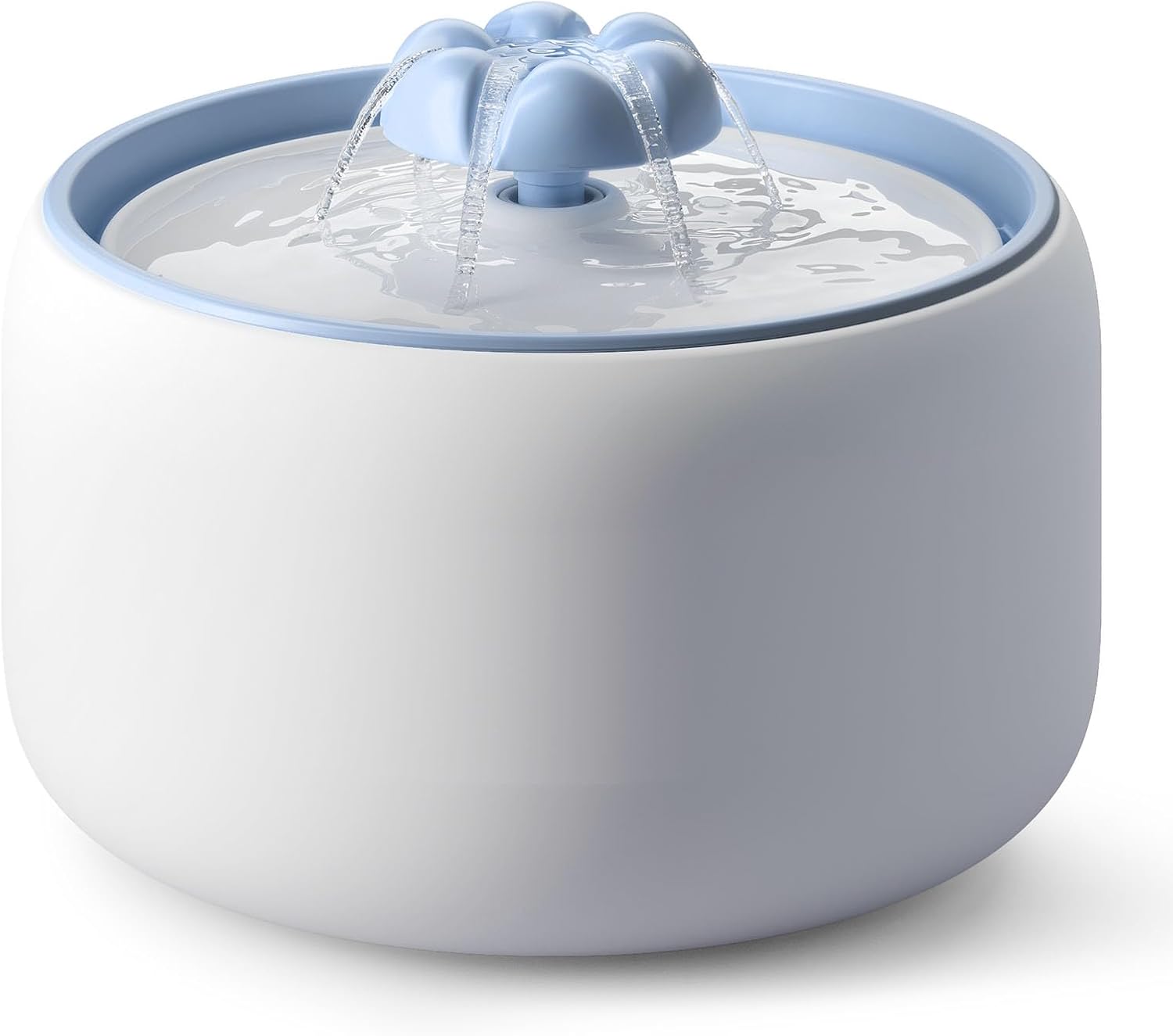
[Blue] W03L 3L Premium Ceramic Cat Water Fountain
Model: W03 LITE
$59.99
$69.99
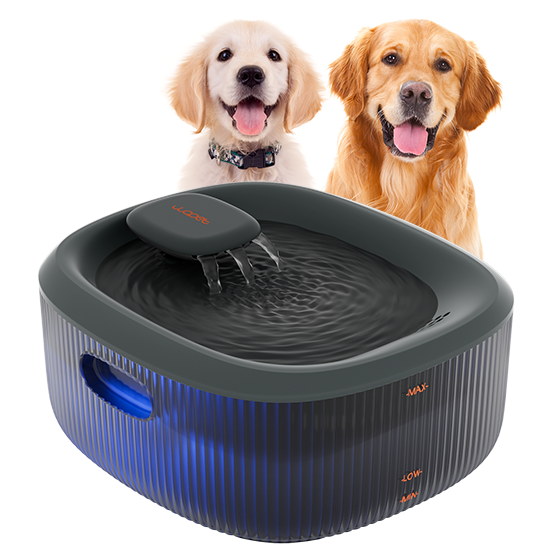
Basin Pet Water Fountain-W600
Model: W600
$43.99
$69.99
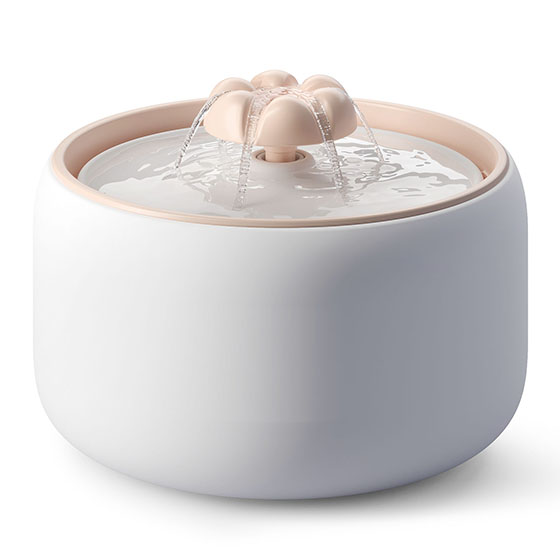
[Basic] Ceramic Pet Water Fountain with Power Cable
Model: W03L
$59.99
$99.00
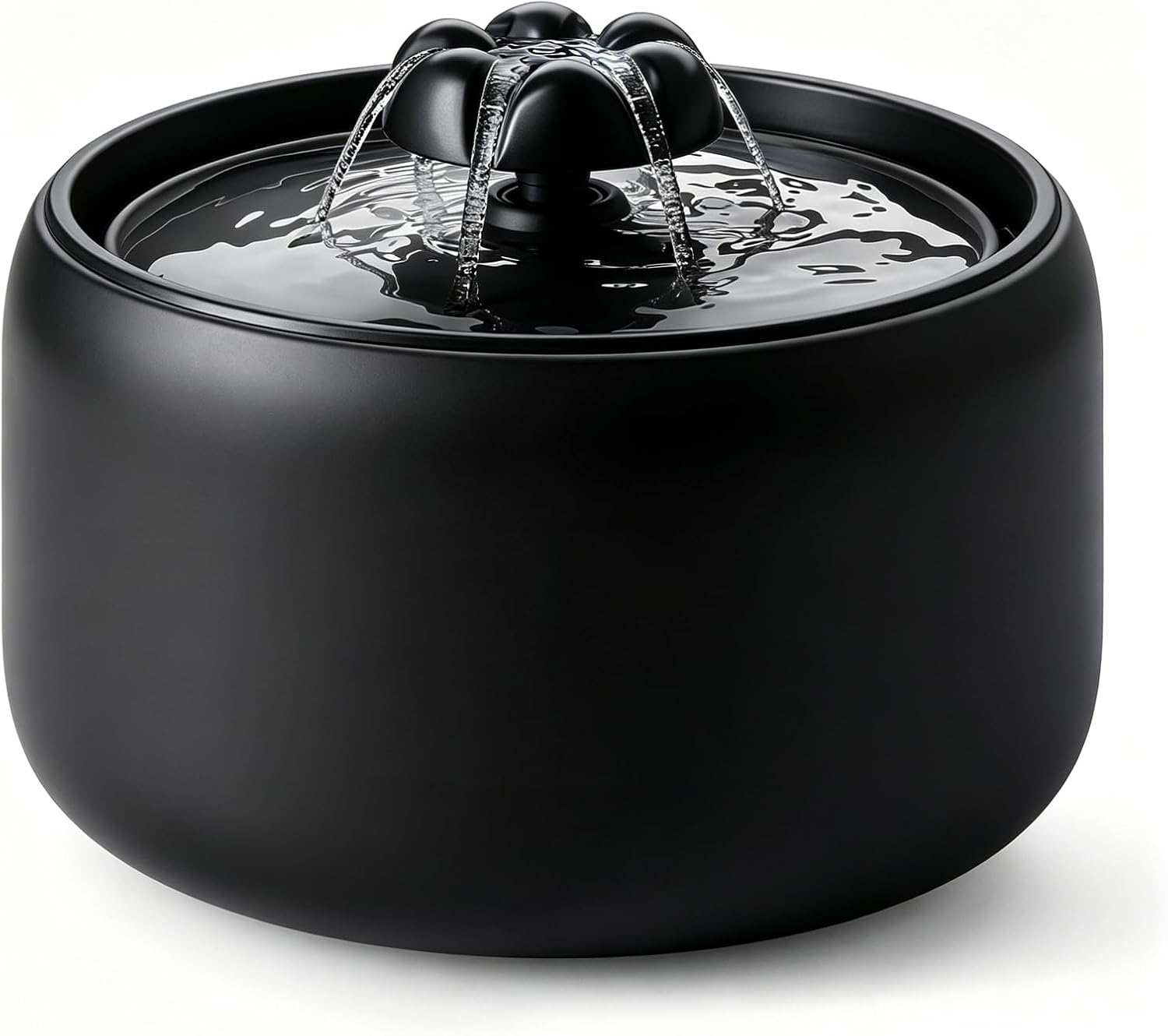
[Black] W03L 3L Premium Ceramic Cat Water Fountain
Model: W03L Black
$59.99
$69.99
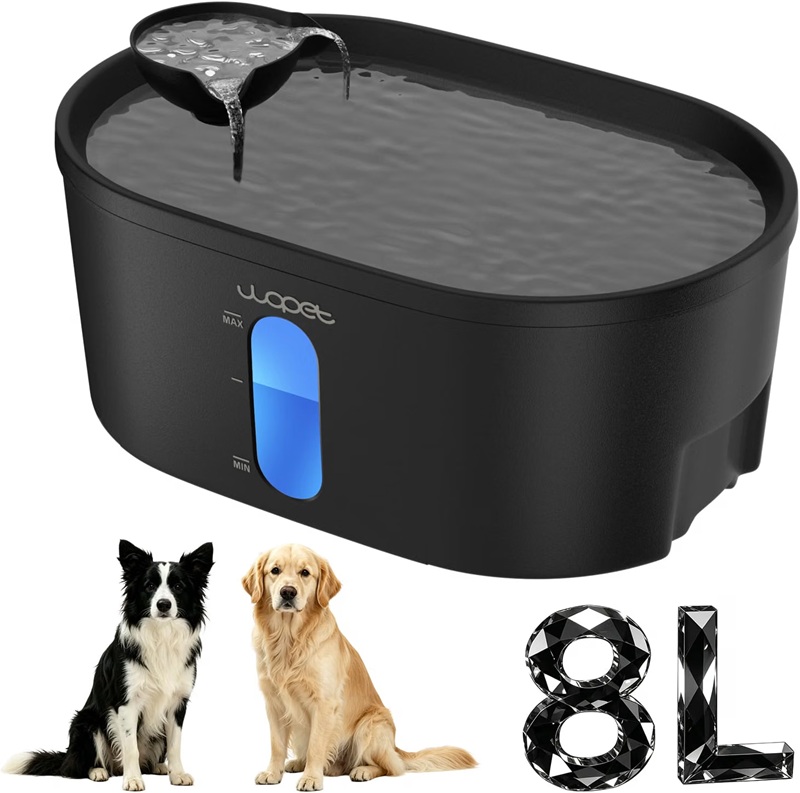
WOPET 8L Pet Water Fountain For Multiple Cats or Large Dogs A08
Model: A08
$49.99
$59.99
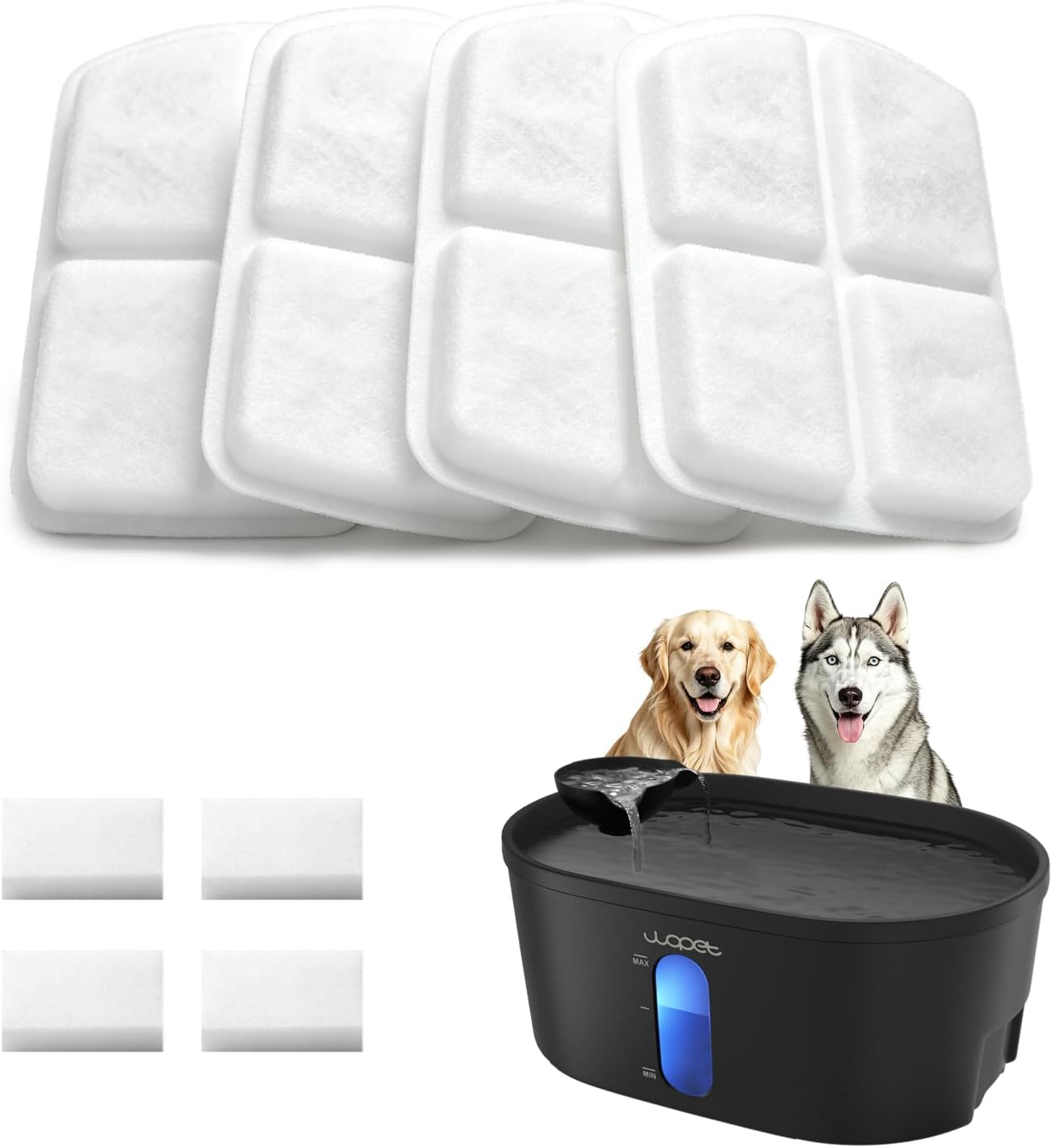
WOPET A08 Dog Water Fountain Filters
Model: A08 Filter
$19.99
$29.99

DOWNLOAD APP

WOpet life




Copyright © 2026 WOPET. All Rights Reserved.