Oct 23, 2026
Author:Jackson Watson
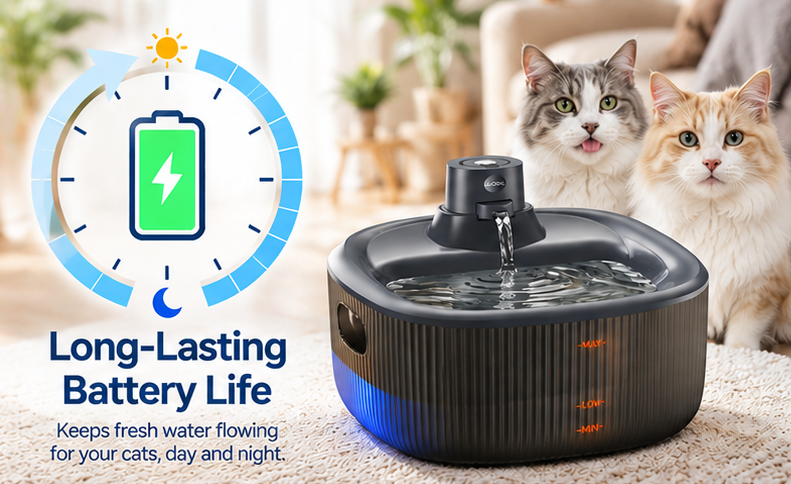
Quick answer: Recharge a wireless cat fountain on the schedule recommended for the exact model, then adjust based on actual use. Do not wait for the fountain to stop. After observing two or three normal charge cycles, schedule charging before the shortest runtime you recorded.
For example, if two charge cycles lasted 10 and 12 days, plan to charge before day 10. Choose a reminder that fits your routine and leaves enough time to recover from a missed . The exact interval will vary by model, mode, and household.
Why There Is No Single Recharge Interval
Wireless fountains do not all consume energy at the same rate. Charging frequency changes with:
• continuous, interval, or sensor mode;
• the number of pets using the fountain;
• how often the sensor activates;
• battery capacity and age;
• pump cleanliness and water level;
• indicator lights and other powered features;
• room temperature and storage conditions.
This is why one household may charge weekly while another charges only a few times a month. For the underlying technical factors, see how long a wireless cat fountain battery lasts.
Build a Charging Schedule in Four Steps
Step 1: Start with the manual
Check the manufacturer’s charging time, approved cable and adapter specifications, indicator meanings, supported operating modes, and any instructions about use while charging. Product-specific guidance should take priority over generic advice.
Step 2: Measure normal runtime
Fully charge the fountain and record when it begins operating in its usual location. Keep the same mode and routine. Note when the low-battery warning appears—not only when the fountain stops.
Repeat this for at least two cycles. One unusually busy week can trigger a sensor more often and make a single result misleading.
Step 3: Use the shortest cycle
If the fountain ran 15 days in one cycle and 12 in another, build the schedule around 12. Reliability matters more than squeezing out the last hours of charge.
Step 4: Add a buffer
Charge before the expected low point. A buffer protects against extra sensor activity, battery aging, or a missed reminder. Place the reminder on a day when someone is normally home to check the device after charging.
Signs It Is Time to Recharge
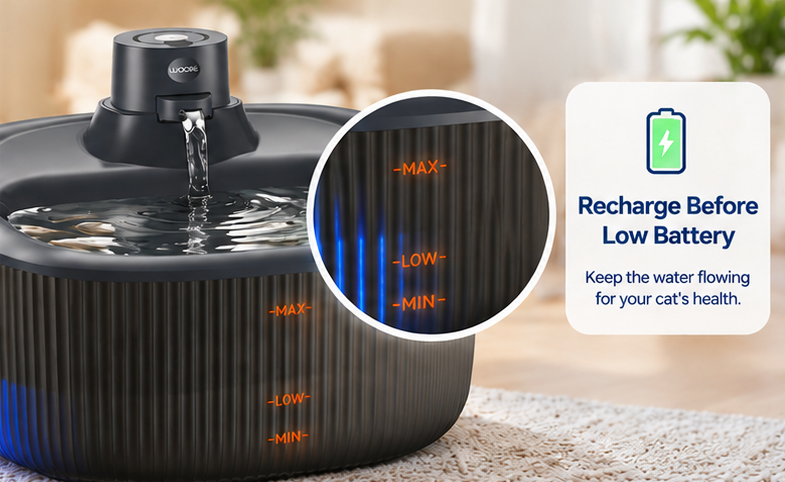
Start with the battery signals described in the manual. Common cues may include:
• a low-battery light or color change;
• a battery icon with fewer bars;
• an app notification on connected models;
• the pump no longer starting in its scheduled mode;
• the unit shutting down at a protected cutoff.
Weak flow is not a reliable battery indicator by itself. It can also mean the water level is low, the filter is misplaced, or the pump needs cleaning.
Should You Wait Until the Battery Is Empty?
No, not when the fountain is a pet’s drinking source. Even if you have heard that rechargeable batteries should be fully drained, reliable access to water comes first. Charge early enough that the fountain remains available.
You also do not need to chase an exact percentage unless the manufacturer specifies one. A repeatable schedule with a safety margin is more useful than trying to optimize every charge.
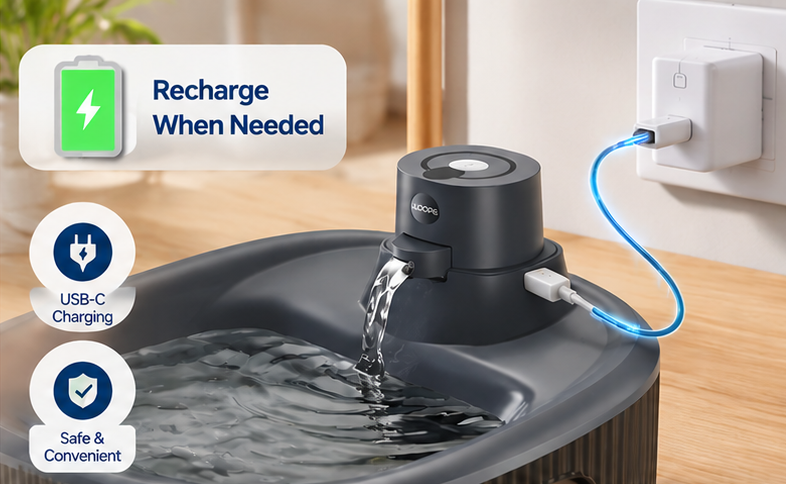
Safe Charging Routine
1. Turn off or take apart the fountain as directed.
2. Keep the battery base and charging cable away from filled water sections.
3. Dry the port, contacts, surrounding housing, and your hands.
4. Use the supplied or approved cable and power adapter.
5. Charge on a stable, dry surface, away from pets that may chew the cord.
6. After charging, reconnect the fountain and confirm normal flow.
The National Fire Protection Association provides general lithium-ion battery safety information, including the importance of safer everyday charging habits. Product instructions remain the primary guide for the fountain itself.
For a fuller inspection checklist, see wireless cat fountain safety.
Can the Fountain Run While It Charges?
Some devices allow operation during charging; others do not. Do not infer this from the shape of the port or from another model in the same product line.
If the fountain can run while charging, keep the port and cable dry and out of your pet’s reach. If the instructions do not allow it—or are unclear—provide a clean water bowl while the fountain charges.
Charging Habits That Can Cause Problems
Using any cable that fits
A cable that fits is not automatically safe to use. Choose the included cable or an approved replacement with the voltage and amperage required by the manufacturer.
Charging next to splashing water
The fountain may be cordless during use, but it reconnects to an outlet when charging. Keep the port and charger dry.
Ignoring shorter runtime
A gradual decline may reflect normal battery aging. A sudden change can also signal a dirty pump, a new operating mode, a damaged cable, or a battery problem. Investigate rather than simply charging more often.
Charging a damaged unit
Stop using the fountain and contact the manufacturer if the battery area becomes swollen, unusually hot, cracked, wet internally, or produces an unusual odor or sound. Do not puncture, open, or repair a sealed battery pack yourself.
UL Research Institutes advises using batteries and chargers supplied or approved by the original manufacturer. Its consumer-focused safe shopping guidance explains why mismatched or counterfeit charging equipment can raise the risk of battery failure.
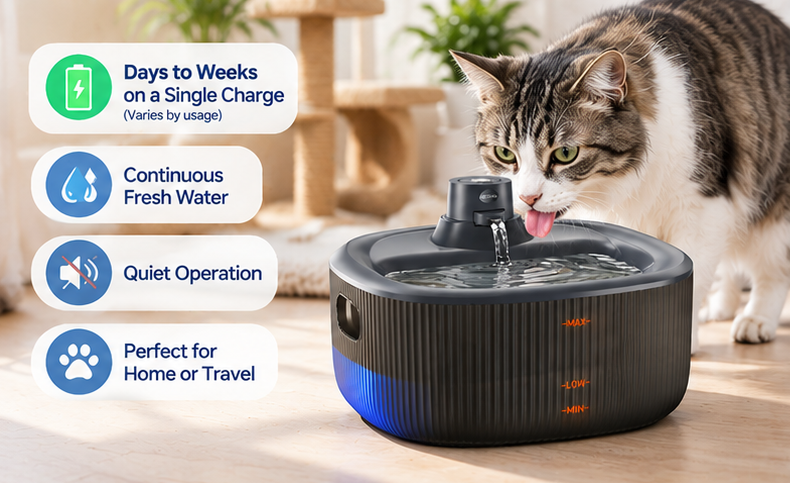
Buy WOPET W600 PRO Cat Water Fountain on Amazon
Match the Schedule to Your Fountain Mode
|
Operating mode |
Likely charging pattern |
What to monitor |
|
Continuous flow |
More frequent |
Pump-on time, heat, water level |
|
Timed/interval flow |
Less frequent than continuous in many designs |
Exact cycle timing, low-battery indicator |
|
Motion/sensor flow |
Varies widely by household |
Number of activations and foot traffic near the fountain |
“Likely” is important here. Efficiency varies by product, and a poorly maintained pump can complicate comparisons.
Use Charging Time for a Quick Inspection
Charging and cleaning do not need to follow the same schedule. Still, charging time is a convenient moment to check the parts you normally overlook:
• replace the drinking water;
• wash approved surfaces;
• inspect the pump intake and impeller;
• check filter condition;
• examine seals, contacts, and the cable;
• dry everything before reconnecting electrical parts.
If the pump is noisy or the flow has weakened, clean the water path before blaming the battery.
When a Different Fountain May Fit Better
If frequent charging becomes inconvenient, consider whether you need continuous flow or whether a corded fountain would work better in that location. If exposed cords are the main concern, look for a rechargeable model with clearly explained sensor or interval modes.
Our rechargeable cat water fountain buying guide explains how to compare power design with capacity, material, noise, cleaning access, and safety features. WOPET’s current pet water fountain collection includes both wireless and corded options for side-by-side consideration.
Frequently Asked Questions
How long does it take to charge a wireless cat fountain?
Charging time varies by model, battery size, and approved power source. Use the charging time and light signals described in the manual.
Can I charge the fountain overnight?
Follow the manufacturer’s instructions. As a general battery-safety habit, charge where the unit is dry, visible, ventilated, and away from combustible soft surfaces; avoid using damaged or unapproved charging equipment.
Should I recharge at a specific battery percentage?
Only if the product shows a percentage and its instructions recommend a specific threshold. Otherwise, use the low-battery light and your observed runtime to set a reminder.
Why am I charging more often now?
Check for a mode change, increased sensor traffic, pump or filter blockage, cable issues, temperature changes, and battery aging. Contact support if the decline is sudden or accompanied by heat, swelling, odor, or damage.
What should my cat drink from while the fountain charges?
Provide a clean bowl of fresh water unless the manual confirms that the fountain can safely operate during charging.
A Practical Charging Rule
Charge a wireless cat fountain before it reaches empty. The best schedule comes from the manual and real household use: measure two or three cycles, use the shortest result, and set an earlier reminder. Safe charging and routine maintenance matter more than stretching every charge to its limit.
Label:
Popular Post

The Ultimate Guide to Tabby Cats: Patterns, Personalities, and More
Mar 27, 2025

Top 10 Most Expensive Cat Breeds in The World
May 07, 2025
Can Cats Have Ice Cream? Dangers, Safe Flavors & Healthy Cat Treats
Sep 02, 2025

My Cat Only Eats A Little at A Time - What to Do?
Feb 27, 2023

Top 8 Reasons Why Does My Cat Sleep Between My Legs?
Mar 03, 2025

[Blue] W03L 3L Premium Ceramic Cat Water Fountain
Model: W03 LITE
$59.99
$69.99
Basin Pet Water Fountain-W600
Model: W600
$43.99
$69.99

[Basic] Ceramic Pet Water Fountain with Power Cable
Model: W03L
$59.99
$99.00
WOPET 8L Pet Water Fountain For Multiple Cats or Large Dogs A08
Model: A08
$49.99
$59.99
WOPET A08 Dog Water Fountain Filters
Model: A08 Filter
$19.99
$29.99
[WHITE] Heritage View 6L Cat Feeder Dual Bowls For Two Cats
Model: HV10DP-white
$114.99
$134.99

DOWNLOAD APP

WOpet life




Copyright © 2026 WOPET. All Rights Reserved.