Nov 03, 2026
Author:Amanda Lyu
When choosing a water fountain for your dog, the material might seem like a small detail. But it can make a noticeable difference in how you clean the fountain, where you place it, and how well it fits your daily routine.
Two popular options are ceramic and plastic dog water fountains. Ceramic models are often appreciated for their smooth glazed surfaces, added weight, and attractive appearance. Plastic fountains, on the other hand, are typically lighter, easier to move, and available in a wider range of designs.
So, is a ceramic dog water fountain better than plastic?
Not necessarily. Both materials can be suitable for everyday use when properly manufactured and maintained. The best choice depends on your dog's size, drinking habits, your household environment, and how much time you want to spend on maintenance.
In this guide, we'll compare ceramic and plastic dog water fountains across the factors that matter most, including safety, cleaning, durability, cost, and convenience.
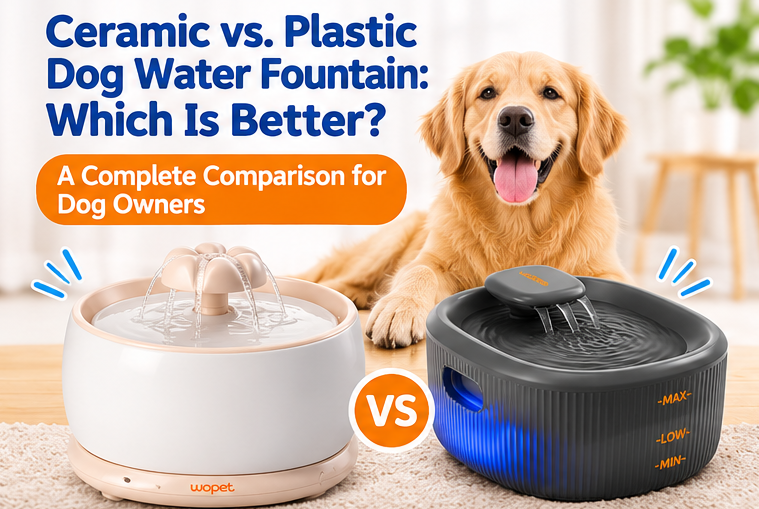
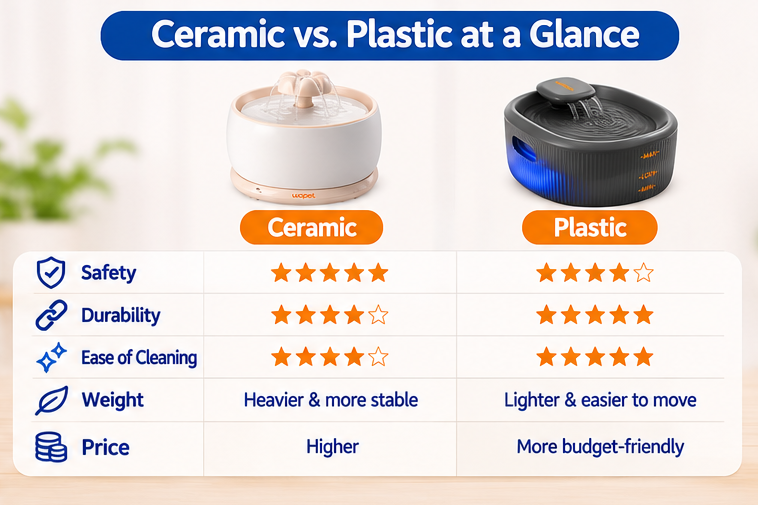
Before looking at the advantages of each material, here's a quick comparison.
| Feature | Ceramic Dog Water Fountain | Plastic Dog Water Fountain |
|---|---|---|
| Weight | Usually heavier | Usually lighter |
| Surface | Smooth glazed finish | Smooth molded surface |
| Scratch resistance | Generally good with intact glaze | Can scratch over time |
| Impact resistance | Can chip or break | Can crack or deform |
| Cleaning | Easy with intact glaze | Easy when undamaged |
| Portability | Less convenient | More convenient |
| Price | Often higher | Often more affordable |
| Stability | Weight may improve stability | Depends on base design |
| Design options | Decorative, classic finishes | Wide variety |
| Everyday maintenance | Regular cleaning required | Regular cleaning required |
Quick answer: Choose ceramic if you prefer a heavier, smooth-surfaced fountain and don't need to move it frequently. Choose plastic if you prioritize lightweight construction, flexible placement, and convenient handling.
Neither material eliminates the need for regular cleaning.
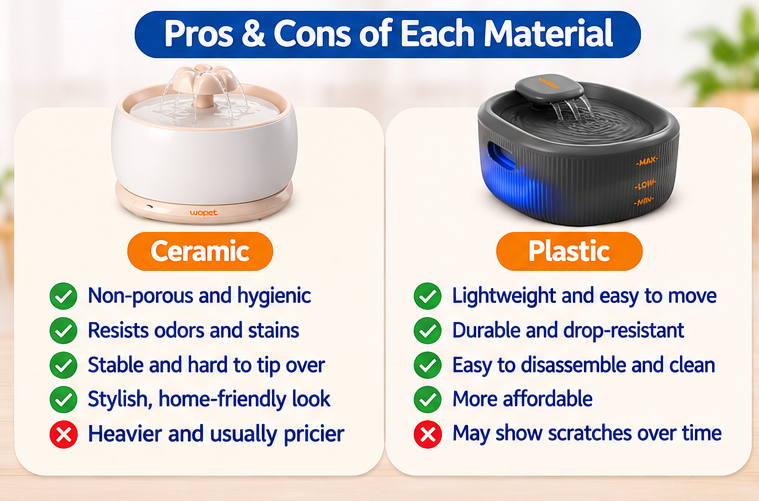
One of the main advantages of a ceramic dog water fountain is its smooth glazed drinking surface.
When properly manufactured and undamaged, glazed ceramic can be relatively easy to clean.
This matters because dog water fountains are exposed to saliva, hair, food particles, and minerals from drinking water.
A smooth surface can make it easier to remove visible residue during routine washing.
However, ceramic does not automatically prevent bacterial growth. Biofilm can develop on ceramic surfaces just as it can on plastic or stainless steel.
The fountain's overall design and cleaning accessibility remain important.
Ceramic fountains are generally heavier than similarly sized plastic models.
This extra weight can help keep a drinking station in place when a dog approaches or accidentally bumps it.
For example, an energetic small dog may occasionally push a lightweight bowl across a smooth floor.
A heavier ceramic fountain may be less likely to move under similar conditions.
However, stability also depends on the base width, shape, and center of gravity.
A heavy fountain with a narrow base can still tip.
Ceramic fountains often feature simple, decorative finishes that complement modern living spaces.
They may be particularly appealing when the drinking station is placed in a visible area such as the kitchen or living room.
Ceramic also offers a different visual appearance from many molded plastic designs.
For owners who value home aesthetics, this may influence the buying decision.
Still, appearance should never take priority over your dog's drinking comfort.
An intact ceramic glaze may resist ordinary scratching better than some softer plastic surfaces.
This can help maintain a smooth drinking area over time.
However, ceramic is brittle. It may resist surface scratches but crack or chip when dropped.
That trade-off is important when uating long-term durability.
A ceramic fountain may be inconvenient to carry to the sink, especially when it has a large reservoir.
This can make cleaning more physically demanding.
For owners who frequently move their dog's drinking station, plastic may be more practical.
Ceramic can chip, crack, or break if dropped or struck.
Damaged surfaces may develop rough edges and become harder to clean thoroughly.
If the drinking basin develops cracks or chips, replace the affected component before continued use.
Some ceramic fountains cost more than basic plastic models.
Material processing, shipping weight, and design complexity can influence pricing.
However, the purchase price should be considered alongside filtration costs, replacement parts, and maintenance requirements.
Many ceramic fountains are designed for cats or small pets.
A compact ceramic fountain may not provide enough drinking space or reservoir capacity for a large dog.
Always check dimensions rather than assuming that ceramic is suitable for every breed.
Plastic dog water fountains offer several practical advantages that make them popular among pet owners.
One of plastic's biggest advantages is its relatively low weight.
A lightweight fountain can be easier to:
Carry to the sink
Reposition around the house
Move during cleaning
Transport when necessary
Handle during refilling
This convenience can be particularly useful for busy households.
For example, if you regularly clean your dog's drinking station in a kitchen sink, a lightweight plastic reservoir may be easier to handle than a heavy ceramic one.
Plastic fountains are frequently available at lower prices than comparable ceramic models.
This makes them accessible to pet owners who want a circulating water source without spending as much upfront.
However, lower initial cost does not always mean lower lifetime cost.
Replacement filters, circulation components, and product durability should also be considered.
Plastic can be molded into different shapes and sizes.
As a result, plastic dog fountains are available with:
Wide drinking basins
Large reservoirs
Compact footprints
Cordless power systems
Different water-flow designs
Removable components
This flexibility can make it easier to find a fountain that fits your dog's drinking habits.
Plastic fountains are available in designs intended for larger pets and households with multiple animals.
For example, the WOPET A08 is positioned for dogs and multi-cat households.
For these homes, reservoir capacity, drinking-area accessibility, and ease of refilling may matter more than the material alone.
Some plastic fountains feature rechargeable, cordless operation.
A wireless model can be positioned away from electrical outlets, making it convenient for apartments or rooms where cables would be difficult to manage.
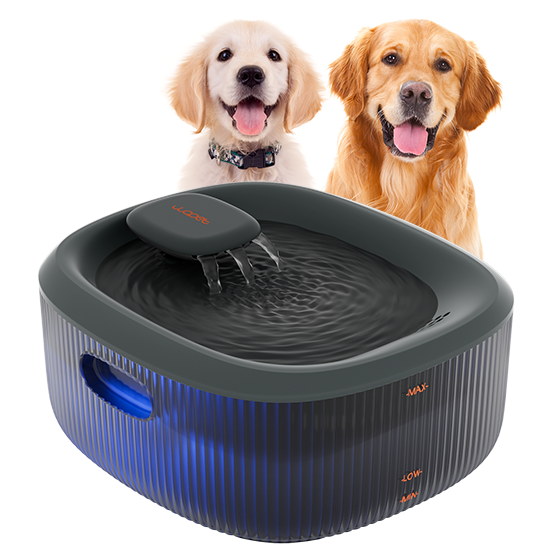
The WOPET W600 Pro is one wireless fountain option worth considering when placement flexibility is a priority.
Remember that wireless operation and plastic construction are separate features. Not every plastic fountain is battery-powered.
Plastic surfaces may become scratched through repeated use or abrasive cleaning.
Deep scratches can create areas where residue is more difficult to remove.
Use non-abrasive cleaning tools and inspect the fountain regularly.
Not all plastics are identical.
A fountain's suitability depends on its material formulation, manufacturing process, and intended use.
Look for clear information about water-contact materials rather than relying solely on marketing descriptions.
Exposure to excessive heat, unsuitable cleaning methods, or harsh chemicals may damage certain plastics.
Only use dishwasher cleaning when the manufacturer specifically approves it.
A lightweight fountain may shift when bumped by an energetic dog.
Look for a stable base and suitable dimensions, especially for medium and large breeds.
Both ceramic and plastic can be suitable for dog water fountains when manufactured appropriately and maintained correctly.
Safety depends on several factors.
For ceramic fountains, consider:
Whether the glaze is suitable for drinking-water contact
Whether the drinking surface is intact
Whether there are cracks or chips
Whether the fountain can be cleaned thoroughly
Whether the manufacturer provides clear material information
Improperly formulated ceramic glazes may raise concerns about substances such as lead or cadmium.
Choose products with appropriate material documentation.
For plastic fountains, consider:
Whether materials are appropriate for drinking-water contact
Whether the manufacturer identifies the materials used
Whether the surface is smooth and undamaged
Whether the fountain can be cleaned without excessive scratching
Whether components show signs of deterioration
BPA, or bisphenol A, is a chemical used in certain plastics and resins.
A BPA-free label indicates a claim about BPA, but it does not automatically establish the overall safety of the finished product.
Material quality, additives, manufacturing, and intended conditions of use still matter.
Safety verdict: Neither ceramic nor plastic is automatically safer. A well-made, properly maintained fountain of either material can be suitable for daily use.
Both materials can be easy to clean when their surfaces are smooth and the fountain is designed for convenient disassembly.
Ceramic drinking basins often have smooth glazed surfaces.
However, their weight and fragility can make handling more difficult.
Owners should avoid dropping ceramic parts or using abrasive tools that could damage the glaze.
Plastic fountains are usually lighter and easier to carry.
However, owners should avoid abrasive cleaning tools that may create scratches.
Follow the manufacturer's cleaning instructions to prevent heat or chemical damage.
The design of the entire fountain.
A fountain with removable parts and accessible water channels may be easier to maintain than one with complicated internal components.
Before buying, check whether you can clean:
The drinking basin
The water reservoir
The circulation system
Internal water channels
Filter compartments
Seals and connectors
Cleaning verdict: Ceramic may offer good surface scratch resistance, while plastic is often easier to handle. The easiest fountain to maintain is usually the one with the simplest accessible design.
For large dogs, drinking-area dimensions and reservoir capacity are often more important than material.
Large dogs generally need more drinking water than small dogs.
A commonly used starting estimate is approximately one fluid ounce of water per pound of body weight daily.
| Dog Weight | Approximate Daily Water Intake |
|---|---|
| 20 lbs | 600 mL |
| 40 lbs | 1.2 L |
| 60 lbs | 1.8 L |
| 80 lbs | 2.4 L |
These are general estimates, not fixed drinking requirements. Diet, exercise, temperature, and health conditions affect actual needs.
A ceramic fountain may be suitable for a large dog if it offers:
A wide drinking basin
Adequate reservoir capacity
Stable construction
Comfortable drinking height
Convenient cleaning access
Plastic may be more practical when you want:
A larger reservoir without excessive weight
Easier refilling
Convenient handling
A wide drinking area
More placement options
Large-dog verdict: A well-designed plastic fountain may be more convenient for some large-dog households, but either material can work if the dimensions and capacity are appropriate.
The initial purchase price is only part of the total cost of owning a dog water fountain.
Both ceramic and plastic fountains may require:
Replacement filters
Circulation-system maintenance
Replacement seals or connectors
Cleaning supplies
Replacement electrical components
Ceramic may maintain a smooth surface for a long time when handled carefully.
However, accidental impacts can cause permanent damage.
Plastic is often more resistant to shattering, but its surface may scratch or deteriorate over time.
The useful life depends on material quality and maintenance.
Suppose a fountain uses a $5 replacement filter every four weeks.
52 weeks ÷ 4 = 13 replacements
13 × $5 = $65 per year
This is an illustrative calculation, not a WOPET-specific price or replacement schedule.
The actual cost depends on the model and manufacturer's instructions.
Cost verdict: Plastic may have a lower upfront price, while ceramic may offer good surface durability. Compare replacement costs and expected maintenance before deciding.
If you're comparing ceramic and plastic fountains, WOPET offers several models worth uating.
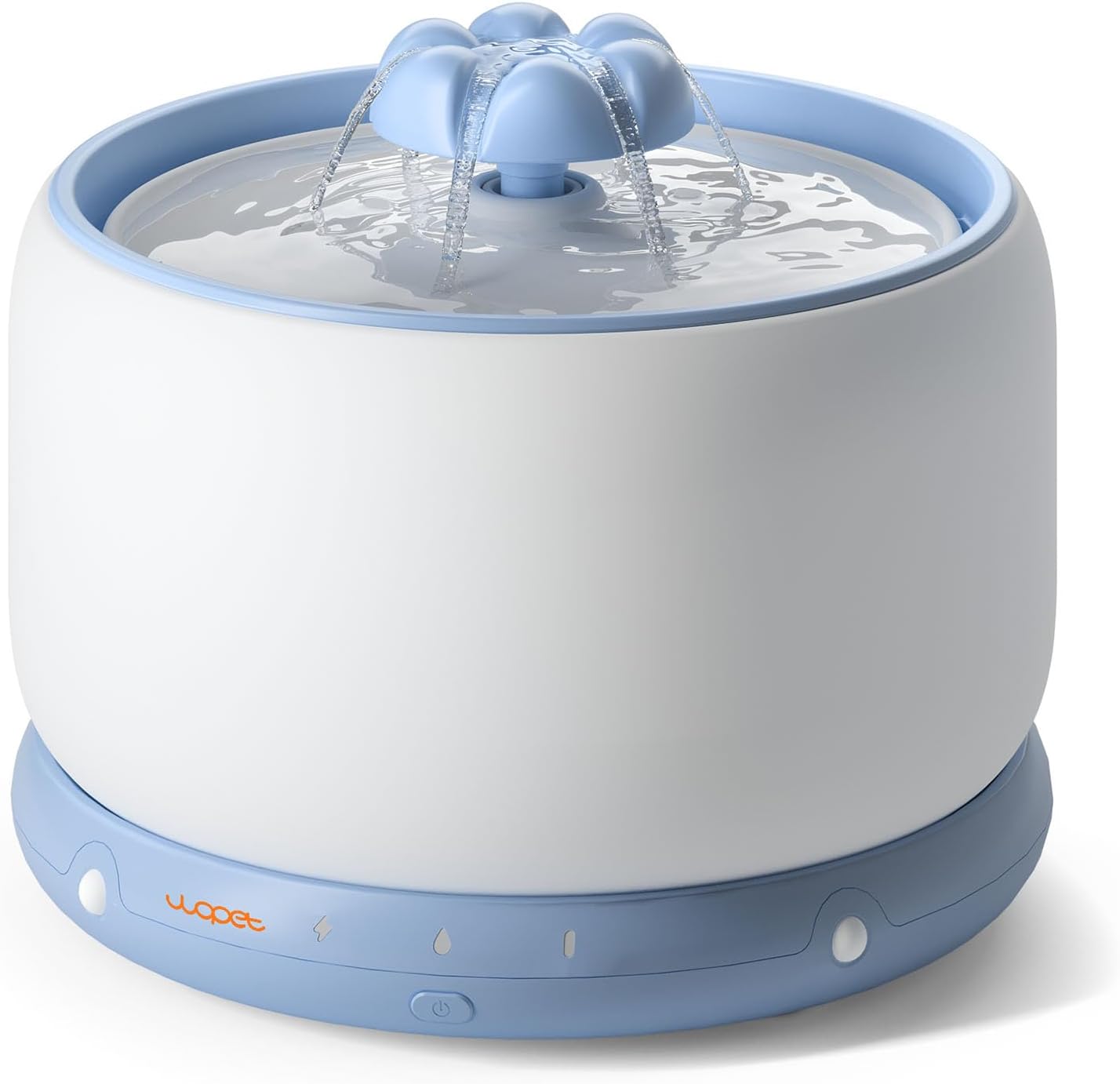
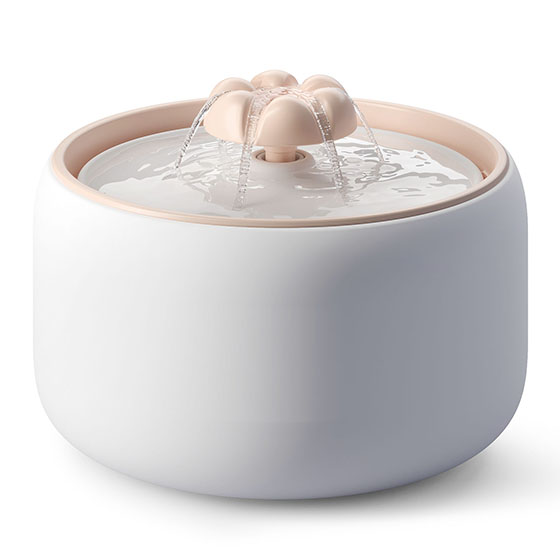
The WOPET W03 is a ceramic fountain option for pet owners who prefer a smooth glazed drinking surface and a more substantial design.
It may appeal to households that prioritize:
Ceramic drinking surfaces
Attractive home-friendly design
Stable placement
Convenient everyday water access
Before buying, check its reservoir capacity and drinking-area dimensions to confirm that it suits your dog's size.
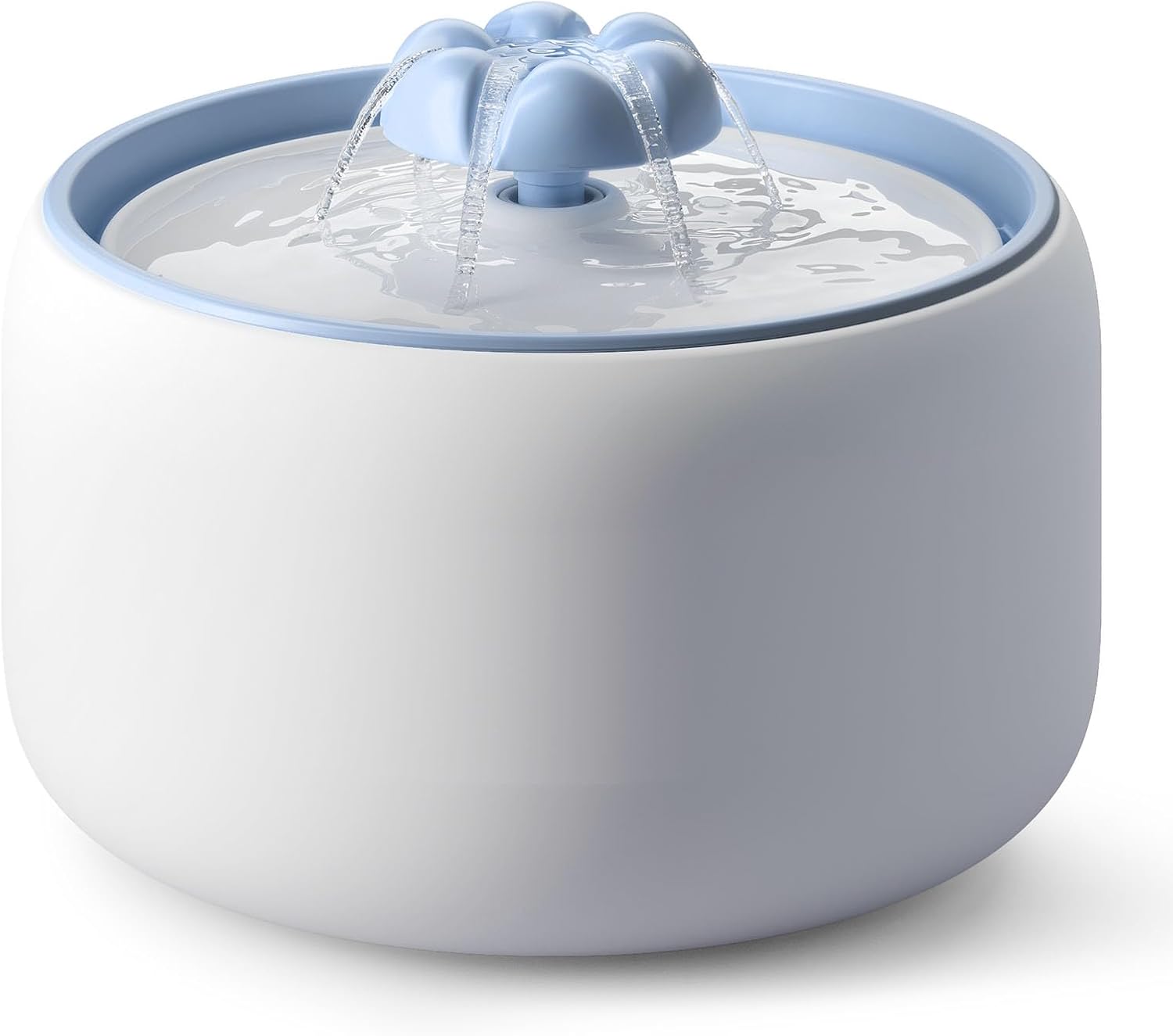
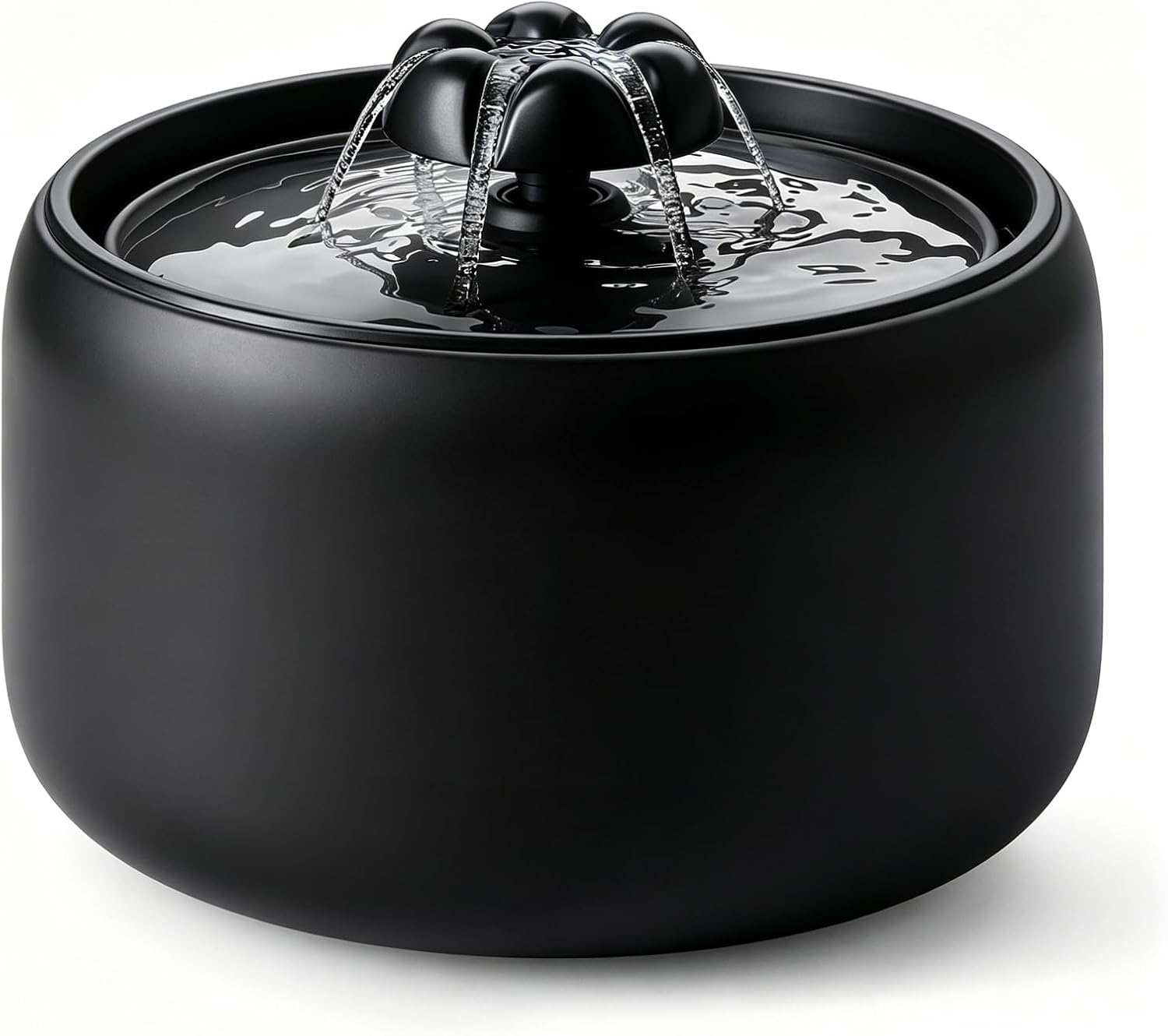
The WOPET W03 Lite is another model to consider when comparing ceramic fountains.
For small dogs or mixed cat-and-dog households, the basin dimensions and drinking height may be particularly important.
Evaluate its current specifications, including capacity, power configuration, and cleaning requirements.
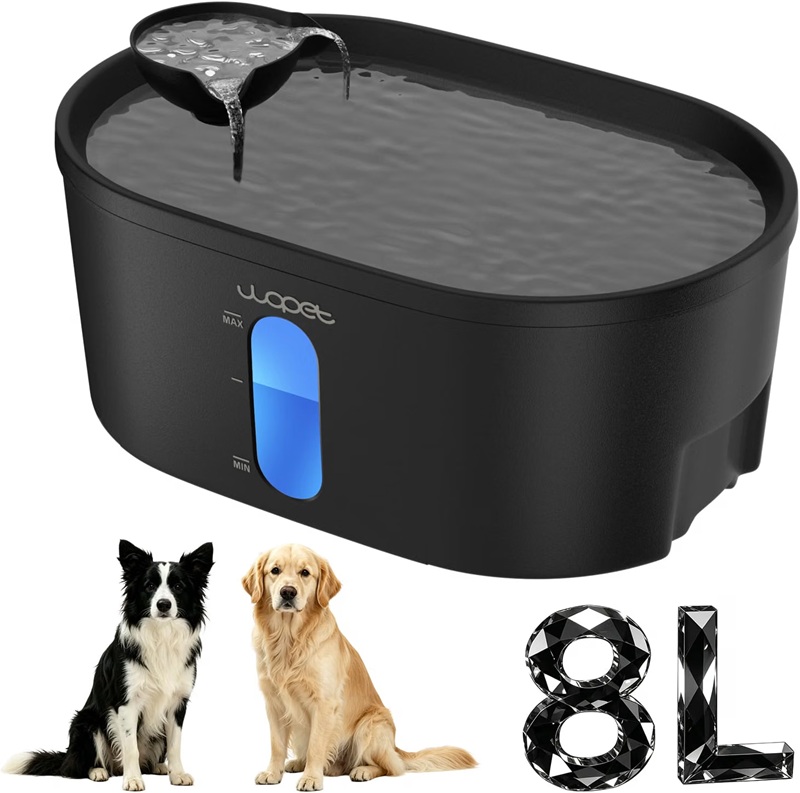
The WOPET A08 is designed for dogs and multi-cat homes.
For owners who prioritize a lightweight drinking station, a plastic fountain may offer practical advantages.
The A08 is worth considering if you want to compare:
Drinking-area accessibility
Reservoir capacity
Cleaning convenience
Portability
Everyday multi-pet use
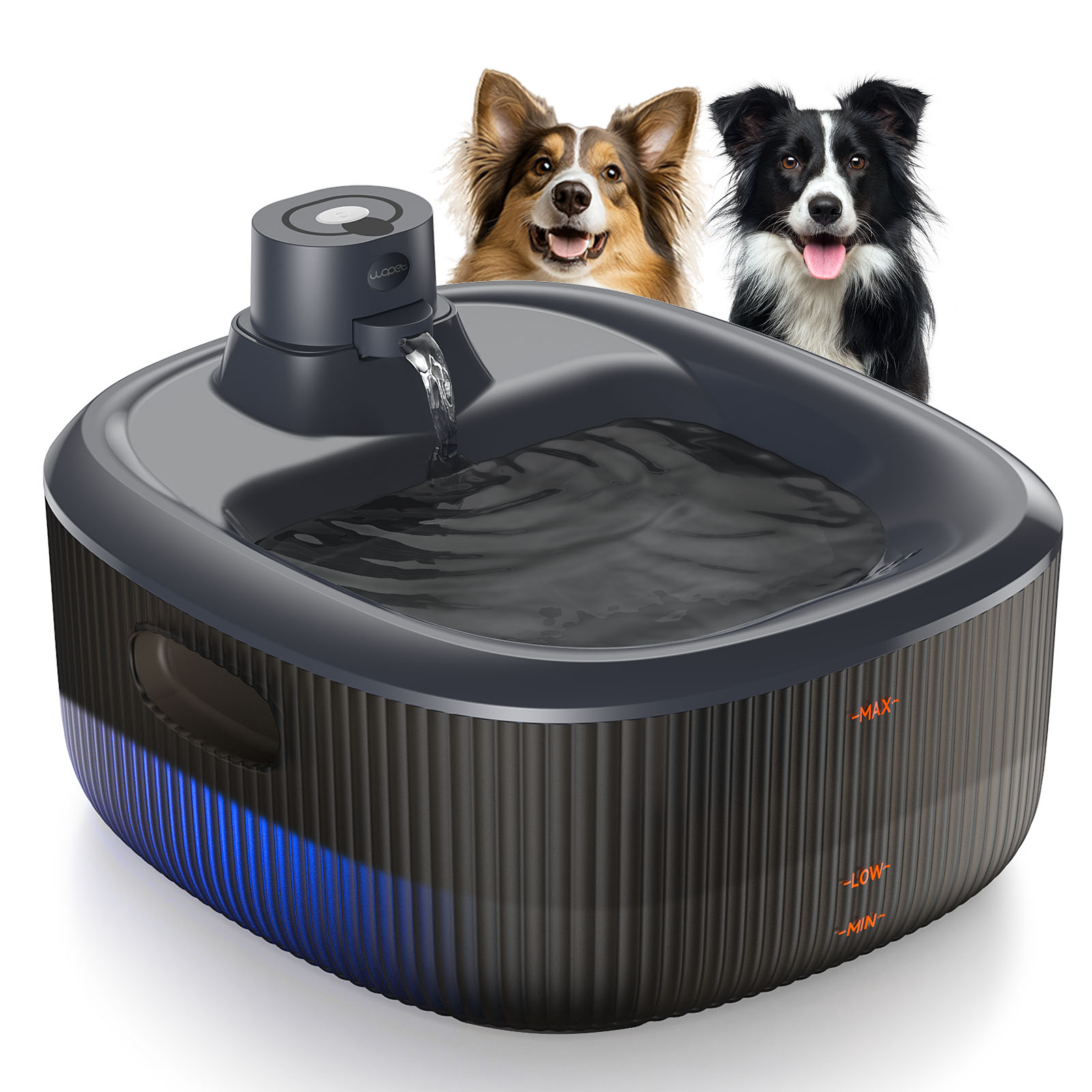
The WOPET W600 Pro is another option for pet owners interested in flexible placement.
Its wireless design can be useful when you want a drinking station away from a permanent power outlet.
When uating the W600 Pro, consider battery runtime, charging requirements, reservoir capacity, and cleaning accessibility.
| Product | Material Category | Main Consideration |
|---|---|---|
| WOPET W03 Pro | Ceramic | Smooth glazed surface and design |
| WOPET W03 Lite | Ceramic | Compact ceramic fountain option |
| WOPET A08 | Plastic | Dogs and multi-cat households |
| WOPET W600 Pro | Plastic | Cordless placement flexibility |
Always confirm the current product specifications before purchasing.
Explore WOPET Pet Water Fountains: https://wopet.com/
Still unsure which material to choose?
Use the following questions to guide your decision.
If yes, plastic may be more convenient because it is generally lighter.
If the fountain stays in one permanent location, ceramic may be a practical option.
Focus on reservoir capacity, drinking-area width, and stability.
A large plastic fountain may be more practical than a compact ceramic one.
An intact ceramic glaze may offer advantages over softer plastic surfaces.
However, ceramic can chip or break if dropped.
Check the actual power configuration.
Some plastic fountains offer rechargeable operation, but material alone does not determine whether a fountain is wireless.
Choose the model that is easiest for you to disassemble, wash, and reassemble.
The most hygienic fountain is one you can maintain consistently.
Ceramic offers a smooth glazed surface and added weight, while plastic is usually lighter and easier to move. Neither material is universally better.
Plastic fountains can be suitable for daily use when made from appropriate materials and maintained correctly. Inspect surfaces for scratches and damage.
Not automatically. Both materials can be suitable when properly manufactured and maintained. Ceramic glaze quality and plastic material composition are important considerations.
Yes. Biofilm can develop on ceramic surfaces, just as it can on plastic or stainless steel. Regular cleaning is essential.
Plastic fountains are often lighter and easier to handle. However, cleaning convenience depends on the fountain's design and surface condition.
Either material can work, but large dogs need adequate water capacity and a comfortable drinking basin. Plastic may offer practical weight advantages in larger designs.
Not necessarily. Ceramic may resist surface scratching but can break from impacts. Plastic may resist shattering but can scratch or deteriorate.
BPA-free labeling addresses BPA but does not guarantee overall product safety. Look for appropriate water-contact materials and clear manufacturer information.
Refresh drinking water daily and clean the fountain regularly according to the manufacturer's instructions. Clean more frequently when visible residue develops or multiple pets share the fountain.
The best choice depends on capacity, drinking-area accessibility, stability, and cleaning convenience. A larger plastic fountain may be easier to handle, but a suitably sized ceramic fountain can also work.
Both ceramic and plastic dog water fountains have meaningful advantages.
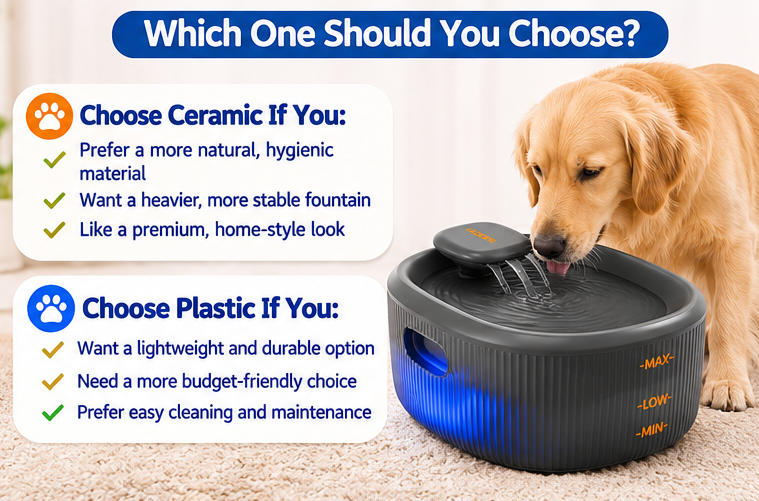
Choose ceramic if you value:
A smooth glazed drinking surface
Greater weight and potentially improved stability
Resistance to everyday surface scratching
An attractive, decorative design
Choose plastic if you value:
Lightweight construction
Easy handling and portability
Often lower purchase costs
A wide range of designs and reservoir sizes
Potential cordless placement options
For pet owners comparing WOPET products, the W03 Pro and W03 Lite offer ceramic options, while the A08 and W600 Pro provide plastic alternatives for different household needs.
Ultimately, the material is only one part of the decision.
The best dog water fountain is the one that provides comfortable access to fresh drinking water, fits your dog's needs, and is easy for you to maintain every day.
Label:
Popular Post

The Ultimate Guide to Tabby Cats: Patterns, Personalities, and More
Mar 27, 2025

Top 8 Reasons Why Does My Cat Sleep Between My Legs?
Mar 03, 2025

What to Do If My Dog's Poop Is Black But Not Tarry
Feb 04, 2023

Superfecundation Cats: When Kittens in One Litter Have Different Fathers
Jul 11, 2025
How Long Does Dry Cat Food Last Once Opened? A Comprehensive Guide
Mar 19, 2025

[Blue] W03L 3L Premium Ceramic Cat Water Fountain
Model: W03 LITE
$59.99
$69.99
Basin Pet Water Fountain-W600
Model: W600
$43.99
$69.99
[Basic] Ceramic Pet Water Fountain with Power Cable
Model: W03L
$59.99
$99.00
[Black] W03L 3L Premium Ceramic Cat Water Fountain
Model: W03L Black
$59.99
$69.99

WOPET 8L Pet Water Fountain For Multiple Cats or Large Dogs A08
Model: A08
$49.99
$59.99
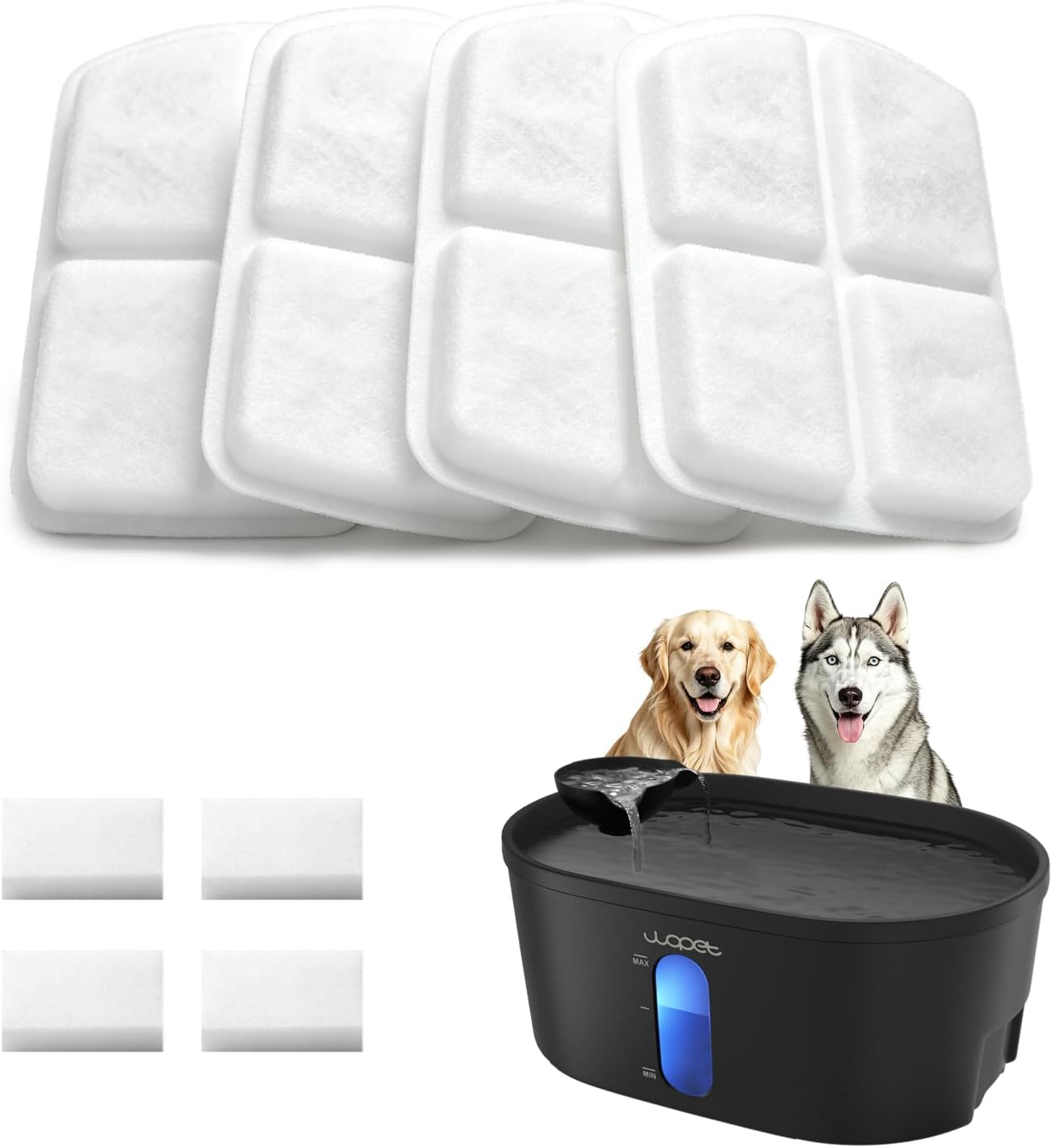
WOPET A08 Dog Water Fountain Filters
Model: A08 Filter
$19.99
$29.99

DOWNLOAD APP

WOpet life




Copyright © 2026 WOPET. All Rights Reserved.