Oct 08, 2026
Author:Amanda Lyu
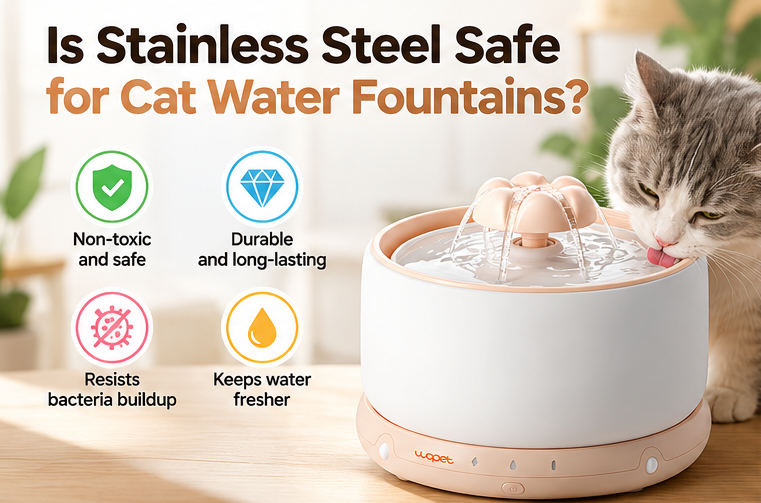
Yes. Stainless steel can be a safe, durable material for a cat water fountain when the water-contact parts are made for that use, smoothly finished, free from peeling coatings or sharp edges, and kept clean and corrosion-free. “Stainless” means corrosion-resistant, not indestructible, so owners should still inspect the tray, seams, openings, and hidden components.
Why Stainless Steel Is Used for Water-Contact Surfaces
Stainless steel combines iron with chromium and may include other alloying elements. Chromium helps form a thin protective oxide layer at the surface, which gives appropriate stainless alloys their corrosion resistance.
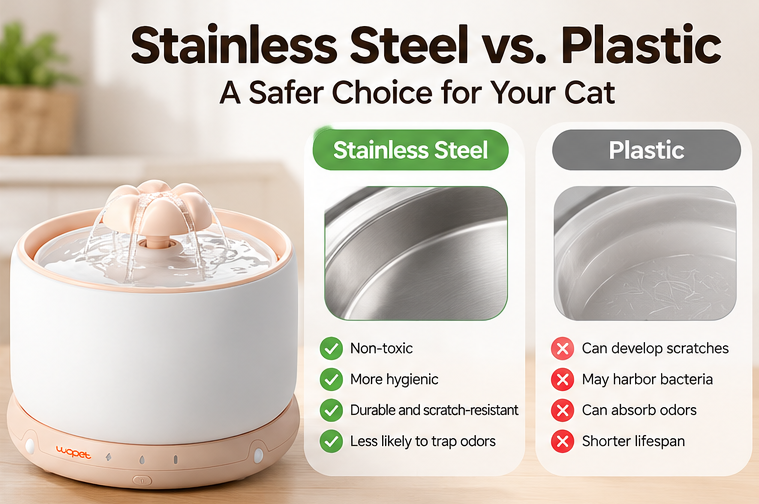
Food equipment commonly uses stainless steel because a suitable alloy and finish can be durable, smooth, and cleanable. NSF standards for food equipment consider material safety, corrosion resistance, and sanitation as parts of the overall design. That does not mean every object described as stainless steel has been independently certified or is appropriate for a pet fountain.
For consumers, the practical standard is simpler: buy a fountain from a traceable manufacturer that identifies its water-contact materials, provides care instructions, and supports replacement parts.
What “Food-Grade Stainless Steel” Does—and Does Not—Tell You
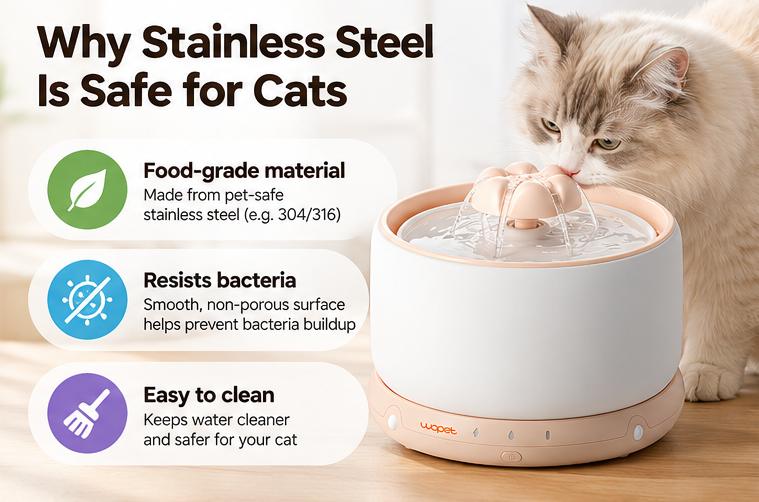
“Food-grade” generally indicates that a material is intended to meet requirements for food-contact use under specified conditions. It is not a single visual grade that shoppers can confirm from appearance alone.
A safe fountain also depends on:
• the exact alloy and its intended use;
• surface finish and manufacturing quality;
• welds, seams, edges, and openings;
• any coatings, adhesives, or decorative layers;
• contact time and cleaning chemicals;
• quality control and traceability;
• the condition of the part after months of use.
Grade numbers such as 304 or 316 can provide useful alloy information, but they do not guarantee that every component, weld, or finish is equally well made. Treat a grade claim as one specification, not a complete safety verdict.
Can a Stainless Steel Fountain Rust?
Stainless steel can stain or corrode under unfavorable conditions. Possible contributors include:
• chloride exposure, including salt or bleach residue;
• harsh or incompatible cleaners;
• steel wool or carbon-steel tools that leave contaminating particles;
• prolonged contact with concentrated mineral deposits;
• damaged finishes or poor-quality material;
• wet crevices that are not cleaned or dried as directed.
An orange mark is not always corrosion of the fountain itself. It may be mineral residue or transferred iron from another object. Clean the part using the manufacturer-approved method, rinse it thoroughly, dry it, and inspect it again.
Stop using the component and contact the manufacturer if a mark returns quickly or the surface shows pitting, flaking, roughness, sharpness, or a failed seam.
Stainless Steel Safety Checklist
Before first use:
1. Confirm that the product is intended for pet drinking water.
2. Read which parts are stainless steel and which are plastic, silicone, or other materials.
3. Inspect edges, seams, openings, and the underside of the tray.
4. Wash removable water-contact parts as directed.
5. Rinse thoroughly and assemble the fountain exactly as instructed.
6. Fill to the correct level before running the pump.
During use:
• change water and clean the fountain on a consistent schedule;
• service the pump and impeller chamber as directed;
• avoid abrasive pads and unapproved chemicals;
• remove mineral buildup before it becomes heavy;
• replace damaged seals, pumps, filters, or trays;
• keep electrical connections dry as instructed.
The Whole Fountain Is Rarely Stainless Steel
Many products described as stainless steel fountains use a metal drinking tray over a plastic reservoir. The pump casing, filter holder, tubing, cable jacket, and seals are generally made from other materials.
This mixed construction can be perfectly practical, but the complete water path needs inspection. A smooth steel top does not compensate for a pump that cannot be opened or a reservoir with inaccessible corners.
When comparing models, identify:
• which surfaces continuously hold water;
• which surface the cat drinks from;
• which parts can be removed;
• which parts are dishwasher-safe;
• whether the pump can be disassembled as directed;
• whether replacement parts match the exact model.
WOPET’s guide to cat water fountain materials and features can help you uate material together with flow, filtration, capacity, and maintenance access.
How to Clean Stainless Steel Without Damaging It
Follow the fountain manual first. A conservative routine is:
1. Unplug the unit and separate electrical from washable components.
2. Remove and discard or set aside the filter according to its instructions.
3. Wash the tray and reservoir with a soft cloth or nonabrasive sponge and an approved cleaner.
4. Open and clean the pump only as the manual directs.
5. Rinse every washable part thoroughly.
6. Dry and inspect surfaces before reassembly.
Avoid steel wool, metal scrapers, undiluted bleach, or improvised chemical mixtures. Never combine cleaning products. If descaling is needed, use only a concentration and contact time approved for that model, then rinse completely.
When Should You Replace a Stainless Steel Part?
Replacement is appropriate when:
• the surface is pitted or flaking;
• corrosion returns after correct cleaning;
• an edge, dent, or seam has become sharp;
• a coating or decorative layer is peeling;
• the tray no longer sits securely;
• a crack or failed joint causes leakage;
• the manufacturer advises retirement after inspection.
Ordinary fine scratches or water spots do not automatically make the part unsafe. Evaluate whether the area remains smooth, stable, and cleanable.
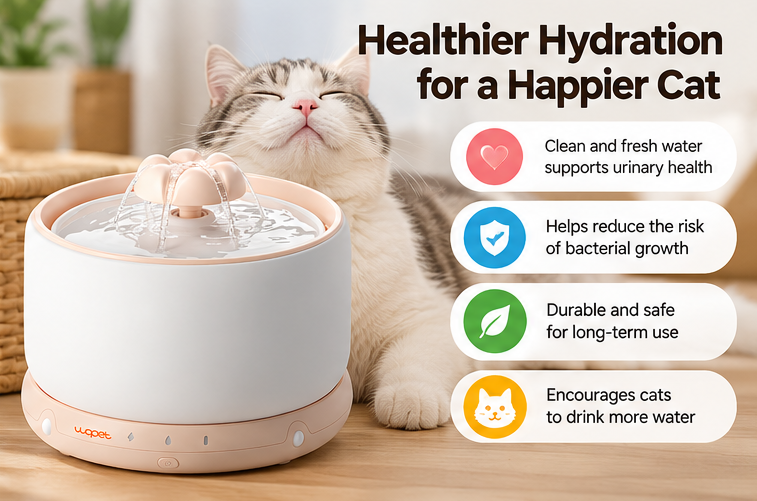
Buy WOPET W03 CAT WATER FOUNTAIN ON AMAZON
Frequently Asked Questions
Does a stainless steel grade number prove a fountain is safe?
No. A grade number identifies alloy composition, but it does not verify the finished fountain’s seams, surface finish, coatings, other water-contact parts, or manufacturing controls. Use it as one specification, not a complete safety claim.
Do household cat fountains need 316 stainless steel?
Not necessarily. Shoppers should prioritize a fountain intended for repeated water contact, with smooth construction, clear care instructions, and available replacement parts. Do not assume that a higher grade number compensates for poor design or maintenance.
Are stainless steel fountains antibacterial?
Do not treat ordinary stainless steel as a substitute for cleaning. A smooth surface can be easy to maintain, but biofilm and residue can still form on steel and in the pump, filter housing, tubing, and reservoir.
Can I use bleach on a stainless steel fountain?
Only if the manufacturer explicitly permits a specific dilution, contact time, and rinsing procedure. Chloride-containing cleaners can damage some stainless surfaces when used incorrectly. Never mix bleach with other cleaners.
What if my cat refuses a stainless steel fountain?
The cause may be reflections, pump sound, flow height, basin shape, location, or unfamiliarity rather than safety. Offer another clean water source and introduce the fountain gradually without forcing the cat to approach it.
Bottom Line
Stainless steel can be a safe and durable cat fountain material, but the claim depends on intended use, construction, surface condition, and correct care. Choose traceable product information, inspect the entire water path, avoid damaging cleaners, and retire parts that become pitted, sharp, or impossible to clean.
Editorial Method and Sources
This safety review distinguishes alloy terminology from finished-product quality. FDA and NSF sources provide the food-contact and sanitation framework; model-specific material claims and cleaning limits should still be confirmed with the fountain manufacturer.
• FDA: Food Packaging and Other Food-Contact Substances
• FDA: Determining the Regulatory Status of Food-Contact Materials
Label:
Popular Post
Top 10 Most Expensive Cat Breeds in The World
May 07, 2025
The Ultimate Guide to Tabby Cats: Patterns, Personalities, and More
Mar 27, 2025
Can Cats Have Ice Cream? Dangers, Safe Flavors & Healthy Cat Treats
Sep 02, 2025
My Cat Only Eats A Little at A Time - What to Do?
Feb 27, 2023
Top 8 Reasons Why Does My Cat Sleep Between My Legs?
Mar 03, 2025
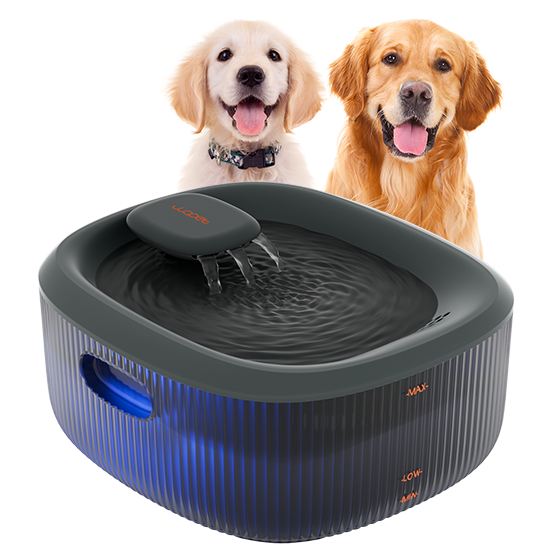
Basin Pet Water Fountain-W600
Model: W600
$43.99
$69.99
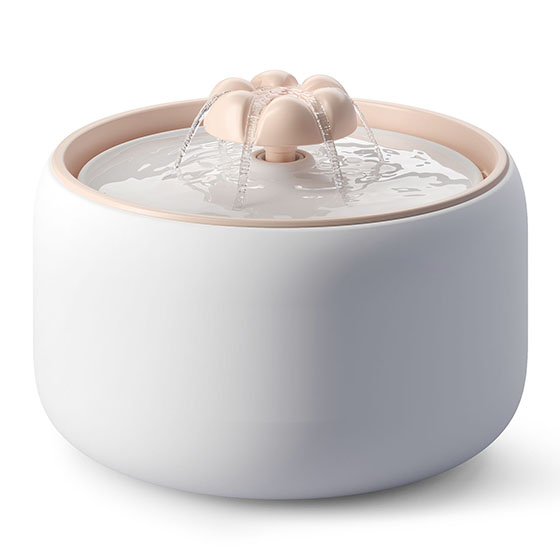
[Basic] Ceramic Pet Water Fountain with Power Cable
Model: W03L
$59.99
$99.00
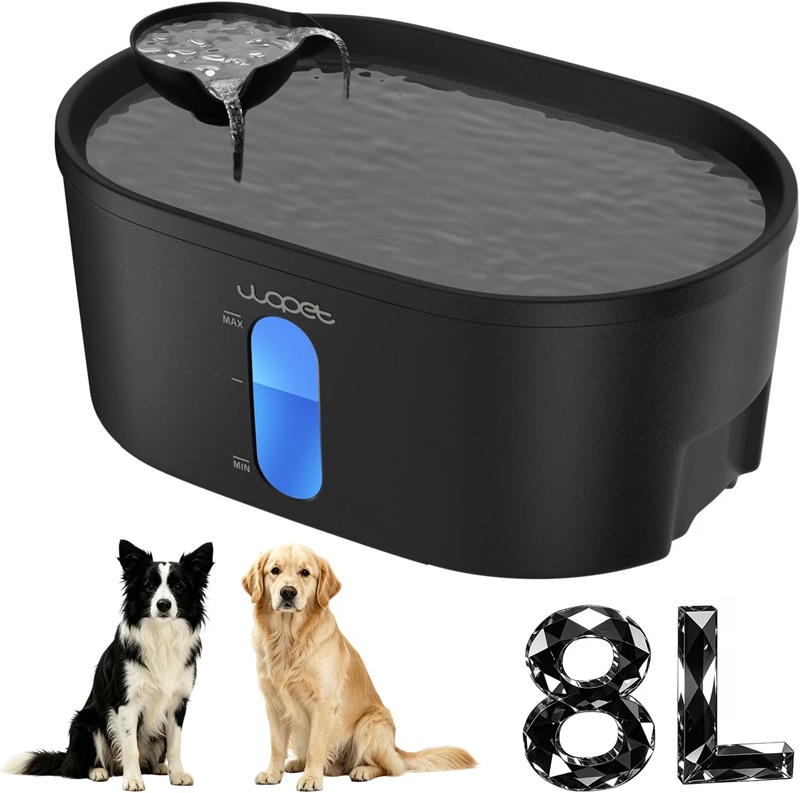
WOPET 8L Pet Water Fountain For Multiple Cats or Large Dogs A08
Model: A08
$49.99
$59.99
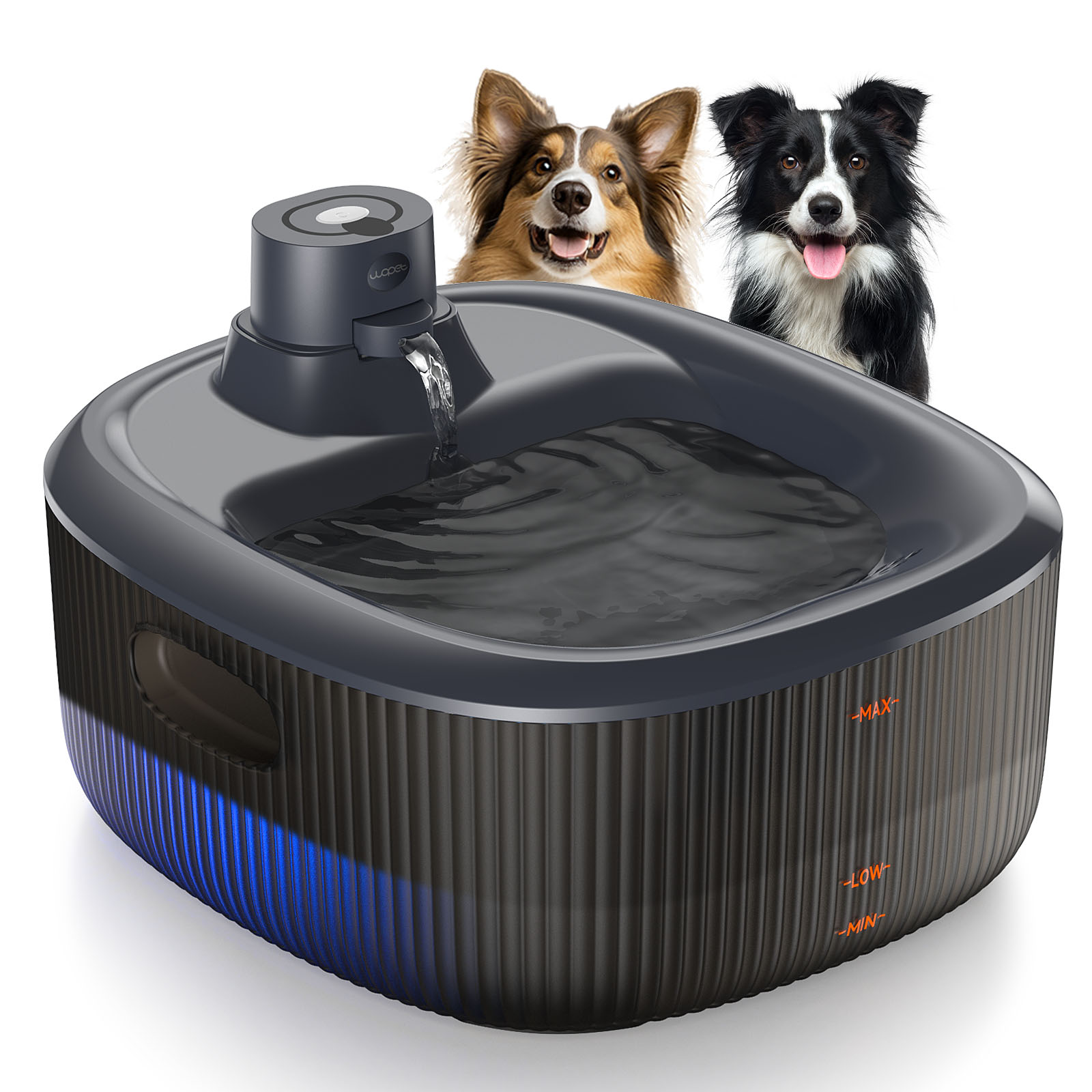
[Upgrade] Basin Wireless Pet Water Fountain
Model: W600 Pro
$69.99
$89.99
Heritage View Pet Feeder Dual Bowls For Two Cats
Model: HV10DP
$119.99
$149.99
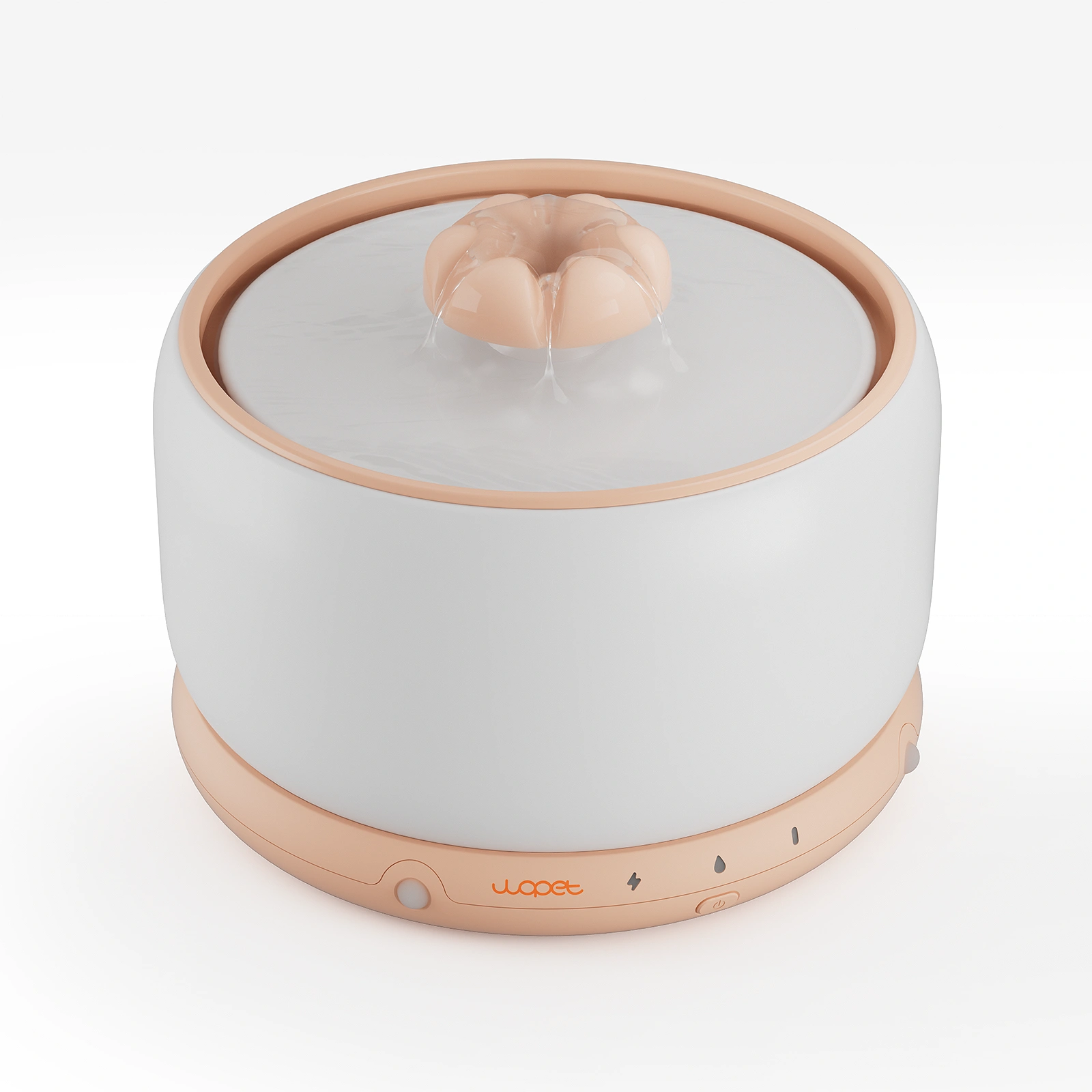
[New] Ceramic Wireless Pet Water Fountain W03
Model: W03
$89.99
$129.00

DOWNLOAD APP

WOpet life




Copyright © 2026 WOPET. All Rights Reserved.