Sep 07, 2026
Author:Amanda Lyu
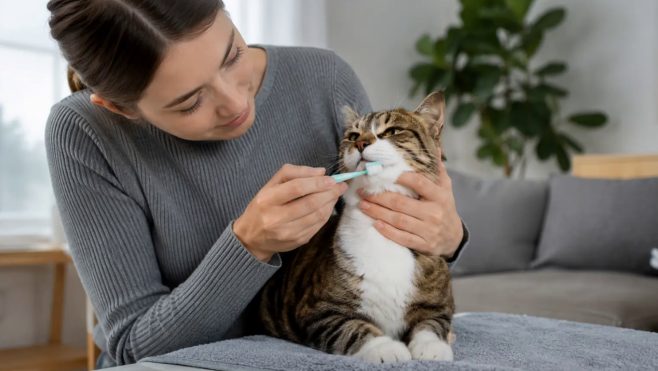
The safest way to brush a cat's teeth is to teach the routine in tiny, voluntary steps. The first goal is not a perfectly clean mouth. It is a cat who remains comfortable when you touch the cheek, lift a lip, introduce cat toothpaste, and finally make a few gentle brush strokes.
|
Quick answer: First confirm that your cat's mouth is not painful. Over several short sessions, pair cheek touches and lip lifts with rewards. Introduce only cat-safe toothpaste, then a soft cat toothbrush. Brush the cheek-facing surfaces near the gumline without forcing the jaw open. Stop before struggling begins. Red or bleeding gums, bad breath, drooling, eating changes, or sudden resistance require a veterinary exam before you continue. |
What are the three rules for stress-free brushing?
• Rule 1: Check for pain first. A painful cat needs an exam, not more restraint.
• Rule 2: Train one small step at a time. Progress only when the current step stays easy.
• Rule 3: End early. A few calm strokes are more useful than a forced full-mouth session.
Should you brush your cat's teeth today?
Brushing is preventive care, not a treatment for an already painful mouth. Before the first session, watch your cat eat and take a brief look at the lips and gums if your cat allows it.
Pause and contact your veterinarian if you notice:
• Red, swollen, receding, or bleeding gums
• Heavy tartar, a fractured tooth, or a pink defect at the gumline
• Persistent bad breath, drooling, or pawing at the mouth
• Food dropping, one-sided chewing, preference for soft food, or reduced appetite
• Facial swelling, jaw chattering, hiding, or uncharacteristic irritability
• Sudden refusal after previously accepting brushing
Do not restrain a painful cat to “get a better look.” Cats often hide oral pain, and forcing handling can cause injury and create a lasting fear response.
How do you prepare a cat for tooth brushing?
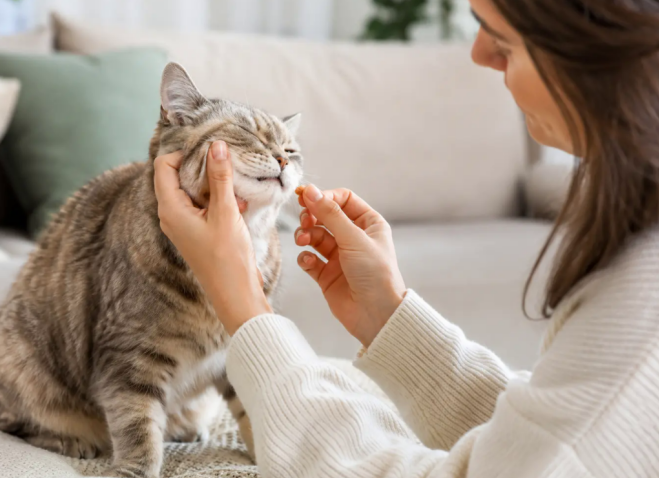
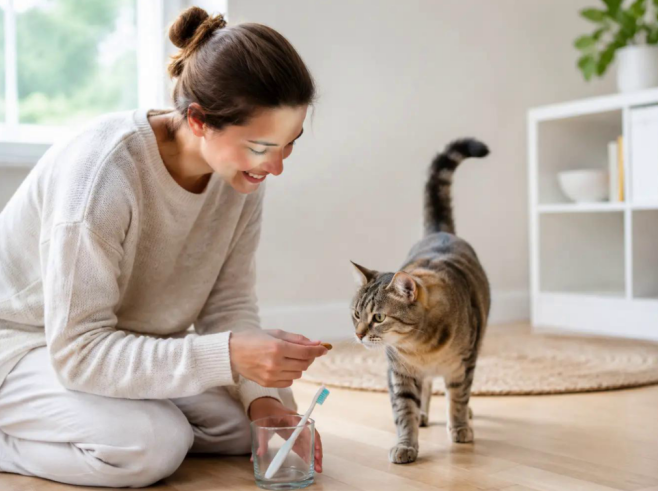
Choose a quiet room and a time when your cat is awake but settled. Place a nonslip towel on a familiar surface. Let your cat stand, sit, or leave; avoid pinning the body or wrapping tightly unless a veterinarian has taught you a specific handling plan.
Build the behavior in stages:
1. Approach the station. Reward your cat for stepping onto or beside the towel.
2. Touch the cheek. Touch for one second, release, and reward.
3. Lift one lip. Reveal a canine tooth briefly without opening the jaw.
4. Touch a tooth. Use a clean finger or gauze only if your veterinarian approves and the mouth appears comfortable.
5. Introduce toothpaste. Offer a tiny taste of feline toothpaste; do not force it into the mouth.
6. Introduce the brush. Let the brush touch one outer tooth, then end the session.
Repeat a stage until the cat stays loose and readily returns. Progress is measured by comfort, not by the number of calendar days.
What supplies do you need?
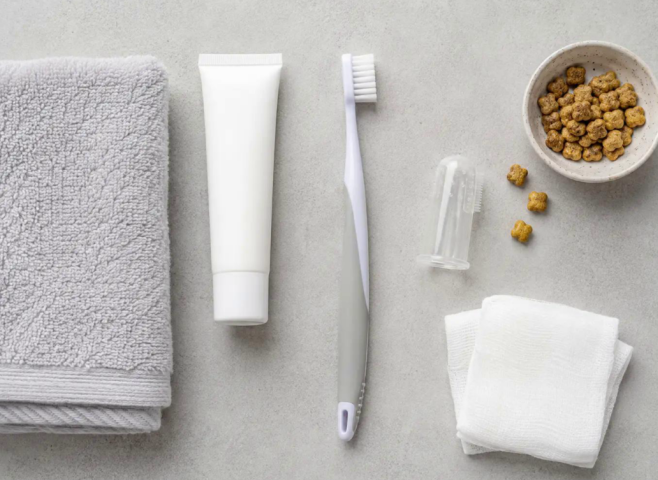
Use:
• A small, soft-bristled cat toothbrush or soft finger brush
• Toothpaste or oral gel labeled specifically for cats
• A nonslip towel or mat
• Tiny, familiar rewards
• Optional gauze for early training, with veterinary guidance
Never use human toothpaste. Cats do not rinse and spit, and human formulas may contain ingredients that are unsuitable for ingestion. Skip mouthwash, baking soda, peroxide, essential oils, and homemade pastes. Do not use a hard brush or a metal scraper.
A finger brush gives good control but places your finger close to the teeth. If your cat has ever bitten during handling, ask the veterinary team to recommend safer equipment and demonstrate the approach.
How do you brush a cat's teeth step by step?
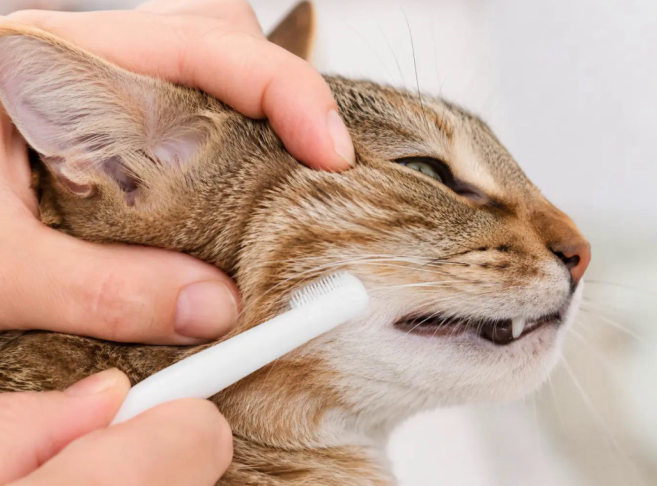
Once the preparation stages are comfortable:
1. Put a small amount of cat toothpaste on the brush.
2. Position yourself beside or slightly behind the cat rather than face-to-face.
3. Support the head lightly without squeezing the throat or lower jaw.
4. Lift one lip. Keep the mouth mostly closed.
5. Place the soft bristles against the outer tooth surface near the gumline.
6. Use light, short circular or back-and-forth strokes.
7. Start with the canine teeth, then work toward the back cheek teeth as tolerance grows.
8. Switch sides only if the cat remains comfortable.
9. Stop, release, and reward.
The cheek-facing surfaces deserve priority because they are accessible without prying the jaw open. You do not need to scrub the tongue-side surfaces during an at-home session. Pressure should be gentle enough that the gums do not blanch or bleed.
For the first successful session, one or two teeth may be enough. Gradually increase coverage before increasing duration.
How long should brushing take?
Training sessions may last only five to ten seconds. A practiced brushing session can remain brief; thoroughness comes from a consistent routine, not from holding the cat still for several minutes.
Daily brushing offers the strongest plaque control. VCA Animal Hospitals describes three times weekly as a commonly recommended minimum for helping remove plaque and reduce tartar accumulation. Follow your veterinarian's advice for your cat, especially after a professional dental procedure.
Plaque returns quickly, so one long session on the weekend is not equivalent to shorter, more frequent care.
How do you know when to stop?
Stop while the session is still successful. Early stress signals include:
• Turning the head away repeatedly
• Ears rotating sideways or flattening
• Tail flicking, skin twitching, or body stiffening
• Crouching, trying to leave, or pushing the brush away
• Growling, hissing, swatting, or attempting to bite
Release immediately and make the next session easier. Punishment, scolding, and forced restraint increase risk without improving plaque control.
Sudden resistance in a cat that previously cooperated is different from ordinary training hesitation. Treat that change as a possible pain signal and arrange an oral exam.
What if your cat will not accept a toothbrush?
First, rule out disease. If the mouth is comfortable but brushing remains unrealistic, ask your veterinarian about VOHC-accepted feline products. Depending on the cat, options may include dental diets, treats, wipes, gels, powders, or water additives that have met defined plaque- or tartar-control standards.
These options are adjuncts. They do not remove established calculus, examine tooth roots, or treat gingivitis or tooth resorption. Avoid buying a product solely because the label says “dental.” Look for the VOHC seal and veterinary guidance.
What common tooth-brushing mistakes should you avoid?
• Starting with a full-mouth session: Begin with a behavior the cat can succeed at.
• Forcing the jaw open: Lift the lip and prioritize outer surfaces.
• Using human toothpaste: Use only a feline-labeled product.
• Brushing inflamed gums: Painful tissue needs diagnosis first.
• Scrubbing hard: Gentle contact disrupts plaque; force causes discomfort.
• Chasing the cat: Invite participation in a predictable location.
• Ignoring a behavior change: New resistance can signal oral pain.
• Assuming white teeth equal health: Disease can hide below the gumline.
Frequently asked questions
Can I use a baby toothbrush for my cat?
A very small, extra-soft brush may sometimes work, but a cat-specific brush is easier to size and control. Ask your veterinarian to check the bristle softness and demonstrate the technique.
Does my cat need toothpaste?
Mechanical brushing is important, while a feline toothpaste can improve acceptance and may provide additional oral-care benefits depending on the product. Never substitute a human formula.
Do I need to brush the inside of the teeth?
For most home routines, focus on the outer, cheek-facing surfaces near the gumline. They can be reached with the mouth mostly closed, which reduces stress. Follow any different instructions from your veterinary team.
What if the gums bleed during brushing?
Stop. Bleeding can reflect inflamed tissue, trauma from technique, or another oral problem. Arrange a veterinary assessment rather than brushing through it.
Can I start brushing an older cat's teeth?
Yes—after a veterinarian confirms the mouth is comfortable. Older cats can learn new handling routines, but dental disease is common, so screening before training is especially important.
Final takeaway
Learning how to brush a cat's teeth is a training project before it is a hygiene task. Check for pain, build consent one step at a time, brush the outer gumline gently, and stop before stress escalates. If brushing is not possible, work with your veterinarian on evidence-backed alternatives rather than forcing the process.
For the wider prevention and professional-care framework, see the complete cat dental care guide.
Sources and editorial methodology
This how-to guide combines veterinary brushing guidance with low-pressure handling principles. It deliberately excludes forceful restraint and avoids presenting brushing as treatment for established dental disease.
• VCA Animal Hospitals: Brushing Your Cat's Teeth
• VCA Animal Hospitals: Prepare Your Pet to Have Their Teeth Brushed
• Cornell Feline Health Center: Feline Dental Disease
• Veterinary Oral Health Council: Accepted Products
• AAHA: Your Pet's Dental Care
• 2025 FelineVMA Feline Oral Health and Dental Care Guidelines
This article provides general educational information and is not a substitute for an examination, diagnosis, or individualized advice from your veterinarian.Label:
Popular Post
The Ultimate Guide to Tabby Cats: Patterns, Personalities, and More
Mar 27, 2025

Top 10 Most Expensive Cat Breeds in The World
May 07, 2025

Can Cats Have Ice Cream? Dangers, Safe Flavors & Healthy Cat Treats
Sep 02, 2025

My Cat Only Eats A Little at A Time - What to Do?
Feb 27, 2023

Top 8 Reasons Why Does My Cat Sleep Between My Legs?
Mar 03, 2025

[Blue] W03L 3L Premium Ceramic Cat Water Fountain
Model: W03 LITE
$59.99
$69.99

Basin Pet Water Fountain-W600
Model: W600
$43.99
$69.99

[Basic] Ceramic Pet Water Fountain with Power Cable
Model: W03L
$59.99
$99.00

WOPET 8L Pet Water Fountain For Multiple Cats or Large Dogs A08
Model: A08
$49.99
$59.99

[WHITE] Heritage View 6L Cat Feeder Dual Bowls For Two Cats
Model: HV10DP-white
$114.99
$134.99

[Upgrade] Basin Wireless Pet Water Fountain
Model: W600 Pro
$69.99
$89.99

DOWNLOAD APP

WOpet life




Copyright © 2026 WOPET. All Rights Reserved.