Sep 03, 2026
Author:Jackson Watson
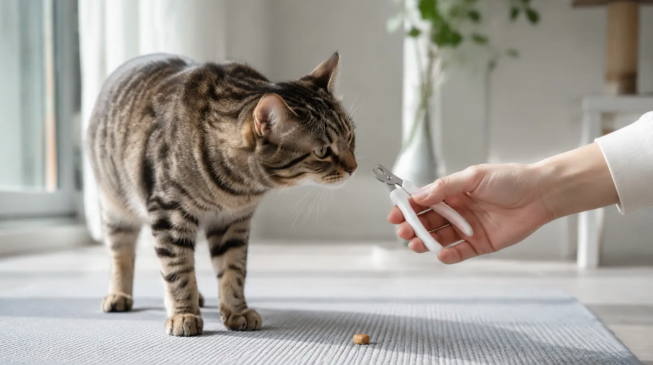
Your cat probably does not hate the idea of tidy nails. They may hate having a sensitive paw held, being restrained, hearing an unfamiliar clip, losing control of the interaction, or remembering a trim that hurt.
The solution is rarely “hold tighter and finish faster.” For many cats, the safest approach is to separate nail trimming into tiny skills—approaching the grooming area, accepting touch on the leg, allowing one toe to be handled, seeing the clippers, and eventually tolerating one small cut. Each step should remain easy enough that your cat can stay relaxed and accept a reward.
|
Quick answer: Stop trying to complete every nail in one sitting. Begin with brief paw-handling practice, pair each comfortable step with a high-value reward, and end before your cat struggles. If resistance appears suddenly or one paw is especially painful, schedule a veterinary exam before continuing training. |
Seven common reasons cats resist nail trims
1. Cat paws are sensitive
Paws contain many sensory receptors and are essential for movement, balance, scratching, hunting, and environmental feedback. Even a social cat that enjoys petting may dislike having a toe isolated and pressed.
Handling becomes more difficult when a person grabs directly for the paw, squeezes the toe, bends a leg into an uncomfortable angle, or maintains contact after the cat tries to withdraw.
2. Restraint removes control
Many cats object more to being pinned or tightly held than to the clip itself. A cat that cannot step away may escalate from freezing to struggling, vocalizing, scratching, or biting.
Using the minimum restraint necessary—and allowing pauses—can change the emotional experience. The goal is not to prove that you can hold the cat still. It is to help the cat predict that calm behavior leads to rewards and that clear discomfort leads to a break.
3. The clippers are unfamiliar
Clippers bring a new shape, smell, movement, and sound close to a sensitive body part. A cat may also feel a brief vibration or pressure through the claw when the blades close. Dull clippers make this sensation worse by crushing rather than cutting cleanly.
4. A previous trim was painful
Cutting the quick, twisting a toe, catching fur, or holding a cat through panic can create a strong memory. Even if the current session is physically safe, the context may predict pain to the cat.
Rebuilding trust can take longer than teaching a cat with no bad history. That is normal. If you recently nicked the quick, first make sure the toe has healed; our guide on what to do after cutting a cat’s nail too short explains what to monitor.
5. The session lasts too long
Owners often continue because “only three nails are left.” From the cat’s perspective, however, each extra second can push mild concern into panic. Finishing one comfortable nail is more useful than forcing a full set and making the next session harder.
6. Rewards arrive too late
A treat given several minutes after a stressful trim may not change how the cat feels about the clippers. Rewards work best when they follow each small, acceptable step: touching the shoulder, sliding a hand down the leg, touching the paw, extending one claw, or making one clip.
Choose a tiny portion of something your cat values and reserve it for grooming practice. The reward should support training without replacing balanced meals or adding a large number of calories.
7. Something hurts
Sudden resistance should raise a medical question. Arthritis, an overgrown nail, a torn claw, a sore paw pad, inflammation, or another injury may make handling painful. Cats often hide discomfort, so a behavior change may be the first sign.
Ask your veterinarian to examine your cat if one paw is much harder to touch, your cat limps or licks a toe repeatedly, the nail looks abnormal, or a previously cooperative cat suddenly refuses.
Learn your cat’s stop signals
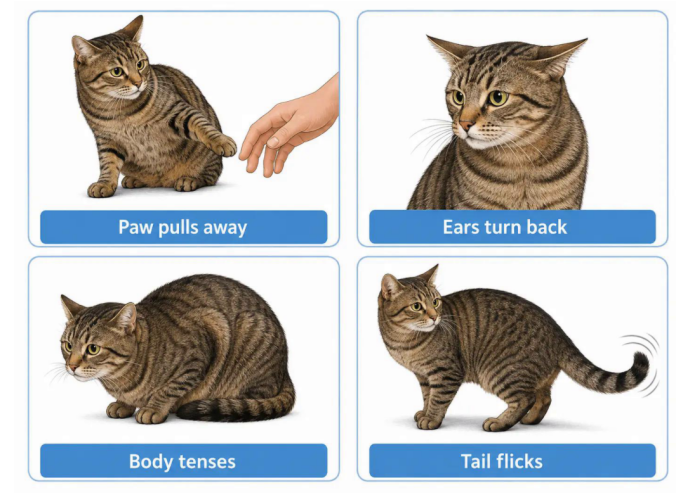
Do not wait for a bite or scratch. End or simplify the session when you notice:
• Pulling the paw away repeatedly
• Turning the head sharply toward your hand
• Ears rotating sideways or flattening back
• Tail-tip twitching or forceful tail swishing
• Skin rippling, body tension, crouching, or freezing
• Dilated pupils or whiskers pulled tightly back
• Refusing a treat they normally value
• Growling, hissing, swatting, or trying to escape
A cat that freezes is not necessarily comfortable. Stillness can be a stress response. Look at the whole body and whether the cat voluntarily stays or returns for another repetition.
A low-stress nail-trim training plan
Move forward only when your cat remains loose, willingly stays nearby, and continues taking rewards. Some cats progress in days; others need several weeks. There is no benefit in rushing.
Stage 1: Build a predictable station
Choose a familiar, nonslip location such as a mat, low table, sofa corner, or your lap. Once or twice a day, invite your cat to the area, offer a reward, and let them leave. Do not touch the paws yet.
Keep sessions under a minute. The station should predict something pleasant, not capture.
Stage 2: Work down the leg gradually
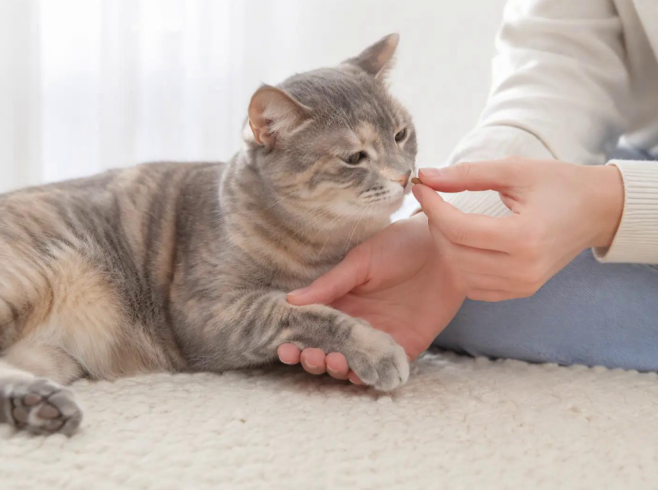
While your cat is relaxed, touch the shoulder briefly, reward, and stop. Across later sessions, slide your hand a little farther down the leg. Eventually touch the top of the paw for one second.
If the paw pulls away, release it. At the next session, return to an easier location on the leg. Releasing does not “reward bad behavior”; it prevents fear from escalating and gives you information about the current threshold.
Stage 3: Introduce the clippers separately
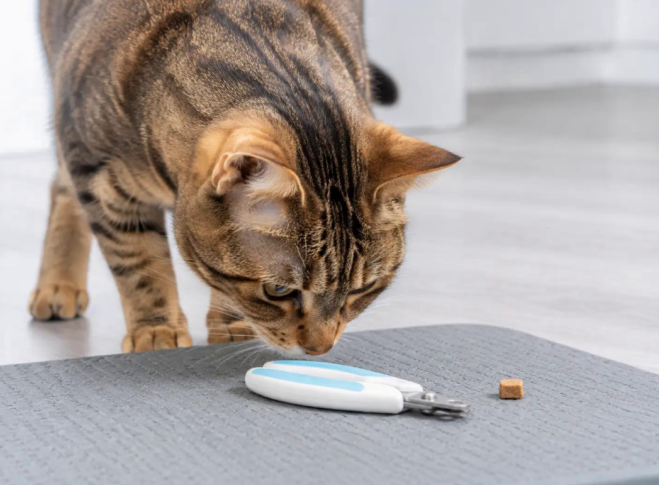
Place closed clippers several feet away during a reward session. Over multiple repetitions, bring them closer only if your cat stays comfortable. Let your cat investigate, but do not move the clippers toward their face.
Practice opening and closing the clippers away from the paw, pairing the sound with a reward. The ASPCA suggests conditioning cats to the clipping sound before attempting a nail; the important principle is that sound exposure remains mild and voluntary.
Stage 4: Practice extending one claw
Support the paw lightly. Touch one toe, apply gentle pressure to extend the claw for less than a second, release, and reward. Do not clip.
When your cat can repeat this comfortably, hold the closed clippers in the other hand. Then touch the clipper lightly near—but not across—the tip, reward, and finish.
Stage 5: Trim one tiny tip
Under bright light, identify the clear hooked tip and the pink quick. Remove only the narrow tip, set the clippers down, and reward immediately.
That may be the entire session. On another day, trim a second nail. VCA’s cat nail-trim guidance specifically supports building from one claw to several over time rather than forcing a full trim at once.
For safe cutting angles and preparation, follow the WOPET complete cat nail care guide.
What not to do
• Do not punish, yell, or spray water. These responses increase fear and do not teach cooperation.
• Do not chase your cat. Chasing makes both the grooming location and your approach predictive of restraint.
• Do not hold through escalating panic. A terrified cat can injure both themselves and the handler.
• Do not scruff as a routine strategy. It does not teach the underlying skill and can increase distress.
• Do not hide pain with speed. If a claw is damaged or overgrown, ask a veterinarian to handle the medical problem.
• Do not use human sedatives or leftover medication. Only a veterinarian should prescribe medication for your individual cat.
What if the nails must be trimmed now?
Training takes time, but an overgrown claw approaching the pad cannot wait for weeks. Contact your veterinary clinic or a cat-experienced groomer. Explain your cat’s fear in advance so the team can plan low-stress handling.
A veterinarian can also determine whether pain is contributing and, when appropriate, prescribe medication for a safer visit. Professional help is not a training failure; it prevents an urgent grooming need from becoming a dangerous home struggle.
Frequently asked questions
Can two people make a cat nail trim easier?
Sometimes, if both people are calm and the cat is already comfortable with them. One person can offer rewards while the other handles a paw. Two people should not use greater force to overpower a frightened cat.
Is wrapping a cat in a towel safe?
Some cats relax in a familiar, loose towel wrap; others panic when enclosed. Introduce the towel separately and never cover the face or restrict breathing. Stop if the cat struggles, overheats, or becomes more distressed. Ask your veterinary team to demonstrate safe handling.
Why does my cat bite only during nail trims?
Biting may be a last attempt to stop restraint, fear, or pain. Treat it as communication. End the session, rule out a painful paw problem, and restart training below the point that triggers defensive behavior.
Can I trim my cat’s nails while they sleep?
It may work once, but waking to unexpected paw restraint can damage trust or trigger a defensive reaction. A predictable, reward-based routine is safer in the long term.
How many nails should I trim per session?
As many as your cat can comfortably tolerate—even if that number is one. Comfort and future cooperation matter more than finishing all paws at once.
Final takeaway
A cat that hates nail trims is usually protecting sensitive paws, avoiding restraint, responding to fear, or communicating pain. Reduce the task until your cat can succeed: brief contact, immediate reward, clear opportunity to pause, and one conservative clip at a time. If fear is intense or resistance appears suddenly, involve your veterinarian before pushing forward.
Editorial sources
• Cat Friendly Homes: Trimming Your Cat’s Nails
This article provides general educational information and is not a substitute for an examination or individualized advice from your veterinarian.Label:
Popular Post
The Ultimate Guide to Tabby Cats: Patterns, Personalities, and More
Mar 27, 2025
Top 10 Most Expensive Cat Breeds in The World
May 07, 2025
Can Cats Have Ice Cream? Dangers, Safe Flavors & Healthy Cat Treats
Sep 02, 2025

My Cat Only Eats A Little at A Time - What to Do?
Feb 27, 2023
Top 8 Reasons Why Does My Cat Sleep Between My Legs?
Mar 03, 2025

[Blue] W03L 3L Premium Ceramic Cat Water Fountain
Model: W03 LITE
$59.99
$69.99

Basin Pet Water Fountain-W600
Model: W600
$43.99
$69.99
[Basic] Ceramic Pet Water Fountain with Power Cable
Model: W03L
$59.99
$99.00

WOPET 8L Pet Water Fountain For Multiple Cats or Large Dogs A08
Model: A08
$49.99
$59.99

[Upgrade] Basin Wireless Pet Water Fountain
Model: W600 Pro
$69.99
$89.99
[Blue] W03 3L Ceramic Cordless Cat Water Fountain
Model: W03
$89.99
$99.99

DOWNLOAD APP

WOpet life




Copyright © 2026 WOPET. All Rights Reserved.