Oct 19, 2026
Author:Sam Wonder
When owners compare cat water fountains, capacity is often one of the first specifications they check.
A 3-liter fountain obviously stores more water than a smaller model, but that does not necessarily mean the cat has to drink from deeper exposed water.
Drinking-surface depth and reservoir capacity are two different design features.
A fountain can store most of its water below the drinking surface while offering a relatively shallow tray at the top.
That distinction is the key to choosing between shallow and deep designs.
Drinking Surface vs Reservoir
Think of a fountain as having two separate areas.
Drinking surface
This is the water your cat can directly reach.
Its width, depth, edge height, and position affect the drinking experience.
Reservoir
This is where most of the fountain's water may be stored.
A deeper reservoir can increase capacity without requiring the cat to place its face inside a deep bowl.
That means you do not necessarily have to choose between comfortable shallow access and useful water capacity.
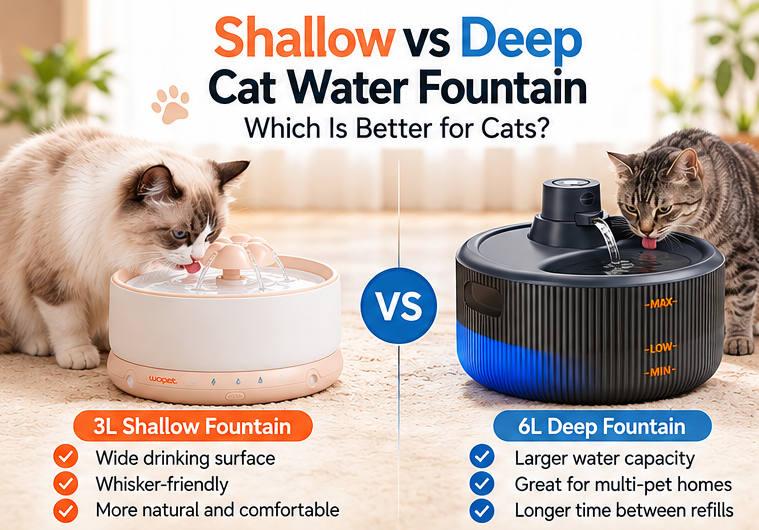
Why Cats May Prefer a Shallow Drinking Surface
International Cat Care recommends trying wide, shallow water containers for cats and notes that reducing contact between the whiskers and the sides may make a drinking setup more appealing. See Encouraging Your Cat to Drink.
A relatively shallow surface can allow a cat to reach the water without placing much of its face inside the container.
It may also make it easier to maintain awareness of the surrounding area while drinking.
This is a useful starting principle—not a rule that every cat prefers exactly the same depth.
Width and Depth Work Together
Depth should never be uated alone.
Consider two examples:
Fountain A: deep but very wide.
Fountain B: shallow but extremely narrow.
The deeper fountain may actually give the cat more room around the face.
A comfortable drinking surface usually balances:
• Adequate width
• Moderate accessible depth
• Easy approach
• Appropriate edge height
For the related width question, read Wide vs Narrow Cat Water Fountain: Which Design Is Better?
Why a Deeper Reservoir Is Still Useful
A larger reservoir can reduce how often you need to top up the fountain.
That may be useful for:
• Multi-cat households
• Larger pets
• Warm homes
• Households with higher water use
But more capacity does not make water maintenance-free.
The reservoir, pump, filter, and drinking surface still require routine inspection and cleaning.
If several cats share the home, WOPET's multi-cat water fountain guide also recommends maintaining separated water sources rather than relying on one high-capacity fountain.
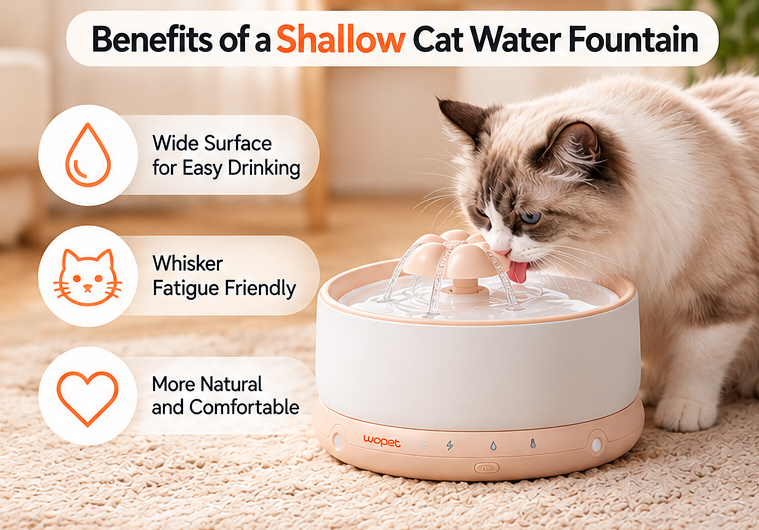
Buy WOPET W03 WIRELESS CAT FOUNTAIN ON AMAZON
Can a Drinking Surface Be Too Shallow?
Yes.
If the usable water layer is extremely shallow or the tray edge is very low, normal movement may increase the chance of spills.
Potential issues include:
• Paw splashing
• Water flowing over the edge
• Greater sensitivity to an uneven floor
• Faster exposure of low-water conditions
The goal is not to find the flattest possible tray.
The goal is comfortable access with enough depth and edge height for normal drinking.
Can a Drinking Surface Be Too Deep?
A very deep, narrow drinking area may require the cat to lower more of its face into the container.
Some cats will not mind.
Others may prefer drinking from the edge or from a broader, shallower option.
Observe how your cat uses existing bowls. If it consistently drinks from the edge of a deep bowl but readily uses a wide shallow dish, that preference may help guide your fountain choice.
What About Whisker Contact?
Depth affects how far the face enters a container, but width is equally important.
A deeper wide basin may still provide plenty of whisker clearance.
A shallow but narrow container may still create more contact with the sides.
That is why wide and shallow are often discussed together in feline water-station guidance.
Avoid treating “whisker fatigue” as a diagnosis. The more useful question is whether your individual cat appears comfortable using the available water source.
Senior Cats and Drinking Access
Older cats may develop mobility limitations that change which drinking positions feel comfortable.
For a senior cat, look beyond depth alone.
Consider:
• Fountain height
• Distance from the edge to the water
• How far the cat must crouch
• Floor traction
• Ability to approach from more than one direction
If an older cat suddenly changes its drinking behavior or seems uncomfortable while drinking, speak with a veterinarian rather than assuming the fountain is the only cause.
What About Kittens?
A low, accessible drinking surface may be easier for a small kitten to reach.
However, the full product design matters too.
Check:
• Stability
• Electrical setup
• Small removable parts
• Manufacturer instructions
Supervise young kittens around unfamiliar equipment and make sure another fresh water source remains available during introduction.
Which Design Splashes Less?
Neither shallow nor deep automatically wins.
Splashing depends on:
• Flow speed
• Stream height
• Edge height
• Surface width
• Fountain stability
• Individual behavior
A stable fountain with a controlled flow and sensible rim design may matter more than simply choosing deeper water.
Which Is Easier to Clean?
A shallow top tray can be easy to see and wipe.
A deeper reservoir can also be easy to maintain if it has:
• Smooth walls
• A wide opening
• Rounded corners
• Direct pump access
Overall architecture matters more than a single depth measurement.
For a full maintenance checklist, see What Makes a Cat Water Fountain Easy to Maintain?
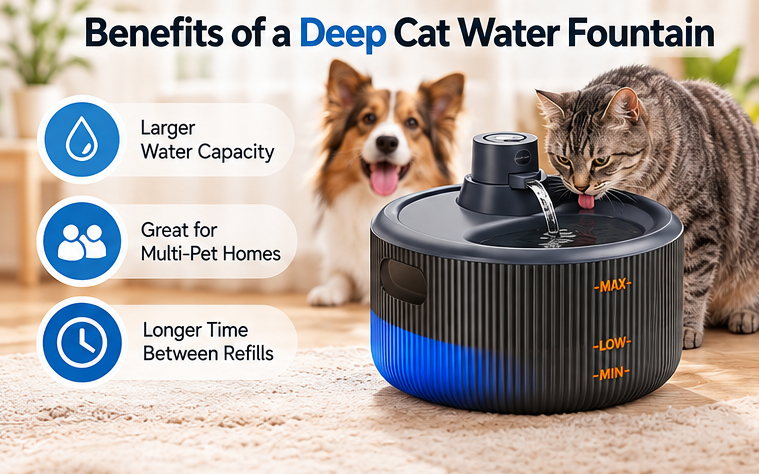
Buy WOPET W600 PRO DOG FOUNTAIN ON AMAZON
Shallow vs Deep Cat Fountain
|
Feature |
Shallow Drinking Surface |
Deep Drinking Surface |
|
Face access |
Usually easier |
Depends on width |
|
Whisker clearance |
Often good when also wide |
Depends heavily on width |
|
Total capacity |
Can still be high |
Can be high |
|
Water visibility |
Often easier |
May sit farther below the rim |
|
Splash control |
Depends on edge design |
Depends on edge design |
|
Cat preference |
Useful starting point for many cats |
Works well for some cats |
A Practical Design for Many Cats
For many households, a sensible configuration is:
A wide, relatively shallow drinking surface connected to a larger reservoir underneath.
This separates the cat-facing design from the owner-facing need for capacity.
The cat gets accessible water while the owner still has a useful reserve.
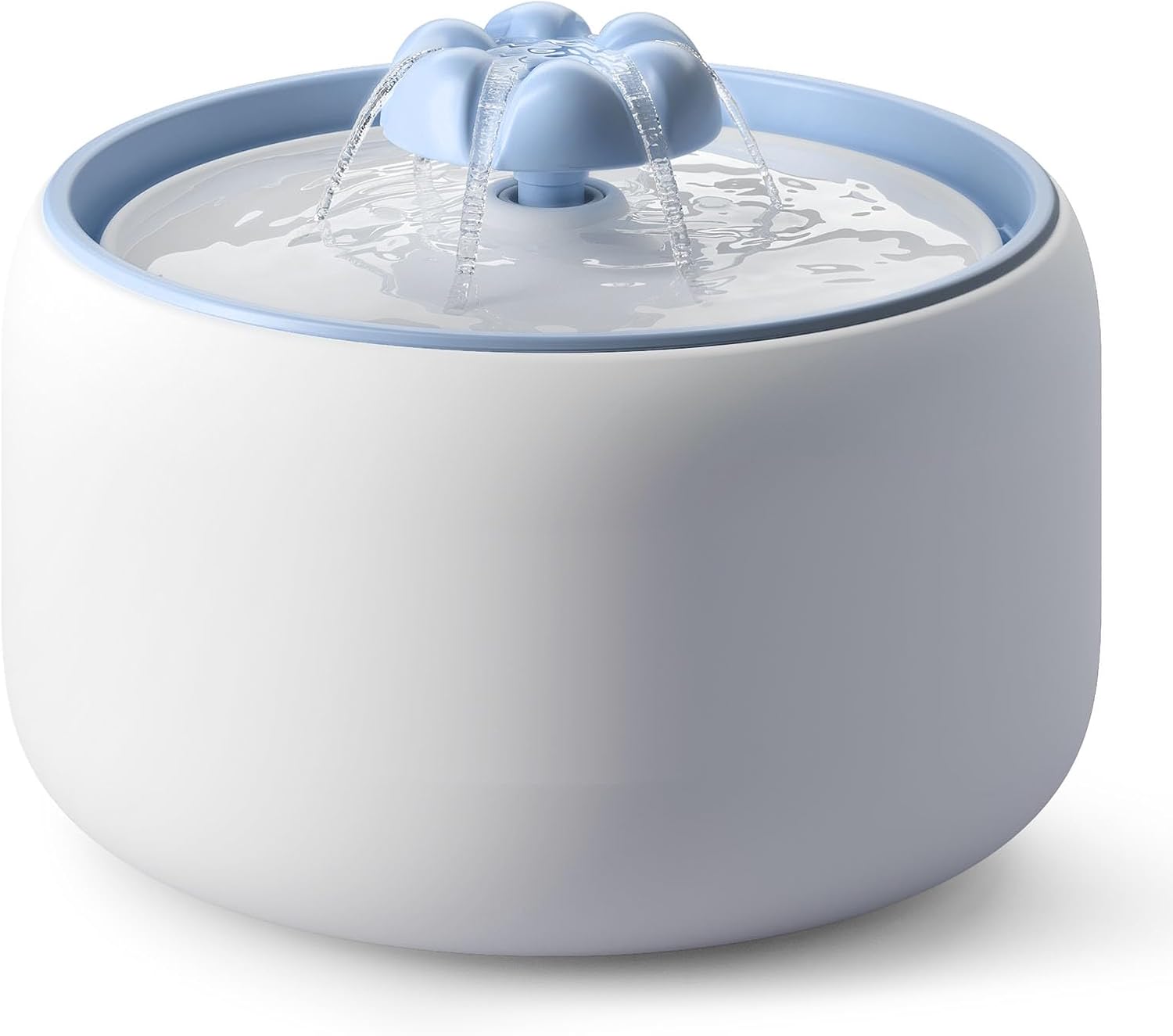
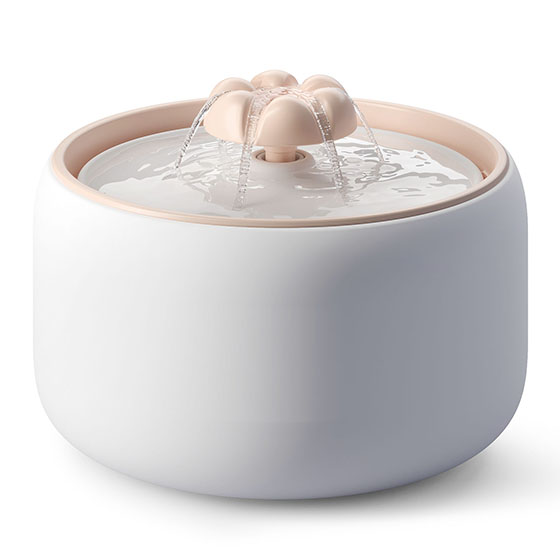
WOPET's W03 Ceramic Wireless Pet Water Fountain is one example of why it is useful to look at published capacity and physical design separately rather than assuming a higher-capacity fountain necessarily presents deep exposed water.
Cats Have Individual Preferences
Cornell's Feline Health Center notes that some cats increase their water intake when fountains are offered, while preferences vary from cat to cat. See Cornell's hydration guidance.
That same principle applies to fountain shape.
One cat may immediately accept a shallow flowing tray. Another may prefer a traditional bowl.
When changing the setup, monitor whether your cat is actually using the new water source rather than assuming any one design will suit every cat.
WOPET's article Is a Cat Water Fountain Worth It for One Cat? provides a useful framework for testing whether a fountain actually solves a problem in a single-cat home.
Bottom Line
For the drinking area, a wide and relatively shallow surface is often a useful starting point.
For the reservoir, additional depth can be practical because it provides capacity without requiring the cat to drink from a deep exposed container.
So the best design does not necessarily choose shallow or deep.
It can combine:
Shallow, accessible drinking surface + deeper storage reservoir.
That is a more useful way to uate cat water fountain depth.
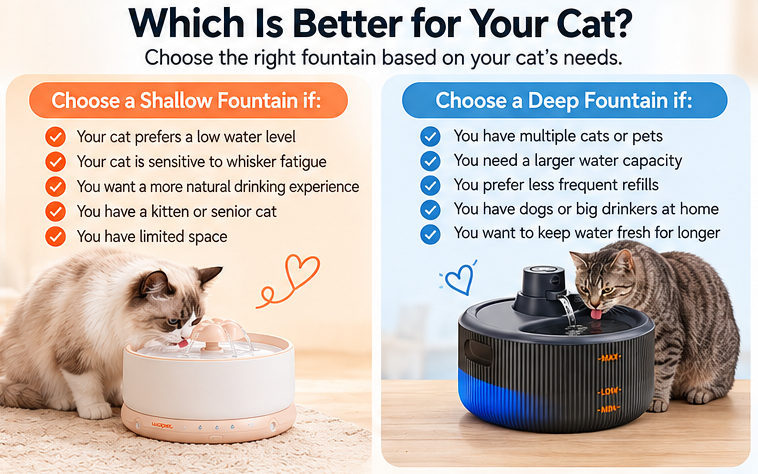
Frequently Asked Questions
Is shallow water always better for cats?
No. A wide, relatively shallow drinking surface is a useful starting point, but cats have individual preferences. The fountain still needs enough water depth and edge height to operate correctly without spilling.
Does a larger-capacity fountain have deeper drinking water?
Not necessarily. Capacity usually describes the total amount of water stored in the fountain. A large reservoir can sit below a shallow drinking tray, so published capacity does not reveal the depth of the exposed drinking surface.
Do shallow cat fountains splash more?
They can, but depth alone does not determine splashing. Flow rate, stream height, rim design, fountain stability, water level, and your cat’s behavior all affect how much water reaches the floor.
Is a shallow fountain better for kittens or senior cats?
An accessible drinking surface may be easier to reach, but height, stability, floor traction, electrical safety, and the manufacturer’s age guidance also matter. Sudden changes in an older cat’s drinking behavior should be discussed with a veterinarian.
How can I tell if a fountain is too deep for my cat?
Watch whether your cat repeatedly stretches from the edge, avoids lowering its face, approaches and walks away, or consistently chooses another clean water source. These behaviors are clues rather than a diagnosis, so also consider placement, cleanliness, noise, and possible health concerns.
Label:
Popular Post
The Ultimate Guide to Tabby Cats: Patterns, Personalities, and More
Mar 27, 2025
Top 10 Most Expensive Cat Breeds in The World
May 07, 2025
Can Cats Have Ice Cream? Dangers, Safe Flavors & Healthy Cat Treats
Sep 02, 2025
My Cat Only Eats A Little at A Time - What to Do?
Feb 27, 2023
Top 8 Reasons Why Does My Cat Sleep Between My Legs?
Mar 03, 2025
[Blue] W03L 3L Premium Ceramic Cat Water Fountain
Model: W03 LITE
$59.99
$69.99
Basin Pet Water Fountain-W600
Model: W600
$43.99
$69.99
[Basic] Ceramic Pet Water Fountain with Power Cable
Model: W03L
$59.99
$99.00
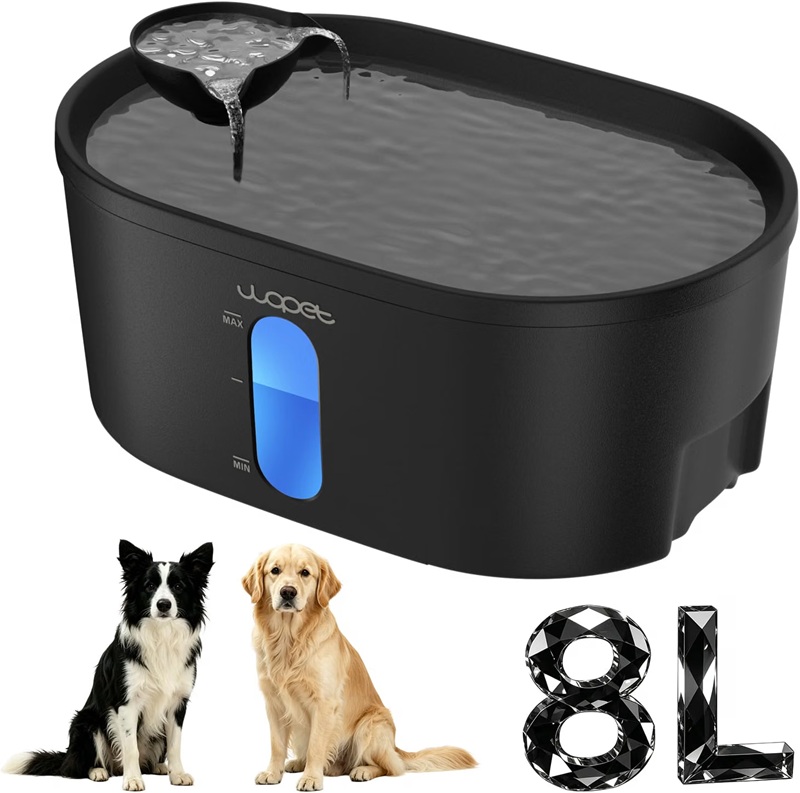
WOPET 8L Pet Water Fountain For Multiple Cats or Large Dogs A08
Model: A08
$49.99
$59.99
[WHITE] Heritage View 6L Cat Feeder Dual Bowls For Two Cats
Model: HV10DP-white
$114.99
$134.99
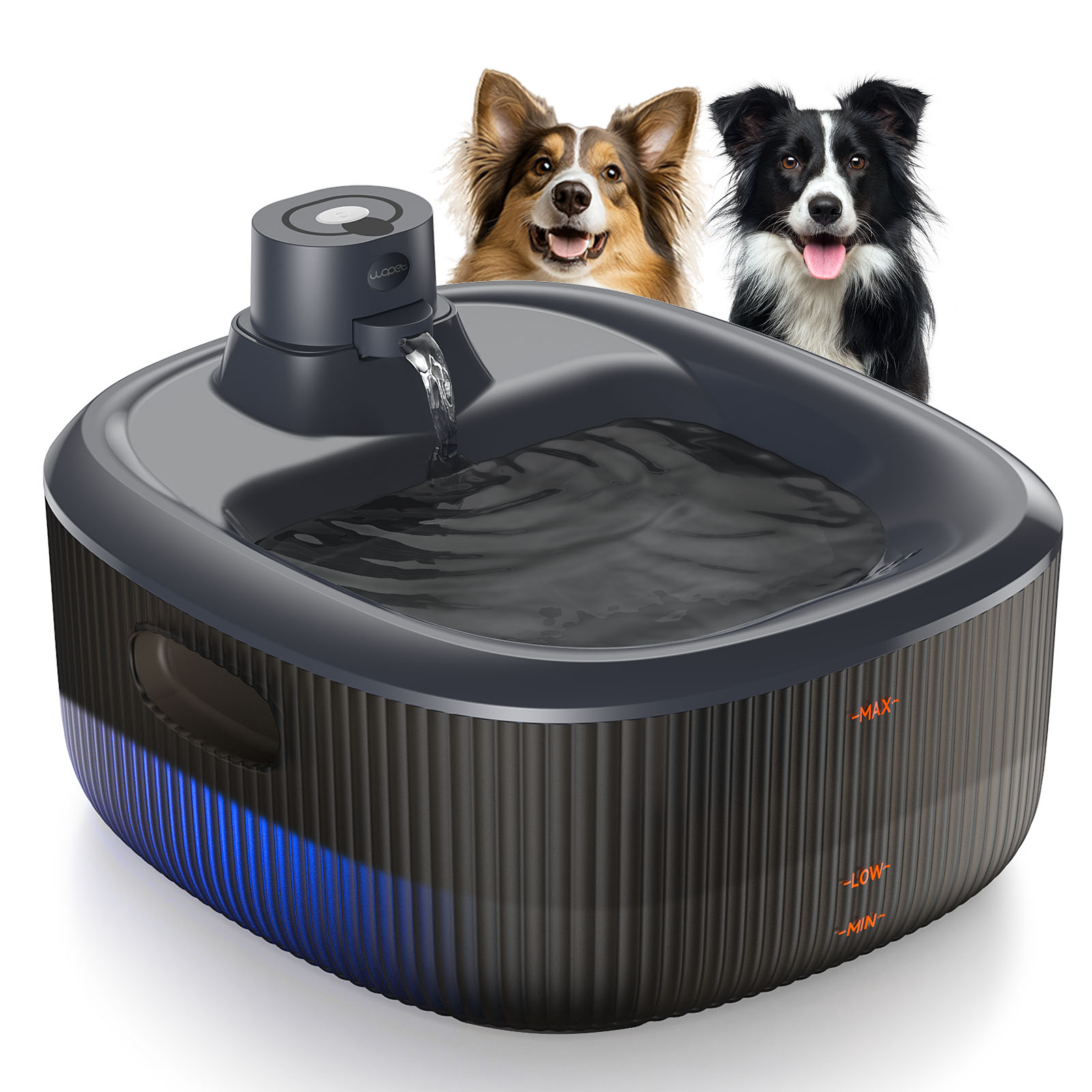
[Upgrade] Basin Wireless Pet Water Fountain
Model: W600 Pro
$69.99
$89.99

DOWNLOAD APP

WOpet life




Copyright © 2026 WOPET. All Rights Reserved.